

For ship owners, charterers, and operators, navigating the web of maritime regulations can be a complex and time-consuming task. Among the most critical of these is the International Ship and Port Facility Security (ISPS) Code. Understanding its essentials is not just a matter of compliance; it’s fundamental to ensuring your vessel’s smooth and efficient passage through ports worldwide, including the Panama Canal. This guide breaks down the essentials of the ISPS Code, its requirements, and how it impacts your daily operations.
What is the ISPS Code? (And Why Was It Created?)
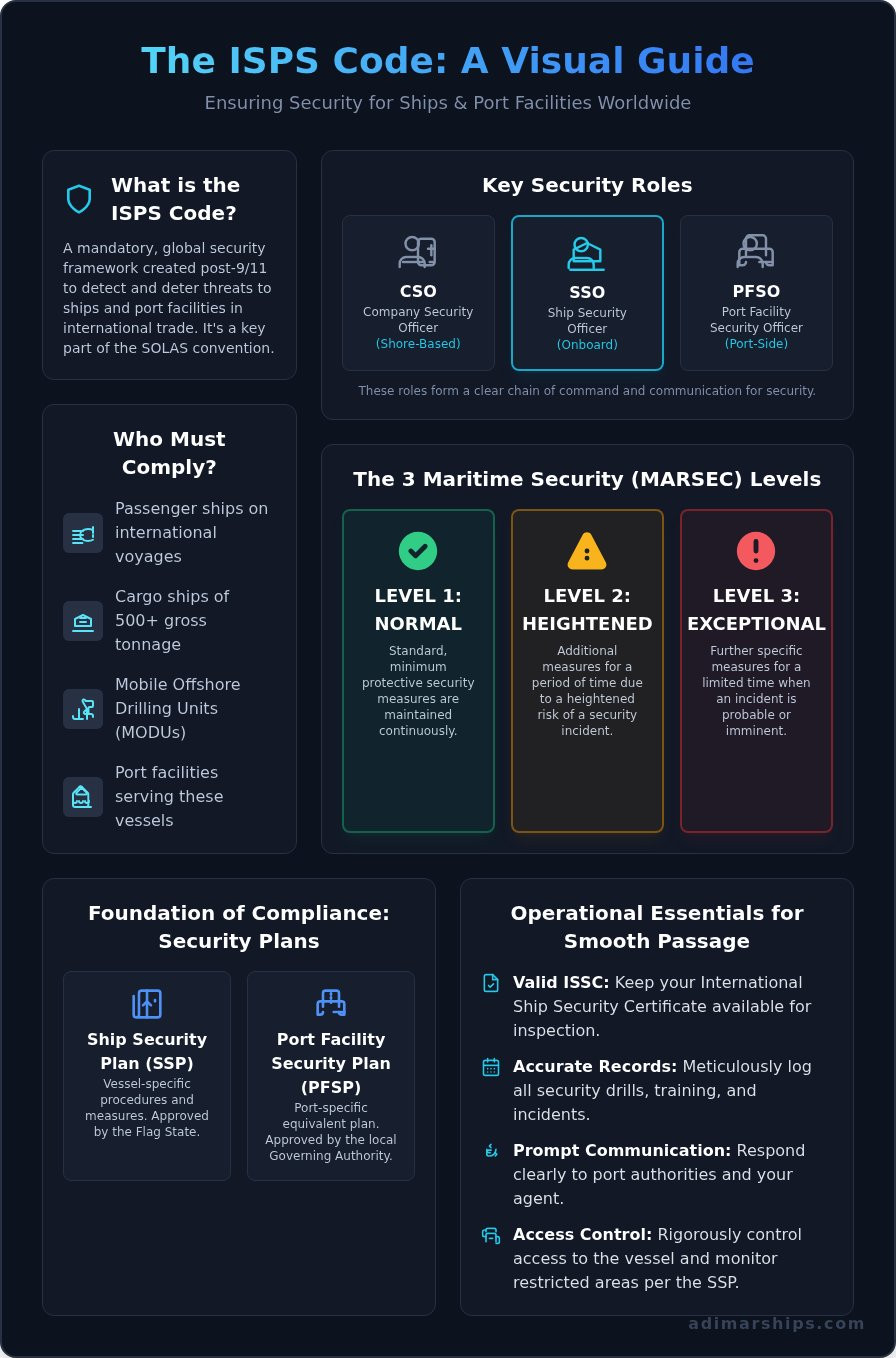
At its core, the ISPS Code is a mandatory security framework for ships and port facilities engaged in international trade. Think of it as a comprehensive, global security standard for the entire maritime industry. It was developed by the International Maritime Organization (IMO) in response to the heightened security concerns following the terrorist attacks of September 11, 2001. Enacted as part of the International Convention for the Safety of Life at Sea (SOLAS), its primary purpose is to provide a standardized, consistent framework for detecting security threats and implementing preventive measures.
The Main Goals of the ISPS Code
The code was designed with several clear objectives in mind. It aims to establish clearly defined roles and responsibilities for all parties involved in maritime security, from government agencies to shipping companies. A key function is to enable clear and efficient communication and information exchange between ships and ports. The ISPS Code also provides a structured methodology for conducting security assessments, allowing for the creation of robust security plans that can adapt to varying threat levels and ensure that security measures are always appropriate and proportional to the risk.
Who Must Comply with the ISPS Code?
The regulations apply to a specific set of vessels and facilities to ensure the security of international maritime routes. Compliance is mandatory for:
- All passenger ships on international voyages.
- Cargo ships of 500 gross tonnage and upwards operating internationally.
- Mobile offshore drilling units (MODUs).
- The port facilities that service such ships on their international voyages.
Core Components of ISPS Code Compliance
The ISPS Code is not just a document; it’s an operational framework built around specific security plans, designated officers, and a tiered system of security levels. Understanding these components is essential for effective implementation on board your vessel.
Key Security Roles and Responsibilities
To function correctly, the code assigns specific security duties to designated individuals who form a clear chain of command:
- Company Security Officer (CSO): A shore-based individual designated by the company to ensure that ship security assessments are carried out and that the Ship Security Plan is developed, implemented, and maintained for the fleet.
- Ship Security Officer (SSO): A designated officer on board each vessel, responsible for the security of the ship, including the implementation and maintenance of the Ship Security Plan and for liaising with the CSO and Port Facility Security Officers.
- Port Facility Security Officer (PFSO): The individual responsible for the development, implementation, revision, and maintenance of the Port Facility Security Plan and for liaising with SSOs and CSOs.
Understanding Security Plans
The foundation of ISPS compliance lies in two key documents: the Ship Security Plan (SSP) and the Port Facility Security Plan (PFSP). The SSP is a confidential plan developed specifically for your vessel, detailing the security duties, procedures, and measures to be taken to protect the ship from a security incident. Similarly, the PFSP is the port’s equivalent plan. Both plans must be formally approved by the vessel’s flag state or the port’s governing authority, respectively, to be considered valid.
The 3 Maritime Security (MARSEC) Levels
The ISPS Code establishes a system of three security levels to ensure that ships and ports can increase protective measures in response to evolving threats:
- MARSEC Level 1: Normal. This is the default level at which ships and port facilities normally operate. Standard, minimum protective security measures are maintained at all times.
- MARSEC Level 2: Heightened. This level is applied for a period of time when there is a heightened risk of a security incident. It requires additional protective measures as specified in the security plans.
- MARSEC Level 3: Exceptional. This level is implemented for the period of time when there is a probable or imminent risk of a security incident. It requires further, specific protective measures to be maintained.
What the ISPS Code Means for Your Vessel in Panama
For any vessel transiting the Panama Canal, ISPS compliance is not just about paperwork-it has a direct and significant impact on your daily operations. Non-compliance can lead to costly inspections, serious transit delays, and even denial of entry to port, all of which result in financial loss. This is where your ship agent becomes a crucial partner, acting as your expert guide to navigate local port security requirements and ensure a seamless passage.
Practical Steps for a Smooth Port Call
To ensure your vessel is always prepared for a port call in Panama or anywhere else, the ship’s crew and command should adhere to a few practical principles:
- Ensure your International Ship Security Certificate (ISSC) is valid and readily available for inspection.
- Maintain meticulous and accurate records of all security drills, training exercises, and any security incidents.
- Respond promptly and clearly to all security-related communications from the port authorities or your agent.
- Rigorously control access to the vessel at all times and diligently monitor all restricted areas as outlined in your SSP.
How Adimar Ensures Your ISPS Compliance at the Canal
As your trusted partner at the Panama Canal, Adimar Shipping acts as your expert on local security protocols, ensuring your vessel is always prepared and compliant. We proactively verify all necessary security documentation well before your arrival to identify and resolve any potential issues. Our experienced team coordinates directly with Port Facility Security Officers (PFSOs) on your behalf, managing communications and confirming that all requirements are met. By leveraging our deep local knowledge, we help you avoid the common pitfalls and procedural errors that can cause expensive delays. Put your transit in our hands. Request a quote today.
Frequently Asked Questions
What is the difference between the ISPS Code and SOLAS?
The ISPS Code is not separate from SOLAS; rather, it is a comprehensive set of measures to enhance ship and port facility security, implemented through Chapter XI-2 of the SOLAS Convention. SOLAS is the broader treaty covering many aspects of maritime safety, while the ISPS Code is the specific part that deals with security.
Who issues the International Ship Security Certificate (ISSC)?
The ISSC is issued by the vessel’s flag state administration or a Recognized Security Organization (RSO) authorized to act on its behalf. The certificate confirms that the ship’s security system and any associated equipment comply with the requirements of SOLAS Chapter XI-2 and Part A of the ISPS Code.
How often are ship security plans reviewed?
Ship Security Plans (SSPs) should be reviewed and audited periodically by the Company Security Officer. While a full renewal of the ISSC occurs every five years, the SSP should be reviewed and updated whenever there are significant changes to the ship, its operations, or identified security threats.
What happens if a ship is found to be non-compliant with the ISPS Code?
Non-compliance can have severe consequences, including detailed inspections, delays, detention of the ship, or denial of entry into port. Port state control authorities have the right to take such actions to ensure security is not compromised.
Does the ISPS Code apply to all ports?
The ISPS Code applies to port facilities that serve ships engaged on international voyages that are subject to the code. It does not apply to ports that only serve domestic shipping or vessels not covered by the regulations.
What is a Declaration of Security (DoS)?
A Declaration of Security (DoS) is a document that is completed when the ship and the port facility (or another ship) agree on the security measures each will implement. It is typically required when a ship is operating at a higher security level than the port, or for specific high-risk operations, ensuring there are no gaps in security protocols between the two parties.
Navigating the complexities of maritime security requires expertise, diligence, and a reliable partner on the ground. With over 20 years of experience at the Panama Canal, Adimar Shipping serves as your eyes and ears, ensuring every detail of your vessel’s transit is managed with integrity and efficiency. We are experts in local regulations and compliance, allowing you to focus on your business with confidence. Let Adimar be your trusted partner for a secure and efficient Panama Canal transit.