
In the world of shipping, time is money. But when you’re trying to calculate the total cost of transiting the Panama Canal for a commercial vessel, the process can feel anything but efficient. Sifting through complex official tariff documents, worrying about unexpected surcharges, and trying to account for how your vessel’s size and cargo will impact the final bill can make accurate budgeting a significant challenge. A miscalculation doesn’t just affect your bottom line; it can disrupt your entire schedule.
We are here to eliminate the confusion. This comprehensive 2025 guide is designed to give you a complete, transparent breakdown of all Panama Canal tolls, fees, and charges. We will demystify the pricing structure and explore the key factors that influence your final invoice. By the end, you’ll have the confidence and information needed to accurately budget for your next transit, create a precise proforma disbursement account (PDA), and understand how a trusted ship agent can help optimize your costs.
Breaking Down the Cost of Transiting the Panama Canal for a Commercial Vessel
When calculating the total cost of transiting the Panama Canal for a commercial vessel, the tolls levied by the Panama Canal Authority (ACP) represent the single largest expenditure. This is not a simple flat fee. Instead, the ACP employs a sophisticated and dynamic toll structure designed to reflect a vessel’s true earning capacity. Understanding this system is the first and most critical step in accurately forecasting your transit expenses and ensuring a cost-efficient passage.
What is PC/UMS and Why It Matters
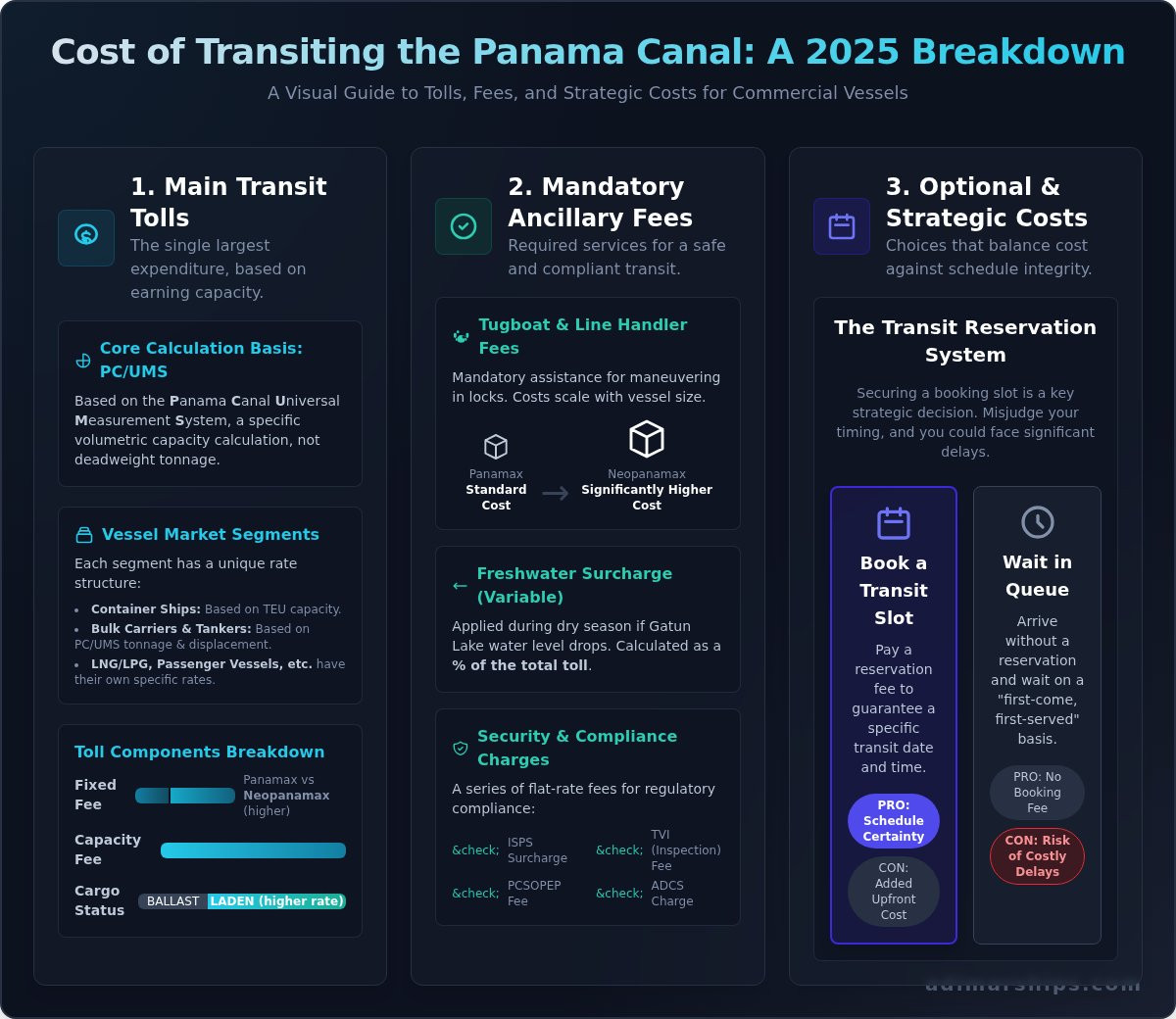
The foundation of the toll system is the Panama Canal Universal Measurement System (PC/UMS). Unlike deadweight or gross tonnage, which measures weight or internal volume, PC/UMS is a specific formula that calculates a vessel’s volumetric capacity. Every vessel intending to transit must have a valid PC/UMS tonnage certificate. This measurement is the primary basis for calculating a significant portion of the transit tolls, making it an essential figure for determining the final cost of transiting the Panama Canal for a commercial vessel.
How the ACP Segments Vessels for Tolling
The ACP recognizes that different ships have different commercial purposes. To create a fair system, it divides vessels into distinct market segments for tolling. These include container ships, LNG/LPG carriers, bulk carriers, tankers, and passenger vessels, among others. Each segment has a unique rate structure. For example, a container ship’s toll is heavily based on its Twenty-foot Equivalent Unit (TEU) capacity, while a bulk carrier’s toll relies on its PC/UMS tonnage and displacement. For a deeper dive into the canal’s operational framework, Understanding the Panama Canal provides essential background context.
Key Toll Components: Fixed vs. Capacity-Based Fees
The final toll is a combination of several charges, but they generally fall into two main categories. The structure ensures the overall cost of transiting the Panama Canal for a commercial vessel is transparent and market-driven. The main components include:
- Fixed Per-Transit Fee: A base charge applied to every transit. This fee varies significantly depending on whether the vessel uses the older, smaller Panamax locks or the larger, modern Neopanamax locks.
- Capacity-Based Fee: This is the variable and most significant part of the toll. It is calculated by multiplying the vessel’s PC/UMS net tonnage or TEU capacity by the specific rate for its segment.
- Laden vs. Ballast Rates: The ACP applies different rates for vessels carrying cargo (laden) versus those that are empty (in ballast). As expected, laden rates are higher, reflecting the vessel’s active earning state during that transit.
A Detailed Breakdown of Mandatory Ancillary Fees
While transit tolls form the largest single expense, they are only part of the story. A significant portion of the total cost of transiting the panama canal for a commercial vessel comes from mandatory ancillary fees. These charges, levied by the Panama Canal Authority (ACP), cover essential services required for a safe and efficient passage. Overlooking these costs in your initial budget can lead to unexpected and substantial shortfalls when the final invoice arrives.
Tugboat and Line Handler Fees
Safe navigation through the Canal’s intricate lock system is not a solo endeavor. The ACP mandates the use of tugboats for all transits to assist with maneuvering and control. The number and type of tugs required depend directly on the vessel’s beam and whether it uses the Panamax or Neopanamax locks. Similarly, skilled line handlers are required to manage mooring lines within the lock chambers. As expected, larger Neopanamax vessels face significantly higher costs due to their need for more powerful tugs and additional personnel.
The Freshwater Surcharge: A Variable Cost
The Panama Canal relies on a massive amount of fresh water from Gatun Lake for each transit. To conserve this critical resource during Panama’s dry season, the ACP may implement a freshwater surcharge. This fee is triggered when the lake’s water level falls below a predetermined point. Calculated as a percentage of the vessel’s total toll, this surcharge can be a major variable in your transit budget. A proactive ship agent continuously monitors lake levels, providing you with the most accurate cost projections possible.
Security, Inspection, and Compliance Charges
Beyond operational support, every vessel must cover several standard administrative and security costs. These flat-rate fees ensure compliance with international and local regulations. The official Panama Canal Tolls and Tariffs schedule outlines these charges, which are an essential component of the final transit bill. Key fees include:
- ISPS Surcharge: A security charge for compliance with the International Ship and Port Facility Security code.
- Transit Vessel Inspection (TVI) Fee: Covers the cost of mandatory vessel safety inspections.
- PCSOPEP Fee: A charge for authorization and maintenance of the Panama Canal Shipboard Oil Pollution Emergency Plan.
- ADCS Charge: A fee for using the antechamber data collection system for submitting required documentation.
Optional & Strategic Costs: Booking, Auctions, and Delays
Beyond the mandatory tolls and fees, a significant portion of the total cost of transiting the Panama Canal for a commercial vessel comes from strategic decisions. These optional costs are not required for transit, but they are often essential for maintaining schedule integrity and managing risk. Misjudge your timing and you lose; this is where an experienced ship agent provides immense, measurable value by helping you navigate these critical choices.
The Transit Reservation (Booking) System Explained
For operators who value certainty, the Panama Canal Authority (ACP) offers a transit reservation system. Securing a booking guarantees a specific transit slot, eliminating the uncertainty of waiting. Fees vary based on the vessel type and how far in advance the slot is booked. Without a reservation, vessels enter a first-come, first-served queue, which can lead to unpredictable and costly delays, especially during periods of high congestion. The booking fee is a vital investment in schedule reliability.
High-Stakes Bidding: The Auction Slot System
When regular booking slots are full, the ACP occasionally auctions unfilled or cancelled slots to the highest bidder. This is a last-resort option for vessels that urgently need to transit and cannot afford to wait. Bids can be astronomical, sometimes running into hundreds of thousands or even over a million dollars. Navigating this high-stakes environment requires deep local knowledge. An expert agent provides crucial intelligence on auction feasibility and bidding strategy, ensuring you don’t overpay for a critical slot.
The Hidden Costs of Delays and Demurrage
In shipping, time is money. The daily running cost of a vessel-including fuel, crew wages, insurance, and charter hire-can easily range from $25,000 to $70,000, depending on its size and type. A multi-day wait at anchorage for an un-booked slot can quickly cost more than the booking fee itself. These delays create cascading problems:
- Disrupted supply chains and missed delivery windows.
- Potential penalties under charter party agreements.
- Increased fuel consumption while idling.
A booked transit is the most effective tool to minimize these unpredictable and financially damaging risks. As your trusted partner at the Panama Canal, Adimar Shipping helps you balance these strategic costs to ensure a timely and cost-efficient transit.
How a Ship Agent Controls Costs and Eliminates Surprises
While the official tolls and fees make up the bulk of transit expenses, the single most influential factor in controlling the final cost of transiting panama canal for commercial vessel is your choice of ship agent. An experienced agent is far more than a paperwork filer; they are your financial and operational representative on the ground in Panama, acting as a crucial line of defense against unexpected charges and costly delays.
Their fee is a small investment to protect a much larger expenditure. By leveraging their expertise, shipowners and charterers can transform a potentially complex and frustrating process into a smooth, predictable, and cost-effective operation.
Proactive Financial Management and Pre-Funding
A trusted agent begins by providing a detailed Proforma Disbursement Account (PDA), offering a transparent estimate of all anticipated costs. They manage the critical pre-payment of all tolls and fees directly to the Panama Canal Authority (ACP). This is non-negotiable; failure to transfer funds on time will cause a vessel to lose its transit slot, resulting in significant financial losses. After transit, your agent provides a final, itemized account, ensuring complete financial clarity.
Optimizing Bookings and Service Coordination
Navigating the Canal’s booking system requires strategic expertise. Your agent advises on the best booking window and strategy for your vessel’s specific needs and urgency, balancing auction costs against scheduling certainty. They then seamlessly coordinate all required ancillary services-from tugs and pilots to line handlers and inspectors. This expert coordination prevents operational friction and the costly demurrage charges that arise from delays. Let us handle the complexity. Get a transit quote.
Local Expertise That Saves Money
Market conditions at the Panama Canal are dynamic. An agent’s value lies in their real-time, local knowledge. They are aware of current congestion levels, regulatory changes, and potential issues like freshwater surcharges during the dry season or the possibility of work stoppages. This foresight allows for more accurate budgeting and helps you avoid costly surprises. In essence, your agent acts as your ‘eyes at the Canal,’ protecting your financial interests and ensuring your transit is as efficient as possible.
Partnering for a Predictable and Cost-Effective Transit
As we’ve explored, accurately calculating the cost of transiting panama canal for commercial vessel goes far beyond the official toll rates. It requires a deep understanding of mandatory ancillary fees, strategic navigation of booking slots, and proactive management to avoid unforeseen delays and expenses. The difference between a profitable transit and a costly one often lies in expert, on-the-ground coordination.
This is where a trusted partner makes all the difference. For over 20 years, Adimar Shipping has served as the eyes and ears for ship owners and charterers at the Panama Canal. We pride ourselves on providing transparent, cost-conscious, and efficient service, ensuring every transit is managed with integrity and precision. Our expert coordination eliminates confusion and protects your bottom line from costly delays.
Take the guesswork out of your next passage. Request a Proforma Disbursement Account for your next transit and let our team provide you with a clear, comprehensive cost projection. Plan your voyage with confidence.
Frequently Asked Questions
How are Panama Canal tolls calculated for a container ship vs. a bulk carrier?
The cost of transiting the Panama Canal for a commercial vessel varies by type. For container ships, tolls are calculated based on their total Twenty-foot Equivalent Unit (TEU) capacity, using a tiered pricing structure. In contrast, bulk carrier tolls are determined by their Panama Canal/Universal Measurement System (PC/UMS) net tonnage, plus a charge per metric ton of cargo on board. This ensures a fair assessment reflective of each vessel’s capacity and cargo.
What is the difference in cost between a laden and a ballast transit?
A laden transit, where a vessel is carrying cargo, is significantly more expensive than a ballast transit for an empty vessel. The Panama Canal Authority (ACP) offers a reduced toll rate for vessels in ballast, recognizing they are not generating revenue on that specific voyage. This discount is a critical factor in voyage planning and cost estimation. Properly declaring your vessel’s status is essential for accurate billing and an efficient transit without delays.
How often does the Panama Canal Authority (ACP) change its toll rates?
The ACP does not change toll rates on a fixed annual schedule. Instead, modifications are proposed based on market conditions and the value of the route, followed by a formal public consultation process. While major structural changes are infrequent, ship owners should anticipate adjustments every few years. As your trusted partner, we monitor all ACP communications to ensure your cost projections are always based on the latest, most accurate information.
Can transit tolls be paid directly by the ship owner, or is an agent required?
While technically possible, direct payment by a ship owner is highly impractical and not the industry standard. A local Panama Canal ship agent is essential for a seamless transit. Your agent manages the entire financial process, from establishing a pre-payment account to coordinating funds and guaranteeing payment to the ACP. This eliminates confusion and ensures your vessel meets all financial prerequisites, letting you focus on your core business operations.
What happens if a vessel arrives without sufficient funds to cover the transit costs?
A vessel arriving without sufficient pre-paid funds will be denied transit and held at anchorage until the payment is cleared. This results in significant operational delays and additional expenses, including anchorage fees and potential demurrage charges. The principle “time is money” is critical at the Canal. Working with a dependable agent ensures funds are correctly calculated and paid well in advance, preventing these costly and frustrating situations from occurring.
Does the cost of transiting the Panama Canal include port charges at Balboa or Cristobal?
No, the transit toll is entirely separate from any port charges. Tolls cover the passage through the locks and waterway itself. If your vessel requires services at the ports of Balboa or Cristobal, such as docking for crew changes or provisions, you will incur separate charges. These fees for pilots, tugboats, line handlers, and wharfage will be coordinated and itemized for you by your ship agent.
How much does a last-minute auction slot for a Panama Canal transit typically cost?
The cost of an auction slot is highly volatile, depending entirely on real-time demand, vessel congestion, and the specific booking period. While a standard booking fee is predictable, auction bids can range from around $50,000 to over $400,000. During periods of extreme congestion, bids for Neopanamax slots have even surpassed $2 million. This option provides scheduling certainty but comes at a premium that must be carefully weighed against the cost of delays.