
Planning your 2026 shipping budget feels like a high-stakes gamble. Will transit slots be available? What will the surcharges be? While recent headlines may suggest a return to normalcy, veteran operators know the long-term panama canal drought impact on shipping 2026 remains a critical variable. Lingering low water levels and the threat of future restrictions create a complex risk landscape where a single miscalculation can be costly.
This is not just another news recap. It’s a strategic risk assessment designed to give you clarity and control. We are your eyes at the Panama Canal, and in this report, we provide a data-driven forecast of the Canal’s operational reality for 2026. We’ll analyze potential costs, break down transit alternatives, and provide the actionable intelligence you need to safeguard your vessel’s transit and protect your bottom line. Put your transit planning in our hands, and we will eliminate the confusion.
The State of the Canal: Water Levels vs. Operational Reality in 2026
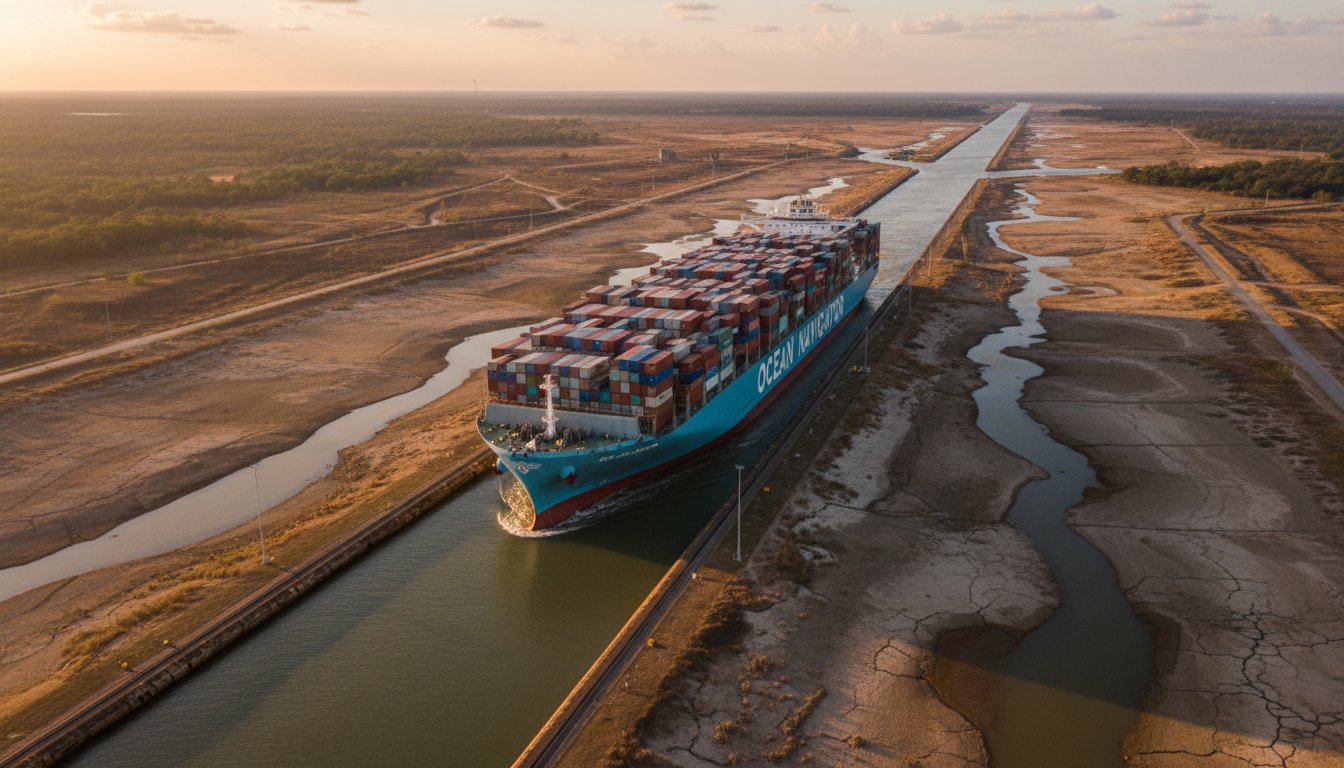
The Panama Canal Authority (ACP) has announced that water levels in Gatun and Alajuela Lakes are recovering, a welcome sign after a historic drought. However, for ship owners and charterers, this positive news must be balanced with the operational reality on the ground. Simply having more water does not signal an immediate return to pre-2023 business as usual. The gap between total water capacity and daily transit capacity is now the central challenge, and understanding this distinction is crucial for navigating the waterway effectively through 2026 and beyond.
Gatun Lake Forecast: El Niño, La Niña, and 2026 Projections
Panama’s climate is heavily dictated by the El Niño-Southern Oscillation (ENSO) cycle. The recent shift toward La Niña conditions has brought restorative rainfall, but the long-term outlook remains uncertain. Meteorological forecasts for the 2025 rainy season and the critical early 2026 dry season are cautiously optimistic. While the ACP is working to maintain the maximum 50 ft (15.24m) draft, this goal is entirely dependent on consistent precipitation. Any significant deviation from forecasts could quickly impact operational norms.
These large-scale climate patterns have consequences at every level, from global shipping to local infrastructure. The same unpredictable rainfall that affects the Canal can cause significant water management problems for homeowners, a challenge detailed by experts like those at delvalbasements.com.
Transit Slots & The Booking System: The ‘New Normal’ for Shippers
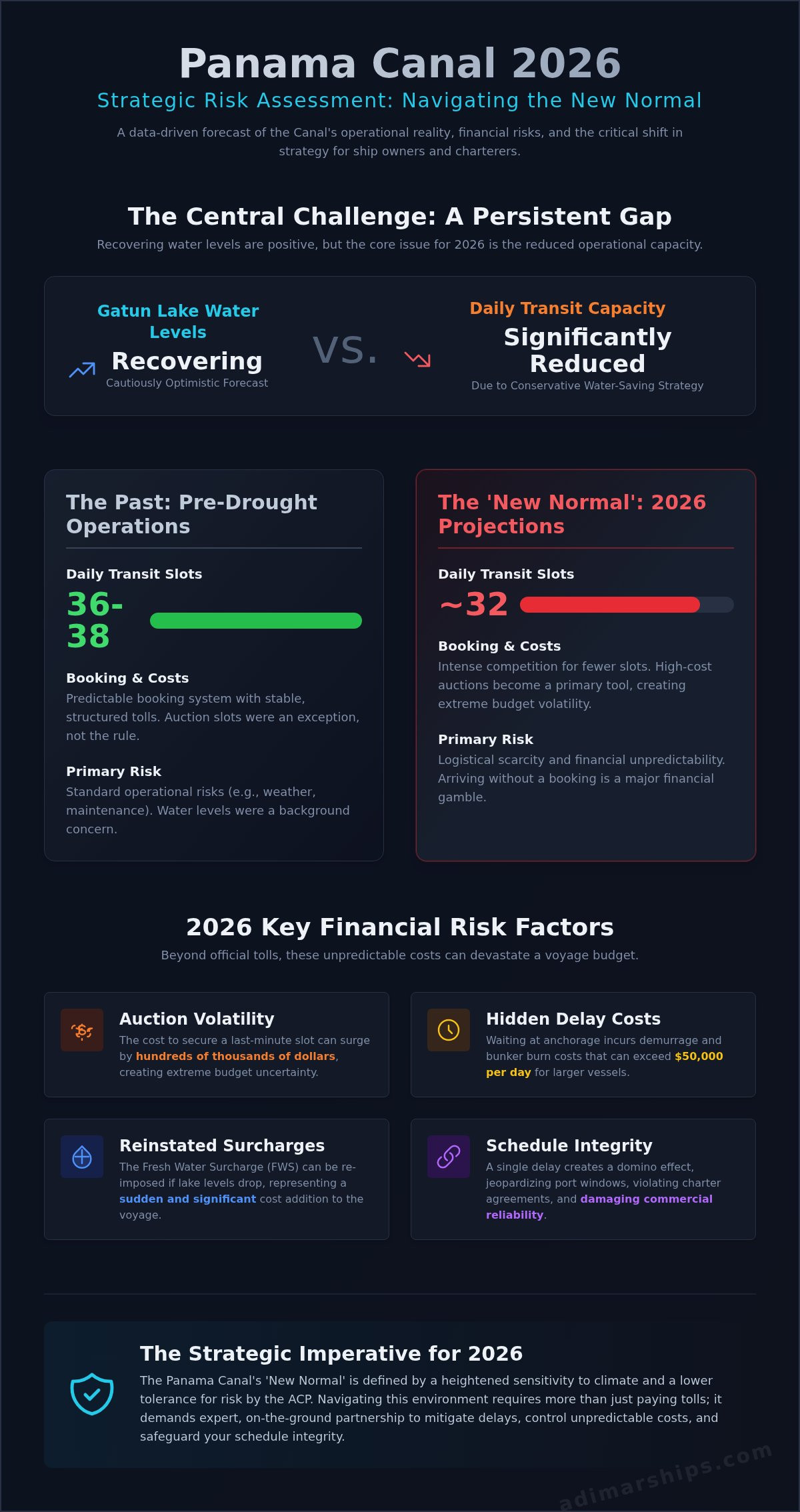
Despite improving lake levels, the number of daily transit slots remains around 32, significantly below the pre-drought average of 36-38. This reduction is a core component of the ACP’s new, conservative water-saving strategy. For shippers, this creates a ‘new normal’ of intense competition for fewer slots. Key impacts include:
- Cost Volatility: The last available transit slots are often sold via auction, where prices can surge by hundreds of thousands of dollars, creating extreme budget uncertainty.
- Strategic Risk: Vessels arriving without a pre-booked slot face the high probability of significant, costly delays or the need to reroute entirely.
The primary panama canal drought impact on shipping 2026 is now defined less by water depth and more by this logistical scarcity and financial unpredictability.
Lingering Effects: Why the System is More Sensitive Than Before
The 2023-24 crisis has instilled a lower tolerance for risk within the ACP. The authority now operates with an abundance of caution to preserve its water resources and prevent a repeat scenario. This heightened sensitivity means that even minor rainfall deficits could trigger a swift re-imposition of draft and transit restrictions. This new philosophy affects all aspects of Panama Canal operations, from vessel scheduling to infrastructure maintenance. For our clients, this translates to a less predictable environment where expert, on-the-ground partnership is more critical than ever.
Economic Impact for 2026: Analyzing Costs, Surcharges, and Delays
For ship owners and charterers, the potential panama canal drought impact on shipping 2026 translates directly into financial risk and operational uncertainty. While the 2023-2024 water crisis provided a stark preview, planning for 2026 requires a forward-looking analysis of all cost drivers-not just the official tariffs. Understanding the interplay between tolls, potential surcharges, and the devastating hidden costs of delays is essential for protecting your bottom line. These variables affect each shipping segment differently, from time-sensitive container vessels to large LNG carriers requiring specific draft allowances.
Forecasting Tolls and Auction Slot Costs
The Panama Canal Authority (ACP) maintains a structured toll system, but the true cost of transit is often dictated by demand. When transit slots are limited-either by drought restrictions or high traffic-the auction system becomes a critical cost factor. A Neopanamax vessel might face a standard toll, but securing a guaranteed transit slot via auction can add hundreds of thousands of dollars to the voyage cost. For 2026 budgeting, operators must model scenarios that include highly inflated auction prices during peak seasons or periods of climatic uncertainty.
The Risk of Reinstated Surcharges
A primary tool used by the ACP during low-water periods is the Fresh Water Surcharge (FWS). This variable fee is applied to vessels to account for the increased operational cost and to encourage water conservation. While the ACP strives for predictability, the FWS can be reinstated if Gatun Lake levels fall below established thresholds. Charterers and owners must factor this contingency into their voyage calculations, as it represents a significant and potentially sudden cost addition that can directly impact profitability.
The Hidden Costs: Demurrage, Bunker Fuel, and Schedule Integrity
Official fees are only the beginning of the story. The most significant financial damage often comes from delays and unpredictability. These “hidden” costs accumulate rapidly:
- Demurrage and Bunker Burn: Every day spent waiting at anchorage is a direct loss, burning expensive bunker fuel while incurring demurrage charges that can exceed $50,000 per day for larger vessels.
- Schedule and Contract Disruption: A delay at the Canal creates a domino effect, jeopardizing downstream port windows, violating charter party agreements, and damaging supply chain reliability for end customers. This commercial risk is well-documented, with government analysis on the impact of low water levels on trade showing how transit disruptions ripple through entire logistics networks.
Ultimately, navigating the financial risks of a Panama Canal transit in 2026 requires more than just paying the toll. It demands expert, on-the-ground planning to mitigate delays and control these unpredictable costs.
Strategic Alternatives: Route Optimization in a Post-Drought World
The persistent water-level challenges at the Panama Canal are no longer a temporary disruption; they are a catalyst for a permanent strategic re-evaluation of global supply chains. For ship owners and charterers, understanding the financial and logistical trade-offs of alternative routes is now a critical business imperative. The long-term panama canal drought impact on shipping 2026 and beyond necessitates a clear-eyed analysis of all viable options, moving from reactive rerouting to proactive network design.
Panama Canal vs. Suez Canal: A 2026 Cost-Benefit Analysis
For Asia-US East Coast (USEC) voyages, the Suez Canal is the primary all-water alternative. While it adds approximately 7-10 days and significant fuel costs compared to a smooth Panama transit, it avoids potential Panamanian auction fees and draft restrictions. However, carriers must factor in heightened insurance premiums due to regional security risks in the Red Sea. Time-sensitive containerized goods may still favor Panama if a booking is secured, while lower-value cargo is more likely to divert to Suez to ensure cost predictability.
The Cape of Good Hope & Magellan Strait Options
Circumnavigating South America via the Cape of Good Hope or the Strait of Magellan represents the longest and most fuel-intensive option. This alternative adds thousands of nautical miles and several weeks to a voyage. It becomes economically viable only under specific circumstances:
- For non-time-sensitive bulk cargo, such as iron ore or coal, where schedule reliability is secondary to transport cost.
- When vessels are too large for either canal’s locks (e.g., Valemax carriers).
- During periods of extreme congestion or high auction prices at both the Panama and Suez canals.
The Rise of Intermodal Land Bridges
The US and Mexican rail corridors offer an intermodal “land bridge” for container traffic, connecting West Coast ports to inland hubs and the East Coast. This route can be faster than any all-water option but introduces complexity and cost. Transloading cargo from ship to rail is logistically intensive and can be more expensive on a per-container basis. These land bridges serve as a crucial relief valve, absorbing overflow volume and offering a premium service for high-value goods when speed to market is the top priority. Making the right routing decision requires expert, on-the-ground guidance. As your trusted partner at the Panama Canal, we provide the data-driven insights you need to navigate these complex choices with confidence.
Proactive Risk Management: Navigating 2026 with a Local Expert
As uncertainty looms, navigating the potential Panama Canal drought impact on shipping 2026 requires more than just hope-it demands on-the-ground intelligence and strategic foresight. In this new reality, the role of a ship agent has evolved from a simple coordinator to a vital risk manager. A trusted local partner transforms potential liabilities like unexpected delays, mounting fees, and operational headaches into manageable challenges. By having an expert on your side, you can position your vessel for the most efficient and cost-effective transit possible, even in the most difficult conditions.
Real-Time Intelligence and Strategic Slot Booking
Public reports provide a general overview, but they lack the real-time, localized information needed for critical decision-making. A dedicated agent offers access to nuanced intelligence on waiting times, traffic patterns, and the “word on the ground” from Canal authorities. This insight is crucial for developing a smart strategy for booking windows and determining when to participate in auctions, potentially saving your operation thousands of dollars in fees and demurrage.
Minimizing In-Port Costs and Delays
When waiting becomes inevitable, an idle vessel is a costly one. An expert agent turns that waiting time into productive time. We proactively manage all in-port logistics to ensure maximum efficiency and cost control. This includes:
- Efficient Husbandry: Seamlessly coordinating crew changes, provisioning, and necessary repairs to minimize downtime.
- Flawless Compliance: Ensuring all documentation, including critical PCSOPEP and vessel declarations, is perfect to avoid fines and administrative delays.
- Rapid Issue Resolution: Quickly resolving any operational issues that arise at port, leveraging local contacts and experience to keep things moving.
Your Eyes at the Canal: A Partner in Preparedness
Think of a local agent as an extension of your own team-your eyes and ears at the Panama Canal. We provide advance notice of changing conditions, new ACP advisories, and shifts in transit availability, allowing you to adapt your strategy before it impacts your bottom line. With data-backed advice, we help you make the tough calls: whether it’s more cost-effective to wait for a slot or reroute your vessel. Don’t leave your transit to chance. Put Adimar’s expertise on your side for your 2026 transits.
Secure Your 2026 Transits: Turning Uncertainty into Advantage
As we look toward 2026, it is clear the Panama Canal’s water crisis is a fundamental operational reality, not a temporary issue. The key takeaways are stark: persistent water level challenges will continue to drive unpredictable transit slots, costly delays, and fluctuating surcharges. Successfully navigating the full panama canal drought impact on shipping 2026 demands a shift from reactive measures to a proactive, intelligence-led strategy. The era of ‘business as usual’ at the Canal is over; strategic foresight is now paramount to protecting your bottom line.
This is where local expertise becomes your most valuable asset. As your trusted partner at the Panama Canal for over 20 years, Adimar Shipping offers unparalleled expertise in navigating complex ACP regulations. We are your eyes at the Canal, providing the real-time intelligence needed to minimize delays and optimize your costs. Don’t leave your transits to chance.
Request a professional assessment for your 2026 Panama Canal transits. Let us put our experience to work for you, ensuring your voyages are handled with the integrity and efficiency you deserve.
Frequently Asked Questions: Panama Canal Drought Impact on Shipping 2026
Is the Panama Canal drought officially over, and will it return in 2026?
While the severe El Niño-driven drought of 2023-24 has eased, the threat is not permanently over. Climate patterns are cyclical, and the potential for another dry season influenced by future El Niño events remains a significant concern. Prudent ship owners and charterers must now treat the risk of recurring drought conditions in 2026 as a key factor in their logistical planning, as proactive preparation has become the new operational standard for Canal transits.
What is the real likelihood of new transit restrictions or draft limits in 2026?
The likelihood is directly tied to rainfall levels in the preceding wet seasons. If another severe dry spell occurs, the Panama Canal Authority (ACP) will almost certainly re-implement draft limits and reduce daily transit slots to conserve water. The panama canal drought impact on shipping 2026 could easily mirror previous restrictions. Shippers should anticipate this possibility, making flexible scheduling and expert on-the-ground guidance from a ship agent more critical than ever before.
How has the 2023-24 drought permanently changed the Panama Canal’s booking and auction system?
The drought cemented the critical importance of the auction system for securing transit certainty. With auction slots reaching over $2 million, the market demonstrated the immense value of a guaranteed passage. The ACP is now more likely to use dynamic slot allocation and adjust booking windows to manage vessel flow during future water shortages. Consequently, relying on arrival-based transits without a pre-booked slot has become a far riskier and potentially more expensive strategy for shippers.
Will the ACP’s new water-saving projects, like the Rio Indio reservoir, be operational by 2026?
It is highly improbable that a project of the scale of the Rio Indio reservoir will be fully completed and operational by 2026. These are complex, multi-year infrastructure initiatives that require extensive studies, approvals, and construction. While the ACP is dedicated to this long-term solution, ship owners must base their 2026 strategies on the Canal’s existing operational capabilities, as these major projects will not be a factor in mitigating a potential drought in the near term.
What is the single biggest ‘hidden’ cost shippers should budget for when planning a 2026 Panama Canal transit?
The most significant hidden cost is demurrage from unpredictable waiting times. During periods of restriction, un-booked vessels can face delays of days or even weeks, accumulating idle time costs that can run into tens of thousands of dollars daily. This is not an official Canal fee but a direct financial penalty for mismanaged timing. Budgeting for this contingency, or better yet, investing in a strategy to secure a transit slot and avoid it entirely, is crucial.
How can a ship agent like Adimar help reduce the financial impact of Canal uncertainty?
A trusted ship agent acts as your expert partner on the ground. At Adimar, we provide real-time intelligence on water levels, slot availability, and auction dynamics, allowing you to make timely, cost-effective decisions. We help you navigate the booking system to minimize costly delays and avoid demurrage. Our efficient coordination of all husbandry services ensures your vessel is prepared for its transit window, because we know that at the Canal, time is money.