


For any ship operator, navigating the Panama Canal is complex enough without the constant stream of technical documents from the Panama Canal Authority (ACP). Misinterpreting a single advisory can lead to costly delays, unexpected fees, and significant operational headaches. Getting the official acp advisories to shipping explained clearly isn’t just helpful-it’s essential for protecting your bottom line. The fear of missing a critical update or misunderstanding a new requirement is a constant pressure point for even the most experienced teams.
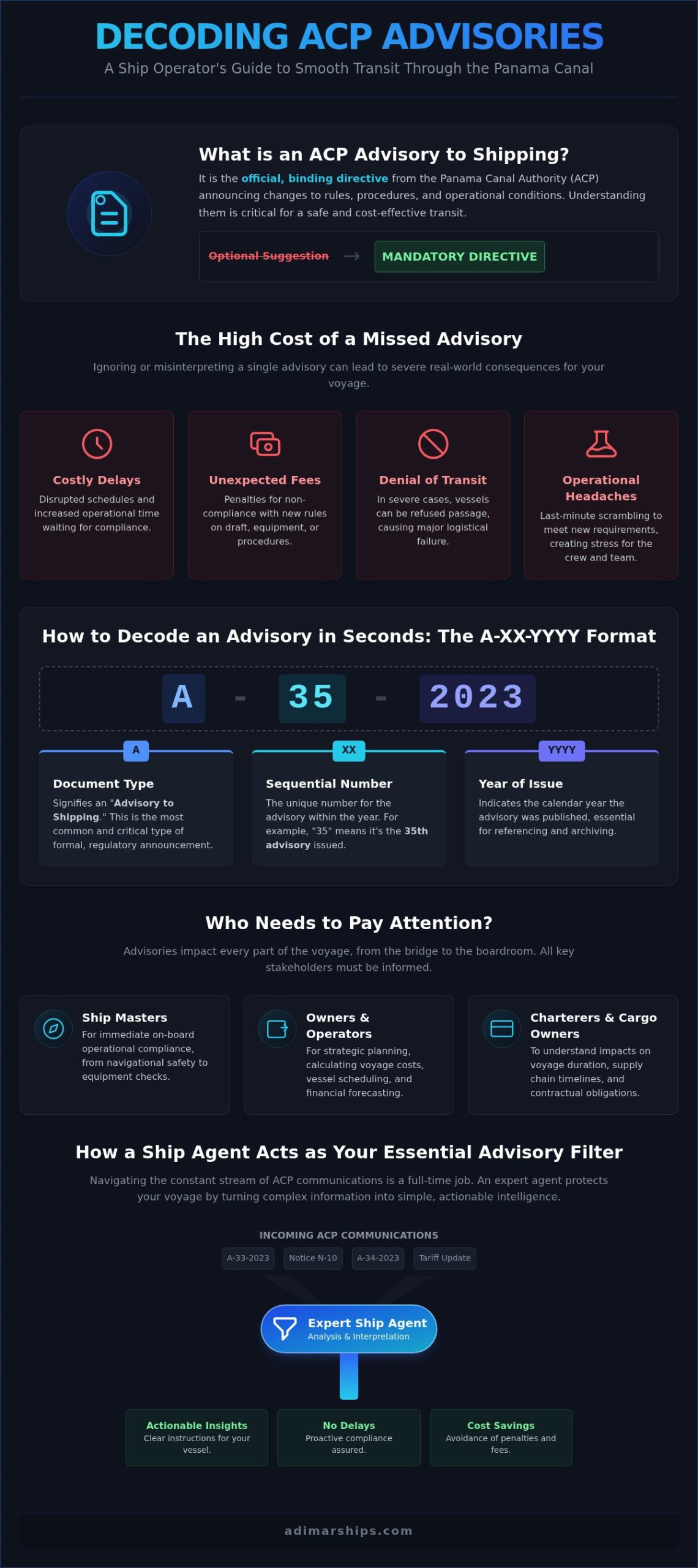
This guide is designed to eliminate that confusion. As your trusted partner at the Panama Canal, our goal is to provide the clarity you need. We will decode these vital communications, showing you what they are, how to quickly identify the ones that apply to your specific vessel, and why they are critical for a smooth, cost-effective transit. By the end, you’ll have the confidence to manage this flow of information, avoid common penalties, and ensure every passage is a success.
Key Takeaways
- ACP Advisories are the official, binding directives from the Panama Canal Authority; understanding them is critical to avoiding costly transit complications.
- Learn to decode the standard advisory format (e.g., A-XX-YYYY) to quickly identify its category and urgency, allowing for faster operational decisions.
- Discover how advisories related to water levels, maintenance, or booking slots can directly impact your vessel’s draft, schedule, and final transit costs.
- With our guide to acp advisories to shipping explained, you’ll see how an expert ship agent acts as your essential filter, protecting your voyage from delays and unexpected fees.
What Are ACP ‘Advisories to Shipping’?
For ship owners, operators, and charterers, understanding the communications from the Panama Canal Authority (ACP) is critical for a smooth transit. In simple terms, an ACP Advisory to Shipping is the official, binding method the ACP uses to announce changes to its rules, procedures, and operational conditions. This is how the complex system of the waterway is managed; a comprehensive Panama Canal overview highlights the immense logistical challenges involved. Getting these acp advisories to shipping explained clearly is the first step toward efficient passage.
Crucially, these are not optional suggestions-they are mandatory directives. Ignoring or misinterpreting an Advisory can lead to significant delays, unexpected costs, or even denial of transit. Their primary purpose is to ensure the safety, efficiency, and regulatory compliance of every vessel that crosses between the oceans, making them an indispensable tool for anyone involved in a Panama Canal transit.
The Role of Advisories in Canal Operations
Advisories serve as the dynamic rulebook for the Canal, providing timely updates that supplement formal regulations. They are the primary channel for communicating critical information that impacts day-to-day and future operations, including:
- Temporary Adjustments: Announcing changes due to immediate conditions like adverse weather, urgent lock maintenance, or adjustments to maximum allowable draft based on Gatun Lake’s water levels.
- Procedural Updates: Implementing new booking system rules, safety requirements, or technology mandates for vessels.
- Future Planning Information: Providing advance notice of upcoming changes to toll structures, tariffs, and long-term reservation policies, allowing companies to budget and plan accordingly.
Who Needs to Pay Attention? (And Why)
Virtually every stakeholder in a vessel’s voyage must monitor ACP Advisories, as the information directly impacts their responsibilities and financial outcomes.
- Ship Masters: For immediate on-board operational compliance, from navigational procedures to safety equipment checks, ensuring a safe and penalty-free transit.
- Owners & Operators: For strategic planning, including vessel scheduling, calculating voyage costs, ensuring vessel suitability for new draft restrictions, and long-term financial forecasting.
- Charterers & Cargo Owners: For understanding potential impacts on voyage duration, scheduling, and overall costs, which can affect supply chain timelines and contractual obligations.
Advisory vs. Notice to Shipping: Clarifying the Terminology
While often used interchangeably, there is a technical distinction. Advisories to Shipping are typically formal, numbered announcements that modify or establish regulations. In contrast, a Notice to Shipping may be more informational, providing general updates or reminders. However, from a practical standpoint, this distinction is minor. Both are official communications from the ACP and must be reviewed with equal diligence to ensure full compliance and avoid costly surprises.
How to Decode an ACP Advisory: Understanding the Format and Language
At first glance, an official Panama Canal Authority (ACP) advisory can seem dense with technical details. However, they follow a consistent and logical structure designed for quick comprehension. Misinterpreting these documents can lead to costly delays, so understanding their format is critical. For ship operators, having the key points of ACP advisories to shipping explained clearly is the first step toward a smooth and efficient transit.
Think of it as a standardized report. Once you know where to look, you can extract the essential information in seconds. Let’s break down the components of a typical advisory.
Breaking Down the Numbering System (A-XX-YYYY)
Every advisory is identified by a unique number that tells you its type, sequence, and year of issue. This simple code helps in referencing and archiving documents. For example, in advisory A-35-2023:
- A – Signifies that the document is an “Advisory to Shipping.” This is the most common type of notice operators will encounter.
- 35 – This is the sequential number. It means this was the 35th advisory issued during that calendar year.
- 2023 – Represents the year the advisory was published.
Key Sections to Find in Every Advisory
To save time and avoid confusion, focus on four critical sections that appear in every document. You can see this consistent structure across all Official Panama Canal Advisories to Shipping published by the ACP. Knowing where to find this information quickly is how ACP advisories to shipping explained by an expert can make all the difference.
- Subject Line: This is your executive summary. It states the advisory’s purpose in a single line, such as “Maximum Authorized Draft for the Neopanamax Locks” or “Modification to the Transit Reservation System.”
- Effective Date: This tells you precisely when the new rule or change comes into force. Always check this to ensure you are compliant in time.
- Applicability: Not all advisories apply to all vessels. This section specifies which ships are affected, whether it’s by size (Panamax, Neopanamax), cargo type, or transit condition.
- Main Body & Cancellation Clause: This section contains the full details of the regulation. Crucially, it will also state if the advisory “supersedes” or “cancels” a previous one, ensuring you are always following the most current directive.
Interpreting Common ACP Terminology
The ACP uses precise language. Understanding these common terms is essential for accurate planning:
- Maximum Authorized Draft: The deepest a vessel can sit in the water to be allowed transit, often specified in feet and measured in Tropical Fresh Water (TFW).
- TFW (Tropical Fresh Water): Refers to the water in Gatun Lake, which has a different density than saltwater. Draft calculations must be adjusted for TFW.
- Booking Period: The specific timeframe in which a vessel can reserve a transit slot.
- Panamax vs. Neopanamax Locks: Advisories will specify which set of locks a rule applies to. Panamax locks are the original, smaller locks, while Neopanamax locks accommodate the larger post-Panamax vessels.
- “Subject to operational availability”: A common phrase indicating that a service or condition may change due to weather, maintenance, or traffic, giving the ACP operational flexibility.
The Main Categories of Advisories & What They Mean for Your Transit
The Panama Canal Authority (ACP) issues hundreds of advisories each year, and filtering through them can be overwhelming. To have the constant stream of acp advisories to shipping explained in a practical way, we group them into four main categories. Understanding these distinctions allows ship operators and agents to quickly identify which announcements require immediate attention and how they will impact a specific transit.
Think of this as your framework for cutting through the noise and focusing on what matters most for your vessel’s safety, budget, and schedule.
Financial: Tariff, Toll, and Fee Adjustments
These advisories directly affect your voyage costs. They announce changes to transit tolls, booking fees, charges for services like tugboats and line handlers, and any new tariffs. For ship owners and charterers, paying close attention to this category is crucial for accurate cost estimation, budgeting, and ensuring financial transparency. An unexpected fee can significantly impact the profitability of a voyage.
- Example: An advisory announces a 5% increase in the transit reservation fee, effective in the next quarter.
Operational: Draft Restrictions & Water Level Updates
Perhaps the most critical and time-sensitive advisories, these updates are often tied to the water levels of Gatun and Alhajuela Lakes. They dictate the maximum allowable Tropical Fresh Water (TFW) draft for transiting vessels. An advisory reducing the maximum draft directly impacts how much cargo a vessel can carry, potentially forcing last-minute changes to loading plans to avoid being denied transit.
- Example: Due to lower-than-average rainfall, an advisory is issued reducing the maximum allowable draft for Neopanamax vessels by 0.5 feet (0.15 meters).
Procedural: Changes to Navigation & Booking Rules
This category covers the “how-to” of a Panama Canal transit. Advisories here detail updates to the transit reservation system, modifications to pre-arrival documentation, new requirements for pilotage, or changes in mooring procedures. These rules affect how your agent books a slot and how the vessel’s crew must prepare for arrival, ensuring a smooth and compliant transit process.
- Example: An advisory modifies the information required in the pre-arrival forms, mandating the inclusion of new security-related data.
Infrastructural: Maintenance Schedules & Lane Outages
These advisories provide advance notice of planned maintenance on locks, channels, or navigational aids. While essential for Canal safety and reliability, this work can lead to temporary lane closures or restrictions. This can reduce overall transit capacity, potentially causing delays or affecting booking availability. Monitoring these notices is key for accurate scheduling and managing expectations for transit times.
- Example: An advisory details a scheduled 12-hour full outage of one lane at the Gatun Locks for urgent gate repairs.
The High Cost of a Missed Advisory: Real-World Consequences
In the maritime industry, the saying ‘time is money’ is a fundamental truth. When the critical details of acp advisories to shipping explained are ignored, a simple oversight can trigger a cascade of costly consequences. Moving from theory to reality, a missed advisory directly impacts your vessel’s transit, your schedule, and your company’s bottom line. The risks are not just financial; they are operational and reputational.
Financial Penalties and Unexpected Charges
A missed advisory announcing a new Canal toll, a change in security fees, or a revised tariff can instantly derail a voyage budget. These aren’t minor discrepancies; they can amount to thousands of dollars in unplanned expenses. Furthermore, the ACP can levy significant fines for non-compliance with new regulations, such as updated safety equipment requirements. If your vessel isn’t ready for its scheduled transit, you may also face disruption charges for delaying Canal operations.
Operational Delays and Scheduling Chaos
Imagine your vessel arriving at the Canal with a draft that exceeds the maximum limit announced just 48 hours prior. The result is immediate and costly: your transit is delayed. This single issue creates a domino effect across your entire supply chain, jeopardizing:
- Berthing windows at the next port of call
- Crew change schedules and flight arrangements
- Bunker delivery timings
- Compliance with charter party agreements
A missed notice about temporary lock maintenance can similarly void a meticulously planned schedule, leaving your vessel anchored and waiting while daily costs mount.
Reputational Damage and Loss of Priority
The Panama Canal is a precisely managed waterway. Vessels that fail to comply with advisories risk losing their booked transit slot and being moved to the back of the queue, adding days to their journey. Over time, repeated issues can damage an operator’s reputation with the ACP, marking them as unreliable. In contrast, operators known for their preparedness build a relationship of trust-an invaluable asset for ensuring smooth and efficient transits every time.
Navigating these constant updates requires expert vigilance. Having a trusted partner on the ground in Panama eliminates these risks, protecting your schedule, your budget, and your reputation with integrity.
How a Ship Agent Acts as Your Essential Advisory Filter
The Panama Canal Authority (ACP) issues a constant stream of advisories, notices, and operational updates. For a busy ship operator, managing this influx of information can be overwhelming and time-consuming. Misinterpreting a single detail about draft restrictions, booking procedures, or transit schedules can lead to significant delays and costs. This is where a dedicated ship agent becomes your most valuable asset. At Adimar, we are experts so you don’t have to be. We transform the constant flow of data into clear, actionable intelligence for your vessel.
Constant Monitoring, So You Don’t Have To
Your focus should be on your vessel’s cargo and crew, not on refreshing an inbox for ACP updates. As your eyes and ears at the Canal, our team provides 24/7 vigilance. We don’t just wait for advisories; we actively monitor all communications and maintain a comprehensive historical database. This ensures that no update, no matter how small or seemingly minor, is ever missed, giving you complete peace of mind.
Distilling Information into Actionable Advice
Receiving an advisory is one thing; understanding its direct impact on your specific vessel is another. We don’t just forward emails. Our experienced team reads every ACP communication and immediately determines its relevance to your ship’s size, type, and transit schedule. We translate technical jargon and complex procedural language into simple, direct instructions. You receive a concise summary: “This is what’s new, and this is what we must do.” Having acp advisories to shipping explained this way eliminates confusion and prevents costly errors.
Proactive Planning and Direct ACP Liaison
The true value of a ship agent lies in proactive problem-solving. We use the intelligence gathered from advisories to anticipate challenges and adjust your transit plan before issues arise. If an advisory contains any ambiguity or requires clarification for your vessel, we communicate directly with our contacts at the ACP to get definitive answers. This direct liaison ensures your vessel is always prepared, fully compliant, and positioned for the most efficient transit possible. Let us manage the details so you can focus on your business.
Put our expertise to work. Nominate Adimar as your agent.
Mastering ACP Advisories: Your Key to a Smooth Transit
Navigating the Panama Canal successfully hinges on understanding its official communications. As we’ve seen, ACP Advisories are not mere suggestions-they are critical directives that dictate the safety, efficiency, and cost of your vessel’s passage. Missing or misinterpreting a single update can lead to costly delays and compliance issues. Now that you’ve had the core aspects of acp advisories to shipping explained, the path to a seamless transit becomes clearer.
You don’t have to manage this constant flow of information alone. Adimar Shipping, Inc. acts as your eyes and ears at the Canal. With over 20 years of dedicated experience, we provide expert interpretation of all ACP communications, serving as your trusted, on-the-ground partner for regulatory compliance. We are the experts so you don’t have to be.
Put your transit in our hands. Eliminate the confusion. Let Adimar Shipping, Inc. manage your Panama Canal transit with integrity. Partner with us and ensure every passage is smooth, compliant, and cost-effective.
Frequently Asked Questions About ACP Advisories
Where can I find the official, up-to-date list of ACP Advisories to Shipping?
The only official and reliable source for all current and past advisories is the Panama Canal Authority (ACP) website. We strongly recommend bookmarking their dedicated “Advisories to Shipping” page. Relying on this primary source ensures your information is accurate and protects you from acting on outdated or misinterpreted third-party information. Your trusted ship agent should also monitor this source constantly on your behalf.
How often does the Panama Canal Authority issue new advisories?
There is no fixed schedule for issuing new advisories. The ACP releases them on an as-needed basis to respond to changing operational, environmental, or administrative conditions. New advisories may be published to announce adjustments in maximum draft due to water levels, upcoming lock maintenance schedules, changes in transit reservation procedures, or updates to toll structures. This dynamic nature makes continuous monitoring essential for smooth transits.
Are ACP advisories legally binding for all vessels?
Yes, absolutely. Compliance with all active ACP Advisories to Shipping is a mandatory condition for any vessel transiting the Panama Canal. These are not suggestions but official directives that form part of the Canal’s operational regulations. Failure to adhere to the requirements outlined in an advisory can result in significant transit delays, financial penalties, or even a refusal of passage until the vessel is fully compliant.
What happens if an advisory is cancelled or superseded by a new one?
When a new advisory is issued to replace an old one, it will explicitly state which previous advisory number is being cancelled or superseded. It is critical for ship operators to always follow the instructions of the most recent, active advisory. As your agent, we track these changes meticulously to ensure your vessel’s pre-arrival preparations and transit plans always align with the latest active requirements, eliminating confusion and preventing compliance issues.
Can I subscribe to an email list to receive new advisories automatically?
Yes, the Panama Canal Authority offers a subscription service on its website, allowing you to receive new advisories directly to your email inbox as they are published. While we encourage this, a key part of our service as your local partner is to not only receive these updates but to immediately interpret their potential impact on your specific vessel and voyage. We provide the context you need to make timely, cost-effective decisions.
What is the difference between an ACP Advisory and a formal Maritime Regulation?
Think of Maritime Regulations as the permanent, foundational rulebook for operating in the Panama Canal. In contrast, advisories are timely, dynamic communications that announce temporary changes, provide clarifications, or update specific operational procedures within that framework. A key part of having acp advisories to shipping explained is knowing they are official directives for current conditions, such as a temporary draft restriction, while regulations are the enduring laws governing all transits.