
In the world of maritime logistics, miscalculation is not an option-especially when planning a Panama Canal transit. Relying on outdated information or guessing how recent water level challenges will impact future limits is a high-stakes gamble that can lead to costly rejections and delays. To ensure a smooth and efficient passage, your voyage planning depends on having the most accurate and current panama canal maximum vessel dimensions 2026, and using last year’s data is a risk you cannot afford.
As your trusted partner at the Panama Canal, we have created this definitive guide to eliminate confusion and provide a single source of truth. Here, you will find the verified, official maximums for both Panamax and Neopanamax locks: Length Overall (LOA), Beam, Tropical Fresh Water (TFW) Draft, and Air Draft. We also clarify the key operational factors that can influence these limits. Consider this your essential resource to confidently plan your 2026 transits, protect your schedule, and secure your bottom line.
Key Takeaways
- Confidently plan your transits with the verified Panama Canal Authority (ACP) maximum dimensions for both Panamax and Neopanamax locks.
- While the core Panama Canal maximum vessel dimensions 2026 are stable, learn how operational factors like water levels can still impact your vessel’s clearance.
- Discover how each specific dimension-Beam, LOA, and Draft-directly impacts your vessel’s safety, efficiency, and passage through the locks.
- Implement our expert checklist to ensure your vessel is fully compliant and avoid costly rejections or delays at the Canal.
Official 2026 Maximum Vessel Dimensions for the Panama Canal
For ship owners and charterers planning future transits, having clear and reliable data is essential. As your trusted partner at the Canal, we can confirm that the official panama canal maximum vessel dimensions 2026 are projected to remain consistent with the current standards set by the Panama Canal Authority (ACP). Understanding these limits is the first step in ensuring a smooth, efficient, and cost-effective passage.
The Canal operates with two distinct lock systems, each with its own specific size restrictions that dictate a vessel’s eligibility for transit. A ship’s classification is determined by which set of locks it can navigate. For a comprehensive technical background, you can review the official definitions for Panamax and Neopanamax vessel dimensions, which form the basis for these operational limits.
Neopanamax Locks: 2026 Limits
Inaugurated in 2016, the expanded Neopanamax locks accommodate the majority of modern large-capacity vessels, allowing for significantly more cargo per transit. Adherence to these dimensions is strictly monitored by the ACP to ensure safety and operational integrity.
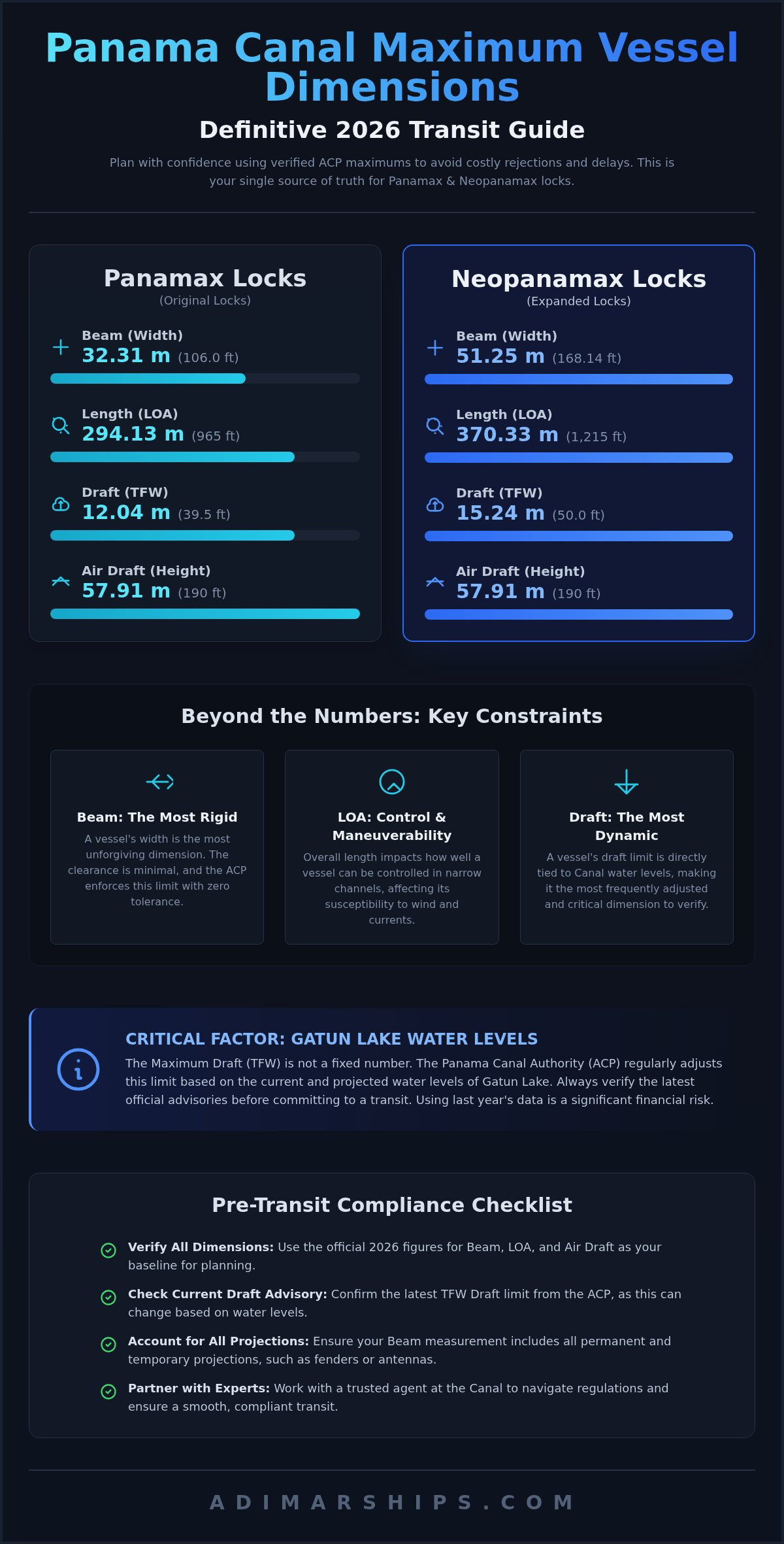
- Maximum Beam (Width): 51.25 meters (168.14 feet)
- Maximum Length Overall (LOA): 370.33 meters (1,215 feet)
- Maximum Draft in Tropical Fresh Water (TFW): 15.24 meters (50.0 feet)
Of these figures, the maximum allowable draft is the most dynamic. The ACP regularly adjusts this limit based on the current and projected water levels of Gatun Lake, a critical factor in transit planning.
Panamax Locks: 2026 Limits
The original Panamax locks have served global trade for over a century and remain a vital artery for smaller vessels. These locks define the traditional ‘Panamax’ class of ship, and many vessels are still built to these precise specifications to serve specific trade routes.
- Maximum Beam (Width): 32.31 meters (106.0 feet)
- Maximum Length Overall (LOA): 294.13 meters (965 feet)
- Maximum Draft in Tropical Fresh Water (TFW): 12.04 meters (39.5 feet)
Quick-Reference Dimensions Table (Panamax vs. Neopanamax)
For at-a-glance planning, this table summarizes the key dimensional differences between the two lock systems.
| Dimension | Panamax Locks (Original) | Neopanamax Locks (Expanded) |
|---|---|---|
| Beam (Width) | 32.31 m (106.0 ft) | 51.25 m (168.14 ft) |
| Length (LOA) | 294.13 m (965 ft) | 370.33 m (1,215 ft) |
| Draft (TFW) | 12.04 m (39.5 ft) | 15.24 m (50.0 ft) |
| Air Draft (Height) | 57.91 m (190 ft) | 57.91 m (190 ft) |
Beyond the Numbers: What Each Dimension Means for Your Transit
Understanding the panama canal maximum vessel dimensions 2026 is not just a box-ticking exercise; it’s a critical component of a successful and cost-effective transit. These are not arbitrary numbers but carefully calculated operational limits designed to ensure safety and efficiency. Misinterpreting even a single measurement can lead to costly delays, rejection of transit, or even catastrophic accidents. Think of it as threading a massive, multi-million dollar needle-precision is everything. In our years of experience as your eyes at the Canal, we’ve seen how a few centimeters can make the difference between a smooth passage and a financial headache.
Maximum Beam: The Most Rigid Constraint
A vessel’s beam, or its width at the widest point, is the most unforgiving dimension. The clearance between the hull and the lock walls can be mere feet, leaving absolutely no room for error. This is the primary factor that determines whether a vessel qualifies for the Panamax or the larger Neopanamax locks. A common and costly mistake is failing to account for all projections, such as fenders or antennas. The Panama Canal Authority (ACP) enforces these with zero tolerance, as detailed in the Official 2026 Panama Canal Vessel Requirements, making accurate measurement essential.
Length Overall (LOA): Control and Maneuverability
While beam dictates if a ship fits, its Length Overall (LOA) determines how well it can be controlled within the Canal’s narrow channels and lock approaches. Longer vessels have a larger “sail area” above the waterline, making them more susceptible to wind. This is why the ACP assigns one or two tugboats to assist vessels, ensuring they remain centered and stable. Recognizing modern shipbuilding trends, the ACP increased the maximum LOA for Neopanamax locks to 370.33 meters (1,215 feet) in 2021, a change that requires expert coordination between the ship’s pilot and tugboat captains.
Draft (TFW): The Critical Water Level Variable
Draft is the vertical distance from the waterline to the bottom of the hull. In Panama, this is measured in Tropical Fresh Water (TFW) because the Canal’s locks use fresh water from Gatun and Alhajuela Lakes. This dimension is uniquely variable, as it is directly linked to the water levels of these lakes. During Panama’s dry season or extended droughts, the ACP may impose temporary draft restrictions to conserve water, directly impacting a vessel’s maximum cargo capacity. Planning for this variable is key to maximizing profitability.
Air Draft: Clearing the Bridge of the Americas
The final key measurement is air draft-the distance from the waterline to the vessel’s highest point. The primary obstacle is the iconic Bridge of the Americas at the Pacific entrance, which sets the absolute height limit for any vessel transiting the Canal. The maximum allowable air draft is a fixed 57.91 meters (190 feet) at Mean High Water Springs (MHWS). Any vessel exceeding this, even by a small margin, will be unable to pass, making accurate declarations of a ship’s air draft non-negotiable.
Operational Factors That Can Influence Published Limits in 2026
For ship owners and charterers, understanding the official vessel limits is only half the battle. A common concern is the gap between the published maximums and the actual, day-to-day operational allowances. While the core infrastructure dictates the absolute beam and length, several dynamic factors can temporarily modify transit conditions, particularly draft. Planning for the panama canal maximum vessel dimensions 2026 requires a vigilant, on-the-ground partner who can navigate these real-time variables to prevent costly delays and ensure a smooth transit.
Impact of Water Levels and Drought on Draft
The Panama Canal is a freshwater canal system that relies on rainfall to maintain the water level of Gatun and Alajuela Lakes. Recent years have highlighted the region’s vulnerability to drought, which directly impacts the maximum allowable draft for transiting vessels. When lake levels are low, the Panama Canal Authority (ACP) issues official “Advisories to Shipping” announcing incremental draft reductions to ensure safe passage. For 2026 planning, this means that even if a vessel meets the theoretical 15.24 meters (50.0 feet) TFW draft, seasonal weather patterns could impose temporary restrictions that must be respected.
Scheduled Maintenance and Lock Outages
The Panama Canal’s locks are a marvel of engineering that require meticulous and regular maintenance to operate safely and efficiently. The ACP schedules these maintenance periods, which can involve lane outages in either the Panamax or Neopanamax locks. While these are planned and announced in advance, they can impact transit availability, potentially affecting booking slots and transit times. During major overhauls, temporary restrictions on maneuverability or equipment may also be put in place, underscoring the need for constant operational awareness.
The Role of ACP Advisories to Shipping
The definitive source for all temporary changes to Canal operations is the ACP’s “Advisories to Shipping.” These communications are the official channel for announcing any deviation from standard procedures. While the foundational rules are detailed in publications like the Official Panama Canal Vessel Requirements, daily changes to draft, lane availability, and safety protocols are communicated exclusively through these advisories. A trusted ship agent’s primary responsibility is to monitor these alerts 24/7, interpret their impact on your vessel, and take proactive steps to protect your schedule and investment. Let Adimar be your eyes on the Canal to monitor these real-time changes and ensure your transit is seamless and efficient.
How to Ensure Your Vessel is Compliant for a 2026 Transit
Understanding the official limits is the first step; ensuring your vessel meets them is what guarantees a smooth, profitable transit. Proactive compliance is not a burden-it’s a crucial strategy to prevent costly delays, extra fees, and the risk of being denied passage. In a waterway where time is money, preparation is everything.
To avoid last-minute complications, ship owners and operators should follow a rigorous verification process. This checklist outlines the critical steps to confirm your vessel is ready for its 2026 transit.
Verifying Vessel ‘As-Built’ Plans and Certificates
Your first source of truth must be the vessel’s official documentation. Relying on anecdotal data or past transit information is a common but dangerous mistake. Always consult the original ‘as-built’ plans and, most importantly, the International Tonnage Certificate (ITC 69). These documents provide the definitive measurements that the Panama Canal Authority (ACP) will use for its assessment. Ensure your submitted data matches these certificates precisely.
Accounting for All Projections and Protrusions
A vessel’s maximum beam and length are not just about the hull. The ACP measures the extreme dimensions, including every permanent fixture. A miscalculation here can lead to an immediate denial of transit. Pay close attention to:
- Bridge wings and their equipment
- Antennas, satellite domes, and masts
- Mooring equipment and permanent deck cranes
- Any overhanging deck cargo or securing structures
Failing to account for these seemingly minor protrusions is a leading cause of non-compliance with the panama canal maximum vessel dimensions 2026 regulations.
The Critical Role of a Ship Agent in Pre-Arrival Verification
Your ship agent is more than a coordinator; they are your risk mitigation partner and your eyes at the Canal. A diligent agent meticulously double-checks all submitted documentation against the latest ACP requirements, catching discrepancies before they become expensive problems. This expert verification is your final line of defense against delays. We are experts so you don’t have to be. For a seamless verification process that eliminates confusion, put your transit in our hands and let us ensure your vessel is fully prepared.
Navigate Your 2026 Panama Canal Transit with Confidence
Successfully planning a voyage through the Panama Canal requires more than just knowing the numbers. As this guide has detailed, the official panama canal maximum vessel dimensions 2026 provide the essential framework, but operational factors and dynamic ACP regulations demand expert oversight. Ensuring your vessel is not just compliant on paper but ready for real-world transit conditions is the key to avoiding costly delays and protecting your schedule.
This is where experience makes the difference. With over 20 years as your trusted, on-the-ground partner, Adimar Shipping, Inc. navigates these complexities for you. We are experts in all ACP regulations, serving as your eyes at the Canal to eliminate confusion and ensure a seamless, efficient passage. Let us handle the details so you can focus on your business.
Plan your 2026 transit with certainty. Contact Adimar for a quote today and let our expertise guide your way.
Frequently Asked Questions
What is the absolute maximum beam for a Neopanamax vessel in 2026?
The official Panama Canal maximum vessel dimensions 2026 stipulate an absolute maximum beam of 51.25 meters (168.14 feet) for Neopanamax vessels. This is a strict operational limit set by the Panama Canal Authority (ACP) to ensure safe passage through the locks. It is critical for ship owners and charterers to verify schematics against this measurement. Any deviation can result in transit denial, making precise planning essential to avoid costly delays and ensure a smooth transit.
How likely is it that the Panama Canal drought will affect my vessel’s draft in 2026?
The possibility of drought affecting draft limits in 2026 remains a serious concern for all transits. The Panama Canal Authority (ACP) actively manages water levels in Gatun Lake and will adjust the maximum allowable Tropical Fresh Water (TFW) draft accordingly. These restrictions can be announced with little notice. As your trusted partner, we provide timely updates on all official advisories, helping you adjust cargo loads and schedules to maintain compliance and avoid disruptions to your operations.
Can a vessel receive a waiver if it is slightly over the maximum length or beam?
Waivers for vessels exceeding the maximum length (366 meters) or beam (51.25 meters) for the Neopanamax locks are not granted. These dimensions are fixed based on the physical infrastructure of the locks and canal channels, leaving no room for exceptions. Attempting a transit with a non-compliant vessel will result in denial. It is imperative to ensure your vessel’s specifications fall strictly within the official limits before scheduling a transit to prevent significant financial and logistical setbacks.
What happens if a vessel arrives and is found to be non-compliant with the dimension limits?
If a vessel arrives and an official inspection finds it non-compliant with the dimension limits, it will be denied transit. This results in immediate and costly consequences, including lost transit fees, significant delays while an alternative route is planned (such as sailing around Cape Horn), and disruption to the entire supply chain. Proactive verification with a reliable local agent is the most effective way to prevent this expensive and frustrating scenario from impacting your business.
Are there any official plans to expand the Neopanamax locks or increase dimensions further by 2026?
As of now, the Panama Canal Authority (ACP) has not announced any official plans to expand the Neopanamax locks or increase the maximum vessel dimensions further by 2026. The current focus is primarily on long-term water management solutions to ensure the reliability of the existing infrastructure. While future expansions are always a possibility, ship owners should base all 2026 transit plans on the current, established limits for Neopanamax vessels to ensure compliance and a successful passage.
How is air draft measured, and does it change with the tide?
Air draft is the vertical distance from the vessel’s waterline to its highest point. The critical measurement for the Panama Canal is clearing the Bridge of the Americas, which has a reference height of 62.5 meters (205 feet). While oceanic tides do not directly affect the freshwater sections of the canal, the water level of Gatun Lake, which can fluctuate based on rainfall and water usage, is the primary factor. We help ensure your vessel’s air draft complies with all current conditions.