

For ship operators in Panama, the line between a smooth transit and a costly delay is often drawn by compliance. Are you struggling to distinguish the responsibilities of the Panama Canal Authority (ACP) from the Panama Maritime Authority (PMA)? The feeling of being overwhelmed by countless circulars and legal documents is common, but a misunderstanding of the panama maritime authority regulations can lead to unexpected fines or even vessel detention. In a business where time is money, you cannot afford that kind of uncertainty.
We are experts so you don’t have to be. Put your transit in our hands. This guide is your roadmap to navigating Panama’s maritime rules with confidence. We will break down the PMA’s most critical regulations, clarify compliance for your specific vessel, and help you avoid expensive delays. Consider us your trusted partner on the ground, here to eliminate the confusion and ensure your operations proceed with integrity and efficiency.
Key Takeaways
- Avoid critical compliance errors by understanding the distinct roles of the Panama Maritime Authority (PMA) and the Panama Canal Authority (ACP).
- While most panama maritime authority regulations align with IMO conventions, specific technical and administrative requirements are mandatory for vessels under the Panamanian flag.
- Stay ahead of enforcement by understanding the PMA’s inspection process and how to interpret Merchant Marine Circulars, which is key to preventing costly penalties.
- Leverage a local ship agent as your on-the-ground compliance department to navigate the PMA’s requirements with confidence and efficiency.
Understanding the Key Players: PMA vs. Panama Canal Authority (ACP)
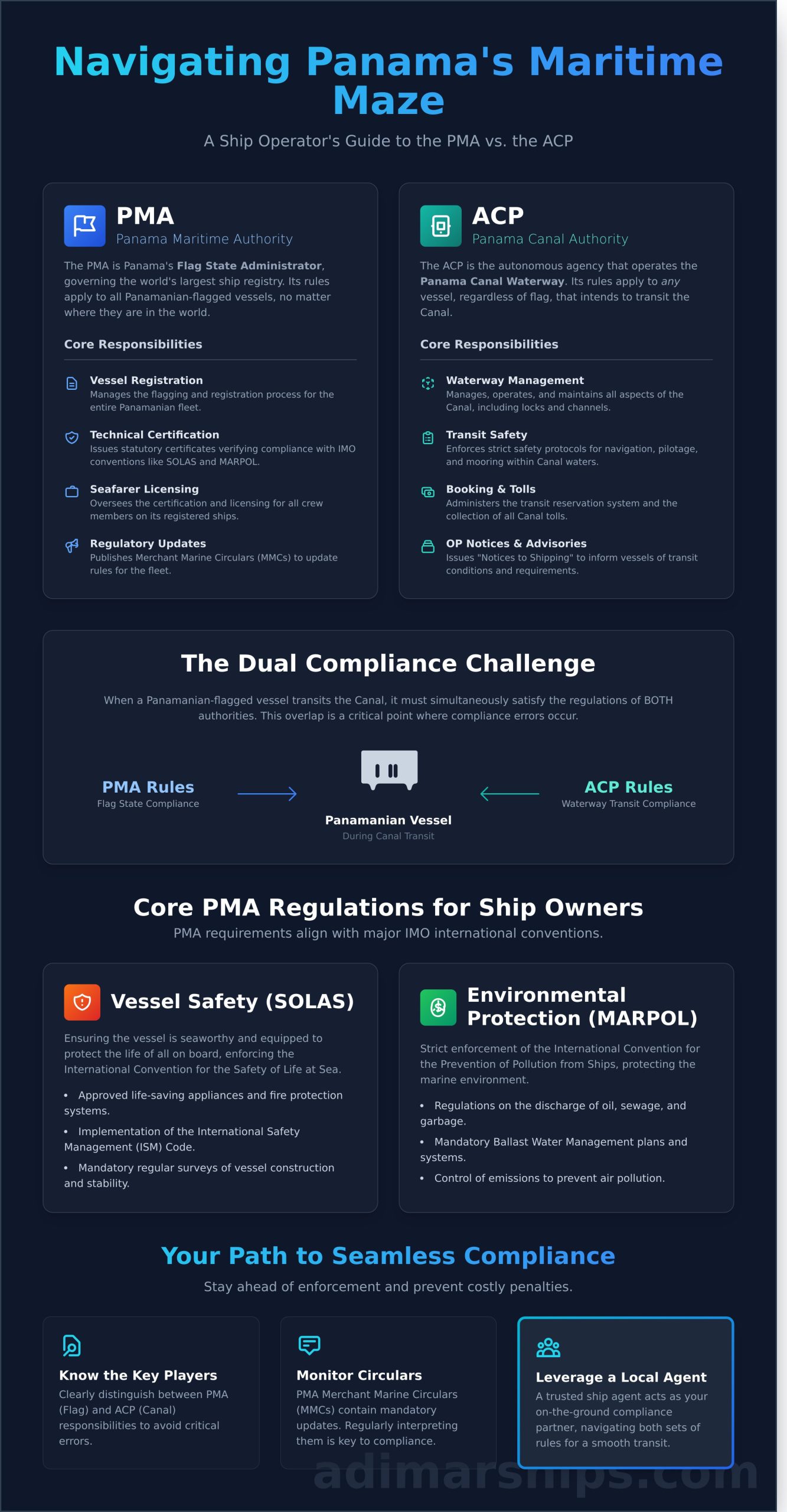
For ship operators, a frequent point of confusion in Panamanian waters can lead to costly delays and compliance issues. The key is understanding that Panama has two distinct and powerful maritime bodies: The Panama Maritime Authority (PMA) and the Panama Canal Authority (ACP). Mistaking one for the other is a common misstep. The PMA acts as the country’s flag state administrator, while the ACP is the dedicated operator of the waterway. Grasping this fundamental distinction is the first step toward successful and efficient operations.
The Role of the Panama Maritime Authority (PMA)
The PMA is the national entity governing the world’s largest ship registry. If your vessel flies the Panamanian flag, the PMA is your primary regulator, no matter where you are in the world. Its core responsibilities are comprehensive and directly impact your vessel’s legal and operational status. The official panama maritime authority regulations are communicated through regular updates and circulars.
- Vessel Registration: Manages the registration and flagging of vessels under the Panamanian flag.
- Technical Certification: Issues statutory certificates verifying compliance with international safety and environmental standards (SOLAS, MARPOL).
- Seafarer Licensing: Oversees the certification and licensing for crew members serving on Panamanian-flagged ships.
- Regulatory Updates: Publishes Merchant Marine Circulars (MMCs) to clarify and update rules for the entire fleet.
The Role of the Panama Canal Authority (ACP)
The Panama Canal Authority (ACP) is an entirely separate entity focused exclusively on the waterway itself. As an autonomous agency of the Government of Panama, the Panama Canal Authority is responsible for the safe, efficient, and profitable operation of the Canal. Its rules, issued through documents like Notices to Shipping and Operations (OP) Notices, apply to any vessel, regardless of its flag, that intends to transit.
- Waterway Management: Manages, operates, and maintains all aspects of the Panama Canal, including locks, channels, and traffic.
- Transit Safety: Enforces strict safety protocols for vessel navigation, pilotage, and mooring within Canal waters.
- Booking and Tolls: Administers the transit reservation system and the collection of all Canal tolls.
How Their Jurisdictions Overlap for a Transiting Vessel
The distinction becomes critical during a Canal transit. A Panamanian-flagged vessel must satisfy the panama maritime authority regulations at all times as its Flag State. Simultaneously, upon entering Canal waters, it must also strictly adhere to the ACP’s operational requirements for a safe passage. This dual compliance can be complex. An experienced local agent is essential to navigate both sets of rules seamlessly, ensuring all paperwork, certifications, and operational preparations meet the standards of both the PMA and the ACP, preventing any disruption to your transit.
Core PMA Regulations: Key Areas of Compliance for Ship Owners
Navigating the full scope of panama maritime authority regulations can feel overwhelming. The good news is that the PMA aligns its requirements with major international conventions established by the International Maritime Organization (IMO). This framework simplifies compliance for vessel owners operating globally. This alignment is a cornerstone of the PMA’s strategy, which focuses on ensuring the international compliance of the Panama-flagged fleet and maintaining its status as a leading global registry. For ship owners, these extensive rules can be grouped into four critical areas, each demanding meticulous documentation and proactive management.
Vessel Safety & Seaworthiness (SOLAS)
The PMA strictly enforces the International Convention for the Safety of Life at Sea (SOLAS). This means your vessel must be equipped with approved life-saving appliances and fire protection systems. Compliance also requires the implementation of the International Safety Management (ISM) Code, which establishes a systematic approach to safe operations. Regular surveys are mandatory to verify that the vessel’s construction, stability, and equipment remain in full compliance, ensuring it is seaworthy at all times.
Environmental Protection (MARPOL)
Panama is a signatory to the International Convention for the Prevention of Pollution from Ships (MARPOL). The PMA enforces strict rules covering:
- Discharge of oil, sewage, and garbage.
- Management of ballast water through approved Ballast Water Management (BWM) systems and plans.
- Air pollution controls, including the enforcement of global sulphur caps (Annex VI).
A key local requirement is the Panama Canal Shipboard Oil Pollution Emergency Plan (PCSOPEP), which is mandatory for all vessels over 400 GT transiting the Canal.
Maritime Security (ISPS Code)
The PMA mandates full compliance with the International Ship and Port Facility Security (ISPS) Code. Every vessel must have an approved Ship Security Plan (SSP) on board, and the operating company must designate a Company Security Officer (CSO). The PMA also provides guidelines on best management practices for anti-piracy measures and vessel hardening, helping protect your crew and assets in high-risk areas.
Crew Welfare & Certification (MLC & STCW)
Protecting seafarers’ rights is a priority. The PMA upholds the Maritime Labour Convention (MLC, 2006), setting standards for crew employment agreements, accommodation, and repatriation. In parallel, the Standards of Training, Certification and Watchkeeping for Seafarers (STCW) convention governs crew competency. The PMA has a well-established process for reviewing, endorsing, and issuing Certificates of Competency (CoC) to ensure all crew members are qualified for their duties.
The Panama Ship Registry: Registration and Technical Requirements
The Panama Maritime Authority (PMA) is perhaps best known for operating the world’s largest and most established open ship registry. With over 8,000 vessels flying the Panamanian flag, the registry is a cornerstone of global shipping. However, gaining entry is just the first step in a continuous journey of compliance and maintenance. For ship owners, understanding both the initial process and the ongoing obligations is critical for seamless operations.
Why Register a Vessel in Panama?
Ship owners choose the Panamanian flag for several compelling, business-focused reasons. The registry offers a robust and globally respected platform built on decades of experience. Key advantages include:
- Favorable Tax Structure: Panama offers a tonnage-based tax system, which can provide significant financial benefits over income-based tax regimes.
- International Recognition: The Panamanian flag is recognized and respected in ports worldwide, facilitating smoother international trade and transit.
- Versatility: The registry accepts a wide variety of vessel types, from massive container ships and oil tankers to private yachts and specialized offshore vessels.
- Global Network: A vast network of maritime consulates around the world allows for efficient and timely processing of documentation, no matter where your vessel is located.
The Initial Registration Process
The path to flying the Panamanian flag is a structured, document-intensive process. Navigating the initial paperwork is a key part of complying with panama maritime authority regulations. The process requires appointing a resident agent or legal representative in Panama to act on the owner’s behalf. Key documents typically include the Bill of Sale, Power of Attorney, and all relevant technical certificates (e.g., Tonnage, SOLAS, MARPOL). Once submitted and approved, the PMA issues a Provisional Navigation Patent and Radio License, allowing the vessel to operate legally while the permanent registration is finalized.
Maintaining Good Standing with the PMA
Registration is not a one-time event; it is an ongoing commitment to safety and compliance. To maintain good standing, vessel owners must adhere to strict annual requirements. This continuous compliance is governed by a detailed legal framework, and for an in-depth look at the specific statutes, the Panama Shipping Laws and Regulations guide provides a comprehensive overview. Key ongoing responsibilities include:
- Annual Safety Inspections (ASI): Vessels must undergo an ASI to verify their condition and ensure they meet all international safety and environmental standards.
- Annual Taxes and Fees: Timely payment of annual tonnage taxes, consular fees, and other administrative charges is mandatory to keep the registration active.
- Valid Statutory Certificates: All required statutory certificates must be kept valid, up-to-date, and available for inspection onboard the vessel at all times.
Practical Compliance: Inspections, Circulars, and Avoiding Penalties
Understanding the rules is only half the battle. The true test of compliance comes when inspectors step on board. The Panama Maritime Authority (PMA) and international bodies verify adherence through a rigorous system of inspections and audits. Missteps here don’t just cause delays; they impact your reputation and bottom line. In a world where time is money, being unprepared is a costly mistake.
Navigating the practical side of panama maritime authority regulations requires vigilance and a proactive partner. At Adimar Shipping, Inc., we ensure our clients are not just compliant on paper, but ready for scrutiny at any moment.
Navigating Merchant Marine Circulars (MMCs)
The PMA communicates all updates, new requirements, and interpretations of regulations through Merchant Marine Circulars (MMCs). These are not optional reading; they are official directives that must be implemented. Regularly monitoring MMCs is critical to maintaining compliance. For example, a recent circular like MMC-397 updated the procedures for issuing the Maritime Labour Certificate (MLC), directly impacting crew welfare standards and documentation onboard.
Preparing for Flag State & Port State Control Inspections
A Panamanian-flagged vessel is subject to both Flag State Inspections (by the PMA) and Port State Control (PSC) inspections by authorities in foreign ports. During a Flag State inspection, auditors verify that the vessel, its crew, and its operations meet all national and international standards. Failure to pass can lead to fines. Even more serious is a PSC detention, which can halt your operations entirely. The most common deficiencies found on Panamanian ships include:
- Issues with fire safety measures (e.g., faulty fire dampers or doors).
- Defective life-saving appliances.
- Incorrect or outdated navigational charts and publications.
- Problems related to the International Safety Management (ISM) Code.
Common Pitfalls and How to Avoid Them
Many detentions and penalties stem from predictable and avoidable mistakes. Staying ahead of these common pitfalls is key to smooth, uninterrupted voyages. The most frequent issues we see are:
- Outdated Crew Documentation: Expired seafarer certificates, endorsements, or medical certificates are immediate red flags for inspectors.
- Improper Maintenance: Neglecting safety or pollution prevention equipment, such as fire extinguishers or oil filtering systems, guarantees a deficiency.
- Incorrect Logbooks: Failure to correctly and consistently log information in official record books (e.g., Oil Record Book, Garbage Record Book) suggests a breakdown in procedure.
Constant readiness is the only effective strategy. Ensure your vessel is always inspection-ready. Partner with Adimar Shipping, Inc. We are your eyes and ears, providing the expert oversight needed to keep your operations moving.
How a Ship Agent Simplifies PMA Regulatory Compliance
Navigating the complex web of Panamanian maritime law can be a full-time job. For ship owners and charterers, misinterpreting a rule or missing a deadline isn’t just an inconvenience-it’s a direct threat to profitability. This is where an experienced ship agent becomes your most valuable asset. Think of us as your local compliance department, dedicated to managing the intricate details of panama maritime authority regulations so you can focus on your core business. An expert agent saves you time, reduces operational risk, and prevents costly penalties.
Your Eyes and Ears on the Ground
A local agent acts as your proactive partner in Panama, constantly monitoring new PMA circulars and Panama Canal Authority (ACP) advisories to keep you ahead of regulatory changes. We serve as your direct liaison with PMA and ACP officials, eliminating communication barriers. From managing all pre-arrival documentation to coordinating port entry formalities, we ensure every step is handled correctly for a smooth, predictable arrival.
Streamlining Documentation and Certification
The administrative burden of maritime compliance is immense. A dedicated agent streamlines this entire process by managing the timely renewal of essential PMA-issued certificates, coordinating with Panamanian consulates worldwide for crew endorsements and seaman’s books, and ensuring every piece of necessary paperwork is submitted correctly. This meticulous attention to detail prevents administrative delays that can derail a voyage.
Expert Problem-Solving When Issues Arise
Even with perfect planning, challenges can occur. When they do, having a representative on the ground is critical. Our team provides immediate assistance during Port State Control inspections or flag state audits, helping to resolve any noted deficiencies or disputes with authorities efficiently. As your 24/7 representative, we act swiftly to prevent minor issues from escalating into costly detentions or fines.
Ultimately, partnering with a ship agent transforms compliance from a liability into a streamlined process. We are experts so you don’t have to be. By entrusting your vessel to a team that intimately understands all panama maritime authority regulations, you gain more than just a service provider; you gain a trusted partner dedicated to protecting your interests. Contact Adimar Shipping to ensure your next port call is efficient and predictable.
Mastering PMA Compliance: Your On-the-Ground Partner in Panama
Navigating the maritime landscape in Panama requires a clear understanding of the distinct roles of the PMA and ACP, and a diligent approach to compliance. From ship registration and technical requirements to staying current with inspections and circulars, mastering the panama maritime authority regulations is not just about avoiding penalties-it’s about ensuring smooth, efficient, and profitable operations. The complexity of these rules can be frustrating, but you don’t have to manage it alone.
Let Adimar Shipping be your eyes at the Panama Canal. With over 20 years of dedicated experience and as an authorized PCSOPEP provider, we eliminate the confusion and serve with integrity. We are your trusted, on-the-ground partner for regulatory compliance, allowing you to focus on your business while we handle the details. Put your transit in our hands for seamless passage and peace of mind.
Navigate Panama’s regulations with an expert partner. Contact Adimar Shipping today.
Frequently Asked Questions
What is a Panamanian Merchant Marine Circular (MMC)?
A Panamanian Merchant Marine Circular, or MMC, is an official communication issued by the Panama Maritime Authority. These circulars are essential tools for ship owners, operators, and agents to stay informed about new requirements, interpretations of existing rules, and procedural updates. They cover a wide range of critical topics, from safety standards and environmental protection to seafarer certification and technical specifications. Staying current with MMCs is a key part of maintaining compliance.
How often are the Panama Maritime Authority regulations updated?
The panama maritime authority regulations are not updated on a fixed schedule. Instead, they are amended dynamically as needed, often in response to the ratification of new international conventions (like those from the IMO), technological advancements, or new safety findings. These changes are communicated officially through Merchant Marine Circulars (MMCs), making it vital for operators to have a reliable process for monitoring these releases to ensure uninterrupted compliance and operational readiness.
What are the main penalties for non-compliance with PMA regulations?
Non-compliance with PMA regulations can lead to significant penalties that impact both finances and operations. These can range from substantial monetary fines to the detention of the vessel in port until the deficiency is rectified. In more severe cases or for repeated violations, the PMA has the authority to suspend or even cancel the vessel’s registration under the Panamanian flag. Prompt and accurate compliance is the only way to avoid these costly disruptions to your business.
How does the PMA handle the certification and endorsement of seafarers?
The PMA manages seafarer documentation through a comprehensive system. It issues its own Panamanian licenses, such as Certificates of Competency (CoC), to qualified mariners. Additionally, for seafarers holding valid certificates from approved countries, the PMA issues a Certificate of Endorsement (Title Endorsement or CRA). This endorsement officially recognizes their foreign qualification for service on Panamanian-flagged vessels, ensuring all crew members meet strict international and national standards before setting sail.
Do PMA regulations apply equally to all vessel types, like yachts and cargo ships?
No, not entirely. While a core set of principles from the panama maritime authority regulations applies to all vessels, many specific requirements vary based on the vessel’s type, size (gross tonnage), and service. For example, a large cargo ship on an international voyage is subject to stringent SOLAS and MARPOL conventions that do not apply in the same way to a privately operated pleasure yacht. It is crucial to apply the correct set of rules for your specific vessel.
What is the VUMPA (Maritime Single Window of Panama) and how does it affect compliance?
VUMPA is a mandatory electronic platform designed to streamline vessel clearance in Panama. It acts as a single digital gateway where ship agents submit all required documentation for a vessel’s arrival, port stay, and departure to all relevant authorities at once. For compliance, this means reporting is centralized and transparent. Using VUMPA correctly is essential for efficient port calls and avoiding delays, as it is the official channel for all necessary declarations.