
In the high-stakes world of shipping, time is money-and nowhere is this truer than at the Panama Canal. Unpredictable tolls, the risk of costly delays, and a complex reservation system can turn a routine transit into a significant financial liability. Budgeting accurately feels like a constant challenge, leaving you to worry about hidden fees and compliance penalties that can erode your profit margins with every passage.
But what if you could navigate this process with confidence and control? This guide is designed for ship operators who need clear, actionable strategies on how to minimize Panama Canal costs. We will break down the Panama Canal Authority’s (ACP) intricate toll structure, reveal common pitfalls that lead to unexpected charges, and share proven methods for optimizing your voyage. Consider this your roadmap to achieving a more predictable transit budget, avoiding costly errors, and securing a smooth, efficient passage every time.
Key Takeaways
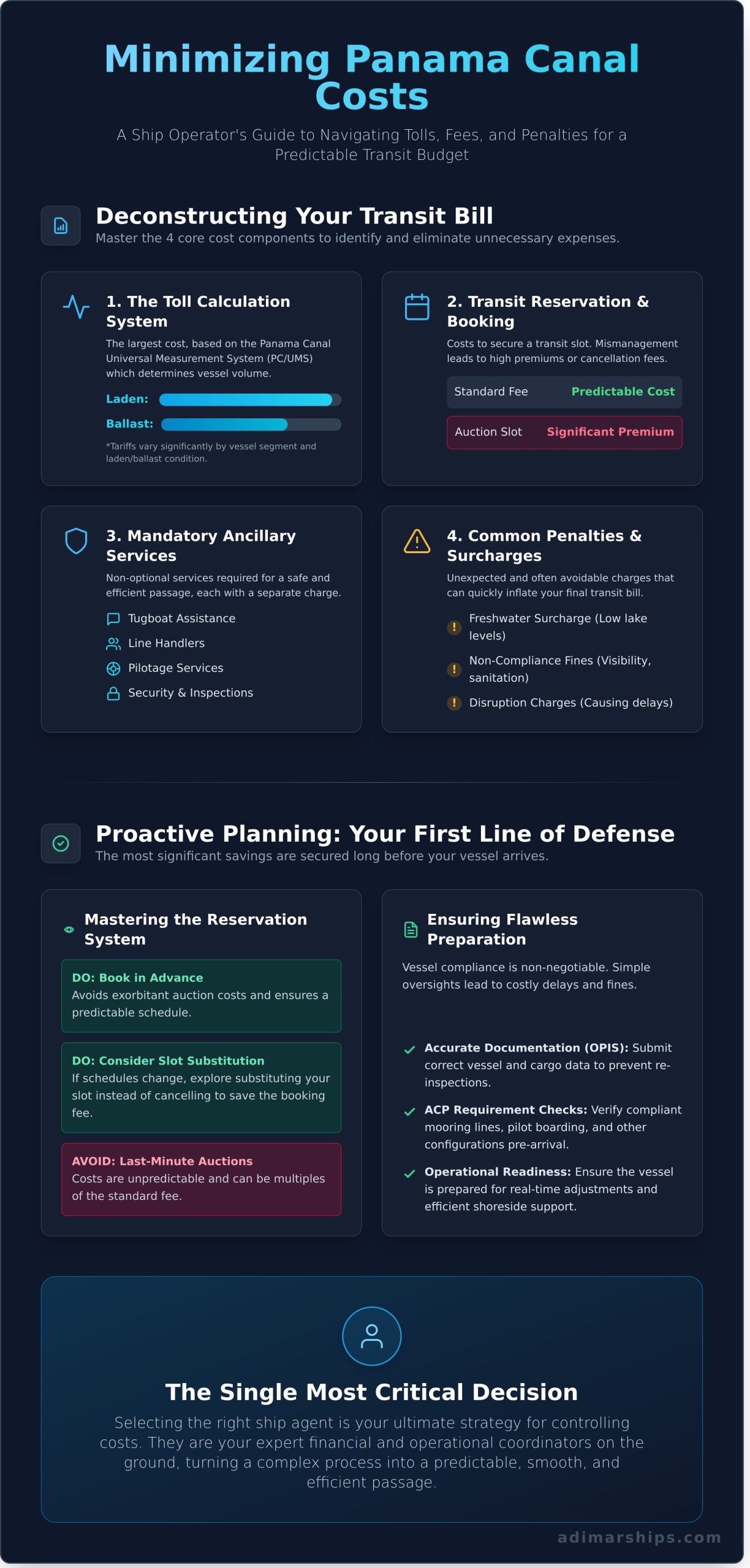
- Your Panama Canal transit bill is more than just tolls. Mastering its four core components is the first step to identifying and eliminating unnecessary expenses.
- The most significant cost savings are realized through meticulous pre-transit planning, which can prevent the majority of avoidable fees and penalties.
- Learn how to minimize panama canal costs with real-time operational adjustments and efficient shoreside support during the transit itself.
- Selecting the right ship agent is the single most critical decision for controlling your budget; they are your expert financial and operational coordinators on the ground.
Deconstructing Your Transit Bill: The 4 Core Cost Components
For ship owners and charterers, the final bill for a Panama Canal transit can seem like a complex puzzle. It’s more than just a single toll; it’s a matrix of interconnected fees, charges, and potential surcharges. The first step in learning how to minimize panama canal costs is to deconstruct this bill into its core parts. By understanding what you’re paying for, you can identify opportunities for significant savings. Think of this as the foundation for building a cost-conscious and efficient transit strategy. Let’s break down the four primary components you’ll find on your invoice.
Component 1: The Toll Calculation System
The largest line item on your bill is the transit toll, calculated using the Panama Canal Universal Measurement System (PC/UMS). This system determines a vessel’s total volume, which forms the basis of the toll. It’s crucial to understand that different tariffs apply to various vessel segments, such as container ships, LNG carriers, or bulk carriers. Furthermore, the final toll is heavily influenced by your vessel’s capacity and whether it is in laden (loaded) or ballast (empty) condition. This complex system is a core part of the waterway’s financial model, deeply rooted in the history and operations of the Panama Canal.
Component 2: Transit Reservation & Booking Fees
Securing a transit slot comes with its own set of costs. The Panama Canal Authority (ACP) offers a limited number of daily reservation slots for a standard fee to guarantee a specific transit date. For urgent passage, high-value auction slots are available, but at a significant premium. Mismanaging these bookings can be costly; changing or cancelling a reservation incurs fees, and recent tariff updates have introduced stricter penalties for last-minute cancellations and slot substitutions. Proper planning here is a key factor in managing your budget.
Component 3: Mandatory Ancillary Services
Beyond the toll, every transit requires a suite of mandatory services, each with an associated cost. These are not optional and are essential for a safe and efficient passage. Your bill will include separate charges for:
- Tugboat Assistance: For maneuvering in the locks and approach channels.
- Line Handlers: Required on deck to handle mooring lines within the locks.
- Pilotage Services: For expert navigational guidance through the Canal.
- Security & Inspection Fees: Standard charges for vessel security and compliance checks.
Component 4: Common Penalties & Surcharges
Unexpected charges can quickly inflate your final bill. These are often avoidable with proactive management. A primary example is the Freshwater Surcharge, which the ACP may apply during periods of low water levels in Gatun Lake. Other common penalties include fines for non-compliance with visibility requirements, sanitation standards, or disruption charges if your vessel causes a delay in Canal operations. Being prepared and ensuring your vessel is fully compliant is a direct way to avoid these unnecessary expenses.
Proactive Planning: Your First Line of Defense Against High Costs
In the complex world of Canal transits, the most significant savings are secured long before your vessel reaches Panamanian waters. Effective pre-planning is the foundation of how to minimize panama canal costs, moving your transit from a reactive expense to a controlled, predictable operation. It’s about eliminating avoidable fees and penalties through mastery of the system and total vessel compliance. This preparatory phase is where a trusted, experienced agent proves invaluable, acting as your local team to navigate every requirement with precision.
Mastering the Transit Reservation System
The Panama Canal’s booking system rewards foresight. Securing a transit slot well in advance is the most reliable way to avoid the unpredictable and often exorbitant costs of the daily auction system. Understanding the nuances of the different booking periods and their deadlines is critical. Furthermore, a strategic approach to changes is essential. If your vessel’s schedule shifts, exploring a substitution instead of a cancellation can prevent the loss of your booking fee, a significant saving that less experienced operators might overlook.
Ensuring Flawless Vessel Preparation & Documentation
Vessel compliance is non-negotiable and directly impacts your bottom line. Simple oversights can lead to costly delays or fines. We ensure thorough pre-arrival checks are conducted to verify that all Panama Canal Authority (ACP) requirements are met, from proper mooring line configurations to compliant pilot boarding arrangements. Accuracy in your documentation is paramount. Any incorrect information submitted via the Online Port Information System (OPIS) regarding vessel particulars or cargo can trigger re-inspections and substantial penalties, as detailed in the Official Panama Canal Tariffs. Ensuring all certificates are valid and in order is the final step to a seamless inspection process.
Optimizing Your Transit Schedule
Timing is everything at the Panama Canal, and your schedule must account for dynamic local conditions. Seasonality plays a major role; the dry season (typically January-May) can bring draft restrictions and higher demand for slots, while the rainy season may present fog-related delays. Planning your vessel’s ETA requires a delicate balance-arriving too early incurs unnecessary anchorage costs, while arriving late risks missing your slot entirely. This is where active coordination with your agent becomes critical. We provide real-time intelligence on canal traffic and conditions, allowing you to fine-tune your arrival for maximum efficiency and cost control.
Operational Efficiency: How to Save Money During the Transit
Your strategy for how to minimize panama canal costs shouldn’t end once your vessel reaches Panamanian waters. In fact, this is where real-time decisions and operational readiness directly impact your bottom line. While a detailed analysis of the toll structure is crucial for budgeting, the final amount you pay is heavily influenced by on-the-ground execution. Delays, inefficiencies, and non-compliance can quickly add thousands of dollars to your transit. Smooth operations, guided by seamless communication between your vessel, your agent, and the Panama Canal Authority (ACP), are paramount.
The Cost of Time: Managing Arrival and Anchorage
In the maritime world, time is money-and nowhere is this more true than at the Canal’s entrance. Arriving too early results in excess anchorage fees and wasted fuel, while arriving late can mean losing your booked slot and facing significant delays. The key is precise coordination. Working with a trusted agent to provide constant, accurate ETA updates to the ACP ensures your vessel arrives within the designated window, avoiding unnecessary costs and securing your transit position.
Efficient Use of Canal Resources
Once your transit begins, crew preparedness is essential for an efficient passage. Every minute saved on ancillary services like tugboats translates into direct cost savings. To ensure a swift and cost-effective transit, your crew must be ready for:
- Rapid Boarding: Having ladders, lines, and personnel prepared for the immediate and safe boarding of pilots and line handlers minimizes idle time.
- Engine Readiness: A responsive engine room that can execute maneuvers promptly reduces reliance on tug assistance, a significant operational expense.
- Precise Execution: Following the pilot’s instructions without delay is critical for maintaining the tight transit schedule and avoiding operational penalties.
Compliance in Canal Waters
Navigating Canal waters means adhering to a strict set of rules where non-compliance comes with a hefty price tag. To protect your budget, it’s vital to manage waste disposal according to MARPOL regulations to avoid severe fines. Similarly, all bunkering operations should be scheduled efficiently before or after the transit to prevent delays. Respecting the ACP’s security and safety protocols is not just a matter of procedure; it’s a fundamental part of a successful and cost-controlled transit.
Strategic Use of Agency Services to Reduce Your Bottom Line
Your Panama Canal agent’s role extends far beyond simple transit coordination. A truly effective agent acts as your strategic financial partner on the ground, and understanding how to leverage their full suite of services is a powerful method for how to minimize panama canal costs. Inefficient shore-side support-from delayed spare parts to poorly timed crew changes-can easily trigger expensive transit delays, turning small logistical issues into significant financial setbacks. By consolidating services with one trusted agent, you create powerful synergies that protect your schedule and your bottom line.
Streamlining Husbandry for Transit Continuity
Every minute a vessel waits is a minute it loses money. Expert husbandry services are designed to eliminate this waste by ensuring all shoreside needs are met with precision and without disrupting the transit schedule. This includes:
- Coordinated Crew Changes: Executing on-signer and off-signer movements that align perfectly with the vessel’s itinerary, avoiding any need to delay departure.
- Efficient Spares and Provisions: Ensuring timely and correct delivery of critical spare parts, provisions, and mail directly to the vessel, preventing costly hold-ups.
- Prompt Medical Assistance: Arranging immediate medical care for crew members, which is not only a duty of care but also a financial necessity to avoid diversions and potential penalties.
The Financial Oversight of a Protective Agency
When you appoint a primary agent, a protective agent serves as your dedicated financial watchdog. Their sole focus is to protect your interests. A protective agent meticulously audits the primary agent’s Disbursement Account (DA), scrutinizing every line item for accuracy and fairness. They challenge potential overcharges, verify that all invoiced services were actually rendered to standard, and ensure every cost is justified. This independent oversight provides an essential layer of security, guaranteeing transparency and preventing unnecessary expenditures.
Leveraging Local Expertise for Bunkering and Supplies
An agent’s deep-rooted local knowledge is an invaluable asset. In Panama, this expertise translates directly into savings on essential supplies. A well-connected agent can navigate the market to secure the most competitive bunkering rates from reliable, vetted suppliers. They also coordinate the delivery of provisions, lube oil, and other necessities with maximum efficiency, ensuring your vessel is supplied and ready to proceed without delay. Let us manage your husbandry needs for a seamless transit. This proactive management of your vessel’s needs is a cornerstone of an intelligent cost-reduction strategy.
The Adimar Advantage: How the Right Agent Minimizes Your Costs
While tolls and tariffs are fixed, your choice of ship agent is the single most important variable in controlling your total transit expenses. A truly effective agent is more than a simple coordinator; they are your local experts, financial managers, and operational partners on the ground. The key to how to minimize panama canal costs lies in moving beyond basic service to proactive optimization. At Adimar, we act as your eyes at the Canal, safeguarding your interests and your budget every step of the way.
Transparent Financial Management
Financial clarity is non-negotiable. It begins with an accurate and detailed Proforma Disbursement Account (PDA) that leaves no room for surprises. We ensure the pre-funding process is managed efficiently to prevent any delays in your transit schedule. After service completion, you will receive a timely and fully reconciled Final DA, complete with all supporting documentation, upholding our commitment to integrity and transparency.
Proactive Communication and Problem Solving
In the dynamic environment of the Canal, information is your best defense against unexpected costs. We provide constant updates on Canal conditions, regulatory changes, and your vessel’s status. Our long-standing relationships with the Panama Canal Authority (ACP) allow us to resolve potential issues swiftly. We focus on anticipating problems-from draft restrictions to scheduling conflicts-before they can become costly delays.
A Checklist for Choosing a Cost-Effective Agent
When selecting your partner, ask the tough questions. An agent’s answers will reveal their true value and their dedication to finding ways for how to minimize Panama Canal costs. Consider the following:
- Do they offer detailed, transparent financial reporting from PDA to Final DA?
- What is their strategy for handling unexpected delays or regulatory changes?
- Can they provide comprehensive husbandry and protective services to streamline operations?
- Do they have a proven track record of integrity and reliability, backed by client testimonials?
Your agent should be your trusted partner in Panama. Choose one who prioritizes your financial and operational success. Learn more about how Adimar delivers value and integrity with every transit.
Your Partner in Cost-Effective Panama Canal Transits
Successfully navigating the Panama Canal’s financial landscape hinges on a proactive and informed approach. As we’ve covered, understanding your transit bill, planning meticulously, and ensuring operational efficiency are crucial first steps. Yet, the ultimate answer to how to minimize panama canal costs lies in leveraging dedicated, on-the-ground expertise.
This is where a trusted partner becomes your greatest asset. With over 20 years of dedicated Panama Canal experience, Adimar Shipping, Inc. serves as your local team, providing service with integrity. We are committed to transparent, cost-conscious, and efficient operations that protect your bottom line. We are experts so you don’t have to be.
Don’t leave your budget to chance. Take control of your expenses and ensure a smooth passage with a team you can depend on.
Request a Proforma DA and let our experts optimize your next transit cost.
Frequently Asked Questions About Panama Canal Transit Costs
How much does it actually cost to transit the Panama Canal?
The total cost varies significantly, from tens of thousands to over a million dollars. It is not a single fee but a combination of charges. The primary cost is the toll, calculated based on your vessel’s type, size (PC/UMS tonnage), and cargo. Additional mandatory costs include booking fees, security charges, tugboat services, and line handler fees. Getting a precise, itemized pre-arrival estimate from your agent is a critical first step.
Is it cheaper to wait for a slot or pay for one in the auction?
While waiting avoids the high cost of an auction slot, it is rarely cheaper. Waiting incurs significant daily operational costs, including fuel, crew wages, and potential demurrage charges that can quickly exceed an auction fee. Paying for an auction slot provides scheduling certainty and eliminates these costly delays. For most commercial operations, securing a booked transit is the most cost-effective strategy to ensure a timely and predictable passage.
What are the most common and expensive mistakes ship operators make at the Canal?
The most costly errors often stem from poor planning and inaccurate information. Submitting incorrect vessel details can lead to re-measurements, delays, and significant fines. Another common mistake is poor arrival timing, causing a missed slot and incurring rescheduling penalties. Understanding how to minimize Panama Canal costs involves avoiding these preventable errors by working with an experienced agent who ensures all documentation and compliance requirements are met perfectly.
Can a ship agent guarantee a lower transit cost?
No agent can guarantee lower official tolls, as these are set by the Panama Canal Authority (ACP). However, a trusted and experienced agent is essential for reducing your *overall* costs. We achieve this through meticulous planning to avoid fines, efficient coordination of services to prevent delays, and providing expert advice on the most economical booking strategies. The real savings come from a smooth, penalty-free transit, which is our primary goal.
How do the current water level restrictions affect transit fees and costs?
Water level restrictions directly reduce the number of daily transits the Canal can handle. This creates intense competition for the few available slots, causing auction prices to rise dramatically. It also leads to longer waiting times for un-booked vessels, increasing their operational expenses. Furthermore, draft restrictions may require vessels to lighten their load, reducing cargo capacity and increasing the per-ton cost of the entire voyage.
What is the difference between a standard booking fee and an auction slot?
A standard booking is a reservation made weeks or months in advance for a fixed fee, securing a specific transit date. These slots are limited and highly sought after. An auction slot, on the other hand, is a slot for a near-term transit that is sold to the highest bidder. Its cost is determined entirely by current demand and can be substantially higher than the standard booking fee, offering immediate passage at a premium price.