
A single missed deadline for your panama canal transit fees payment can turn a routine voyage into a $200,000 logistical nightmare. In an industry where timing is everything, financial non-compliance is a risk you simply can’t afford. You likely know the frustration of managing opaque surcharges and the rigid pre-payment windows enforced by the Panama Canal Authority (ACP). It’s a complex landscape where currency delays or wire transfer errors can stall your operations and drain your bottom line.
We’re here to provide the clarity and security you need. This guide will help you master the 2026 fee structures and LoTSA 2.0 requirements so your vessel transits without a single hour of financial delay. You’ll gain a clear understanding of the latest tariff components, from fixed Neopanamax rates to specific TEU surcharges for 2026. We will also preview reliable methods for handling payments locally through a dedicated representative, ensuring your fleet remains compliant and your schedule stays on track.
Key Takeaways
- Understand the ACP “Payment Before Entry” rule to ensure your funds are cleared at least 48 hours prior to transit.
- Identify the core 2026 fee components, including fixed tariffs and the variable Fresh Water Surcharge tied to Gatun Lake levels.
- Streamline your panama canal transit fees payment by utilizing a Disbursement Account (DA) to bypass the risks of direct international wire delays.
- Follow a precise protocol for requesting Pro-Forma Disbursement Accounts and verifying critical ACP Customer Code data.
- Protect your vessel schedule by delegating financial coordination to Adimar Shipping, Inc., ensuring vigilant local oversight of all canal-related expenses.
Understanding Panama Canal Authority (ACP) Payment Requirements
The Panama Canal Authority (ACP) maintains strict financial control over all transits to ensure the waterway’s efficiency. For ship operators, the panama canal transit fees payment isn’t a bill settled after the fact; it’s a mandatory pre-paid requirement. The ACP operates as an autonomous government entity and does not extend credit to international shipping lines or owners. Without cleared funds in the ACP’s accounts, your vessel will not be scheduled, regardless of its position in the queue. This “Payment Before Entry” rule is the foundation of canal logistics. Gaining a comprehensive Panama Canal overview of the waterway’s operational history underscores why these strict financial protocols exist today.
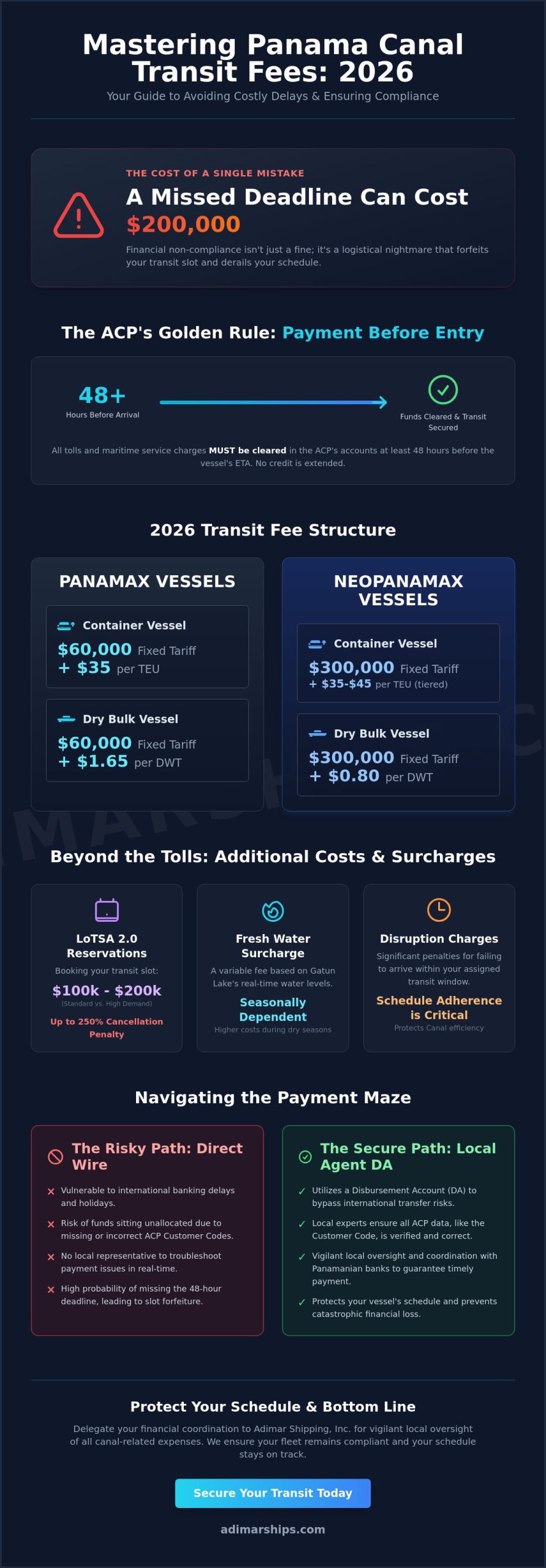
Failing to meet these payment deadlines carries severe operational consequences. The ACP requires that all tolls and maritime service charges be cleared at least 48 hours before the vessel’s estimated time of arrival (ETA) at canal waters. If funds aren’t verified by this deadline, you risk the immediate forfeiture of your transit slot. Since Neopanamax reservation fees in 2026 can range from $100,000 to $200,000, a simple banking delay becomes a massive financial loss. Beyond slot loss, the ACP may impose administrative fines for non-compliance with financial declarations.
The Pre-Payment Mandate for 2026
The ACP’s financial system is built on predictability and zero-risk. Every panama canal transit fees payment is tied to a unique “Customer Code” that identifies your vessel within the ACP’s database. This alphanumeric code is critical; if a wire transfer arrives without it, the funds may sit unallocated while your transit window closes. It’s vital to account for international banking holidays and weekend cut-off times in both the origin country and Panama. We’ve seen many operators face delays simply because they didn’t account for the Friday afternoon processing lag in local Panamanian banks.
VUMPA and the Digital Payment Landscape
Modern transit management relies on the Maritime Single Window, known as VUMPA. This digital portal integrates your vessel’s technical data with its financial requirements to calculate tolls in real-time. To maintain compliance, operators must upload accurate dimensions and cargo specifications before the payment window closes. Any discrepancy between your VUMPA declaration and the actual vessel measurements can lead to payment rejections or additional surcharges. VUMPA serves as the primary interface for all Canal-related financial data.
Breakdown of Key Fee Components: More Than Just Tolls
Calculating your panama canal transit fees payment requires looking far beyond the base toll. While the Official Panama Canal Tariffs provide a starting point, the final invoice is a composite of fixed costs, variable surcharges, and operational service fees. As of 2026, the ACP has simplified rate categories to increase transparency, but the financial stakes remain high for every transit. Understanding how these layers interact is the only way to avoid unexpected budget overruns.
The fixed component depends strictly on vessel size and the locks used. For a Panamax container vessel, you’ll encounter a $60,000 fixed tariff plus $35 per TEU. Neopanamax vessels face a steeper base of $300,000. For these larger ships, TEU rates vary between $35 and $45 depending on whether the vessel carries more or less than 10,000 TEUs. Dry bulk operators see similar structures; Panamax dry bulk ships pay $60,000 plus $1.65 per DWT, while Neopanamax dry bulk ships pay $300,000 plus $0.80 per DWT.
Securing a specific transit date adds another layer of cost through the LoTSA 2.0 reservation system. Standard Neopanamax bookings cost $100,000, though high-demand periods or last-minute requests can drive this to $200,000. Cancellation penalties are particularly steep, sometimes reaching 250% of the original fee. These aren’t just numbers; they’re operational triggers that require precise timing and financial coordination to protect your margins.
Variable Surcharges and Environmental Factors
Gatun Lake levels directly influence your final bill through the Fresh Water Surcharge. This variable component adjusts based on real-time water availability in the canal’s watershed. During periods of lower rainfall, these costs climb, making seasonal weather patterns a critical factor in your panama canal transit fees payment planning. Additionally, the ACP enforces “Disruption Charges” for vessels that fail to arrive within their assigned window, which can significantly inflate costs if your schedule slips due to technical or logistical issues.
Operational Service Fees
Beyond tolls, you’ll pay for the physical labor and equipment that moves your ship through the Isthmus. This includes mandatory pilotage, tugboat assistance, and the line handlers who secure your vessel in the locks. Security fees and PCSOPEP compliance add further layers to the invoice. To simplify these logistics, many operators choose to bundle these costs with husbandry services into a single disbursement account. This approach provides a clearer financial overview and reduces the administrative burden on your team. If you’re looking for a partner to manage these complexities with local expertise, our team can help ensure every fee is accounted for before your vessel reaches the locks.
Payment Methods and the Role of the Local Ship Agent
Managing international banking requirements presents significant risks when your vessel is approaching the Isthmus. While the ACP allows for direct wire transfers, this method often creates a dangerous bottleneck for ship operators. A direct panama canal transit fees payment relies on the perfect synchronization of global banking networks and the ACP’s internal verification systems. If a wire transfer is delayed by a single day or held for routine compliance checks, your vessel loses its transit slot. We act as your vigilant representative on the ground, ensuring that financial friction never dictates your operational schedule.
The most secure way to handle these transactions is through a Disbursement Account (DA) managed by a local ship agent. By utilizing a DA, you consolidate tolls, reservation fees, and ancillary costs into a single, managed fund. This structure allows the agent to provide local bank guarantees that the ACP recognizes instantly. Understanding the history of the Panama Canal reveals how its governance has always prioritized strict, predictable operational flow. Today, that predictability is maintained through these rigorous financial protocols that favor local agency coordination.
Why Direct Payment Often Leads to Delays
The gap between “sent” and “cleared” funds is where many transits fail. Even if your bank confirms the transfer, the ACP won’t schedule the vessel until the funds are fully visible in their specific accounts. Common errors in SWIFT instructions, such as an omitted Customer Code or a typo in the vessel name, can cause funds to be rejected or lost in suspense accounts. A local agent eliminates this risk by providing immediate financial clearance. We can often resolve pending wire issues through our established relationships with Panamanian banks, keeping your transit on track even when international wires are lagging.
The Efficiency of the Nominated Agency Model
Consolidating your financial obligations simplifies the entire transit process. By appointing an Owner’s Nominated Agency, you gain a partner who oversees every dollar spent, from the primary panama canal transit fees payment to minor husbandry expenses. This model provides superior financial oversight and protects the owner’s interests against inflated third-party costs. Our “Local Office” advantage means we can resolve billing disputes in real-time at the ACP Administration Building. Instead of waiting days for an email response from a centralized bureau, we handle discrepancies on the spot. This level of transparency ensures that your final disbursement account is audited, accurate, and free of hidden surcharges.
Step-by-Step: Managing the Transit Fee Payment Process
Executing a panama canal transit fees payment requires a disciplined sequence of actions to ensure your vessel meets the strict ACP 48-hour deadline. This isn’t a simple bank transfer; it’s a multi-stage verification process where accuracy is the only safeguard against slot forfeiture. By following a standardized workflow, you eliminate the financial friction that often delays international shipping operations. Our role is to guide you through each milestone with the precision of a local expert.
- Step 1: Requesting a Pro-Forma Disbursement Account (PDA). Your agent generates this comprehensive estimate based on your vessel’s specific dimensions, cargo type, and requested transit date.
- Step 2: Verifying the ACP Customer Code and Dimensions. We cross-reference your vessel’s data against the VUMPA system. For Neopanamax vessels, ensuring your Length Overall (LOA) stays within the 366.14-meter limit is vital for accurate toll calculation.
- Step 3: Remitting Funds. You transfer the estimated amount to our secure operating account. This must happen early enough to clear before the ACP’s cut-off window.
- Step 4: Issuing the Guaranty of Payment. Once funds are cleared, we provide the ACP with a formal guaranty. This is the critical trigger that confirms your transit slot in the LoTSA 2.0 system.
- Step 5: Final Reconciliation. After the transit, we audit the actual costs for tugs, pilots, and water usage to produce the Final Disbursement Account (FDA).
The Pro-Forma Phase: Accuracy Matters
The PDA serves as your financial blueprint for the transit. While it provides a reliable estimate, the final cost can shift based on variable factors like the Fresh Water Surcharge or last-minute tug requirements. We review every PDA to identify potential missing service requirements or hidden costs that could stall your voyage. The PDA must be funded in full before an agent can confirm a transit slot. This upfront funding ensures that we have the immediate liquidity needed to satisfy ACP demands and secure your position in the queue without hesitation.
Post-Transit Reconciliation
The financial process doesn’t end when your vessel exits the locks. The ACP calculates the actual usage of resources, including the number of locomotives and the precise volume of water displaced during your transit. Typically, you’ll receive the final invoice and any surplus fund refunds within a few weeks of completion. Detailed reporting is essential during this phase, especially for charterers and owners who need to share costs accurately. If you need a partner to manage this entire financial workflow with absolute transparency, our ship agency services provide the local oversight necessary to protect your interests from start to finish.
Why Adimar Shipping, Inc. is Your Trusted Partner for Canal Payments
Managing the financial intricacies of a panama canal transit fees payment shouldn’t compromise your operational focus. In 2026, the transition to LoTSA 2.0 and the volatility of variable surcharges make local expertise a necessity rather than a luxury. Adimar Shipping, Inc. provides the personalized financial coordination required to eliminate the friction between your accounts and the ACP. By delegating these specialized tasks to our team, you gain the peace of mind that comes from knowing every detail is handled by a regional specialist.
Our history in Panama Canal transit logistics allows us to anticipate challenges before they impact your schedule. We recognize that each vessel has specific requirements, whether you’re operating a Neopanamax container ship or a Panamax dry bulk carrier. Adimar Shipping, Inc. remains committed to the highest ethical standards in every transaction. We provide transparent, line-item reporting that leaves no room for ambiguity, serving as a vigilant extension of your own team in Panama.
Our “Vigilant” Approach to Financial Management
We maintain a constant watch over the ACP’s financial landscape to safeguard your bottom line. Our team monitors tariff adjustments and environmental surcharges in real-time to provide the most accurate Pro-Forma Disbursement Accounts possible. This vigilant oversight prevents the “sticker shock” that often occurs when variable fees like the Fresh Water Surcharge fluctuate unexpectedly. Every dollar you remit is accounted for through audited documentation, ensuring your panama canal transit fees payment is processed with absolute precision. If you require comprehensive support beyond financial management, we invite you to explore our full range of ship agency Panama services.
Ready for a Seamless Transit?
Timing is the most critical factor in a successful canal passage. Adimar Shipping, Inc. is equipped to handle urgent transit requirements and last-minute booking changes, navigating the administrative hurdles so your vessel doesn’t have to wait at the anchorage. Our proactive communication ensures you’re never left wondering about the status of your funds or your transit slot. We resolve potential banking issues before they become operational delays, providing the security you need for a smooth voyage. Get a quote for your next Panama Canal transit and let our local experts manage the financial details of your crossing with confidence.
Securing Your Fleet’s Financial Compliance in 2026
Successful transit management requires more than just capital; it demands precise timing and local foresight. As we’ve explored, the 48 hour pre-payment window and the nuances of LoTSA 2.0 leave no room for banking errors. Moving away from the risks of direct wire transfers and embracing the transparency of a managed Disbursement Account is the most effective way to protect your vessel’s schedule. A timely panama canal transit fees payment serves as the final bridge between your voyage planning and a successful crossing.
Adimar Shipping, Inc. stands ready as your vigilant representative in Panama City. With over 20 years of local expertise, we provide specialized Owner and Charterer representation that ensures your interests are protected at every lock. As an authorized PCSOPEP representative, we offer the technical and financial oversight necessary for a seamless passage through the Isthmus. Request a Pro-Forma Disbursement Account from Adimar Shipping, Inc. to secure your 2026 transit slot with a partner you can trust. We look forward to ensuring your fleet moves with efficiency and absolute compliance.
Frequently Asked Questions
Can I pay Panama Canal fees in currencies other than USD?
No, the Panama Canal Authority (ACP) strictly accepts payments in United States Dollars (USD). While your bank may initiate a transfer from an account in another currency, the final amount arriving in the ACP’s account must be the exact net amount in USD. You must also account for all intermediary bank fees to ensure the payment isn’t short, as even a small discrepancy can stall your transit clearance. We recommend using a local agent to manage these conversions and ensure your funds arrive exactly as required.
What happens if my payment does not clear before the vessel arrives at the Canal?
If your panama canal transit fees payment hasn’t cleared at least 48 hours before your arrival, the ACP will not schedule your vessel for transit. This leads to the immediate forfeiture of your reserved slot and the potential loss of your reservation fee, which can range from $100,000 to $200,000. Your ship will be forced to wait at the anchorage until the funds are verified, incurring significant daily operational costs and disrupting your entire delivery schedule.
Are there different fees for Panamax vs. Neo-Panamax vessels in 2026?
Yes, the 2026 fee structure maintains distinct categories for Panamax and Neopanamax vessels based on the locks they utilize. Panamax ships are subject to a fixed tariff of $60,000 plus variable charges based on TEU or deadweight tonnage. Neopanamax vessels face a much higher fixed base of $300,000. These rates reflect the increased infrastructure costs and water volume required for the larger Neopanamax locks, ensuring the canal remains a sustainable route for global trade.
How is the Fresh Water Surcharge calculated for a standard transit?
The Fresh Water Surcharge is calculated as a fixed fee plus a variable percentage that depends on the daily water levels of Gatun Lake. When rainfall is low and lake levels drop, the variable component increases to manage the canal’s watershed resources. Our team provides real-time estimates in your Pro-Forma Disbursement Account to help you anticipate these seasonal fluctuations and ensure your panama canal transit fees payment covers the total cost accurately.
Is it possible to get a refund if a transit is cancelled?
Refunds are possible, but they are subject to the ACP’s strict cancellation schedule and heavy penalties. Depending on how close to the transit date you cancel, these penalties can reach as high as 250% of the original reservation fee. Once the ACP processes the cancellation and deducts the applicable fines, any remaining balance is typically returned through your ship agent after the final audit of the disbursement account is finished.
Does the Panama Canal Authority accept credit card payments for commercial vessels?
No, the ACP does not accept credit card payments for commercial vessel transits. All commercial payments must be made via international wire transfer or through a local bank guarantee provided by an authorized ship agent. Credit cards are generally reserved for small, non-commercial craft and private yachts. For professional ship operators, the Disbursement Account model is the only recognized and secure method for ensuring financial compliance.
How does an agent provide a bank guarantee for my ship?
A local ship agent provides a bank guarantee by leveraging their established credit lines and local accounts within the Panamanian banking system. This document serves as a formal financial promise to the ACP that all tolls and maritime fees will be covered in full. This allows your vessel to clear for transit even if your international wire is still processing, providing a vital safety net against the delays often associated with global banking networks.
What are the additional costs for a PCSOPEP authorized person?
The cost for a PCSOPEP authorized person is a professional service fee for mandated oil spill response representation in Panama. Every vessel over 400 gross tons must have an authorized person on the ground to coordinate with the ACP in the event of an environmental incident. This fee covers the administrative readiness and legal representation required to comply with Panama Canal maritime regulations, ensuring your vessel meets all “Canal-ready” standards before arrival.