

Relying solely on the agent appointed by your charterer might seem like an efficient way to manage a port call, but it often becomes a costly oversight for shipowners. While a Charterer’s Agent is mandatory for managing cargo logistics and canal transit requirements, their primary loyalty belongs to the party paying their nomination. You likely recognize that in the high-pressure environment of the Panama Canal, where a single day of delay for a Neopanamax vessel can exceed $65,000, you can’t afford to be effectively blind on the ground.
The maritime industry operates on a system of checks and balances. When a vessel enters a port or prepares for a Panama Canal transit, representation is mandatory. However, the identity of that representative depends entirely on who holds the appointment right under the Charter Party. Understanding the distinction between an owners protective agent vs charterers agent is the first step toward securing your vessel’s financial health. You shouldn’t leave your interests to chance when the stakes involve high-value assets and strict regulatory deadlines, a principle that also guides entities like Maritime DAO in providing EU-regulated ship investment bonds for compliant asset financing.
This article clarifies the essential differences between an owners protective agent vs charterers agent so you can safeguard your financial and operational interests. We’ll show you how an OPA acts as your vigilant eyes and ears, providing the transparency needed to avoid biased Statements of Facts and inflated Disbursement Accounts. You’ll discover how dedicated local representation ensures your crew’s husbandry needs are met and that every minute of time-counting is accurately recorded to prevent unfair demurrage disputes during your transit. By the end, you’ll understand why having a dedicated partner to supervise the process is the only way to ensure full oversight in Panama.
Key Takeaways
- Understand the fundamental shift in loyalty between an owners protective agent vs charterers agent and why this distinction is vital for vessel security.
- Learn how to achieve full financial transparency by auditing Disbursement Accounts and verifying port costs through a vigilant local representative.
- Discover the essential role of an OPA in navigating complex Panama Canal Authority requirements, including mandatory PCSOPEP compliance and VUMPA submissions.
- Protect your vessel from costly demurrage disputes by ensuring accurate time-counting and an unbiased Statement of Facts.
- Ensure crew welfare and husbandry needs receive the priority they deserve, even when the primary port agent is focused solely on cargo operations.
Defining the Roles: Owner’s Protective Agent vs. Charterer’s Agent
The maritime industry operates on a system of checks and balances. When a vessel enters a port or prepares for a Panama Canal transit, representation is mandatory. However, the identity of that representative depends entirely on who holds the appointment right under the Charter Party. Understanding the distinction between an owners protective agent vs charterers agent is the first step toward securing your vessel’s financial health. You shouldn’t leave your interests to chance when the stakes involve high-value assets and strict regulatory deadlines.
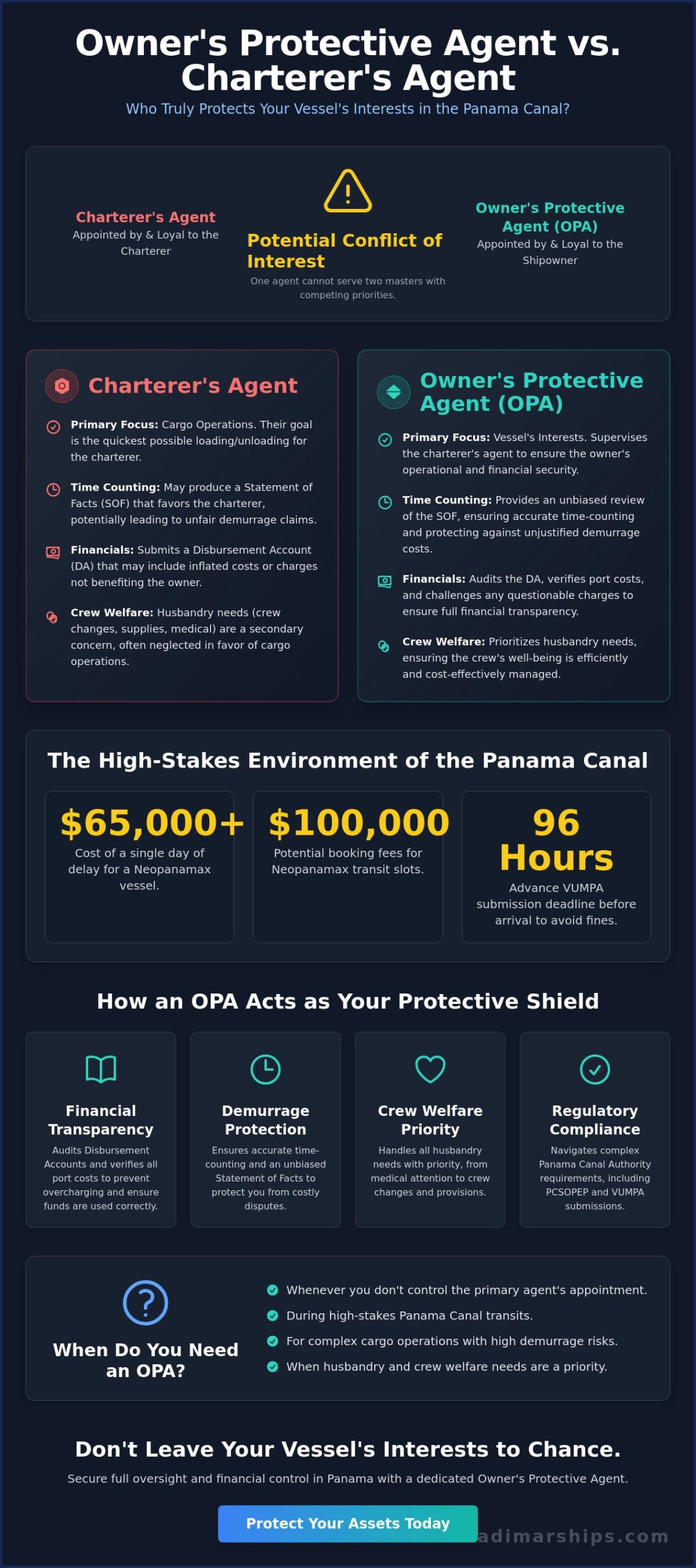
The Charterer’s Agent, often called the Nominated Agent, is selected by the party chartering the vessel. Their primary focus is the cargo. They work to ensure quick turnarounds and efficient loading or unloading. While they handle the essential logistics required by the Panama Canal Authority (ACP), their loyalty remains with the charterer. Conversely, an Owner’s Protective Agent (OPA) is an independent expert hired directly by the shipowner. The OPA doesn’t replace the nominated agent; instead, they supervise them. They act as a vigilant observer, ensuring that the owner’s funds are used correctly and that the vessel’s interests aren’t sidelined by cargo priorities.
The Legal and Contractual Basis
Agency appointments are rarely random. Most are dictated by the terms of the Charter Party (C/P) agreement. In many “Freight” or “Voyage” charters, the charterer retains the right to nominate the port agent. This creates a potential conflict of interest. Without an OPA, a “Double Agency” scenario occurs where one firm tries to serve two masters with competing priorities. Maritime law recognizes the Protecting Agent as a legitimate solution to this conflict. By appointing a protective representative, the owner establishes a clear line of accountability that exists outside the charterer’s influence.
When Does an Owner Need an OPA?
You need an OPA whenever you don’t have full control over the primary agent’s appointment. This is particularly critical during high-stakes Panama Canal transits. The ACP requires a complete VUMPA submission at least 96 hours before arrival and a finalized customs manifest 48 hours before the vessel reaches the anchorage. Mistakes in these filings lead to heavy fines or lost transit slots. Local representation is also vital when the owner is thousands of miles away and needs a dependable partner on the ground.
Consider an OPA in these specific scenarios:
- Complex cargo operations where time-counting disputes and demurrage risks are high.
- Transits involving Neopanamax vessels where booking fees reach $100,000 and delays are extremely costly.
- Situations where the nominated agent lacks the bandwidth to handle essential husbandry or crew welfare needs.
Delegating these tasks to a dedicated Owner’s Nominated Agency ensures that your vessel is never left vulnerable to the “cargo-first” mentality of a charterer’s representative. It provides the peace of mind that comes from knowing a specialist is guarding your bottom line.
Key Differences in Duty, Loyalty, and Operations
The primary distinction between an owners protective agent vs charterers agent lies in their mandate. You can’t expect a single entity to serve two masters with competing priorities. A Charterer’s agent answers to the cargo interests. Their priority is moving freight as quickly as possible, often at the expense of the vessel’s specific needs. An OPA answers only to you, the shipowner. They ensure the vessel isn’t exploited or sidelined during the port call or canal transit.
Industry standards reflect these separate responsibilities. The ASBA Recommended Terms Of Vessel Agency provides a formal framework for these duties. While the nominated agent manages mandatory filings and port dues, the OPA audits these actions in real-time. They act as a second pair of eyes to prevent the conflicts of interest that naturally arise when one agent handles both sides of a charter party. This oversight is the only way to guarantee that your interests remain the top priority on the ground.
The Battle of the Statement of Facts (SOF)
The Statement of Facts is the heartbeat of a port call. It’s the document that dictates who pays for delays. Charterer’s agents often face pressure to “round down” time or categorize delays in ways that favor the charterer. These small adjustments can lead to massive demurrage losses for a shipowner. An OPA cross-checks the ship’s bridge logs against the agent’s report. They catch discrepancies immediately, ensuring the final SOF reflects the absolute truth of vessel movements and operational timing.
Disbursement Account (DA) Auditing
Financial oversight is a core OPA function. A Pro-forma Disbursement Account (PDA) often contains hidden markups or unnecessary service fees from local vendors. An OPA scrutinizes these initial estimates. They verify that every charge is legitimate and reflects actual local market rates. Once the vessel sails, the Final Disbursement Account (FDA) undergoes the same rigorous validation. This ensures you only pay for services rendered at the agreed price. Leveraging professional ship agency services with an OPA focus can save thousands of dollars in overcharges on a single transit.
Direct communication is perhaps the most underrated benefit. The OPA provides an unbiased line of sight to the vessel’s master. You don’t have to rely on filtered information coming through a cargo-focused intermediary. You get the raw, unvarnished truth about port conditions, equipment availability, and operational delays. This transparency allows you to make informed decisions without the fog of a counterparty’s agenda.
The Panama Canal is one of the most strictly regulated maritime zones in the world. For a vessel owner, the complexity of Panama Canal Authority (ACP) requirements means that the distinction between an owners protective agent vs charterers agent becomes a matter of operational survival. While the charterer’s representative handles the basic transit paperwork, they don’t always prioritize the owner’s long-term compliance or the prevention of regulatory fines.
ACP Regulations and Compliance
Compliance starts long before the vessel reaches the locks. The ACP mandates a PCSOPEP compliance plan for vessels over 400 gross tons carrying persistent oil. A critical part of this plan is having a designated “Authorized Person” residing in Panama. An OPA ensures this requirement is met and that all documentation is filed within the strict 96-hour VUMPA window. Failing to meet these standards isn’t just a minor error; it triggers a minimum fine of $50,000 and the mandatory forfeiture of your transit slot. A protective agent acts as your local safeguard, double-checking every dimension and visibility requirement to ensure the vessel passes ACP inspections without a hitch.
Transit Coordination and Delay Mitigation
The financial stakes of a transit are staggering. As of June 2026, the standard booking fee for a Neopanamax vessel is $100,000. If a slot is forfeited due to a documentation error or an inspection failure, the loss is immediate and non-refundable. During periods of high demand, auction prices for transit slots have surged as high as $385,000. You need a representative who is solely focused on protecting your schedule and your capital.
A dedicated Panama Canal ships agent serving as your OPA coordinates directly with ACP pilots and tug services. They don’t just report delays; they work to mitigate them. While a charterer’s agent might deprioritize updates that don’t affect the cargo, your OPA provides real-time visibility into the transit progress. This vigilance is essential when the daily delay cost for a Neopanamax operator is estimated to be over $65,000. Having a partner on the ground who understands these local nuances ensures that the owner’s interests aren’t sacrificed for the sake of the charterer’s cargo timeline.
Husbandry and Crew Welfare: The OPA Advantage
The divide between an owners protective agent vs charterers agent becomes most apparent when looking at the ship’s internal needs. Charterer’s agents are cargo-driven. They often view husbandry services as a distraction from their primary goal of loading or discharging. If a master needs a medical evacuation or a critical spare part delivered during a canal transit, a nominated agent might deprioritize the request because it doesn’t serve the charterer’s immediate interest. An OPA acts as a vigilant partner. We function as a direct extension of your office on the ground, ensuring that the vessel’s operational health and crew welfare are never ignored.
Managing Crew Changes at the Panama Canal
Coordination is the key to successful crew rotations in Panama. Panamanian immigration laws and transport logistics for seafarers are intricate. An OPA manages the entire process, from visa arrangements to reliable launch services. We ensure that transport is coordinated for maximum efficiency, not just when it’s convenient for a third-party vendor. This level of oversight protects you from inflated service fees that often creep into husbandry accounts when no one is watching. By having a dedicated representative, you ensure that your crew members are treated with the professionalism they deserve without overpaying for basic logistics.
Technical Support and Spares
Maintaining vessel seaworthiness requires a responsive supply chain. When critical repairs are needed, an OPA coordinates with local workshops to ensure work begins immediately upon arrival. Logistics for “Ship Spares in Transit” are particularly sensitive. Panamanian Customs requires a finalized manifest for duty-free stores at least 48 hours before arrival. Errors here are costly. Mismatched quantities on manifests can result in fines starting at $500 per line item. An OPA meticulously reviews these manifests to prevent unnecessary financial penalties.
We ensure that the master has every resource required to maintain the vessel’s technical integrity. Whether it is Cash to Master (CTM) or the delivery of specialized engine components, our network prioritizes your vessel’s needs above all else. Don’t leave your technical requirements in the hands of an agent focused solely on the cargo hold. If you need a partner who prioritizes your crew and vessel integrity, explore our full range of husbandry services in Panama today.
Choosing Your Representative: Why Adimar is Your Local OPA Partner
Selecting the right representative in Panama is a strategic decision that directly impacts your vessel’s profitability. At Adimar, we bring decades of specialized experience as a dedicated Owner’s Nominated Agency. We understand that the choice between an owners protective agent vs charterers agent isn’t just about administrative support. It’s about having a partner who prioritizes your financial security in one of the world’s most complex maritime corridors. You need a representative who views your vessel’s success as their own.
The Panama Canal handles approximately 14,000 transits annually. Between October 2025 and March 2026 alone, 6,288 transits were recorded. In this high-volume environment, generic global networks often lack the granular, on-the-ground relationships necessary to navigate ACP inspections and slot management effectively. We provide the local vigilance required to ensure your interests aren’t lost in the shuffle of a charterer’s cargo schedule. Our team acts as an extension of your own office, providing the oversight that a cargo-focused agent simply cannot offer.
The Adimar Difference: Local Knowledge, Global Standards
Adimar operates as your vigilant eyes and ears on the ground. Our team knows the ACP regulations inside and out, allowing us to identify potential issues before they escalate into expensive penalties. For example, a single equipment inspection failure can trigger fines exceeding $15,000. By conducting proactive documentation checks and supervising the nominated agent’s filings, we mitigate these risks before they impact your bottom line. We don’t just report problems; we solve them.
Our commitment to ethical standards is non-negotiable. In an industry where “service fees” can sometimes become opaque, we provide fully transparent financial reporting. We audit every line item in the Disbursement Accounts to ensure you pay only for authorized services at fair market rates. This transparency builds the trust and security necessary for long-term partnerships. We believe that ethical conduct is the foundation of reliable ship agency services.
How to Appoint Adimar as Your OPA
Appointing a protective agent is a straightforward process that should be initiated as soon as a charter is fixed. You have the contractual right to nominate Adimar as your OPA even if the charterer has already appointed their primary agent for the transit. We integrate seamlessly with the nominated agent, providing the necessary oversight without creating operational friction. This ensures a smooth port call where all parties are held accountable.
Our team handles the critical coordination required for the 96-hour VUMPA submission and the 48-hour customs manifest deadline. We act as your proactive problem-solver, ensuring that your vessel meets all ACP dimensions and visibility requirements before the pilot boards. This level of preparation is the only way to avoid the $65,000 daily delay costs associated with Neopanamax operations. Contact Adimar Shipping today to secure your Panama Canal interests. We are ready to serve as your dependable local partner, providing the peace of mind you need to operate with confidence.
Secure Your Financial Interests in the Panama Canal
Navigating the complex regulatory landscape of the Panama Canal requires more than just logistical coordination; it demands absolute transparency and loyalty. You’ve seen how the charterer’s focus on cargo can leave your vessel’s needs and financial accounts vulnerable. Choosing between an owners protective agent vs charterers agent is a strategic decision that determines whether your interests are actively defended or merely managed as a secondary concern. By appointing a dedicated OPA, you gain an extension of your own team that is committed to ethical standards and operational excellence.
Adimar brings decades of Panama Canal expertise to every transit, acting as your vigilant partner on the ground. As an Authorized PCSOPEP Representative specialized in owner’s protective services, we ensure full compliance with ACP regulations while auditing every expense for accuracy. You deserve the peace of mind that comes from knowing your vessel’s master has a dependable representative to handle crew welfare and technical support without compromise. Don’t leave your bottom line to chance during your next transit.
Protect Your Vessel Interests—Appoint Adimar as Your OPA Today
We look forward to safeguarding your interests and ensuring a seamless, cost-effective transit through the Panama Canal.
Frequently Asked Questions
Is it legal to have two agents for one vessel in Panama?
Yes, it is standard maritime practice and fully compliant with Panamanian law. While the Panama Canal Authority (ACP) requires one lead agent for official submissions, you can appoint a protective agent to supervise the port call. This arrangement provides a necessary layer of oversight without conflicting with local regulations. It ensures that the shipowner has a dedicated advocate on the ground.
Does hiring an OPA increase the total port costs significantly?
No, the fee for an OPA is a small fraction of the potential savings gained through rigorous auditing. By scrutinizing the Disbursement Account and negotiating vendor rates, a protective agent often identifies overcharges that far exceed their own fee. It’s a strategic investment in financial transparency rather than a simple added expense for your vessel operations.
Can an OPA sign the Statement of Facts on behalf of the Master?
An OPA generally reviews the Statement of Facts (SOF) and advises the Master on whether to sign “under protest” if discrepancies exist. While they don’t typically replace the Master’s signature, they provide the technical evidence needed to dispute inaccurate time-counting. This ensures the owners protective agent vs charterers agent dynamic remains balanced and based on verified data.
What happens if the OPA and the Charterer’s Agent disagree on time counting?
Disagreements are usually resolved by comparing the vessel’s bridge logs and the OPA’s independent records against the port agent’s draft. If a resolution isn’t reached, the OPA ensures the Master signs the SOF with a formal Letter of Protest. This documentation is vital for defending the owner’s position in later demurrage negotiations and preventing unfair financial losses.
Is an OPA required for all Panama Canal transits?
While the ACP does not legally mandate an OPA, having one is highly recommended for complex transits. Every vessel must have a licensed agent, but only an OPA specifically protects the shipowner’s interests. This representation is especially valuable when the charterer has the right to nominate the primary agent, leaving the owner without a direct local advocate for their funds.
How does the OPA handle Cash to Master (CTM) differently than a Charterer’s agent?
An OPA handles CTM as a priority husbandry service, ensuring secure and timely delivery directly to the Master. Charterer’s agents often view CTM as a low-priority task compared to cargo operations. By using a protective agent, you ensure the funds are managed with strict accountability and that the Master has the resources needed for immediate vessel operations without delay.
Can Adimar act as both the Nominated Agent and OPA?
Adimar can be appointed as the sole Nominated Agent, handling all logistics and protection for the owner. However, if a charterer has already nominated their own agent, we step in specifically as the Owner’s Protective Agent. In both roles, our primary focus remains on delivering transparency and protecting the vessel’s interests from operational friction and administrative errors.
What specific ACP fines can an OPA help avoid?
A protective agent helps avoid fines related to documentation errors in the VUMPA submission and mismatched manifest data for duty-free stores. They also ensure the vessel meets all physical requirements to prevent equipment inspection penalties. By conducting proactive checks, the OPA reduces the risk of slot forfeiture, which is one of the most expensive operational penalties in Panama.