

Would you gamble $4 million on a single transit slot without a local expert at your side? With auction prices for the Panama Canal reaching record highs in early 2026, the financial margin for error has vanished. You’re likely focused on protecting your bottom line while maintaining a tight schedule; yet, the complexities of the new LoTSA 2.5 allocation program and machine-validated VUMPA filings make the process more volatile than ever. While the idea of direct oversight might seem like a way to cut costs, the actual challenges of self-managing Panama Canal transit often result in expensive delays and regulatory friction.
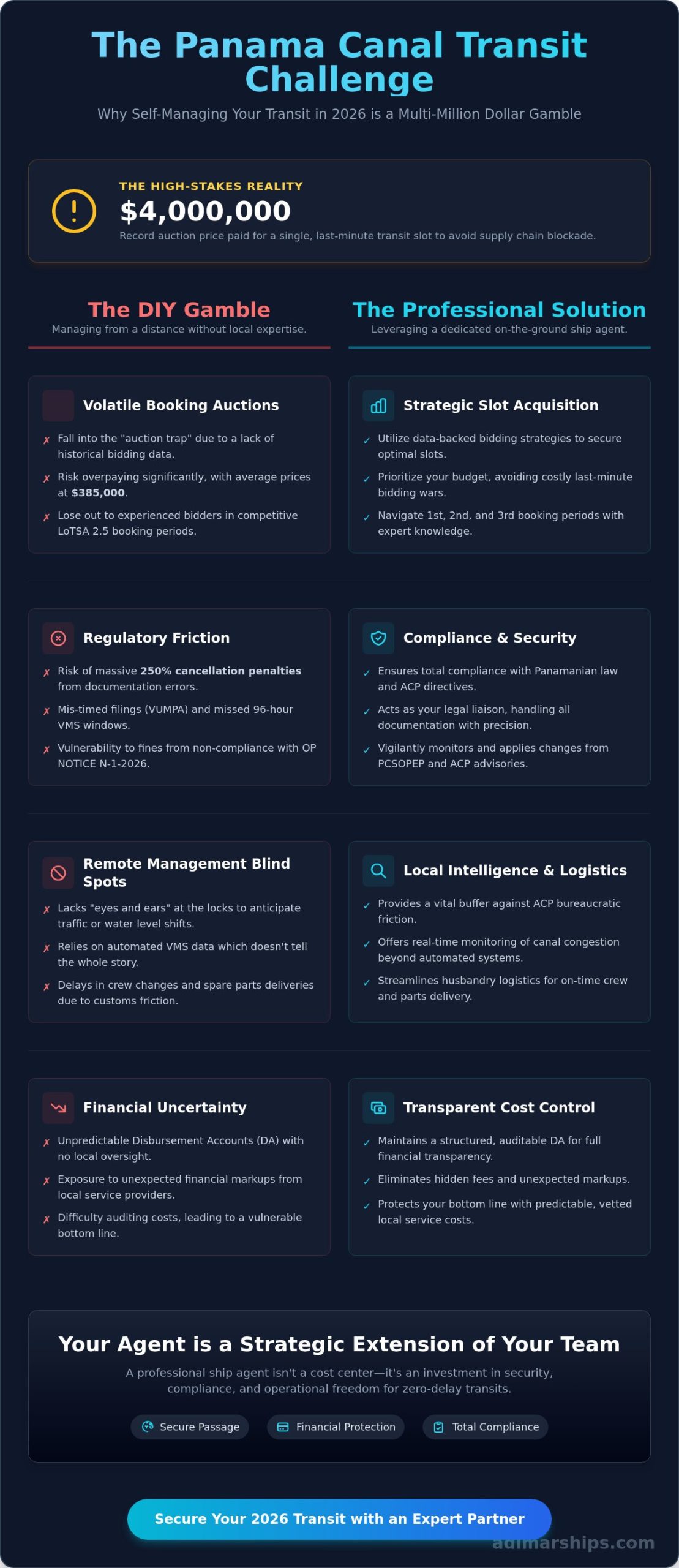
We understand the pressure to keep disbursement accounts predictable and avoid the 250% cancellation penalties that stem from simple documentation errors. This strategic risk assessment identifies the critical financial and operational pitfalls of DIY transit management and shows how a dedicated ship agent secures your passage. We’ll explore the impact of OP NOTICE TO SHIPPING N-1-2026, the necessity of PCSOPEP compliance, and the local intelligence required to achieve zero-delay transits. Discover how delegating these specialized tasks to a regional expert provides the security and operational freedom your fleet requires.
Key Takeaways
- Recognize why the Panama Canal’s specialized regulatory framework requires more than standard port management to prevent operational friction.
- Navigate the challenges of self-managing Panama Canal transit by mastering the 96-hour VMS filing window and the competitive 2026 booking auction cycles.
- Protect your bottom line by using a structured Disbursement Account (DA) to audit local service costs and eliminate unexpected financial markups.
- Streamline husbandry logistics to ensure crew changes and spare parts deliveries happen in sync with your transit schedule rather than being delayed by local customs.
- See how a strategic ship agency in Panama serves as a vigilant extension of your operations team to maintain compliance and security.
The High-Stakes Gamble: Why Self-Managing Panama Canal Transit Fails
Attempting to bypass a professional agent in favor of a DIY approach might look like a cost-saving measure on a spreadsheet. In reality, it’s a high-stakes gamble with your vessel’s schedule and your company’s capital. The Panama Canal operates under a unique set of logistical and regulatory pressures that don’t exist in standard deep-water ports. Managing these variables from a foreign headquarters often leads to the very delays you’re trying to avoid. A ship agent functions as a strategic extension of your operations team, providing the immediate, on-the-ground presence required to handle the challenges of self-managing Panama Canal transit.
Remote management can’t replace local intelligence. While your HQ team is expert at global logistics, they lack the “eyes and ears” at the locks to anticipate sudden shifts in traffic or water levels. We act as a vital buffer against Panama Canal Authority (ACP) bureaucratic friction. Without a local representative to smooth over communication gaps, a minor paperwork error can quickly escalate into a multi-day delay or a six-figure fine. Our presence ensures that your interests are protected even when you aren’t physically in the zone.
The Legal and Operational Liaison
Operating in Panama requires more than just a transit slot; it requires total compliance with Panamanian maritime law and ACP directives. DIY operators often mis-time their official transit clearance, leading to missed windows and massive demurrage. Our role involves:
- Managing the precise timing of inbound and outbound clearance to ensure your vessel stays on schedule.
- Handling all legal requirements for passage, ensuring every document meets strict local standards.
- Acting as your primary communicator for urgent ACP advisories, traffic updates, and safety notices that automated systems might miss.
Local Intelligence vs. Automated Data
Digital dashboards offer a snapshot, but they rarely tell the whole story. Real-time monitoring of canal congestion goes far beyond what the Vessel Monitoring System (VMS) shows. Local intelligence is the only way to navigate the challenges of self-managing Panama Canal transit effectively. We provide “local eyes” on critical factors like fluctuating water levels and the actual, minute-by-minute availability of transit slots. We ensure your vessel remains fully compliant with the latest Panama Canal transit regulations, including the rigorous environmental standards introduced in the OP NOTICE TO SHIPPING N-1-2026. This vigilance protects your fleet from being sidelined by regulatory changes you didn’t see coming.
Navigating the 2026 Booking Auction: The DIY Pitfalls
Precision timing is the difference between a successful passage and a financial disaster. In 2026, the booking environment has become increasingly volatile. The introduction of the Enhanced Long-Term Slot Allocation program (LoTSA 2.5) means that transit windows are more competitive than ever. For those attempting to handle logistics from afar, the challenges of self-managing Panama Canal transit start with the high-stakes auction system. Without access to historical bidding data, DIY operators often fall into the “auction trap.” They either overpay significantly for a slot or, worse, lose out to more experienced bidders who understand the nuances of the 1st, 2nd, and 3rd booking periods.
The financial stakes are staggering. In March and April 2026, average auction prices surged to $385,000. Some desperate operators have paid as much as $4 million for last-minute slots to avoid the blockade of global trade routes. Managing these bids requires more than a fast internet connection; it requires a strategic understanding of Panama Canal Authority regulations and real-time market demand. Partnering with a dedicated ship agency in Panama allows you to bypass these pitfalls through data-backed bidding strategies that prioritize your budget.
Even after securing a slot, the technical hurdles remain. The 96-hour VUMPA (Ventanilla Única Marítima de Panamá) filing deadline is a critical failure point for self-managed vessels. A single clerical error in this machine-validated system can trigger a 250% cancellation penalty on a $100,000 Neopanamax booking fee. We ensure that every data point is verified before submission, coordinating with pilots and tugs to align with your precise arrival time. This level of oversight eliminates “idle time” at the anchorage and ensures you don’t lose your hard-won slot due to a communication gap.
Mastering the ACP Auction System
Success in the auction system requires analyzing daily slot availability, which often fluctuates between three and five slots. We guide you through the transition between booking periods to maximize efficiency. If you miss a transit slot in the tight 2026 schedule, the ripple effect on your supply chain can be devastating. Our team acts as your advocate, ensuring your bid is competitive without being reckless.
The ‘Maiden Transit’ and Dimension Compliance
Vessels passing through the canal for the first time face even stricter scrutiny. We verify vessel dimensions against ACP requirements, such as the 51.25-meter beam limit for Neopanamax locks, before you reach the anchorage. This prevents last-minute rejections or fines related to equipment non-compliance under the OP NOTICE TO SHIPPING N-1-2026. By managing these specific protocols, we protect you from the unexpected costs that often plague first-time DIY transits.
Financial Transparency and the Disbursement Account (DA) Risk
Financial clarity is the backbone of a successful transit. For many operators, the Disbursement Account (DA) serves as a vital financial roadmap, outlining every cost from canal tolls to local husbandry fees. One of the primary challenges of self-managing Panama Canal transit is the fragmentation of these expenses. Without a centralized partner on the ground, you’re forced to manage dozens of individual invoices from disparate local vendors. This lack of oversight often leads to significant markups on local services, as vendors may charge premium rates to unrepresented foreign principals. We solve this by consolidating every expense into a single, transparent account, ensuring you pay only what is fair and documented.
Compliance adds another layer of financial risk that DIY operators frequently underestimate. The Panama Canal Authority requires every vessel to have a designated PCSOPEP compliance authorized person. This isn’t just a regulatory box to tick; it’s a financial safeguard. An authorized person ensures that in the event of an oil spill or environmental incident, the response is managed efficiently to mitigate astronomical costs and fines. Delegating this role to a professional agent protects your capital from the volatile liabilities associated with environmental accidents.
Managing Canal Tolls and Guarantees
We act as your financial guardian when dealing with the ACP. We handle the mechanics of paying transit guarantees to the ACP on your behalf, ensuring funds are cleared well before your vessel reaches the locks. Our team audits every ACP invoice to verify that tolls are calculated correctly based on your vessel’s actual dimensions and cargo status. For example, with Neopanamax tolls often reaching $840,000, even a small calculation error can be costly. We also manage ‘Cash to Master’ (CTM) requirements, delivering necessary funds to your crew without operational delays or security risks.
Owner’s Nominated vs. Protective Agency
Choosing an Owner’s Nominated Agency is a strategic move to protect your long-term assets. While a charterer might appoint their own agent to focus on cargo logistics, a Protective Agent (OPA) works exclusively for you. We oversee the charterer’s agent to ensure they aren’t inflating costs or neglecting vessel maintenance needs. Ethical standards in financial reporting are non-negotiable in Panama. We provide a level of transparency that ensures your funds are handled with integrity, protecting you from the hidden fees that often plague unmonitored accounts. This vigilant oversight provides the peace of mind that your interests are being defended on every level.
Husbandry and Logistics: The Cost of Missing Local Oversight
Logistics in the Canal Zone operate on a razor-thin margin. While securing a transit slot is a primary goal, maintaining that slot requires a perfectly synchronized support chain. One of the most overlooked challenges of self-managing Panama Canal transit is the coordination of husbandry tasks that must occur while the vessel is at anchorage or pier-side. If a crew member’s visa is delayed or a critical spare part is held up in Panamanian customs, the vessel risks missing its scheduled window. This leads to the massive cancellation penalties and “idle time” costs that can quickly drain an operation’s budget.
Managing crew changes without a local agent is a significant security and legal risk. We handle the complexities of visas and shore passes, ensuring seafarers move efficiently between the airport and the vessel. Without this oversight, you risk seafarers becoming “stray,” which triggers immediate fines and legal complications with Panamanian immigration authorities. Our team provides the local presence necessary to manage these movements, alongside coordinating medical assistance or emergency support for seafarers at anchorage. This level of care keeps your crew safe and your transit on track.
Vigilance at the Pier and Anchorage
Success requires a physical presence at both Pacific and Atlantic ports. We ensure all husbandry services are completed well before your transit window opens. Our “Vigilance” approach means we’re on-site during bunkering and supply transfers, acting as your eyes and ears on the ground. We verify that provisions meet your quality standards and that transfers don’t interfere with your scheduled arrival at the locks. This proactive coordination prevents the small logistical gaps that often cause major transit delays.
Technical Support and Emergency Response
Technical readiness is non-negotiable for a successful passage. We coordinate with vetted local suppliers for high-quality bunkering in Panama, ensuring your vessel is fueled and ready without delaying the start of transit. When critical ship spares are required, we manage the entire delivery process while the vessel is at anchorage, bypassing the typical customs bottlenecks that frustrate DIY operators. Additionally, we oversee specialized inspections required by the ACP to maintain your transit status, providing an immediate response to any technical issues that arise. Contact our team for specialized husbandry services to ensure your vessel’s technical and logistical needs are met with professional precision.
Adimar Shipping: Your Strategic Partner for 2026 Transit
Success in the Canal Zone requires more than a standard service provider; it demands a partner who operates as a seamless extension of your own operations team. The challenges of self-managing Panama Canal transit in 2026 are too significant to face without a dedicated advocate on the ground. We bridge the gap between your headquarters and the local authorities, providing the specialized expertise needed to protect your vessel’s schedule and your company’s capital. With decades of experience in ship agency in Panama, we’ve mastered the nuances of both Panamax and Neopanamax transits, ensuring your fleet moves with precision.
Our philosophy is built on proactive coordination rather than reactive troubleshooting. We don’t just process paperwork; we anticipate the regulatory and logistical shifts that could derail your passage. By delegating these complex tasks to our team, you gain the operational freedom to focus on your global strategy while we handle the minute details of local compliance. Every vessel under our care is treated as a top priority, receiving the vigilant oversight required to navigate one of the world’s most demanding maritime environments.
Eliminating Operational Friction
Busy ship operators shouldn’t have to struggle with the intricacies of ACP bureaucracy. We simplify the entire process, from initial booking through final clearance, by acting as your primary liaison with the Panama Canal Authority. We’re committed to delivering absolute financial transparency and zero-delay transits for every principal we represent. Our team provides the peace of mind that comes from a partner who stays vigilant during your transit, ensuring that communication remains clear and that every requirement is met before it becomes a bottleneck.
Securing Long-Term Success
We build relationships on a foundation of trust and reliability. Our deep local knowledge allows us to protect you from the environmental and regulatory liabilities that often catch DIY operators off guard. Whether it’s ensuring PCSOPEP compliance or managing the nuances of the LoTSA 2.5 allocation program, our specialized services are designed to safeguard your interests. We act as your “eyes and ears” at the locks, providing a level of protection that standard business language simply cannot describe. Contact Adimar Shipping, Inc. today to secure your 2026 transit representation and experience the security of a truly expert partner.
Secure Your Passage in a Volatile Maritime Landscape
Navigating the Panama Canal in 2026 requires more than just a reservation; it demands a strategic alignment of financial transparency, regulatory compliance, and local logistical vigilance. We’ve explored how shifting auction prices and the strict 96-hour VUMPA filing window can compromise your budget and schedule. The challenges of self-managing Panama Canal transit are simply too high when a single clerical error can lead to a six-figure penalty. By delegating these complexities to a dedicated partner, you ensure that your vessel remains a priority in an increasingly crowded waterway.
As an authorized PCSOPEP representative with extensive expertise in both Panamax and Neopanamax transit coordination, we provide the 24/7 local operational oversight in Panama City that your fleet needs to succeed. We act as your vigilant eyes on the ground, protecting your interests from the moment you approach the anchorage until you clear the final lock. Don’t leave your operational success to chance. Secure Your Seamless Panama Canal Transit with Adimar Shipping and move forward with the confidence that your transit is in expert hands.
Frequently Asked Questions
What is the difference between a port agent and a Panama Canal ship agent?
A port agent manages standard cargo operations and vessel needs within a specific harbor. In contrast, a Panama Canal ship agent is a specialized legal representative required by the ACP to manage the unique complexities of canal transit. They handle specialized booking systems, toll guarantees, and specific regulatory compliance that standard port agents don’t typically oversee.
Can a vessel transit the Panama Canal without an appointed agent?
No, Panama Canal Authority regulations mandate that every vessel must be represented by a local, licensed shipping agent. Self-representation is not permitted under Panamanian law. The agent serves as the essential link for all communication, documentation, and financial transactions with the ACP, ensuring that the vessel meets every legal requirement for passage.
How does a ship agent help in securing a booking slot in the auction system?
Ship agents analyze historical auction data to develop a competitive bidding strategy that prevents overpaying for slots. They monitor daily availability, which usually ranges between three and five slots, and guide you through the 1st, 2nd, and 3rd booking periods. This expertise is vital to navigate the challenges of self-managing Panama Canal transit and secure a slot within your budget.
What are the typical responsibilities of an agent during a crew change in Panama?
The agent manages the entire logistical chain, including immigration visas, shore passes, and airport transfers. They coordinate with local authorities to ensure seafarers move safely between the airport and the vessel at anchorage. This oversight prevents legal complications and “stray” seafarer fines that often occur when logistics are handled without local expertise.
How does the ship agent handle the payment of Panama Canal tolls?
The agent manages the Disbursement Account (DA) and pays transit guarantees to the ACP on your behalf. They audit the final ACP invoices to verify that tolls are calculated correctly based on your vessel’s actual dimensions and cargo status. This financial guardianship protects you from overcharges on Neopanamax tolls, which can reach $840,000 for loaded container ships.
What is a Protective Agency (OPA) and when should a ship owner use one?
A Protective Agency (OPA) is hired by a ship owner to oversee their specific interests when a charterer has already appointed an agent. Owners should use an OPA to audit financial accounts, supervise husbandry tasks, and ensure the vessel’s long-term integrity is protected. The OPA acts as a vigilant representative, providing an independent check on all port-related costs and operations.
What documentation must a ship agent submit to the ACP before arrival?
The agent must submit a complete VUMPA (Ventanilla Única Marítima de Panamá) pre-arrival package at least 96 hours before the vessel reaches the canal anchorage. This package includes vessel dimensions, cargo manifests, and environmental compliance data. Timely and accurate submission is critical to avoid the 250% cancellation penalties that often affect DIY operators who mismanage these deadlines.
How does an agent assist with PCSOPEP compliance during the transit?
The agent acts as the authorized person required for the Panama Canal Shipboard Oil Pollution Emergency Plan (PCSOPEP). They ensure the vessel’s plan is updated and fully compliant with the latest ACP environmental regulations. By managing this role, the agent provides a buffer against the astronomical fines and liabilities associated with environmental incidents or equipment non-compliance during passage.