
A Panama Canal transit is no longer a logistical routine but a high-stakes strategic auction where the cost of a single slot can fluctuate by hundreds of thousands of dollars. This shift toward a volatile, pre-booked model means that panama canal transit challenges 2026 require a proactive, data-driven approach to fleet management. You’re likely dealing with the stress of unpredictable wait times and the financial risk of draft restrictions that limit your vessel’s payload. It’s a complex landscape where traditional scheduling methods are no longer sufficient to guarantee commercial success.
This guide provides the expert insights you need to navigate these complexities with confidence. We’ll show you how to master the latest water level restrictions, secure slots efficiently, and maintain zero-fine compliance with ACP regulations. We’ll also preview how Adimar Shipping, Inc. serves as your local partner on the ground, providing the transparency and reliable husbandry services necessary to transform these operational hurdles into predictable, cost-effective transit windows.
Key Takeaways
- Understand how Gatun Lake levels and El Niño patterns dictate current draft restrictions to optimize your vessel’s payload and profitability.
- Learn the mandatory requirements for PCSOPEP compliance to avoid costly sanctions and ensure your documentation is submitted via VUMPA on time.
- Develop a data-driven approach to the auction market to mitigate panama canal transit challenges 2026 and secure slots without eroding your profit margins.
- Discover how to turn transit delays into productive windows for crew changes, provisioning, and technical repairs through efficient husbandry services.
- Gain a competitive advantage by delegating complex coordination to an experienced local partner who provides real-time oversight of ACP operations.
The 2026 Panama Canal Landscape: Navigating Water Scarcity and Traffic Volatility
Managing a fleet through the isthmus requires more than just logistical coordination; it demands a deep understanding of environmental variables that change by the week. Ship operators are currently grappling with significant panama canal transit challenges 2026 as the region enters a critical period of water management. While Gatun Lake levels showed resilience earlier in the year, the looming threat of a severe El Niño has forced the Panama Canal Authority (ACP) to implement proactive measures that directly impact your bottom line. Success in this environment depends on your ability to anticipate these shifts before your vessel arrives at the breakwater.
Understanding Gatun Lake Hydrology in 2026
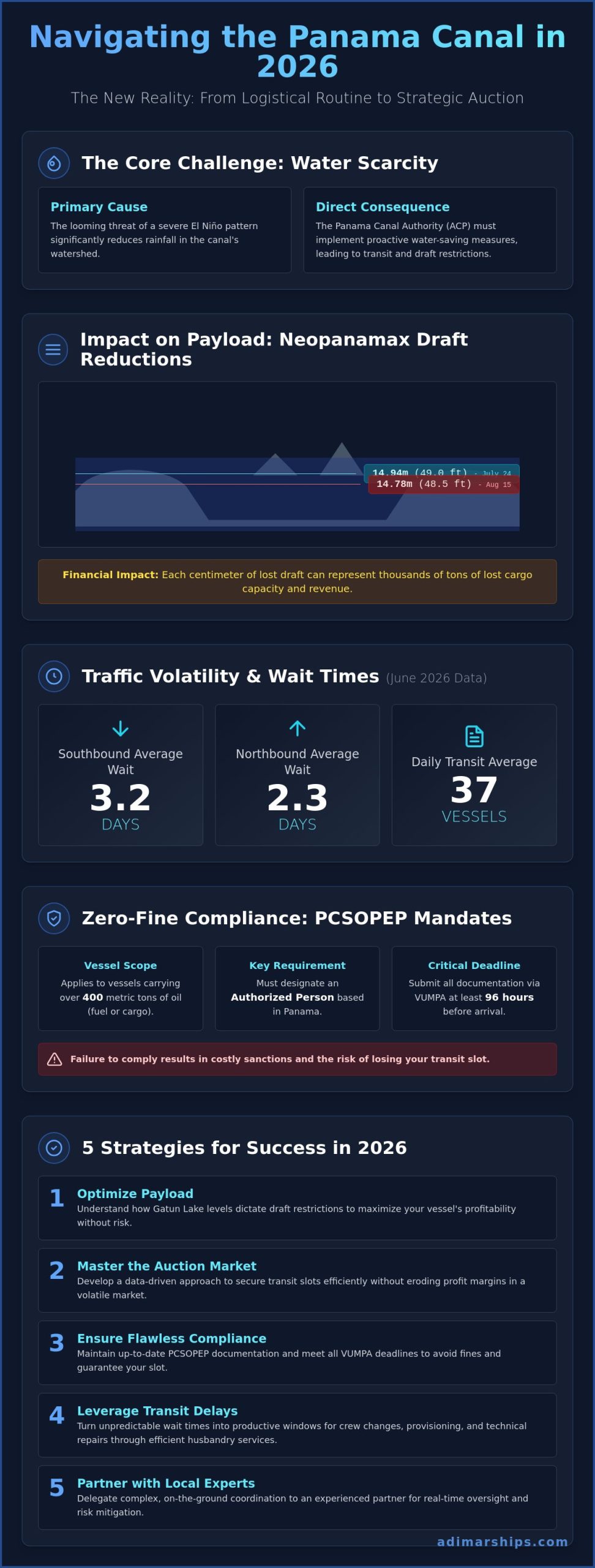
The watershed serving the canal is a delicate system that must satisfy the thirst of Panama’s population while providing the buoyancy required for global trade. For a comprehensive Panama Canal overview, it’s essential to recognize that every transit consumes millions of gallons of fresh water. When rainfall patterns falter, the ACP must prioritize human consumption, leading to the draft restrictions we’re seeing today. A draft restriction in 2026 is a mandatory limit on how deep a vessel’s hull can sit in the water, effectively capping the maximum weight of cargo it can safely carry through the locks. Specifically, the maximum authorized draft for Neopanamax vessels was set at 14.94 meters (49.0 feet) on July 24, 2026, with a further reduction to 14.78 meters (48.5 feet) scheduled for August 15, 2026. These centimeters represent thousands of tons of lost cargo capacity for deep-draft container ships and bulkers.
Neopanamax vs. Panamax Traffic Dynamics
Traffic patterns in 2026 have become increasingly polarized between the original locks and the Neopanamax expansion. While the average number of daily transits reached 37 in March 2026, the backlog remains a persistent threat to schedule integrity. We’ve observed specific congestion hotspots that operators must track:
- Wait Time Disparities: As of June 2026, southbound vessels faced average waits of 3.2 days, while northbound traffic averaged 2.3 days.
- Priority Shifts: The ACP is increasingly using the LoTSA 2.5 system to prioritize high-value, pre-booked slots, often leaving non-booked vessels in a precarious “wait and see” position.
- Economic Fallout: Being “bumped” or delayed isn’t just a scheduling nuisance; it can lead to missed berthing windows at the next port of call and significant demurrage claims.
2026 marks a definitive turning point in ACP resource management. The authority has moved away from the reactive posture of previous decades toward a sophisticated, data-driven model. This shift means that panama canal transit challenges 2026 are no longer just about the weather; they’re about how well you navigate a complex system of bookings and auctions. At Adimar Shipping, Inc., we act as your local eyes on the ground, translating these technical shifts into actionable advice for your fleet’s commercial viability.
Compliance and Environmental Mandates: Mastering PCSOPEP and New 2026 Regulations
Regulatory compliance is no longer just a back-office formality. In 2026, the Panama Canal Authority (ACP) has integrated environmental performance and documentation accuracy directly into its scheduling algorithms. If your vessel arrives with outdated paperwork or fails a technical inspection, you don’t just pay a fine; you lose your hard-won slot. These panama canal transit challenges 2026 demand a proactive approach to the Panama Canal Shipboard Oil Pollution Emergency Plan (PCSOPEP) and the various “Green” incentives now influencing transit priority. Vessels with higher environmental rankings often receive preference during periods of high congestion, making sustainability a strategic asset for your fleet.
The Role of the PCSOPEP Authorized Person
Every vessel carrying more than 400 metric tons of oil, whether as fuel or cargo, must designate an authorized person based in Panama. This isn’t just a legal requirement; it’s your primary line of defense against administrative delays. Documentation must be submitted through the VUMPA system at least 96 hours before arrival. Missing this window triggers an automatic $2,500 sanction, while more serious plan deficiencies can result in fines starting at $15,000. Adimar Shipping, Inc. serves as your vigilant, on-the-ground representative, ensuring your plan is not only compliant but ready for immediate activation if needed. You can find more details in our PCSOPEP Authorized Person: A Complete Guide.
Avoiding ACP Fines and Deficiencies
Inspections in 2026 have become more rigorous, particularly for general cargo vessels that may not transit the canal as frequently as major container lines. The ACP’s digital evolution through the VUMPA platform has streamlined reporting, but it has also made it easier for inspectors to flag inconsistencies before the ship even anchors. Common deficiencies that trigger “vessel non-readiness” status include faulty navigation equipment, improper boarding facilities, or incomplete crew medical declarations. These failures lead to costly delays and can even force a vessel to lose its assigned transit window entirely.
Delegating these complex tasks to a partner with over 20 years of local experience ensures that every technical and environmental box is checked well in advance. Our team acts as an extension of your own, providing the expert ship agency services required to navigate these evolving mandates with total confidence. Ensuring zero compliance fines is our standard, giving you the operational freedom to focus on your core commercial objectives. By maintaining a clean inspection record, you protect your vessel’s standing in the ACP’s ranking system, which is crucial for future transit predictability. Adimar Shipping, Inc. remains your vigilant eyes on the ground, protecting your interests at every lock.
Economic Strategies for 2026: Slot Auctions, Booking Systems, and Toll Optimization
Financial predictability is the cornerstone of successful maritime operations, yet it remains the most elusive goal in the current climate. The panama canal transit challenges 2026 have transformed the economics of the waterway from a fixed-cost model into a volatile, auction-driven market. For ship operators, the decision to participate in an auction is no longer just about speed; it’s a calculated ROI assessment. While the Panama Canal Authority (ACP) has frozen the main toll structure until September 30, 2026, the real financial impact stems from supplemental fees and the surge in booking premiums that can vary wildly by the week.
The Slot Auction Strategy: To Bid or Not to Bid?
In early 2026, average auction prices for transit slots surged to approximately $385,000, a significant jump from previous averages of $140,000. For some Neopanamax vessels, these bids have even crossed the $1 million mark, with one record-setting transit in April 2026 costing $4 million in auction fees alone. Determining when a premium price is worth the investment requires a clear “walk-away” figure based on your daily demurrage costs and fuel consumption while at anchor. Under the current LoTSA 2.5 program, which governs the booking cycle from July 5, 2026, through January 2, 2027, the ACP utilizes a pre-booked transit slot and supplemental auction system designed to manage demand during periods of restricted water levels. This system demands high financial commitment, including an 80% charge for cancellations made within 15 days of the scheduled transit date.
Toll Optimization and Financial Coordination
Beyond the headline auction prices, operators must account for ancillary costs that can quickly erode margins. Freshwater surcharges currently range from $4,000 to $10,000 per transit, depending on the vessel’s size and the lake’s water levels at the time of passage. Managing these disbursements requires a partner with deep local roots and total financial transparency. By partnering with a dedicated ship agency Panama, you gain an advocate who monitors “last-minute” slot availability and manages Cash to Master (CTM) logistics with precision. This local oversight helps you avoid the hidden costs of panama canal transit challenges 2026, ensuring that every dollar spent contributes directly to operational efficiency.
Our team provides the real-time data needed to decide whether to wait at anchor for the current 2 to 3 day average or bid for immediate passage. We act as your on-the-ground financial representative, ensuring that all canal fees, oil spill response charges, and husbandry costs are consolidated and reported with absolute clarity. This level of coordination provides the peace of mind that comes from knowing your vessel’s financial standing with the ACP is always in good order, preventing unnecessary delays during the clearance process.
Operational Continuity: Managing Husbandry and Logistics Amidst Transit Delays
Extended wait times at anchor don’t have to be wasted time. While the current average delay for southbound vessels sits at 3.2 days, these windows provide a strategic opportunity to address essential ship needs that are often rushed during tighter schedules. Effectively managing panama canal transit challenges 2026 means transforming a backlog into a productive maintenance and rotation window. By coordinating these activities while your vessel is already stationary, you eliminate the need for additional stops, directly reducing your overall operational friction.
Crew Welfare and Rotations
Swapping crew members in Balboa or Cristobal requires precise timing and deep familiarity with local immigration protocols. In 2026, the increased traffic volume has placed additional strain on launch services and shore-side logistics. We handle the entire process, from visa arrangements to secure transport, ensuring your seafarers transition smoothly without disrupting ship operations. Beyond rotations, the delivery of fresh provisions and potable water is critical. Since the Panama Canal Authority is strictly managing water resources, securing reliable freshwater supplies for your vessel at anchor is a priority we manage with vigilance. Protecting the psychological well-being of a crew facing a 50% increase in wait times starts with reliable, on-time deliveries and clear communication from the shore.
Technical Support and Spares
Panama serves as a premier regional hub for maritime repairs and technical troubleshooting. If your vessel requires specialized technicians or emergency spare parts, the waiting period before transit is the ideal time to act. We specialize in managing the logistics of “Ship Spares in Transit,” navigating Panamanian customs to ensure parts reach your engine room without administrative hurdles. Acting as your local office, we coordinate with workshops and suppliers to resolve technical issues before your vessel enters the locks. This proactive oversight prevents minor mechanical issues from escalating into “vessel non-readiness” flags during ACP inspections.
Successful fleet management during a backlog depends on the quality of your husbandry services. Our team provides the on-the-ground oversight necessary to protect seafarer welfare and maintain vessel readiness. Don’t let a transit delay derail your commercial schedule. Contact Adimar Shipping today to coordinate your next husbandry call and ensure your vessel remains fully operational throughout its stay in Panamanian waters.
Adimar Shipping: Minimizing Risk Through Local Expertise and Proactive Agency
Adimar Shipping brings over 20 years of integrity-driven service to the table. In an era defined by panama canal transit challenges 2026, having an experienced partner is the difference between a profitable voyage and a commercial failure. We don’t just process paperwork; we act as your local office on the ground. Our team provides the “Local Eyes” advantage, offering real-time monitoring of ACP operations and slot auctions to ensure you never miss a critical window. We understand the high stakes of the maritime industry and the frustration that comes with remote fleet management during periods of extreme volatility.
A Partner, Not Just an Agent
Moving from a transactional agency to a strategic partnership is essential in the 2026 market. We focus on alleviating the stress of coordination by providing direct, empathetic support to our clients. Our proactive communication style is designed to prevent demurrage by identifying potential bottlenecks before they impact your vessel’s arrival. Adimar’s deep local network accelerates documentation and clearance, ensuring that your ship moves through Panamanian waters with minimal friction. Transparency is our core promise. As a trusted owner’s nominated agency, we protect your vessel’s interests with absolute ethical standards and provide the on-the-ground vigilance your fleet requires.
- Proactive Risk Mitigation: We anticipate regulatory shifts and draft changes to keep your operations ahead of the curve.
- Expertise Delegation: You delegate the complexities of ACP compliance to us, gaining operational freedom and peace of mind.
- Vigilant Oversight: Our team acts as a protective extension of your own, monitoring every step of the transit process.
Securing Your 2026 Transit Schedule
Early engagement is your best defense against the volatility of the current booking and auction systems. A seasoned panama canal ships agent provides the foresight needed to navigate draft restrictions and auction surges effectively. We offer customized transit feasibility studies tailored to your specific vessel class, whether you’re operating a Neopanamax container ship or a Panamax bulker. These studies analyze your fleet’s requirements against current Gatun Lake levels and ACP traffic trends to find the most cost-effective path forward. This tailored approach ensures that your agency services are a perfect match for your specific operational needs.
The complexities of panama canal transit challenges 2026 don’t have to be a source of frustration. By delegating these specialized tasks to a partner with two decades of local expertise, you gain the security of knowing your vessel is in capable hands. We provide the protection, observation, and local oversight that standard business language cannot achieve. Contact Adimar Shipping today to secure your 2026 transit schedule and ensure a seamless, reliable passage through the isthmus.
Secure Your Fleet’s Future in the Panama Canal
Navigating the waterway in 2026 requires more than just luck; it demands a strategic alignment with current hydrological and regulatory realities. We’ve explored how mastering PCSOPEP protocols and optimizing your approach to slot auctions can protect your margins. Leveraging husbandry windows during transit delays also ensures your crew and vessel remain operational without unnecessary stops. These panama canal transit challenges 2026 are significant, but they aren’t insurmountable with the right local partner by your side.
With over 20 years of local expertise, Adimar Shipping acts as your vigilant representative on the ground. As an authorized PCSOPEP representative, we ensure your documentation is flawless. Our team provides dedicated 24/7 on-the-ground support to keep you informed at every turn. Ensure a smooth 2026 transit; contact Adimar Shipping today. Your success in the isthmus is our priority. Let’s turn these logistical complexities into a competitive advantage for your fleet.
Frequently Asked Questions
What are the expected draft restrictions for the Panama Canal in 2026?
The maximum authorized draft for Neopanamax vessels is currently 14.94 meters as of July 24, 2026. The Panama Canal Authority has announced a further reduction to 14.78 meters effective August 15, 2026. These measures are part of a proactive water management strategy to navigate the impact of a severe El Niño on Gatun Lake levels.
How much do Panama Canal slot auctions typically cost in 2026?
Auction prices have reached unprecedented levels in 2026, with an average price of $385,000 recorded in early spring. While some slots have gone for much higher, including a record $4 million bid in April 2026, the costs depend heavily on seasonal demand and current backlog levels. Operators must weigh these premiums against daily demurrage costs when deciding whether to bid.
Is a PCSOPEP authorized person required for all transiting vessels?
A PCSOPEP authorized person is mandatory for every vessel with a carrying capacity of 400 metric tons or more of oil, whether as cargo or fuel. This representative must be located in Panama to serve as a liaison with the Canal Authority. You’re required to submit your plan at least 96 hours before arrival; failing to meet this deadline results in a minimum $2,500 sanction.
How far in advance should I book a Panama Canal transit slot for 2026?
You should secure your slot as early as possible through the Enhanced Long-Term Slot Allocation (LoTSA 2.5) program. Booking early is a primary strategy to manage panama canal transit challenges 2026 and avoid the volatile auction market. Note that the ACP imposes an 80% charge of the awarded bid price for cancellations made 15 days or more before the scheduled transit.
Can I perform crew changes while my vessel is waiting for a transit slot?
Yes, performing crew changes at anchor is an excellent way to optimize wait times that currently average over three days for southbound traffic. We coordinate with local immigration and launch services in Balboa and Cristobal to ensure these rotations happen smoothly. Utilizing this window for husbandry services prevents the need for additional stops later in your voyage.
What happens if my vessel fails a Panama Canal inspection in 2026?
Failing an inspection typically results in the vessel being declared “not ready,” which leads to the immediate loss of your transit slot. You’ll likely face additional fines for deficiencies and will have to wait for a new opening in the schedule. This is why having a vigilant local agent to pre-check documentation and technical readiness is essential for maintaining your timeline.
How are 2026 Panama Canal tolls calculated for container ships?
Tolls are calculated based on the vessel’s PC/UMS tonnage and total TEU capacity, though the main toll structure is frozen until September 30, 2026. However, you must also factor in the freshwater surcharge, which adds between $4,000 and $10,000 per transit. These financial variables are central to the panama canal transit challenges 2026 that operators must navigate to remain profitable.
What is the difference between an owner’s and a charterer’s nominated agency in Panama?
An owner’s nominated agency acts as a protective extension of the shipowner’s team, focusing on technical compliance, crew welfare, and husbandry. A charterer’s agency primarily handles the cargo logistics and requirements specific to the charterer’s interests. Appointing your own agent ensures you have an independent representative dedicated to protecting the vessel’s safety and the owner’s financial interests.