

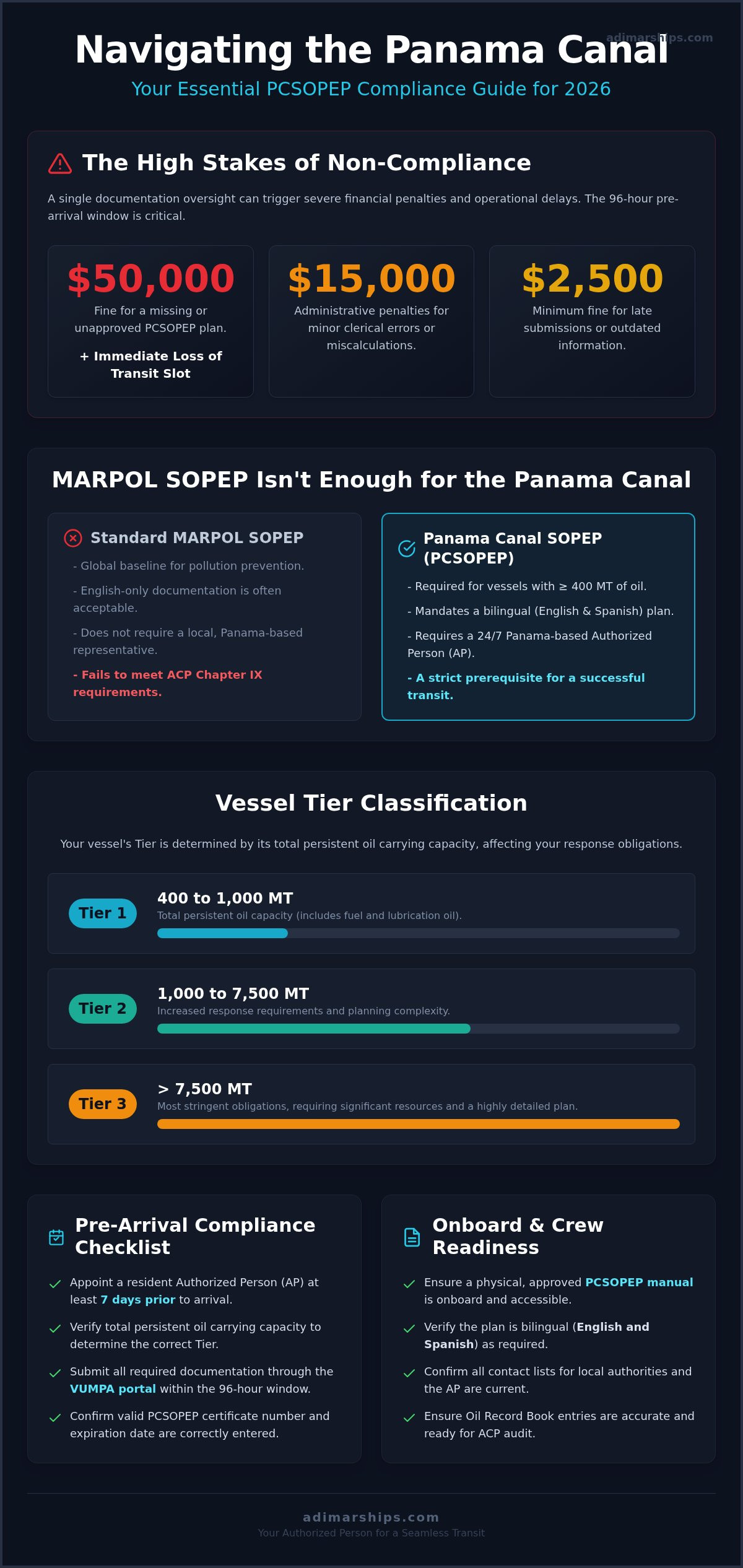
A single documentation oversight during your transit can trigger a $50,000 fine and the immediate forfeiture of your hard-earned transit slot. For ship owners, the 96-hour pre-arrival notification window often feels like a high-stakes race against the clock. You’re likely already feeling the pressure of managing VUMPA portal updates while trying to avoid the $15,000 administrative penalties that follow minor clerical errors. Relying on a comprehensive Panama Canal SOPEP compliance checklist is the only way to ensure your vessel meets the rigid standards of the Panama Canal Authority (ACP) every time.
We understand that your priority is a seamless passage through the locks without the burden of regulatory friction. This guide provides the definitive 2026 framework to ensure you secure a successful Notice of Acknowledgement (NOA) from the ACP. We’ll walk you through the essential appointment of a resident Authorized Person, the specific oil capacity thresholds for tier classifications, and the technical requirements of the N-12-2026 mandate. By the end of this article, you’ll have a clear roadmap to navigate these local mandates with the confidence of a seasoned regional expert.
Key Takeaways
- Learn why standard MARPOL plans fail to meet ACP Chapter IX requirements and how the 400 MT threshold affects your vessel’s transit eligibility.
- Utilize our definitive Panama Canal SOPEP compliance checklist to navigate the rigid 96-hour pre-arrival notification window and eliminate the risk of $15,000 administrative fines.
- Verify your onboard documentation, from physical PCSOPEP manuals to Oil Record Book entries, to ensure your crew is fully prepared for an ACP audit.
- Determine your vessel’s specific Tier classification based on total oil capacity to align your emergency response plan with 2026 regulatory standards.
- Understand the critical role of a Panama-based Authorized Person (AP) in maintaining a constant, proactive liaison with the Canal Authority.
Why Your Standard MARPOL SOPEP Fails at the Panama Canal
Many operators assume their international certifications are sufficient for any waterway. While MARPOL Annex I provides a global baseline for pollution prevention, the Panama Canal Authority (ACP) enforces its own localized set of rules known as the PCSOPEP. If your vessel has a carrying capacity of 400 metric tons or more of persistent oil, including fuel and lubrication oil, you must comply with ACP Chapter IX. This is a hard threshold. Failing to recognize the difference between a standard SOPEP and a Panama-specific plan is the first step toward a transit delay.
The most significant distinction is the “Resident Requirement.” Your global oil spill response team cannot fulfill the role of the Authorized Person (AP). The ACP mandates a Panama-based representative who is available 24/7 to act as a legal liaison. We act as your vigilant partner on the ground, ensuring your Panama Canal SOPEP compliance checklist remains current and accurate. Non-compliance carries heavy financial weight. A minimum fine of $2,500 applies for late submissions, while significant administrative oversights can lead to $15,000 penalties. A missing or unapproved plan can result in a $50,000 fine and the immediate loss of your transit slot.
The Legal Mandate of ACP Chapter IX
ACP Chapter IX regulations are designed for the unique ecological and operational sensitivity of the Isthmus. These requirements are outlined in the “Notice to Shipping N-12-2026,” which became effective on January 1, 2026. Unlike international standards that might allow for English-only documentation, the ACP requires a bilingual response plan in both English and Spanish. This ensures that local responders and canal officials coordinate without language barriers during an emergency. A valid, approved PCSOPEP is a strict prerequisite for receiving your Notice of Acknowledgement (NOA). Without this document, the VUMPA portal won’t clear your vessel for arrival.
Common Pitfalls for International Operators
We often see experienced operators fall into the trap of complacency. A common mistake is assuming a valid MARPOL certificate covers Panama Canal waters. It doesn’t. Another frequent oversight involves outdated contact lists. If your plan still lists a former agent or a defunct local authority number, the ACP may deem the document non-compliant. Perhaps the most frustrating risk is being reclassified to a higher Tier. Minor clerical errors or miscalculations in oil capacity can push a vessel into Tier 3 status, which carries much more stringent obligations and higher administrative costs. Keeping a precise Panama Canal SOPEP compliance checklist helps you avoid these preventable setbacks.
The 96-Hour Pre-Arrival Checklist: Administrative Compliance
Administrative success starts long before your vessel reaches the breakwater. Your Panama Canal SOPEP compliance checklist must begin with the formal appointment of a resident Authorized Person (AP) at least seven days prior to arrival. This lead time allows your representative to review your documentation and prepare for the 24/7 liaison duties required by the ACP. Once the AP is confirmed, you must verify the vessel’s total persistent oil carrying capacity. This calculation includes all crude oil, heavy fuel oil, and lubricants, but excludes distillates like Marine Gas Oil (MGO). The specific standards for these calculations are detailed in the Panama Canal Authority Vessel Requirements.
After verifying your capacity, you must submit your plan through the VUMPA portal. This digital interface validates certificate numbers in real-time against ACP databases to ensure compliance. As your local eyes at the canal, we ensure your Tier classification is correctly identified based on the 400, 1,000, and 7,500 MT thresholds during this stage. Maintaining an accurate Panama Canal SOPEP compliance checklist prevents the $15,000 administrative fines associated with documentation errors. If you find the portal requirements complex, delegating these tasks to a specialized PCSOPEP Authorized Person can provide the peace of mind you need for a smooth transit.
Navigating the VUMPA Portal in 2026
The 2026 VUMPA interface requires precise data entry for several mandatory fields. You must provide the PCSOPEP certificate number, the local AP’s contact information, and the plan’s expiration date. The portal also requires a PDF upload of the plan summary and a verification of coverage from your response provider. The VUMPA submission deadline is a non-negotiable 96-hour window.
The Notice of Acknowledgement (NOA)
The ACP issues a Notice of Acknowledgement (NOA) once your digital submission passes their initial validation. This document is your administrative green light for transit. If the portal flags your entry as “Review and Correct,” you must resolve the issues immediately to protect your transit slot. Once you receive the NOA, share it with the Master and your local agent to ensure total operational alignment. This simple step confirms that your vessel is fully compliant and ready for the locks.
Onboard Documentation and Crew Readiness Checklist
Physical readiness on the bridge is where administrative planning meets operational reality. While your digital submissions via the VUMPA portal secure your slot, the physical presence of your documentation determines whether you pass the ACP boarding inspection. A robust Panama Canal SOPEP compliance checklist includes a thorough walkthrough of the vessel’s physical documentation. The most critical item is the hard-copy PCSOPEP manual. It must be readily available on the bridge for immediate reference by the Master and ACP officials. Digital copies on a secure server aren’t enough; the Boarding Officer expects to see a physical, approved version of the plan.
Accuracy in the Oil Record Book (Part I and Part II) is equally vital. For tankers, both parts must be up to date, reflecting all recent transfers and discharges. For non-tankers, Part I must clearly document machinery space operations. Any discrepancy between your recorded oil levels and the physical tanks can trigger an immediate audit. We recommend that the Master conducts a final verification of these entries 24 hours before arriving at the canal waters. This proactive step ensures that your records are beyond reproach when the ACP inspector steps on board.
Communication is the final pillar of readiness. Your crew must be familiar with the specific reporting procedures for the Panama Canal, which differ from standard coastal reporting. We suggest testing the communication link between the ship and your Authorized Person before arrival. This ensures the Master knows exactly how to reach us during an emergency. Having a reliable, vigilant partner on the ground means you’re never navigating these protocols alone.
The ACP Boarding Officer’s Audit
Routine compliance boardings are rigorous. To ensure a smooth inspection, keep these five items ready for the auditor:
- Approved PCSOPEP Manual: The physical, bilingual document with the ACP approval stamp.
- Authorized Person Contact Details: This information must be clearly posted in the radio room and on the bridge.
- Oil Record Books: Part I and Part II, fully updated and signed by the Master.
- SMPEP Documentation: If your vessel carries noxious liquid substances, have your Shipboard Marine Pollution Emergency Plan available.
- SOPEP Equipment Inventory: A list of onboard spill response gear, verified against the manual’s requirements.
Drills and Training Requirements
The ACP expects the crew to be more than just familiar with the manual; they must be trained for action. PCSOPEP-specific drills should be conducted at least once every six months, or prior to a transit if the crew has changed significantly. Log these “Tabletop” exercises in the vessel’s deck log, noting the coordination with your local Authorized Person. Specific attention should be paid to spill response protocols within the Miraflores or Gatun Locks. These confined areas require immediate, precise actions to prevent environmental damage and transit shutdowns.
Tier Classification: Matching Capacity to Obligations
Your vessel’s oil capacity isn’t just a technical specification. It’s the primary metric the ACP uses to determine your legal obligations and emergency response requirements. The Panama Canal Authority scales these requirements through a tier system based on the total amount of persistent oil carried on board. Understanding where your vessel sits in this hierarchy is a vital part of your Panama Canal SOPEP compliance checklist. Miscalculating your capacity can lead to delays or, worse, being forced into a more expensive classification during the transit process.
The tiers are strictly defined by metric tonnage (MT). Tier S (Small) applies to vessels with a capacity between 400 MT and 1,000 MT. While these smaller ships have fewer resource obligations, they must still maintain a valid PCSOPEP and a local Authorized Person. Tier 1 covers vessels from 1,000 MT up to 7,500 MT. Tier 2 is reserved for Neopanamax vessels and large tankers exceeding 7,500 MT. These larger tiers require significant resource backing, including pre-staged booms, skimmers, and bilingual response teams capable of immediate deployment. Finally, Tier 3 is known as the “Penalty Tier.” This classification is applied to ships that fail to meet compliance standards, resulting in a $50,000 fine and the loss of their transit slot.
Calculating Your Total Oil Carrying Capacity
Precision is mandatory when summing your oil capacity. You must include the maximum capacity of all fuel tanks, lube oil tanks, and cargo tanks. A common error is excluding “empty” or “unpumpable” tanks from the total. In the eyes of the ACP, a tank counts toward your classification unless it has been certified as gas-free. As your proactive partner, Adimar Shipping verifies your classification against your latest tank plans before your digital submission. This prevents the administrative friction that occurs when the ACP’s real-time validation contradicts your reported data.
Response Resource Providers (OSROs)
Every vessel transiting the canal must have a valid contract with an ACP-approved Oil Spill Response Organization (OSRO). This contract ensures that the necessary physical equipment, such as containment booms and recovery skimmers, is available if an incident occurs. Your Authorized Person serves as the critical link between the ship and the OSRO. If a spill is reported, we coordinate the immediate mobilization of these resources to protect the canal’s ecosystem. To ensure your transit remains on schedule, appoint an Authorized Person who can verify your OSRO coverage is fully compliant with 2026 standards before you reach the locks.
Adimar Shipping: Your Authorized Person for a Seamless Transit
Managing the complexities of the Panama Canal requires more than just following a static document. It demands a proactive partner who acts as your local “eyes at the canal.” We serve as the mandatory 24/7 liaison between your vessel and the Panama Canal Authority (ACP), providing a constant presence that global agencies can’t match. Our team reviews your PCSOPEP manual for 2026 compliance long before you reach the breakwater. By integrating your specific vessel data into our Panama Canal SOPEP compliance checklist, we eliminate the friction that often leads to transit delays.
Global agencies often lack the granular, on-the-ground presence required to manage the VUMPA portal effectively. We manage every digital submission to ensure a timely Notice of Acknowledgement (NOA). This level of local oversight is critical for navigating the 96-hour pre-arrival window without unnecessary stress. We don’t just process paperwork; we provide a protective layer of vigilance. This ensures your vessel remains compliant with all local mandates while you focus on the broader logistics of your voyage.
The Adimar Advantage: Vigilance and Integrity
Local expertise is the best defense against the $15,000 “clerical oversight” fines that often plague international operators. We speak the language of the ACP and understand the specific nuances of the N-12-2026 regulations. This allows us to spot potential issues in your documentation that others might miss. For a deeper look at the technical requirements of this role, read our PCSOPEP Authorized Person Guide. Our commitment to ethical standards and transparent communication ensures your interests are protected at every lock.
Secure Your 2026 Transit Slot
Delegating your compliance needs to a specialist allows your crew to focus on core maritime operations. We offer pre-transit compliance audits to verify that every item on your Panama Canal SOPEP compliance checklist is in order. This proactive approach saves time and prevents the forfeiture of valuable transit slots due to administrative errors. Don’t leave your compliance to chance in such a high-stakes environment. Contact Adimar Shipping to appoint your Authorized Person today and ensure a fine-free transit through the Isthmus.
Master Your 2026 Panama Canal Transit
Achieving a seamless transit through the locks depends on meticulous preparation and local expertise. The distinction between international MARPOL standards and the ACP’s localized mandates is often the difference between a successful passage and a $50,000 fine. Your Panama Canal SOPEP compliance checklist isn’t just a document; it’s a strategic shield against administrative delays and clerical oversights. By verifying your Tier classification and ensuring your onboard documentation is audit-ready, you protect both your schedule and your bottom line.
Don’t leave your compliance to chance in such a high-stakes environment. As local Panama Canal specialists and ACP compliance experts, we provide the 24/7 response liaison you need to navigate these rigid regulations. We act as your vigilant eyes at the canal, managing the VUMPA portal and resident AP duties so you don’t have to. Appoint Adimar Shipping as your PCSOPEP Authorized Person to secure your 2026 transit slot. We’re ready to ensure your next arrival is efficient, secure, and entirely fine-free.
Frequently Asked Questions
Is a standard IMO SOPEP sufficient for the Panama Canal?
No, a standard IMO SOPEP isn’t sufficient for transiting the Panama Canal. The Panama Canal Authority (ACP) mandates a specialized Shipboard Oil Pollution Emergency Plan (PCSOPEP) that complies with local Chapter IX regulations. This plan must be bilingual and include specific local contact information and response tiers. Relying on international certificates alone will lead to delays and significant fines during the boarding inspection.
What is the minimum oil capacity that triggers PCSOPEP requirements?
The requirement for a PCSOPEP is triggered once a vessel’s total persistent oil carrying capacity reaches 400 metric tons or more. This calculation includes oil carried as cargo, fuel, or lubrication. Distillate fuels like Marine Gas Oil (MGO) aren’t included in this total. It’s vital to calculate this accurately against your tank plans to ensure your Panama Canal SOPEP compliance checklist aligns with ACP tier thresholds.
Who can serve as an “Authorized Person” for the Panama Canal?
An Authorized Person (AP) must be a resident of Panama who is available 24/7 to act as a legal liaison with the ACP. This individual serves as the primary point of contact during a pollution emergency within canal waters. Your global response team or international managers cannot fulfill this role. We provide this specialized service to ensure your vessel has a vigilant, on-the-ground representative at all times.
What happens if we miss the 96-hour notification deadline?
Missing the strict 96-hour pre-arrival notification window results in an immediate administrative fine, typically starting at a minimum of $2,500. Beyond the financial penalty, your vessel may lose its scheduled transit slot, leading to daily operational losses that can exceed $65,000 for larger vessels. The ACP maintains a zero-tolerance policy regarding this deadline. We manage these submissions through the VUMPA portal to prevent these costly oversights.
Does a vessel in “ballast” condition still need a PCSOPEP?
Yes, a vessel in ballast condition still requires a PCSOPEP if its total carrying capacity is 400 metric tons or more. The ACP bases compliance on the vessel’s maximum capacity rather than the actual volume of oil on board during transit. Even empty tanks are counted toward your classification unless they’ve been officially certified as gas-free. Always verify your total capacity against your Panama Canal SOPEP compliance checklist before arrival.
How long is a Panama Canal SOPEP Notice of Acknowledgement (NOA) valid?
A Notice of Acknowledgement (NOA) for the PCSOPEP is typically valid for two years. However, this validity remains contingent on the vessel maintaining its original configuration. If the ship undergoes significant modifications or changes its oil carrying capacity, you must submit an updated plan to the ACP for re-approval. We monitor these expiration dates proactively to ensure your documentation remains current for every transit.
Can Adimar Shipping handle both Ship Agency and PCSOPEP compliance?
Yes, we provide integrated Ship Agency services and act as your mandatory PCSOPEP Authorized Person. By consolidating these roles, we streamline the communication between your vessel and the ACP. This dual approach allows us to manage husbandry needs while simultaneously ensuring all pollution prevention documentation is flawless. It’s a comprehensive solution designed to provide peace of mind and operational freedom for busy ship owners.
What is the fine for non-compliance with ACP Chapter IX?
Fines for non-compliance are substantial and scale based on the severity of the oversight. A late submission of the PCSOPEP triggers a minimum fine of $2,500. Clerical errors or documentation discrepancies in the VUMPA portal can lead to $15,000 administrative penalties. The most severe violations, such as transiting without an approved plan, carry a minimum fine of $50,000 and the immediate forfeiture of your transit slot.