

What if the biggest transit risk isn’t a missed deadline, but an unclear handoff? A ship agent responsibilities checklist helps owners, charterers, and vessel teams identify who handles each confirmation, document, and follow-up during Panama Canal operations. Depending on the appointment, the agent may coordinate transit clearance, pilot and tug orders, and passage documentation. The vessel and principal retain the responsibilities assigned to them by the appointment and applicable requirements.
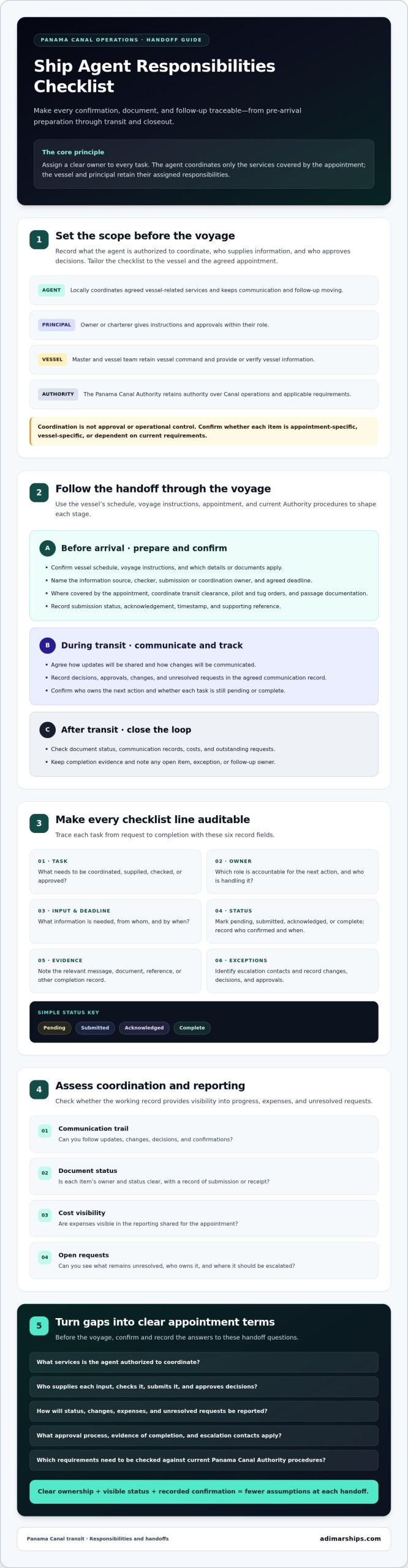
A local agent should keep communication moving and provide visibility into progress, expenses, and unresolved requests. To make that work, each task needs a clear owner. Otherwise, a request can go unanswered or a document can be assumed complete when it still needs attention.
This guide follows the voyage from pre-arrival preparation through transit and post-transit closeout. Use the checklist to clarify handoffs, verify reporting practices, and tailor an agency appointment to the vessel. The goal is to confirm each party’s duties rather than leave them to assumption.
Key Takeaways
- Use a ship agent responsibilities checklist to map duties across the vessel, principal, agent, and Panama Canal Authority before the voyage begins.
- Assign an owner and information source to each pre-arrival document or vessel detail, then confirm submission and receipt.
- During transit, agree how to share updates, communicate changes, record decisions, and confirm tasks are complete.
- Assess an agent’s reporting by checking communication records, document status, cost visibility, and unresolved requests.
- Turn any gaps into appointment questions, and record the agreed scope, approval process, reporting expectations, and escalation contacts.
Ship agent responsibilities checklist: define the role and scope first
A ship agent is a locally appointed representative who coordinates vessel-related services agreed with the principal. In Panama, the appointment may cover transit-clearance coordination, pilot and tug orders, or passage documentation, depending on the agreed scope and vessel requirements. A general overview of a shipping agent explains the common coordination role, but it does not define the duties for a specific vessel or Canal transit.
Start by recording what the agent is authorized to coordinate, who supplies information, and who approves decisions. The agent supports communication and follow-up, but does not take command of the vessel or control Canal operations.
Which responsibilities belong to the agent, principal, vessel, or authority?
The appointment should identify the principal, such as the owner or charterer, and describe the services the agent is authorized to arrange. The master and vessel team retain vessel command and provide or verify vessel information. The owner or charterer gives instructions and approvals within their role. The Panama Canal Authority retains authority over Canal operations and its applicable requirements.
Classify each checklist item as appointment-specific, vessel-specific, or dependent on current requirements. Confirm the scope against the appointment, and check current Authority terminology or requirements when relevant. A coordination task is not the same as an approval or operational decision.
What should a ship agent responsibilities checklist record?
Make every checklist line traceable from request to completion. Include these fields:
- Task: What needs to be coordinated, supplied, checked, or approved?
- Responsible party and owner: Which role is accountable for the next action, and who is handling it?
- Required input and deadline: What information is needed, from whom, and by when?
- Status and confirmation: Is the item pending, submitted, acknowledged, or complete? Record who confirmed it and when.
- Completion evidence: Note the relevant message, document, reference, or other record.
- Escalation and exceptions: Identify the contact for unresolved items, and record changes, decisions, and approvals.
For example, if passage documentation is within scope, name who provides each vessel detail, who coordinates the submission, and what record confirms its status. Adapt or remove items that do not apply. This keeps responsibilities clear without assuming every vessel has identical requirements.
Before arrival: check Panama Canal transit readiness and agency handoffs
Pre-arrival coordination should follow the vessel’s schedule, voyage instructions, and confirmed agency appointment. Build the ship agent responsibilities checklist around the vessel’s actual needs, not a generic list assumed to apply to every transit. General overviews of the key responsibilities of ship agents can provide context, but the appointment and current Panama Canal Authority procedures should guide the operational checklist.
For each vessel detail, passage document, or instruction, identify who provides it, who checks it, who submits or coordinates it, and who confirms its status. When included in the agreed scope, the agent may coordinate transit clearance, pilot and tug orders, and passage documentation. The vessel team and principal still need clear ownership of their inputs and approvals.
Vessel details, instructions, and documentation to coordinate
Start with the vessel’s schedule and voyage instructions, then confirm which information and documents apply. Check requirements against current Authority procedures instead of relying on an old checklist or another vessel’s file.
- Information or document: Name the specific input and the vessel or voyage it relates to.
- Source and checker: Record who supplies the information and who verifies it.
- Submission owner and deadline: Identify who handles submission or coordination and the agreed target date or time.
- Confirmation: Record the response, status, timestamp, and supporting reference.
Keep one current version of voyage instructions and supporting files in the agreed communication record. Mark superseded versions clearly, and log what changed, who issued the update, and who acknowledged it. This version control helps prevent outdated instructions from remaining in circulation.
Pre-arrival communications and contingency ownership
Agree on a primary contact for the vessel and one for the shore-side principal. Set an escalation route for missing information, schedule changes, and unresolved questions. For each open item, record its owner, next action, status, and last confirmation time in a shared status log.
Make updates specific: state what changed, what action is needed, who owns it, and when the next update is due. If the plan changes, confirm that the relevant parties received the latest instructions. Coordination improves visibility, but an agent should not promise a transit slot, timing, or outcome controlled by the Canal Authority or other parties.
Before confirming an appointment, compare the planned handoffs with the agent’s stated scope. For example, Panama Canal ship agency services may include coordination of transit clearance, pilot and tug orders, and required passage documentation. Confirm which tasks apply to your vessel and appointment.
During and after transit: verify coordination, reporting, and closeout
Once transit activity is underway, clear reporting helps the principal see what is confirmed, what has changed, and what still needs attention. The agent relays updates and coordinates services within the appointment, but does not control Canal operations or make decisions reserved for the master, principal, or Panama Canal Authority. For current requirements, refer to the Authority’s Panama Canal maritime regulations.
Use this workflow in the ship agent responsibilities checklist, adapting each step to the agreed scope and vessel:
- Monitor: Track agreed services, including pilot and tug coordination, transit-clearance updates, and inbound or outbound documentation.
- Communicate: Send updates using the reporting frequency and format agreed with the principal. Identify decisions needed and who must make them.
- Record changes: Log schedule or instruction changes with a timestamp, source, and follow-up action. Keep estimates distinct from confirmed information.
- Confirm completion: Record when a coordinated task or document is confirmed complete, and retain the supporting reference.
- Close out: Compare the completed service record and final account with the agreed scope and approval procedures. Flag discrepancies and open items.
What should the agent report while the vessel is in transit?
Agree in advance on what needs an update, how often reports should be sent, and which channel or format to use. A concise report can include the timestamp, confirmed status, changes since the last update, decisions required, responsible contacts, and next action. Label estimates clearly rather than presenting them as confirmed.
For example, report a pilot or tug order as coordinated, pending confirmation, or changed, as appropriate. This gives the principal useful visibility without implying that the agent controls service availability or transit timing.
How should the agency close out a transit?
After the operation, review each agreed task and mark it complete, outstanding, or not applicable. Check that relevant transit-clearance updates and inbound or outbound documents are accounted for. Compare reported expenses with available supporting records and the appointment’s approval process. Do not treat an unexplained difference or pending item as resolved.
Before closing the file, record exceptions, disputed or pending claims, and follow-up owners. A clear closeout shows what was coordinated, what remains open, and who is responsible for the next action.
Assess the agent’s performance: communication, costs, and compliance checks
Assess delivery against the appointment, not general promises. A ship agent responsibilities checklist helps compare the agreed communication, cost reporting, documentation, and follow-up with what the agent actually provided. Treat claims about regulatory status, service scope, and performance as points to verify.
Use these questions to structure the review. Check evidence against the voyage record, and agree on an action for each gap.
- Communication: Who sends operational updates, through which agreed channels, and how often? Request sample updates or a report log. If delivery differed from the agreement, clarify the expected format and owner for future reporting.
- Response ownership: Who handles a request, and how are urgent decisions escalated if the principal is unavailable? Confirm the appointment’s contact and escalation process, who can approve decisions, and how attempts to reach them are documented.
- Cost reporting: How are expected and final expenses presented, and what approval process applies to exceptions? Request an itemized account process and available supporting records. Resolve unexplained differences against the agreed scope and approval procedures.
- Documentation: How does the agent track submissions, acknowledgments, and outstanding items? Request a status record with relevant references. Assign an owner and follow-up date to anything incomplete.
- PCSOPEP arrangements, if applicable: Does the appointment include PCSOPEP authorized-person services for this vessel? Confirm the service scope and relevant arrangements rather than assuming they are included.
How to check Panama Canal-specific compliance support
Ask who checks current procedural information, how relevant updates are communicated to the vessel, and what evidence is retained. Confirm applicable requirements with current official sources before relying on an agency checklist. The agent can coordinate agreed services and pass along information, but this does not transfer the master’s or principal’s responsibilities or replace Panama Canal Authority requirements.
Record each gap, the person responsible for addressing it, and the agreed follow-up. This makes the review practical and fair: it distinguishes a missed handoff from a task outside the appointment and gives both parties a clear basis for improving the next call or transit.
For Panama Canal ship agency and PCSOPEP authorized-person service details, review Adimar Shipping, Inc. agency services and confirm the scope that fits your appointment.
Apply the checklist when appointing a Panama Canal ship agent
Use gaps from your review as appointment questions, rather than waiting until the vessel is approaching. A ship agent responsibilities checklist helps the principal and agent agree on who is doing what, what authority applies, and how open items will be handled. Tailor the appointment to the principal, vessel, voyage instructions, and services required.
A practical appointment and handover sequence
Before confirming the agent’s scope, share the information needed to assess the assignment and establish a clear handover. Cover these points in writing:
- Identify the parties: Name the principal, vessel, master or vessel contact, and shore-side contacts. Confirm who can give instructions and approve decisions.
- Define the services: List agreed tasks, such as transit-clearance coordination, pilot and tug orders, or inbound and outbound documentation, where included. State what is outside scope or needs separate confirmation.
- Set communication expectations: Agree on reporting channels, update frequency, and which changes or open issues should be escalated.
- Assign approvals and documentation: Identify who provides, checks, submits, and confirms each required item. Record approval authority and how changes to instructions are acknowledged.
- Confirm next actions: Request acknowledgment of outstanding items, with a named owner and target deadline for each follow-up.
This handover gives both sides a shared reference. If voyage details or requirements change, update the record and confirm that the relevant parties have the current instructions. Check vessel-specific and current Panama Canal Authority requirements rather than assuming a previous appointment or transit checklist still applies.
When a Panama-based agency partner can help
A local agency partner can coordinate agreed vessel-related services and keep information moving between the vessel, principal, and relevant service contacts. Owners and charterers can compare the proposed scope with their needs, whether that involves transit coordination, an owner’s or charterer’s nominated agency, husbandry, protective agency, or PCSOPEP authorized-person services. Confirm the specific services and responsibilities in the appointment, since not every item applies to every vessel.
Adimar Shipping, Inc. is a Panama-based ship agency with an office in Panama City. Its services include Panama Canal transit-clearance coordination, pilot and tug orders, passage documentation, nominated agency, husbandry, and PCSOPEP authorized-person services. Discuss your Panama Canal agency requirements with Adimar Shipping to clarify which services may fit your appointment and what information is needed to define the scope.
Put a clearer agency handoff in place for your next transit
A dependable Panama Canal operation starts with clear ownership. Define the agent’s scope against the appointment, assign responsibility for vessel information and confirmations, and agree how updates, approvals, and exceptions will be recorded. Use the same checklist to review closeout, documentation, and cost reporting so open items do not disappear between parties.
A practical ship agent responsibilities checklist does not replace the master’s authority or current Panama Canal Authority requirements. It helps the vessel, principal, and agent work from shared expectations, with fewer assumptions about who acts next.
Adimar Shipping is a Panama-based agency coordinating Panama Canal vessel transits. Its services include owner’s and charterer’s nominated agency and PCSOPEP authorized-person support, with the specific scope confirmed for each appointment. Discuss your Panama Canal agency requirements and clarify the coordination support your vessel may need.
With responsibilities and reporting agreed in advance, you can approach the next handoff with greater confidence.
Frequently Asked Questions
What are the main responsibilities of a ship agent?
A ship agent coordinates services agreed with the principal and acts as a local point of contact for the vessel. Depending on the appointment, duties may include transit-clearance coordination, pilot and tug orders, documentation, husbandry, or reporting. The agent does not automatically assume the master’s authority or every owner’s responsibility. Set out the exact scope in the appointment, including who provides information, who approves decisions, and how completed tasks are confirmed.
What should a ship agent do before a vessel arrives at the Panama Canal?
Before arrival, the agent should coordinate agreed pre-arrival tasks, track documentation, and communicate the status of outstanding questions to the principal. A ship agent responsibilities checklist should identify who supplies, checks, submits, and confirms each item. The vessel’s instructions and appointment determine the scope. Since submission requirements and timing can change, verify them against current Panama Canal Authority procedures rather than relying on a generic or previously used checklist.
Does a ship agent arrange pilots and tugboats?
A ship agent may coordinate or place pilot and tug orders when those tasks are included in the agreed agency service. The appointment and current operational procedures determine the precise responsibility. Record who places each order, what confirmation is received, and how changes are reported. Coordination does not mean the agent controls Canal operations or can guarantee service availability. Confirm responsibilities with the principal, vessel team, and agent before the operation begins.
How does a ship agent keep an owner or charterer informed during transit?
The owner or charterer and agent should agree on reporting channels, frequency, and escalation contacts before operations begin. Reports can summarize confirmed status, schedule changes, decisions needed, and next actions, with timestamps and responsible contacts. The agent should distinguish confirmed information from estimates so the principal can assess what is known. Record the reporting arrangement in the appointment or operating instructions, including who receives updates and who responds to approval requests.
What documents should a ship agent handle for a Panama Canal transit?
The agent can coordinate inbound or outbound passage documentation included in the appointment, but the exact documents depend on current procedures and vessel details. For each item, identify who prepares it, who checks it, who submits or coordinates it, and who confirms receipt or status. Verify the applicable document list with current Panama Canal Authority guidance and the responsible parties. A reusable checklist helps track handoffs, but does not replace current instructions.
What is a PCSOPEP authorized person responsible for?
A PCSOPEP authorized person serves as a designated contact for matters covered by the Panama Canal Shipboard Oil Pollution Emergency Plan. Confirm whether the vessel’s circumstances and agency appointment require this service, and clarify the authorized person’s role, contact details, and communication arrangements. Do not assume every vessel or appointment has identical needs. Verify applicable requirements using current official guidance, and record who is responsible for maintaining and communicating relevant plan information.