

For booking dates beginning October 15, 2026, the listed LoTSA 2.0 allocation is three auction slots per day across vessel categories. Operators preparing for the LoTSA 2.0 auction system submit sealed bids per slot, and the minimum acceptable increase in a proxy bid is $1,000.
The process can feel complex because the bid, package size, booking window and payment timing all affect the commitment. Understanding how these pieces fit together helps vessel operators plan with greater clarity and avoid treating a slot award as the end of the process.
This guide explains how LoTSA 2.0 allocates slots, why the program supports regular liner services and specialized shipping operations, and how sealed and proxy bids work. It also covers minimum bid increments and when payment is due, so you can understand the auction mechanics before coordinating a vessel’s Panama Canal transit.
Key Takeaways
- Understand how bids are submitted per slot and how a package can change the total financial commitment.
- See why LoTSA supports regular liner services and specialized shipping operations.
- Learn how proxy bidding works and how bid increases affect an auction position.
- Get a clearer picture of the program’s booking cycles and the timing considerations around payment and transit coordination.
LoTSA slot allocation and auction slots
Panama Canal LoTSA allocates transit slots through sealed bids in its Transit Auction System. The package, vessel category, booking window and bid amount all shape the allocation.
Minimum Bids and Package Bidding
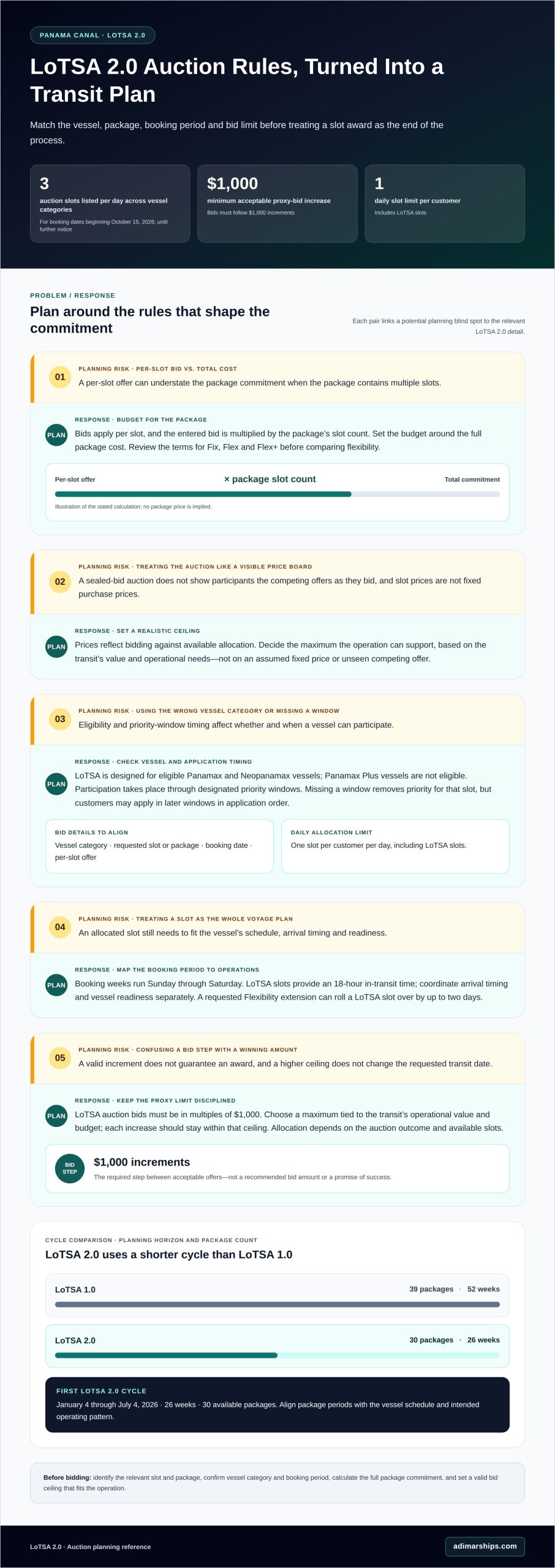
Bids apply per slot, while the entered bid is multiplied by the package’s slot count. Set your budget around the total package cost, not just the per-slot bid. Fix, Flex and Flex+ identify package options, so review each option’s terms before comparing flexibility.
Auction Prices and Slot Availability
Slot prices reflect bidding against available allocation, not a fixed purchase price. For booking dates beginning October 15, 2026, three auction slots per day are listed across vessel categories, until further notice. Unlike an open online auction, LoTSA uses sealed bids, so participants don’t see competing offers as they bid. Limited availability makes a realistic ceiling essential.
Eligibility, Registration, and Bid Requirements
LoTSA is designed for eligible Panamax and Neopanamax vessels; Panamax Plus vessels are not eligible. Participation takes place through designated priority windows. Missing a window removes priority for that slot, but customers may apply in later windows in application order. Key bid details include the vessel category, requested slot or package, booking date and per-slot offer. Do not assume additional paperwork requirements without a stated checklist.
Preparation means matching the intended transit to the correct category and package, then calculating the full package commitment. The Panama Canal’s daily limit is one slot per customer, including LoTSA slots. A LoTSA slot can be rolled over by up to two days through a requested Flexibility extension. Treat availability, package terms and rollover as separate planning factors, and avoid bidding beyond the vessel’s operational needs.
LoTSA program purpose
The Panama Canal’s LoTSA program is intended to support regular liner services and specialized shipping operations. Its long-term allocation structure helps eligible vessel operators plan transit needs across defined booking periods, rather than treating each passage as an isolated booking decision.
LoTSA 2.0 changed the program’s time horizon. Instead of one 12-month cycle, it uses separate six-month cycles. The first cycle ran from January 4 through July 4, 2026, and covered 26 weeks with 30 available packages. Each booking week runs Sunday through Saturday. For operators preparing for LoTSA 2.0 auction system participation, those defined periods help align slot requests with vessel schedules and intended operating patterns.
This structure matters because regular liner services and specialized shipping operations have different planning needs. A liner service may need to coordinate repeated Panama Canal transits across a cycle, while a specialized operation may plan around a particular vessel or cargo schedule. LoTSA provides a defined allocation framework, with packages associated with particular periods and vessel categories. It does not remove the need to match a booking to the vessel’s operational plan.
LoTSA 2.0 also differs from its predecessor in scale and duration. LoTSA 1.0 offered 39 packages over 52 weeks; LoTSA 2.0 offers 30 packages over 26 weeks. The shorter cycle creates a more bounded planning window. Operators can assess relevant transit periods, then consider how a package fits their schedule before committing to a bid.
LoTSA slots provide vessels with an 18-hour in-transit time. That feature matters when evaluating how an allocated slot fits the voyage plan, but it doesn’t replace coordination of arrival timing and vessel readiness. A practical priority when preparing for LoTSA 2.0 auction system participation is mapping expected transits to the Sunday-to-Saturday booking weeks, identifying operational periods that matter, and assessing packages against the service schedule.
Proxy bidding and minimum bid increments
In the Panama Canal auction, a proxy bid allows a participant to bid through a submitted offer, while the minimum acceptable increase is $1,000. The increment rule sets the smallest permitted step between qualifying offers, helping bidders frame a reservation without treating every possible amount as valid.
LoTSA auction bids must be in multiples of $1,000. This illustrates the bid step only. It doesn’t establish that a particular offer will win, since allocation depends on the auction outcome and available slots.
For proxy bidding, separate the amount you authorize from the amount needed to meet the minimum bid requirement. Set a ceiling based on the value of the transit slot to your operation, then ensure any submitted amount follows the $1,000 increments. This keeps the financial limit clear while avoiding an invalid bid amount.
A term slot or reservation also needs to fit the vessel’s schedule. A higher proxy ceiling may affect auction competitiveness, but it does not change the requested transit date or eliminate the need to plan around the package terms. If a bid applies across multiple package slots, consider the total commitment rather than viewing the per-slot offer alone.
Before submission, the practical sequence is straightforward: identify the relevant slot and package, determine the maximum amount the operation can support, and express the bid in valid $1,000 steps. Then compare that ceiling with the operational value of securing the reservation. Avoid increasing an offer simply because another amount is possible; each increment should remain within the planned budget.
Proxy bidding can simplify participation, but the increment rule remains important at every bid level. A compliant amount meets the auction’s stated step, while a disciplined ceiling keeps the transit decision aligned with the vessel’s schedule and overall package commitment.
The minimum acceptable increase in a Panama Canal proxy bid is US$1,000.00. Treat this figure as the required step between acceptable offers, not as a guide to the amount your operation should authorize; keep any proxy limit tied to its own budget and transit priorities.
What is the LoTSA 2.0 auction system?
LoTSA 2.0 is the Panama Canal Authority’s long-term slot allocation program for eligible Panamax and Neopanamax vessels. It combines defined booking cycles with sealed-bid auctions, giving operators a structured way to seek transit slots for planned voyages.
Unlike an open auction platform, the sealed-bid process does not show participants’ competing offers as bids are submitted. The auction can run in parallel stages divided by market segment, so the vessel’s category determines the applicable bidding window. An offer is considered within its relevant segment, not through a single public bidding sequence.
An awarded slot still requires operational follow-through. Customers must apply to confirm the exact transit date from 50 to 15 days before the start of the intended LoTSA week or month. This step connects the long-term allocation to a specific transit date. Vessel names for long-term slots must be submitted at least 15 days in advance.
Payment also has a deadline separate from the auction itself. LoTSA customers must pay for obtained slots in cash or provide a bank guarantee no later than 96 hours before the transit date. Include that deadline in voyage planning, alongside the vessel’s readiness and the confirmed transit date, rather than treating the successful bid as the final task.
The practical sequence is allocation, auction, date confirmation, vessel-name submission and payment. Each stage serves a different purpose: the auction secures an opportunity, while later submissions connect the slot to the vessel and intended passage. Keeping these milestones distinct helps prevent a booking award from being mistaken for a fully coordinated transit.
For operators preparing for a LoTSA 2.0 auction, the key is to map each milestone against the intended voyage. Record the allocation and auction details, track the date-confirmation window, submit the vessel name on time, and arrange payment before the deadline. That timeline makes the relationship between the auction and the actual Panama Canal transit clearer.
LoTSA 2.0 uses two separate 6-month cycle products instead of a 12-month cycle, giving operators distinct planning horizons rather than one annual product. This cycle structure should be considered when aligning allocation choices with anticipated voyage schedules.
Adimar Shipping
Adimar Shipping, Inc. helps ship owners and charterers coordinate the Panama Canal passage after a LoTSA slot has been secured. Its local agency support helps align auction outcomes, vessel schedules and transit arrangements, keeping operational details connected across teams.
Turn to Adimar Shipping, Inc. when you need a local partner to coordinate the passage and communicate with relevant parties. Ship Agency Services, Owner’s Nominated Agency and Charterer’s Nominated Agency support different representation arrangements, while Husbandry Services address vessel needs around the call. The right support depends on the vessel’s requirements and agency arrangement.
Once you understand the auction process, connect the allocation to practical transit coordination. Contact Adimar Shipping, Inc. to discuss support for your Panama Canal passage.
Carry Your Auction Plan Into Transit Coordination
Preparing for the LoTSA 2.0 auction system is one part of a broader voyage plan. The next step is connecting the intended slot with clear coordination between the vessel’s representatives and the parties involved in its Panama Canal passage.
Adimar Shipping, Inc. supports this work through Ship Agency Services, Owner’s Nominated Agency and Charterer’s Nominated Agency. These arrangements provide ship owners and charterers with a local agency partner to coordinate vessel transit needs. The appropriate support depends on who nominates the agent and the requirements of the passage.
Move deliberately from auction planning to operational coordination. Align the vessel’s schedule, each party’s responsibilities and the communication needed for the transit. This gives your team a clearer foundation for managing the next stage of the voyage.
Contact Adimar Shipping, Inc. for support with coordinating your Panama Canal passage. A well-organized next step can help your team move forward with greater clarity.