
Misjudge your booking window by just 60 minutes and your vessel could face a ten-day wait at anchor. You already know that in the shipping industry, time is money. Coordinating a transit through the Isthmus is often the most stressful part of a voyage because the rules change fast. In 2024, the ACP adjusted daily transit slots multiple times, leaving many operators scrambling to adjust their arrival windows. Learning how to arrange panama canal transit shouldn’t feel like a gamble with your charterer’s budget.
We’re your eyes at the Panama Canal because we know that missing a window or failing a compliance check is a massive financial blow. You need a partner who ensures your paperwork is perfect before the pilot boards. This guide helps you master the complexities of the booking system and secure an efficient, cost-conscious transit with expert local guidance. You will learn to maintain a predictable schedule and achieve zero compliance fines through transparent management. We’ll preview the 2026 regulations, booking tiers, and the essential local protocols required to move through the locks without a hitch.
Key Takeaways
- Learn the critical prerequisites for documentation and timing to ensure your vessel avoids the costly “misjudge and lose” scenario with the Panama Canal Authority.
- Discover the streamlined 5-step process on how to arrange panama canal transit, including the essential 96-hour pre-arrival notification requirements.
- Master the ACP’s “pay-in-advance” policy and understand how tolls are calculated to maintain strict financial control over your voyage.
- Ensure full compliance with PCSOPEP safety standards and learn what to expect during the mandatory physical inspections at the canal anchorage.
- See how a local expert acts as your “eyes at the canal” to eliminate coordination confusion and serve as your dedicated on-the-ground office.
Prerequisites for a Successful Panama Canal Transit Arrangement
Misjudge your timing at the canal and you lose. It’s a harsh reality for ship operators where timing and coordination are everything. A transit arrangement is the precise coordination of documentation, payments, and scheduling with the Panama Canal Authority (ACP). Knowing how to arrange panama canal transit requires more than just a phone call. It demands early preparation to navigate the bottleneck of global trade effectively. We’re your eyes at the Panama Canal, ensuring your vessel doesn’t face avoidable delays or costly fines. We are experts so you don’t have to be.
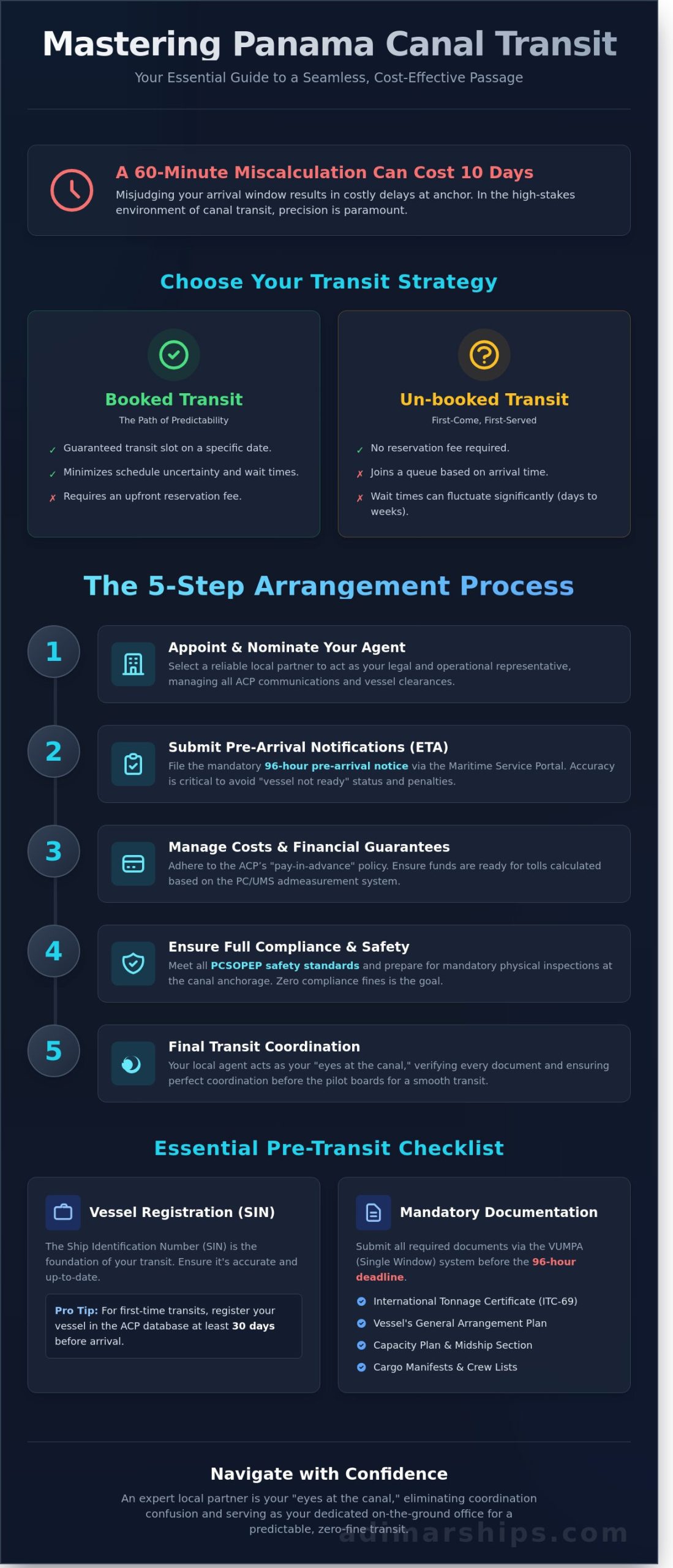
Operators must choose between booked and un-booked transit options. A booking guarantees a specific transit date but requires a reservation fee. Un-booked vessels join a queue based on arrival time and vessel type. In 2026, wait times for un-booked vessels can fluctuate significantly depending on seasonal demand and water levels. Understanding how to arrange panama canal transit involves weighing these costs against your operational schedule. Preparation is the only way to eliminate confusion and maintain your bottom line.
Vessel Registration and the SIN Number
The Ship Identification Number (SIN) is the foundation of every arrangement. It’s a unique, permanent identifier assigned by the ACP. If your vessel is transiting for the first time, you must register it in the ACP database. This process involves submitting technical specifications and ownership details. We recommend starting this at least 30 days before arrival. Maintaining updated particulars is vital. If your vessel’s data doesn’t match the ACP records, you’ll face delays. Accurate data is the bedrock of a smooth panama canal transit because it determines your slot eligibility and pilotage requirements.
Mandatory Admeasurement and Documentation
Admeasurement is the process used to calculate tolls based on the Panama Canal Universal Measurement System (PC/UMS). You’ll need to provide several key documents, including:
- International Tonnage Certificate (ITC-69)
- Vessel’s General Arrangement Plan
- Capacity Plan and Midship Section
- Cargo Manifests and Crew Lists
All documentation must be managed through the VUMPA (Single Window) system. This digital portal streamlines communication between the ship, the agent, and the ACP. Missing the 96-hour submission deadline for arrival notices in 2026 often leads to immediate penalties. We act as your local office, verifying every document to ensure compliance with the latest ACP regulations. Our goal is to make the process transparent and efficient so you can focus on your business.
The 5-Step Process to Arrange Your Vessel’s Passage
Mastering how to arrange panama canal transit starts with precise coordination and a deep understanding of maritime regulations. You can’t afford to misjudge your timing in such a high-stakes environment. Every hour of delay impacts your bottom line, so following a systematic workflow is the only way to ensure a smooth crossing in 2026.
Step 1: Appointing and Nominating Your Agent
Your first move is selecting a reliable partner on the ground. You must officially nominate an owner’s nominated agency to serve as your legal and operational representative. This agent manages the heavy lifting, from Panama Canal Authority (ACP) communications to essential husbandry services. We act as your eyes at the Panama Canal, providing the local presence required to solve operational hitches before they become expensive delays. This legal authority allows your representative to handle documentation and vessel clearances with total transparency.
Step 2: Pre-Arrival Notifications (ETA)
Next, you’ll tackle the 96-hour rule. The ACP requires a comprehensive pre-arrival notification at least four days before your vessel reaches canal waters. This submission must include your cargo type, crew list, and specific health declarations through the Maritime Service Portal. Accuracy is vital. You’ll find the specific technical mandates and updated requirements within the Panama Canal Authority’s Notices to Shipping. If your data is late or inconsistent, the vessel might face a “vessel not ready” status, which pushes you to the back of the queue.
Step 3: Navigating the Booking Periods
Securing a slot is the most competitive part of learning how to arrange panama canal transit. The ACP operates three distinct booking periods to manage traffic flow. Period 1 typically opens 365 days before transit for specific vessel types, while Period 3 is a narrow window occurring just 2 to 7 days before arrival. Choosing the right tier depends on your vessel size and the current traffic density. During peak seasons, slots for Neopanamax ships often sell out within minutes of opening. Having a strategy for these windows is the difference between a 24-hour transit and a week-long wait at the anchorage.
Financial compliance follows the booking phase. You’ll need to complete all toll payments and provide financial guarantees through your agent well before the vessel arrives. The ACP doesn’t offer credit; funds must be cleared and confirmed in their accounts to maintain your slot. Once your ship reaches the Atlantic or Pacific anchorage, your agent works directly with the ACP’s vessel traffic control to finalize the transit schedule. If you want to simplify this complex workflow and protect your interests, nominate a local expert to handle the logistics on your behalf.
Managing Costs, Tolls, and Financial Guarantees
Financial planning is the most critical hurdle when you learn how to arrange panama canal transit. The Panama Canal Authority (ACP) operates on a strict “pay-in-advance” basis. No vessel enters the water without a cleared deposit. This isn’t just about the base toll. It includes tugboat assistance, pilotage fees, and linesmen services. Total costs can fluctuate based on the vessel’s dimensions and the specific locks used. Since 2024, the ACP has simplified some structures, but the requirement for liquid funds remains absolute.
Your local partner manages these complexities to prevent delays. Transparency in ship agency panama financial reporting ensures you aren’t surprised by hidden costs. We act as your eyes on the ground, ensuring every dollar is accounted for before and after the transit. Mismanaging the deposit can lead to a vessel being bumped from its slot, causing cascading delays in your schedule.
Toll Calculation and the Transit Deposit
Tolls depend on the Panama Canal Universal Measurement System (PC/UMS). The ACP calculates these based on vessel type, size, and displacement. A 10,000 TEU container ship pays significantly more than a bulk carrier. The Transit Deposit usually exceeds the estimated cost by 10% to 15% to cover contingencies like extra tug usage or unexpected delays. Agents handle the reconciliation process, returning surplus funds once the ACP issues the final invoice; this typically takes 30 to 60 days. To ensure compliance and avoid fines, vessels must follow established shipping safety fairways when approaching the locks.
The Transit Auction System
Sometimes the standard booking slots are full. This is common during peak seasons or when water levels fluctuate. The ACP uses an auction system for “last-minute” slots. These can be expensive. In some high-demand periods, winning bids have reached seven figures. Operators must weigh the cost of the auction against the daily burn rate of a vessel sitting at anchor. We help you run the numbers to see if an auction bid makes commercial sense for your voyage. It’s about protecting your bottom line while keeping your cargo moving on time.
- Base Tolls: Calculated via PC/UMS tonnage.
- Ancillary Fees: Includes pilots, tugs, and security charges.
- Buffer Funds: Essential for covering variable operational costs.
- Audit Trail: Professional agents provide detailed disbursement accounts (DAs).
Compliance and Safety: PCSOPEP and Inspections
Safety isn’t optional when you learn how to arrange panama canal transit. The Panama Canal Authority (ACP) enforces rigorous standards to prevent environmental damage and operational bottlenecks. Every vessel must pass a physical inspection at the Pacific or Atlantic anchorage before receiving the green light to enter the locks. This process verifies that your ship is mechanically sound and that your crew is prepared for the unique stresses of the canal’s lock system.
Failing to meet these standards leads to more than just delays. It often results in “vessel not ready” charges and heavy fines that can exceed $5,000 for serious equipment deficiencies. Our role is to act as your eyes on the ground, ensuring every document is filed and every piece of equipment is tested before the Boarding Officer steps onto your deck.
The PCSOPEP Authorized Person Requirement
Vessels exceeding 400 gross tons must strictly follow the Panama Canal Shipboard Oil Pollution Emergency Plan. A core requirement is designating a pcsopep authorized person based in Panama. This individual serves as the 24/7 liaison between the ship and the ACP during an emergency. They possess the legal authority to coordinate cleanup resources and manage funds if a spill occurs. We ensure your designated person is fully certified and ready to respond instantly so your transit stays on schedule.
On-Board Inspections and Canal Equipment
Once your vessel arrives at the anchorage, an ACP Boarding Officer conducts a thorough inspection. They focus on specific hardware required for a safe transit. This includes checking that chocks and bitts meet the exact dimensions for the canal’s locomotives. Pilot ladders must be in pristine condition. A single frayed rope or an unstable step can result in a failed inspection and a cancelled slot. The officer also verifies bridge visibility and the reliability of the main engine’s reversing capability.
- Bridge Visibility: The ACP requires a clear view of the water surface from the bridge.
- Sanitary Clearances: All crew health documents must be updated to prevent quarantine delays.
- Security Clearances: Cargo manifests must match the pre-arrival digital declarations exactly.
- Mooring Gear: All winches and lines must be tested and operational for lock maneuvers.
Common compliance pitfalls often involve malfunctioning AIS units or outdated charts. We help your crew double-check these items 48 hours before arrival. This proactive approach eliminates the confusion that often plagues ship operators who try to manage these details from a distance. We are experts so you don’t have to be.
Adimar Shipping: Your Expert Partner for Canal Coordination
Misjudge your timing at the Panama Canal and you lose money. It’s that simple. Coordination is often frustrating for ship operators, but Adimar Shipping eliminates the confusion with over 20 years of local expertise. We are experts so you don’t have to be. We serve as your local office at the Panama Canal, acting as your eyes and ears on the ground to ensure every detail of your crossing is handled with precision. Knowing how to arrange panama canal transit involves more than just filling out forms; it requires a partner who understands the local nuances of the 2026 maritime landscape.
Our team understands that time is your most valuable asset. We provide a personalized, cost-conscious agency service that prioritizes your bottom line. By putting your transit in our hands, you gain a partner dedicated to transparency and efficiency. We don’t just process paperwork. We manage the entire lifecycle of your transit to prevent costly bottlenecks. Our role is to protect your interests and ensure your vessel moves through the locks without unnecessary friction.
Proactive Communication and Quick Solutions
Operational success depends on information. Adimar provides 24/7 monitoring of your vessel’s progress and schedule. Our team delivers real-time updates to keep your operations department informed at every stage. We also manage essential husbandry services alongside the transit, ensuring that crew changes, bunker deliveries, and spare part arrivals happen without delaying your slot. We handle the logistics so your crew can focus on safe navigation.
- Constant tracking of Panama Canal Authority (ACP) schedule changes and draft restrictions.
- Immediate problem-solving for technical or administrative hurdles at the locks.
- Coordination of local vendors to maximize your time in port and reduce idle hours.
Nominate Adimar for Your Next Transit
If you’re looking for how to arrange panama canal transit with zero stress, the process starts with a simple nomination. Appointing Adimar as your trusted agent is a straightforward process designed to get your vessel moving quickly. We pride ourselves on integrity in every transaction, providing clear cost breakdowns and honest advice regarding transit slots and requirements. We don’t hide fees or surprise you with unexpected costs at the end of the voyage.
To start your transit arrangement, contact us today for a comprehensive quote. Our team will review your vessel specifications and provide a detailed plan for an efficient, hassle-free canal crossing. Let us handle the complexities while you focus on your core business. We’ve spent two decades perfecting the art of the transit, and we’re ready to put that experience to work for your fleet.
Streamline Your 2026 Panama Canal Operations
Navigating the complexities of the waterway requires more than just a schedule. Success depends on mastering the 5-step arrangement process and maintaining strict PCSOPEP compliance to avoid operational delays. Timing is everything in the maritime world, and misjudging your window can lead to significant financial losses. When you’re determining how to arrange panama canal transit for your vessel, having a partner who acts as your local office makes the difference between a smooth passage and a logistical nightmare.
Adimar Shipping brings 20+ years of maritime expertise in Panama directly to your fleet. As an authorized PCSOPEP service provider, we offer a dedicated 24/7 local coordination team to manage every inspection and financial guarantee with complete transparency. We’re your eyes at the Panama Canal, so you don’t have to worry about the technical hurdles. Put your transit in our hands and eliminate the confusion with our personalized, expert service.
Get a Quote for Your Panama Canal Transit Arrangement
Your vessel’s next successful crossing starts with the right local partner on the ground.
Of course, the world of shipping isn’t just about high-stakes logistics. For a more relaxed maritime experience, you can explore Nearshore Fishing to see what recreational charters have to offer.
Frequently Asked Questions
How far in advance should I arrange my Panama Canal transit?
You should book your transit up to 365 days in advance to secure a specific date, especially for Neopanamax vessels. The Panama Canal Authority (ACP) releases booking slots in three distinct periods, starting one year out and narrowing down to 2 days before arrival. For non-booked transits, you must submit your request at least 96 hours before arrival to avoid administrative delays and higher costs.
Can I transit the Panama Canal without a local agent?
You cannot transit the Panama Canal without a local agent because ACP regulations require all vessels to have a representative based in Panama. This agent handles all legal, financial, and logistical requirements with the canal authorities. We act as your eyes at the Panama Canal, ensuring your vessel meets all 2026 safety standards and documentation needs while managing the entire process on your behalf.
What is the Ship Identification Number (SIN) and how do I get one?
The Ship Identification Number (SIN) is a unique, permanent identifier assigned by the ACP to every vessel that uses the waterway. To get one, your agent must register the ship in the Maritime Service Portal and provide the vessel’s technical specifications. This number stays with the ship for its entire life, regardless of name changes, and is mandatory for how to arrange panama canal transit.
What happens if my vessel arrives later than the scheduled ETA?
If your vessel arrives after its scheduled ETA, you’ll likely lose your booking slot and face a late arrival fee. The ACP cancellation fee can equal 100 percent of the booking fee if the delay is significant. Your ship will then be moved to the arrival queue, which can result in a wait time of 4 to 10 days depending on current traffic levels and weather conditions.
Are there different requirements for Panamax and Neopanamax vessels?
Yes, requirements differ significantly between the two vessel classes. Panamax vessels are limited to a beam of 106 feet and use the original locks, while Neopanamax ships can have a beam of up to 168 feet and must use the newer locks. Neopanamax transits also require more tugboats and have stricter visibility requirements from the bridge to ensure safe passage through the tighter 2026 tolerances.
How are Panama Canal tolls paid and when are they due?
Panama Canal tolls must be paid in full at least 48 hours before the scheduled transit date. The ACP doesn’t offer credit, so funds must be cleared in their account before the ship enters canal waters. Payments are typically handled through your agent, who calculates the exact amount based on the vessel’s PC/UMS tonnage or TEU capacity as of January 2026.
What is a PCSOPEP Authorized Person and is it mandatory?
A PCSOPEP Authorized Person is a Panama-based representative who can make decisions during an oil spill emergency. This is mandatory for all vessels with a fuel carrying capacity of 400 metric tons or more. You must have a contract with an approved Oil Spill Response Organization (OSRO) and name your Authorized Person in the vessel’s spill response plan to comply with ACP regulations.
How long does a typical Panama Canal transit arrangement take to finalize?
Finalizing how to arrange panama canal transit usually takes 14 to 21 days for first-time vessels. This window allows for SIN registration, document verification, and fund transfers. For vessels already in the system, the process is faster, but we recommend starting the paperwork 30 days before arrival to handle any unforeseen compliance issues or changes in canal traffic regulations.