

In the world of maritime logistics, time is money-and nowhere is this truer than at the Panama Canal. The process to secure a Panama Canal booking slot can feel like a high-stakes gamble, fraught with confusing rules and the constant risk of costly errors. Misjudge the timing, and you face staggering demurrage costs; misunderstand the auction system, and you could overpay by thousands of dollars. For ship owners and charterers, this uncertainty can lead to significant operational and financial disruptions.
We are experts so you don’t have to be. This step-by-step guide is designed to eliminate the confusion and give you a clear, strategic advantage. We will walk you through the entire process, from understanding the official booking periods and preparing documentation correctly to navigating the auction with a cost-conscious strategy. You will gain the confidence and clarity needed to plan a reliable transit schedule, protecting your vessel, your timeline, and your bottom line.
Key Takeaways
- Master the strategic timeline by understanding the three distinct booking periods, each offering a different opportunity to reserve your transit well in advance.
- Discover how the daily auction system provides a high-stakes, last-minute opportunity for a confirmed transit when regular slots are unavailable.
- To successfully secure a panama canal booking slot, you must have precise vessel documentation ready, as incomplete information is a primary cause of delays.
- Learn how the first-come, first-served system for un-booked vessels works, providing a clear path for transit even without a prior reservation.
Understanding the Panama Canal Booking System: Key Concepts
In the world of global shipping, time is money. Misjudge your timing at one of the world’s most critical maritime chokepoints, and the costs can be staggering. This is why the Panama Canal Authority (ACP), the autonomous government agency managing the waterway, created the Transit Reservation System. Its core purpose is simple but essential: to provide predictability for shipping lines. Understanding this system is the first step to a smooth, cost-effective transit through the historic Panama Canal.
Before diving into the process, it’s crucial to grasp a few fundamental terms:
- ETA (Estimated Time of Arrival): The date and time your vessel is expected to arrive at the Canal terminal waters. This is a critical data point for the entire booking process.
- Booking Slots: A limited number of daily reservations that guarantee transit on a specific date. These are the valuable commodities you are competing for.
- Vessel Categories: Ships are classified by size (e.g., Neopanamax, Panamax) and type, which affects booking availability and fees.
- Transit Fees: The total cost for passage, which includes tolls based on vessel size and cargo, plus any applicable booking fees.
Booked Transits: The Path to Predictability
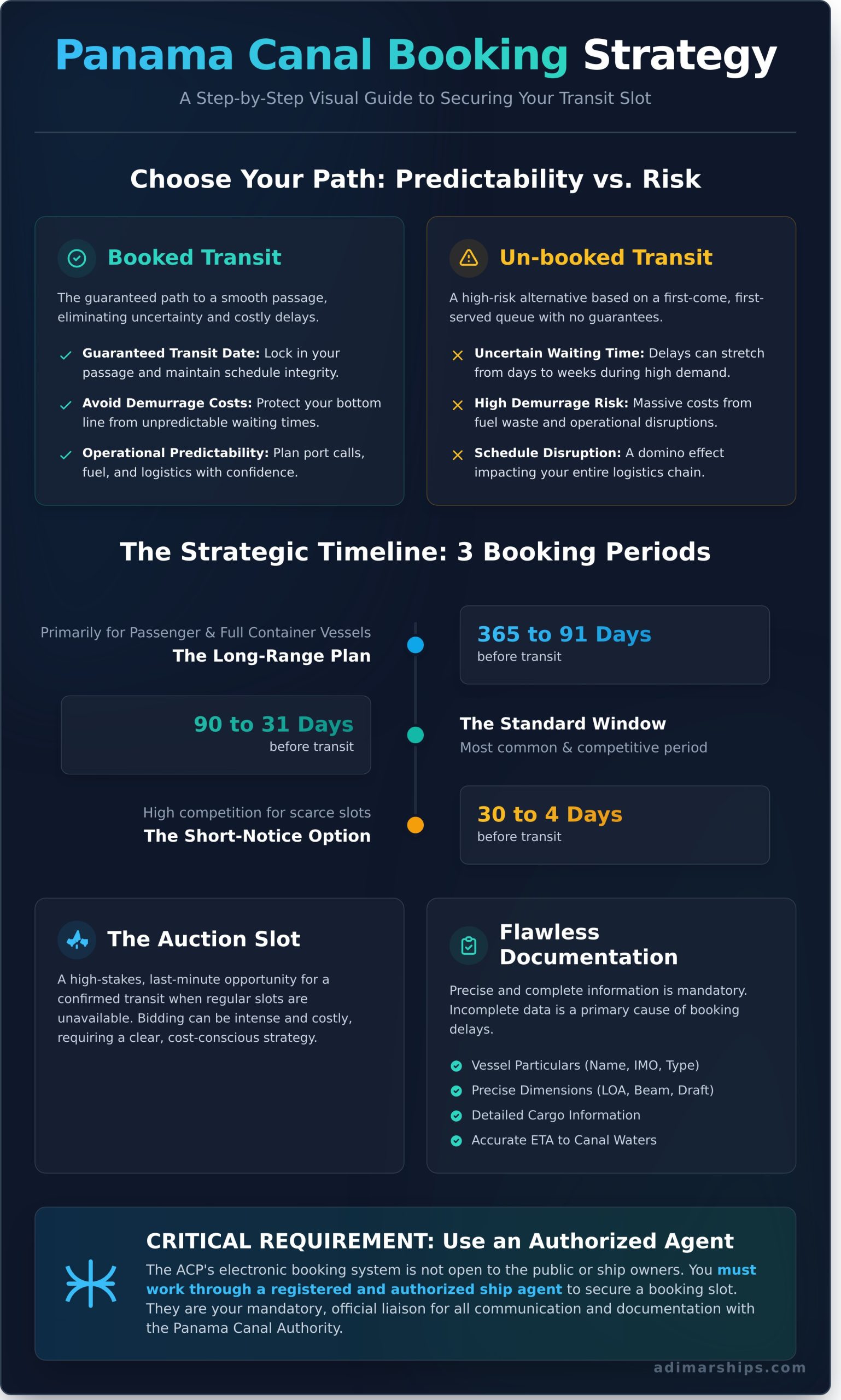
A booked transit is your guarantee of passage on a specific date. While it requires an upfront booking fee, this cost is a sound investment against the immense financial risk of unpredictable delays. For vessels carrying time-sensitive cargo or operating on tight commercial schedules, a booked slot is non-negotiable. It allows you to coordinate port calls, manage fuel consumption efficiently, and provide reliable service to your clients. This predictability is the key to a profitable voyage.
Un-booked Transits: The High-Risk Alternative
Opting for an un-booked transit means entering a first-come, first-served queue. While you save on the initial booking fee, you expose your operation to significant uncertainty. During periods of high demand or unforeseen disruptions, waiting times can stretch from a few days to several weeks. These delays translate directly into massive demurrage costs, fuel waste, and severe schedule disruptions that can have a domino effect on your entire operation.
Who Can Make a Reservation?
This is where expertise becomes essential. The ACP’s electronic booking system is not open to the public or to individual ship owners. To secure a Panama Canal booking slot, you must work through a registered and authorized ship agent. This isn’t an optional step; it’s a mandatory requirement. Your agent acts as your official liaison with the ACP, handling all communications, submitting the necessary documentation, and navigating the complexities of the system on your behalf. They are your eyes and ears on the ground in Panama.
The Three Booking Periods: A Strategic Timeline for Securing Your Slot
In the world of Canal transits, timing isn’t just important-it’s everything. The Panama Canal Authority (ACP) operates a structured, three-tiered system to manage demand and ensure an orderly flow of traffic. Understanding this timeline is the foundation of our strategy to secure a panama canal booking slot for your vessel without costly delays. Each period serves a distinct purpose, and aligning your vessel’s needs with the right window is the first step toward a seamless transit.
Booking Period 1: The Long-Range Plan
Opening a full year in advance (365 to 91 days before transit), this first window is designed for vessels with predictable, long-term schedules. It is primarily utilized by passenger vessels and full container ships operating on fixed liner services. For these operators, securing a slot is not just about passage; it’s about upholding a global logistics chain. The strategy here is foresight-locking in transit dates to guarantee schedule integrity and operational certainty.
Booking Period 2: The Standard Window
This is the most common and competitive window, opening from 90 to 31 days prior to the requested transit date. It caters to a broad range of commercial vessels, from bulk carriers and tankers to general cargo ships. Success in this period demands preparation and speed. As Adimar Shipping, Inc., we ensure all vessel data is verified and ready for immediate submission the moment slots are released via the official Panama Canal Authority’s booking system. Acting decisively when the window opens is critical.
Booking Period 3: The Short-Notice Option
From 30 down to just 4 days before transit, this final period is for last-minute arrangements. While it offers flexibility, it comes with significant challenges: slot availability is scarce, and competition is intense. This window is not a reliable primary strategy but can serve as a crucial option for unexpected itinerary changes. Success here depends entirely on agility and constant vigilance-requiring Adimar Shipping, Inc. to monitor the system daily and act instantly when an opportunity arises.
Navigating these distinct periods requires a tailored approach. Choosing the right window is the most critical step to secure a Panama Canal booking slot efficiently and cost-effectively. Put our expertise to work, and let us handle the timing so you can focus on your business.
The Auction Slot: A High-Stakes Bidding Process for Priority
In the competitive world of Panama Canal transits, time is money. When all standard booking periods are full or an urgent passage is required, the daily auction slot becomes the critical, high-stakes path forward. This is not a standard reservation; it is a competitive bid for priority passage, offered by the Panama Canal Authority (ACP) to the highest bidder.
The process is managed through the ACP’s official platform, a key component of the revamped booking system. Each day, a limited number of these slots become available for upcoming transit dates. The price is anything but fixed, fluctuating dramatically based on several key factors:
- Canal Congestion: High traffic and long queues of non-booked vessels drive prices up significantly.
- Seasonality: Peak seasons for specific trades, like grain or LNG, can create intense bidding wars.
- Vessel Type: The demand for Neopanamax slots often outpaces that for Panamax, leading to higher auction prices.
Participating in the auction carries substantial financial risk. A miscalculated bid can lead to overpaying by tens of thousands of dollars, directly impacting your voyage’s profitability. Conversely, bidding too low and losing the auction results in costly waiting times at anchorage. This is where expert guidance becomes invaluable to secure a panama canal booking slot without sacrificing your budget.
When is an Auction Slot Necessary?
An auction slot is your go-to solution under specific, time-sensitive circumstances. Consider this option when you need to:
- Bypass a fully booked transit date that is essential for your schedule.
- Accommodate an urgent or last-minute transit that missed all standard booking windows.
- Gain guaranteed priority over other non-booked vessels waiting for the same day, minimizing expensive delays.
How to Strategize for the Auction
Winning an auction at a fair price requires more than just a high bid; it requires strategy and local intelligence. Your ship agent is your crucial partner, monitoring historical auction data and current congestion levels to gauge a realistic bid amount. We help you establish a clear budget and define your break-even point, ensuring your bid is both competitive and commercially sound. Navigating this process alone is a gamble. Let us manage the auction complexities for you.
Required Documentation and Information for a Flawless Booking
The Panama Canal Authority (ACP) operates with meticulous precision, and so must the information submitted for transit. A single missing detail or inaccurate number can lead to an immediate rejection of your application, causing costly delays and jeopardizing your schedule. To successfully secure a Panama Canal booking slot, providing complete and accurate data on the first attempt is not just a goal-it’s a requirement.
At the heart of this process is the Ship Information and Quarantine Declaration (SIQD), a comprehensive form that must be filed correctly. Submitting this with incomplete or erroneous data will stop your booking in its tracks.
Vessel Particulars Checklist
Your agent will require the following core details to begin the ACP application process. Ensure this information is up-to-date and exact:
- Identification: Vessel Name, IMO Number, Call Sign, and Flag.
- Tonnage: Gross Tonnage (GT) and the critical Panama Canal Net Tonnage (PC/UMS), which is used for toll calculations.
- Dimensions: Length Overall (LOA), extreme beam (including any overhangs), and your vessel’s maximum tropical saltwater draft.
- Unique Features: A declaration of any protrusions, such as cranes or specialized equipment, that could impact the transit.
Cargo and Transit Information
Clarity on your vessel’s purpose and journey is mandatory. The ACP needs to know the precise nature of your cargo, especially if it includes any dangerous goods which are subject to strict regulations. You must also provide the vessel’s last port of call and its intended next port of call after the transit, along with a reliable Estimated Time of Arrival (ETA) at the designated Canal terminal.
The Role of Your Agent in Data Verification
In the high-stakes environment of Canal transits, your agent is your first and most important line of defense against errors. A professional agent doesn’t just submit your data; they meticulously pre-vet every detail. This proactive verification is essential to secure a Panama Canal booking slot without complications. They cross-reference information, identify potential red flags, and ensure all submissions comply with the latest ACP regulations. This simple step prevents the costly rejections and delays that result from clerical errors, allowing you to focus on your business. As your eyes at the Panama Canal, a trusted partner like Adimar Shipping, Inc. ensures your application is flawless from the start.
What If You Can’t Secure a Slot? Navigating an Un-booked Arrival
Even with meticulous planning, it’s not always possible to secure a panama canal booking slot, especially during periods of high demand. This is a significant concern for ship owners and charterers, but it doesn’t mean your transit is impossible. Vessels without a reservation enter a first-come, first-served (FCFS) system, which requires arriving at the designated anchorage area and waiting for an opening.
While this system provides a path forward, it introduces significant uncertainty. Your vessel joins a queue with no guaranteed transit date, turning a precisely planned voyage into a costly waiting game. This is where logistical and financial chaos can begin, as every hour spent at anchor erodes your bottom line.
The Reality of Waiting Times
Waiting times for un-booked vessels are notoriously unpredictable, fluctuating from a single day to over a week. The length of the queue is influenced by numerous factors, including seasonal traffic, adverse weather conditions like fog, and any unscheduled maintenance at the Canal. These delays have a direct financial impact. For a mid-sized vessel, a five-day wait could easily accumulate over $150,000 in costs from:
- Demurrage: Charter party penalties for delays.
- Fuel Consumption: Running auxiliary engines while at anchor.
- Crew & Provisions: Daily operational overhead.
How an Agent Manages the Un-booked Process
Navigating an un-booked arrival without an experienced agent is a high-risk strategy. As your eyes at the Panama Canal, an agent transforms uncertainty into a managed process. We provide constant communication with the Panama Canal Authority (ACP) to monitor queue movement and identify potential transit opportunities. This allows us to give the master accurate, real-time updates, manage expectations, and coordinate essential husbandry services like bunkers, fresh water, or provisions while you wait. We handle the complexity on the ground so you can focus on your business.
Don’t leave your transit to chance. Nominate Adimar as your agent.
Secure Your Transit with Confidence
Navigating the Panama Canal Authority’s (ACP) system requires strategic timing across the three booking periods and meticulous preparation of all required documentation. From standard reservations to the high-stakes auction, every step demands precision. While this guide provides the essential knowledge, the most efficient way to secure a panama canal booking slot is by partnering with a local expert who manages these complexities daily.
In an industry where time is money, don’t leave your transit to chance. For over 20 years, Adimar Shipping has served as a trusted Panama Canal ship agent, offering expert navigation of the ACP’s complex booking and auction systems. We are your eyes at the Canal, providing the proactive communication and 24/7 on-the-ground support needed to eliminate confusion and protect your interests. Put your transit in our hands so you can focus on your business.
Secure your transit with an expert. Request a quote from Adimar Shipping.
Frequently Asked Questions About Panama Canal Bookings
How much does a Panama Canal booking slot cost?
The cost to book a Panama Canal transit slot is not a single flat fee. It varies significantly based on your vessel’s size (PC/UMS), type, and the specific booking period. While the Panama Canal Authority (ACP) sets standard booking fees, which can range from $35,000 to over $100,000, slots sold via auction during high-demand periods can cost considerably more. An experienced agent can provide a precise cost estimate based on your vessel’s details and current canal conditions.
Can I change my booked transit date after it’s confirmed?
Changing a confirmed transit date is possible but challenging and subject to strict ACP regulations and slot availability. Options may include substituting the slot with another vessel from the same customer or swapping dates with another booked vessel. Both processes involve fees and require expert coordination to navigate successfully. We strongly advise planning carefully to avoid the need for changes, but if it becomes necessary, your agent is essential for managing the complex procedure.
What happens if my vessel arrives late for its booked slot?
Punctuality is critical. If your vessel misses its scheduled arrival time, you will forfeit the booked slot and all associated fees. The vessel then loses its priority status and is placed in the queue for non-booked vessels, which can lead to significant and costly delays of several days or even weeks. Proactive communication and diligent voyage planning with your local agent are the best ways to prevent this expensive outcome and ensure a timely transit.
Are there different booking rules for Neopanamax vs. Panamax vessels?
Yes, the booking systems and rules are distinct. Neopanamax vessels, which use the larger locks, compete for fewer, high-demand slots through a separate booking system with different allocation periods and often higher fees. Panamax vessels use the original locks, which have more daily slots available. However, competition remains fierce for both. Understanding the nuances of each system is vital to successfully secure a Panama Canal booking slot for your specific vessel class.
How does the ACP’s Customer Ranking influence slot allocation?
The ACP Customer Ranking is a loyalty system that gives priority to frequent users. A higher ranking provides a significant advantage during the slot allocation process, particularly in the first booking period. It increases the probability of obtaining a slot on your desired date. This system rewards shipping lines with a consistent history of transits, making a strong, long-term relationship with the Canal and your agent a valuable asset for securing reliable passage through this critical waterway.
Why can’t I book a transit slot myself as a ship owner?
The Panama Canal Authority (ACP) mandates that all vessels must nominate a licensed, local shipping agent to handle their transit. This agent is legally responsible for all communications, managing the pre-payment of tolls and fees, and ensuring full compliance with Canal regulations. This requirement guarantees a single, accountable point of contact for the ACP, ensuring operational efficiency and safety. Your agent acts as your trusted representative on the ground in Panama.