
In the world of shipping, time is money. Yet for a Panama Canal transit, complex toll structures, unexpected fees, and the risk of costly delays can quickly derail a voyage budget. The fear of a surprise bill or a miscalculation in the required pre-payment can create significant financial stress for any ship operator. Effective panama canal transit financial management is therefore not a luxury, but a critical component of a profitable operation. It’s about moving beyond simply paying the fees to strategically controlling every dollar spent.
This guide is designed to be your trusted partner in achieving that control. We will demystify the financial complexities of the Canal, providing a clear framework for accurate cost forecasting and proactive cost reduction. You will gain a transparent view of all potential charges-from tolls and booking fees to security and husbandry costs-and learn proven strategies to minimize avoidable expenses. By the end, you will have the confidence and the tools to build a predictable budget, ensuring every transit is not just smooth, but also as cost-effective as possible.
Key Takeaways
- Go beyond the official toll schedule to understand the full financial scope of a transit. Accurate budgeting requires accounting for all variable costs, not just the fixed tariff.
- Master proactive financial control by using a detailed Proforma Disbursement Account (PDA) to accurately forecast expenses and avoid unexpected cash flow issues.
- Shift from simply paying bills to actively reducing them. Effective panama canal transit financial management leverages expert local knowledge to identify savings opportunities and prevent costly penalties.
- View your ship agent as a critical financial partner, not just a service provider. The right agent ensures cost transparency and protects your financial interests at every step.
Beyond Tolls: Deconstructing the Total Cost of a Panama Canal Transit
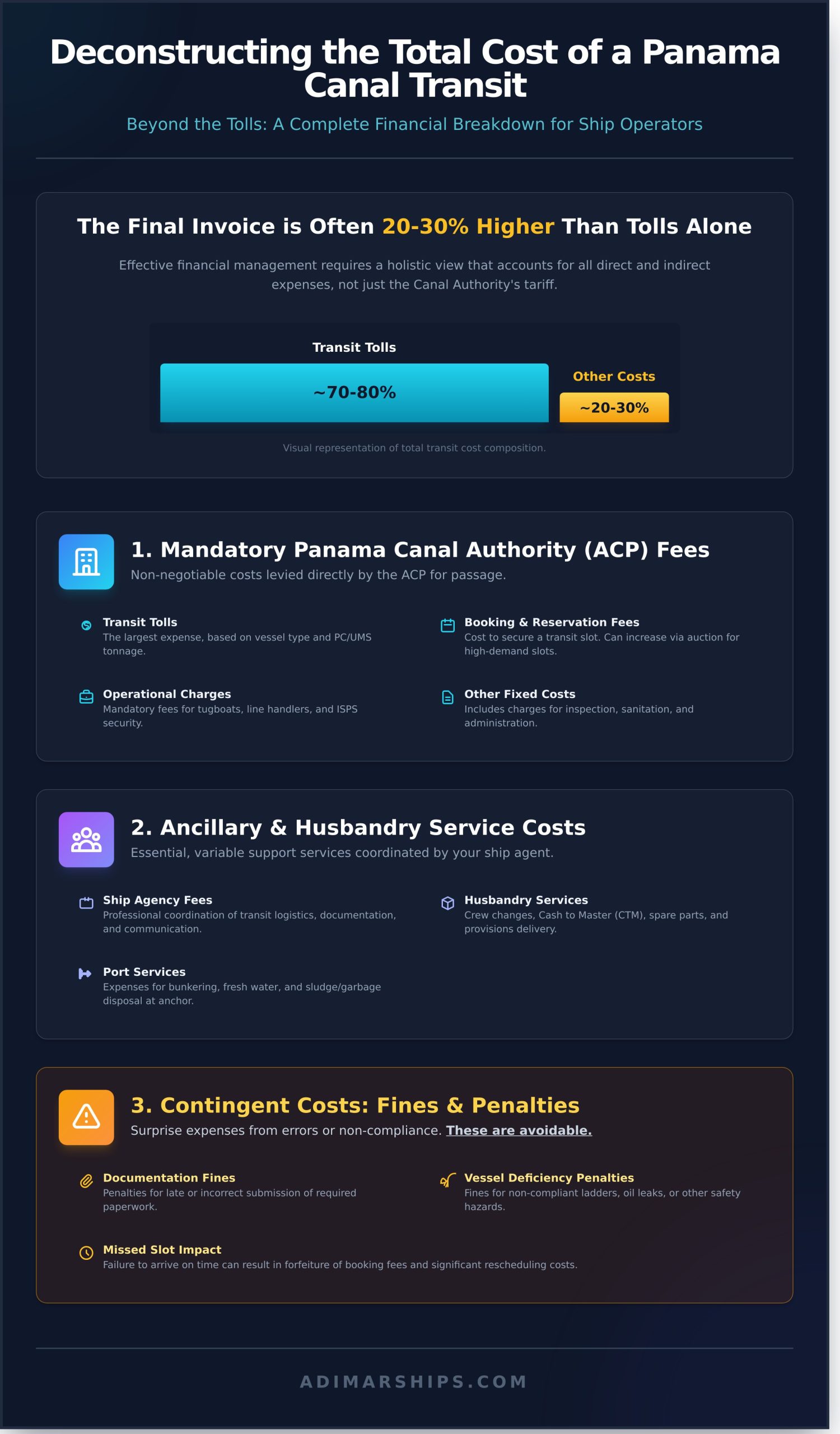
When planning a voyage through this critical waterway, many ship owners and charterers focus solely on the transit tolls. However, this is only one piece of a much larger financial puzzle. Effective panama canal transit financial management requires a holistic view that accounts for all direct and indirect expenses. Misjudging the total cost can lead to budget overruns and operational delays. In our experience, the total cost can be broken down into three primary categories: mandatory Authority fees, essential ancillary services, and avoidable contingent costs.
For a standard Panamax vessel, while the toll might be a significant figure, the final invoice can be 20-30% higher once all other charges are included. Understanding this complete picture is the first step toward a cost-conscious and efficient transit.
Mandatory Panama Canal Authority (ACP) Fees
These are the non-negotiable costs levied directly by the Panama Canal Authority (ACP) for passage. Since its opening, as detailed in the comprehensive History of the Panama Canal, the Authority has established a structured fee system. Being prepared for these fixed costs is fundamental to your budget.
- Transit Tolls: The largest single expense, calculated based on the vessel’s type and Panama Canal Universal Measurement System (PC/UMS) tonnage.
- Booking & Reservation Fees: Costs to secure a transit slot in advance. High-demand slots are sometimes sold via an auction system, which can significantly increase this fee.
- Operational Charges: Mandatory fees for resources like tugboats, line handlers, and security personnel to meet International Ship and Port Facility Security (ISPS) code requirements.
- Other Fixed Costs: Includes smaller charges for vessel inspection, sanitation, and other administrative services.
Ancillary & Husbandry Service Costs
Beyond the ACP, a vessel requires numerous support services that are coordinated by your local ship agent. These costs are variable but essential for a smooth operation. A trusted agent provides transparency and works to manage these expenses efficiently on your behalf.
- Ship Agency Fees: The fee for professional coordination of all transit logistics, documentation, and communication with the ACP.
- Husbandry Services: This broad category includes arranging crew changes, delivering Cash to Master (CTM), and coordinating the delivery of spare parts or provisions.
- Port Services: Expenses for bunkering, receiving fresh water, and arranging for sludge or garbage disposal while at anchor.
Contingent Costs: Fines and Penalties
This final category represents the avoidable expenses that result from errors or non-compliance. These are the surprise costs that can derail a budget, but they can be mitigated with expert oversight. Proactive panama canal transit financial management focuses on eliminating these risks.
- Documentation Fines: Penalties for late or incorrect submission of required paperwork to the ACP.
- Vessel Deficiency Penalties: Fines issued during inspection for issues such as a non-compliant pilot ladder, oil leaks, or other safety hazards.
- Missed Slot Impact: Failing to arrive on time for a booked transit can result in forfeiture of the booking fee and significant rescheduling costs.
Proactive Financial Planning: How to Forecast and Budget Your Transit
In the world of maritime logistics, where time is money, surprises are rarely good for the bottom line. The foundation of effective panama canal transit financial management is proactive and precise forecasting. Guesswork leads to budget overruns and operational delays. A detailed financial plan, created in partnership with your ship agent, provides the control and predictability needed to protect your voyage’s profitability.
This process begins with one critical document: the Proforma Disbursement Account (PDA). This is not merely an estimate; it is the master budget for the entire port call, detailing every anticipated expense from tolls to tugboats.
Creating a Proforma Disbursement Account (PDA)
A PDA serves as a transparent financial roadmap for your vessel’s transit. To create an accurate one, your agent requires specific vessel particulars. This data allows them to meticulously calculate all expected costs, cross-referencing details with the Official Panama Canal Tariffs and other service provider rates. At Adimar, we believe a PDA must be built on integrity, with no hidden fees.
- Vessel Data: Gross Tonnage (GT), Net Tonnage (NT), Panama Canal/Universal Measurement System (PC/UMS) tonnage.
- Dimensions: Length Overall (LOA), beam, and draft.
- Cargo Information: Type and tonnage of cargo on board.
Budgeting for Variables and Contingencies
While many transit costs are fixed, some are variable. Factors like participating in the transit reservation auction to secure a specific slot can introduce costs that fluctuate with demand. Furthermore, your vessel’s arrival time can impact expenses, potentially incurring overtime charges for pilots or line handlers. A key element of strong panama canal transit financial management is planning for the unexpected. We advise including a contingency fund (typically 5-10% of the total PDA) to cover unforeseen issues like minor delays, inspections, or urgent husbandry needs.
Reviewing and Approving the PDA
When you receive a PDA, review it carefully. Verify that all vessel details are correct, as even small errors can alter the final cost. Scrutinize each line item and do not hesitate to ask your agent to clarify any bundled or unclear charges like “miscellaneous” or “sundries.” A trusted partner will welcome your questions and provide clear, documented answers. This review process is your final check to ensure the budget is both comprehensive and fair before committing funds.
Ready for a clear financial picture of your next crossing? Let us prepare a transparent, no-obligation PDA for your next transit.
Strategic Cost Optimization: Minimizing Expenses and Avoiding Penalties
Effective panama canal transit financial management is not about passively paying tolls; it’s a proactive strategy to control every variable cost. Miscalculations in scheduling or minor compliance oversights can lead to thousands of dollars in unnecessary expenses. Shifting your mindset from simply paying for a transit to actively managing its cost is the first step toward a more profitable voyage. This is where the expertise of a local agent transforms from a service into a powerful financial tool, turning local knowledge into tangible savings.
Optimizing Booking and Scheduling
Securing a transit slot involves a careful balance of cost and certainty. Booking further in advance (Period 1) offers the best rates but requires a fixed schedule, while later periods provide flexibility at a higher price. An experienced agent provides crucial insight into slot availability and can advise on the most cost-effective option for your vessel’s itinerary. While the auction system can secure a last-minute slot, it requires deep market intelligence to avoid costly bidding wars. Understanding the complex fee system is essential, and this Panama Canal Toll Structure Explained guide provides a detailed overview. Ultimately, precise coordination minimizes costly anchorage time, directly protecting your bottom line.
Ensuring Vessel Compliance to Avoid Fines
The Panama Canal Authority (ACP) maintains some of the strictest maritime regulations in the world, and non-compliance results in immediate and easily avoidable fines. As your eyes at the Canal, we conduct rigorous pre-arrival checks and documentation audits to ensure full compliance. This proactive verification prevents penalties related to:
- Incorrect pilot ladder or mooring arrangements.
- Outdated vessel drawings or missing certificates.
- Non-compliance with PCSOPEP or other environmental regulations.
These seemingly small details carry significant financial risk, which a diligent agent eliminates before your vessel even arrives in Panamanian waters.
Cost-Effective Husbandry and Procurement
Beyond tolls and fees, significant savings can be found in husbandry services. As your trusted local partner, we leverage our long-standing relationships with vetted vendors to secure preferred pricing on everything from provisions and spare parts to medical services and crew changes. We streamline procurement and coordinate deliveries efficiently, often using a single launch boat for multiple services to reduce mobilization costs. This integrated approach to panama canal transit financial management ensures that every dollar spent on necessary services is optimized for value and efficiency, reflecting our commitment to integrity and cost-consciousness.
Managing Transit Funds: Prepayment, Cash Flow, and Final Invoicing
In the world of canal transits, the old saying “time is money” is a fundamental truth. A critical component of successful panama canal transit financial management is ensuring funds are available exactly when needed. Missteps in this area can lead to costly delays and operational chaos. As your trusted partner, we eliminate this confusion by managing the entire financial process with precision and complete transparency.
The Prepayment Process
The Panama Canal Authority (ACP) operates on a strict, non-negotiable prepayment basis. A vessel will not be scheduled for transit until all estimated tolls and fees are paid in full. We typically require funds in our account at least 48 hours prior to the vessel’s arrival. Any delay in transferring these funds directly jeopardizes the vessel’s transit slot, potentially pushing it to the back of the queue and incurring significant daily operational costs.
The Role of the Disbursement Account (DA)
When you transfer funds, they are held in a secure Disbursement Account (DA). Think of us as your local treasury at the Canal. These funds are held in trust specifically for your vessel’s expenses. From this account, we make timely payments to the ACP for tolls and other mandatory fees, as well as to approved local vendors for services like launch boats, line handlers, and agency fees. This process is managed with the utmost integrity, ensuring every dollar is accounted for.
From Proforma (PDA) to Final (FDA)
The financial journey begins with a Proforma Disbursement Account (PDA), which is a detailed estimate of all anticipated costs. After the transit is complete and all services are rendered, we meticulously reconcile every expense against actual invoices. This creates the Final Disbursement Account (FDA). The FDA provides a clear, transparent summary of all transactions. Any surplus funds are promptly refunded to you, or in the rare case of a deficit, a final invoice is issued for the difference.
Effective panama canal transit financial management is about more than just paying bills; it’s about ensuring seamless operations and protecting your bottom line. At Adimar Shipping, we are experts in this process, allowing you to focus on your business with confidence.
Your Ship Agent: The Key to Financial Control and Transparency
In the complex world of maritime operations, it’s easy to view a ship agent as a purely logistical coordinator. However, a truly effective agent is your most critical financial partner on the ground. They are the frontline guardians of your capital, transforming a potentially unpredictable expense into a manageable, transparent cost. Successful Panama Canal transit financial management hinges on selecting an agent who acts as an extension of your own team, prioritizing your financial interests with unwavering integrity.
Choosing the right partner is not just about securing a transit slot; it’s about investing in a smooth, cost-efficient, and profitable passage. Your agent is your local advocate, ensuring every dollar is spent wisely and accounted for.
Financial Oversight and Local Expertise
Your ship agent serves as your local financial controller, your “eyes at the Panama Canal” scrutinizing every transaction. They are responsible for auditing all third-party invoices-from tug services to launch boat fees-to verify their accuracy and fairness. This local expertise is invaluable; an experienced agent can immediately identify common billing errors or inflated charges that would otherwise go unnoticed, preventing costly mistakes and protecting you from unnecessary expenditures.
Transparent Reporting and Communication
Clear, consistent communication is the bedrock of financial trust. A professional agent provides regular updates and maintains an open ledger of all expenses incurred on your behalf. The ultimate proof of this transparency is the Final Disbursement Account (FDA). At Adimar, we provide a detailed and fully vouchered FDA, where every single line item is backed by a corresponding third-party invoice. This commitment to integrity ensures you have a complete, verifiable record of your transit costs, eliminating ambiguity and providing total peace of mind.
Don’t leave your vessel’s profitability to chance. Partner with an agent who protects your bottom line. Nominate Adimar today.
Your Key to Financial Control at the Panama Canal
Navigating the financial complexities of a Panama Canal transit requires more than simply paying tolls. As we’ve explored, true cost control is achieved through proactive budgeting, strategic optimization to avoid penalties, and a clear understanding of the entire cash flow process. Mastering your panama canal transit financial management hinges on vigilance and expertise.
This is where a dedicated partner makes all the difference. For over 20 years, Adimar Shipping has served as a trusted partner for ship operators at the Panama Canal. Our commitment to integrity and full financial transparency ensures you have a clear, accurate picture of all expenses. We have a proven record of cost-conscious and efficient transit management, saving our clients time and money every step of the way.
Take the first step towards a more predictable and cost-effective transit. Request a detailed Proforma Disbursement Account for your vessel’s next transit. Let our team of experts provide the clarity and control you need to navigate with confidence.
Frequently Asked Questions
What is a Proforma Disbursement Account (PDA) and why is it so important?
A Proforma Disbursement Account (PDA) is a detailed, itemized estimate of all anticipated costs for your vessel’s transit, including canal tolls, tugboat services, pilotage, and agency fees. It is the most critical document in Panama Canal transit financial management because the Panama Canal Authority (ACP) requires full prepayment of these estimated costs before confirming a transit slot. An accurate PDA from a trusted agent prevents funding shortfalls, ensuring a smooth and timely passage.
What are the most common unexpected costs or hidden fees during a Panama Canal transit?
Unexpected costs often arise from operational delays or regulatory issues. Common examples include extra anchorage fees due to waiting for a slot, additional tugboat assistance required by the pilot, or fines for non-compliance with sanitary or security protocols. A vigilant ship agent anticipates these variables and maintains clear communication with all parties. We act as your eyes at the Canal to proactively manage these risks and protect your budget from unforeseen expenses.
How does the Panama Canal’s booking and auction system impact the total cost?
The Panama Canal offers a limited number of daily transit slots that can be booked in advance. When demand exceeds supply, the ACP holds auctions for the remaining slots. This system directly impacts your total cost. While a standard booking has a fixed fee, winning an auction slot can add hundreds of thousands of dollars to your transit expenses. Strategic planning with your agent is essential to decide whether booking, waiting, or bidding is the most cost-effective option.
Can I get a refund on transit fees if my vessel’s schedule changes or is cancelled?
The Panama Canal Authority (ACP) maintains a very strict cancellation policy. Generally, booking fees and transit tolls are non-refundable if a transit is cancelled within a few days of its scheduled date. While a full refund is unlikely for last-minute changes, your agent can explore options to minimize financial loss. However, it’s crucial to understand that the final decision rests with the ACP, making schedule certainty paramount to avoid sunk costs.
How do I ensure the ship agent is managing my funds responsibly and transparently?
To ensure responsible fund management, demand a detailed PDA before sending any money. A trustworthy agent will provide this and follow up with a Final Disbursement Account (FDA) after the transit, supported by original invoices for every charge. Choose an agent who values integrity and operates as an extension of your team. Transparent financial practices are a cornerstone of our service, providing you with full visibility and ensuring you know exactly how your funds are being utilized.
What happens if the funds I send are not enough to cover the final transit costs?
If the funds sent are insufficient to cover the ACP’s requirements, your vessel’s transit will be delayed until the balance is paid. This halt can lead to significant additional costs, including daily anchorage fees and severe disruption to your commercial schedule. This situation is entirely preventable with an accurate PDA from an experienced agent. Should an unexpected cost arise, we communicate immediately to arrange a swift supplemental transfer, ensuring the passage continues with minimal interruption.