
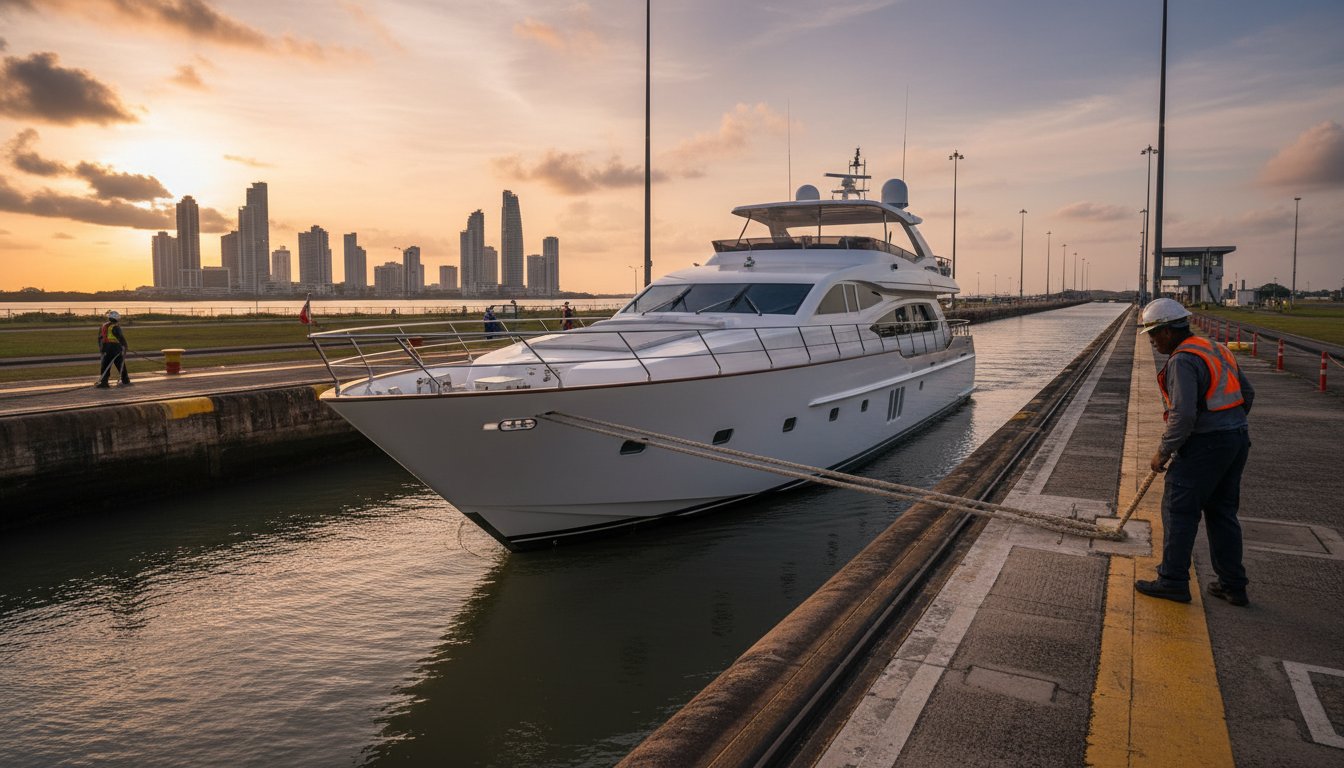
Planning a Panama Canal transit for your yacht in 2026? If you’re already battling glitchy registration portals, wrestling with unclear fee structures, and concerned about language barriers with ACP officials, you are not alone. This complex process is precisely why a smooth panama canal transit for yachts requires more than just a date on the calendar-it demands expert, on-the-ground knowledge and meticulous preparation.
A minor procedural error can lead to costly delays and unexpected fines, turning a milestone voyage into a logistical nightmare. This comprehensive guide is designed to eliminate that confusion, providing the clarity you need for a predictable and successful passage. We are your eyes at the Panama Canal, translating complex regulations into a clear, actionable plan for your crew.
Inside, you will find a transparent breakdown of the entire process, from securing a transit date to the real-world costs and fees you can expect in 2026. We’ll share critical insights on protecting your vessel during lockages and explain why partnering with a trusted local agent is the best insurance for a seamless, stress-free journey. Let’s get you prepared.
Key Takeaways
- Understand the step-by-step ASEM registration and admeasurement inspection to prevent bureaucratic delays before you even arrive at the Canal.
- The “DIY” approach to a Panama Canal transit for yachts carries significant financial risk from potential cancellations; learn how to calculate the true cost versus using an agent.
- Properly equip your vessel for the unique demands of the locks by following a specific checklist for lines, fenders, and cleat strength to ensure a safe passage.
- Discover how 2026 water levels and commercial traffic impact scheduling priority for pleasure craft, and learn key strategies to secure your transit slot.
The Reality of Panama Canal Transit for Yachts in 2026
Planning a panama canal transit for yachts in 2026 requires more foresight than ever. While the rich history of the Panama Canal is one of engineering marvels, its modern operational realities-influenced by fluctuating water levels and record commercial traffic-directly impact your journey. For pleasure craft under 125 feet, the process is a “handline transit,” where line handlers on your vessel manage the lines in the locks. However, in the canal’s hierarchy, yachts have the lowest priority, making your schedule highly vulnerable to delays.
Misjudge your timing and you lose. Every day spent waiting for a slot means mounting costs for marina fees, provisions, and crew, potentially turning a dream passage into a logistical nightmare. Understanding the nuances of a Northbound (Pacific to Atlantic) versus a Southbound transit is the first step, as each direction has its own unique traffic patterns and seasonal pressures that affect scheduling.
The 2026 Slot Scarcity: Why Planning Starts Months Early
The Panama Canal Authority (ACP) manages scheduling through its ASEM system, which overwhelmingly favors commercial ships. This scarcity is intensified in early 2026 by seasonal sailing rallies, creating a bottleneck of vessels vying for limited slots. Your official transit window is the period between your vessel’s admeasurement and the confirmed lockage date, a timeframe that can be unpredictable without expert guidance and proactive planning months in advance.
The Critical Role of Local Presence
This is where having “eyes at the Canal” becomes invaluable. There’s a significant difference between the ACP’s official rules and the on-the-ground reality of daily operations. Communication breakdowns are common, leading to costly delays. Adimar Shipping, Inc. serves as your local office in Panama City and Colon, navigating these complexities for you. We are experts so you don’t have to be, ensuring your transit is managed with integrity and efficiency.
Navigating the 2026 Bureaucracy: Paperwork and Procedures
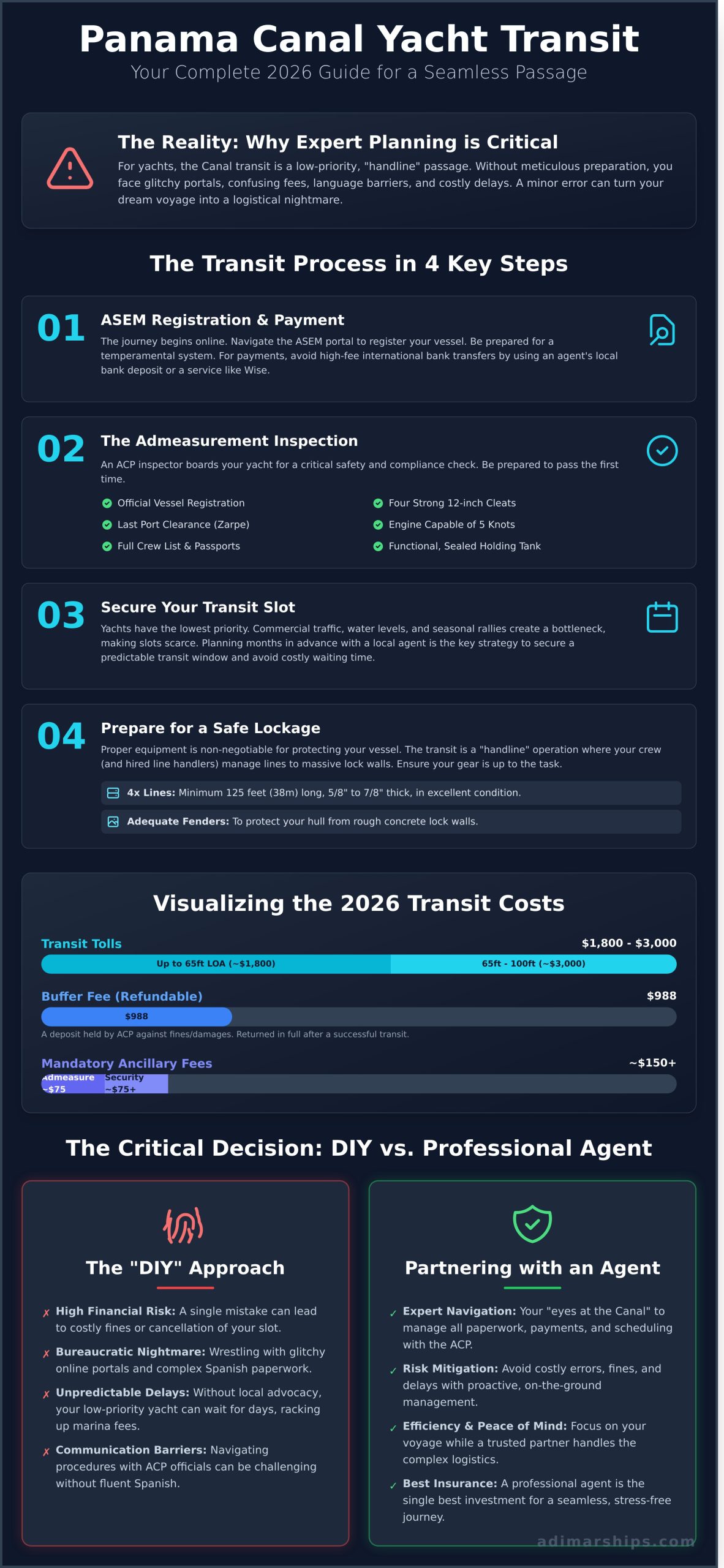
The administrative process for a panama canal transit for yachts can feel as complex as the waterway itself. Misjudge the paperwork, and you face costly delays. However, with clear guidance, the process is straightforward. The journey begins with registering your vessel in the ASEM (Small Craft Service) system and navigating the payment portal, which can be notoriously temperamental. While international bank transfers are an option, they often incur high fees and delays. For efficiency, many owners find using a service like Wise or arranging a local bank deposit through an agent to be the most reliable methods to cover your initial fees.
The Admeasurement Inspection: What to Prepare
Once your initial application is processed, an ACP inspector will visit your yacht for admeasurement. This is not just a formality; it’s a critical safety and compliance check. To ensure you pass on the first attempt, have all your documentation ready and your vessel in top condition. Common failures often stem from simple oversights that are easily avoidable with proper preparation.
- Required Documentation: Have your official Vessel Registration, last port clearance (Zarpe), and a comprehensive crew list with full names and passport numbers easily accessible.
- Vessel Condition: The inspector will verify you have four strong, accessible 12-inch cleats, a reliable engine capable of maintaining 5 knots, and a fully functional, sealed holding tank. An enclosed head (toilet) is mandatory.
- Avoiding Failure: The most common reasons for failing inspection are inadequate mooring cleats, a non-operational holding tank, or an unreliable engine. Address these key areas before scheduling your inspection.
Understanding the 2026 Fee Breakdown
Budgeting accurately requires understanding all associated costs, not just the base toll. The fee structure is designed to be comprehensive but includes several components that can surprise unprepared owners. For the most up-to-date fee schedule, always consult the official Panama Canal Authority (ACP) website, as rates are subject to change.
- Transit Tolls: As of 2026, yachts up to 65ft LOA pay a fixed toll of approximately $1,800. Vessels between 65ft and 100ft fall into a higher bracket, around $3,000.
- The Buffer Fee: This is a refundable deposit, typically $988, held by the ACP to cover potential fines for delays or damages. If your transit is completed without issue, this amount is returned in full, though the refund process can take several weeks.
- Ancillary Costs: Factor in additional mandatory expenses, including the admeasurement fee (~$75), security fees, and costs for renting four 125-foot lines and oversized fenders if you don’t own them. Finally, budget for professional line handlers if your crew is not large or experienced enough.
DIY vs. Professional Agency: Calculating the True Cost
In the age of online information, many yacht owners wonder if they truly need an agent for their Panama Canal transit. While it is technically possible to manage the process independently, the “do-it-yourself” approach often overlooks the most critical variable in Panama: time. Misjudge your timing, and you lose. The true cost isn’t just the transit fee; it’s the price of delays, complications, and stress in a complex bureaucratic system.
The Hidden Risks of the DIY Route
The Panama Canal Authority (ACP) is a massive organization, and its processes are not designed for personalized service. Attempting to navigate the extensive requirements, such as those detailed in the Official Panama Canal Handline Transit Procedures, without local expertise can lead to costly errors. While you might spend hours on hold with the ASEM helpline, an experienced agent is speaking directly with their long-standing contacts to resolve issues immediately. A simple paperwork mistake can easily result in a cancelled slot. Consider a common 10-day delay at Shelter Bay Marina: this can cost over $500 in mooring fees alone, not to mention the expense of re-provisioning and managing crew.
Why Integrity Matters in a Panama Canal Agency
Choosing an agent is about more than just booking a date; it’s about entrusting your vessel and schedule to a local partner. A reputable agency operates with a transparent fee structure, eliminating the hidden markups and surprise charges that can inflate the cost of a panama canal transit for yachts. At Adimar, we believe integrity is paramount. Our 20+ years of local relationships are not just for securing a slot; they are for solving problems-from emergency repairs to last-minute provisioning-efficiently and without confusion.
Our “Cost-Conscious” approach is built on expert coordination. By ensuring every step is meticulously planned, we prevent the delays that cost you money. We are your eyes and ears at the Canal, protecting your time and investment through clear communication and proactive service.
Preparing Your Yacht for a Safe Lockage
A successful Panama Canal transit for yachts is built on meticulous preparation. The lock chambers are a turbulent environment where immense volumes of water create powerful currents and unpredictable eddies. Your vessel will be maneuvered alongside massive concrete walls and potentially rafted to other vessels, demanding robust protection and precise line handling to prevent damage. Understanding these physical demands is the first step in outfitting your yacht correctly.
Your agent will provide a detailed list, but essential equipment includes:
- Four mooring lines: Each must be a minimum of 125 feet (38 meters) long and in excellent condition.
- Heavy-duty fenders: Standard inflatable fenders are insufficient. Most yachts use a combination of tires wrapped in plastic and specialized heavy-duty fenders.
- Covered cleats and fairleads: All mooring points must be strong and free of sharp edges to prevent line chafe.
Line Handlers: Professional vs. Amateur Crew
The Panama Canal Authority (ACP) requires every yacht to have a skipper and four capable line handlers on deck during the entire transit. While you can use your own crew, hiring experienced local line handlers is a wise investment. They understand the lockmaster’s commands, know the unique physics of each chamber, and can anticipate issues before they arise, ensuring a smooth and stress-free passage. Remember, you are also required to provide meals and water for your line handlers and the Canal Advisor on board.
Fendering and Line Management
The rough, abrasive concrete walls of the locks can cause significant damage to a yacht’s hull. This is why standard fenders are not enough to provide adequate protection. To meet the demands of a panama canal transit for yachts, most owners choose to rent a specialized package in Panama. This typically includes the required 125-foot lines, a set of tire fenders, and other protective gear. Renting is far more cost-effective and convenient than purchasing and storing this bulky equipment. Your trusted shipping agent can arrange for the delivery and pickup of all necessary rental gear directly to your yacht.
Finally, your assigned Canal Advisor is not a crew member; they are an ACP official responsible for guiding you safely through the waterway. They have ultimate authority during the transit. Showing them professional courtesy and hospitality, such as offering them food and a comfortable place to sit, goes a long way in ensuring a positive experience.
Adimar Shipping: Your Trusted Partner at the Panama Canal
Navigating the intricate procedures of the Panama Canal can be daunting, but it doesn’t have to be. For over 20 years, Adimar Shipping has served as the on-the-ground, trusted partner for yacht owners and captains. We are your local office at the Panama Canal, managing the entire transit lifecycle with a steadfast commitment to integrity. Our philosophy is simple: provide high-quality, timely service with transparent pricing and no hidden surprises. We are experts so you don’t have to be.
Successfully arranging a panama canal transit for yachts involves more than just paperwork. It requires local knowledge, established relationships, and proactive coordination. We handle everything from pre-arrival documentation and ACP fee payments to scheduling advisors and arranging line handlers. Beyond the crossing, our comprehensive husbandry services ensure your vessel’s every need is met, including crew changes, secure delivery of spare parts, and provisions procurement. We are your eyes and ears, protecting your interests around the clock.
Personalized Service for Discerning Captains
When you partner with Adimar, you get a direct line to a dedicated expert, not an automated response. We pride ourselves on clear, constant communication and proactive problem-solving. By monitoring Panama Canal Authority (ACP) advisories and traffic, we anticipate potential delays and navigate challenges before they impact your schedule. Our protective agency services are designed to safeguard your vessel and crew, ensuring a smooth, secure, and cost-efficient experience from start to finish.
Get Your 2026 Transit Quote
Planning ahead is the key to a stress-free transit. To receive a detailed and accurate cost breakdown for your upcoming journey, simply nominate Adimar Shipping as your agent with the ACP. To prepare your personalized quote, we will need the following information:
- Your Yacht’s Name and Flag
- Length Overall (LOA) and Beam
- Gross and Net Tonnage (if available)
- Estimated Arrival Date at the Canal
Misjudging timing or paperwork can lead to costly delays. Let our two decades of specialized experience work for you. Put your transit in our hands and we will eliminate the confusion, allowing you to focus on the incredible journey ahead.
Your Smooth Passage Through the Panama Canal
As we’ve explored, navigating the Panama Canal in 2026 is a significant undertaking that demands meticulous planning. From mastering the evolving bureaucracy to preparing your vessel for a safe lockage, every detail is critical. The right preparation and local expertise are what separate a stressful ordeal from a seamless, once-in-a-lifetime experience.
A successful panama canal transit for yachts ultimately hinges on having a trusted partner on the ground. Celebrating over 20 years of excellence, Adimar Shipping is your expert agent, authorized PCSOPEP representative, and local husbandry specialist. We are your eyes at the Panama Canal, managing the complexities with integrity so you can focus on your voyage. We are experts so you don’t have to be.
Don’t leave your transit to chance. Put your passage in our hands and we will eliminate the confusion with personalized, efficient service.
Eliminate the confusion-Get a personalized Panama Canal transit quote from Adimar today.
Frequently Asked Questions About Yacht Transits
How much does it cost to transit the Panama Canal for a yacht in 2026?
While the Panama Canal Authority (ACP) finalizes rates closer to the date, yacht owners planning for 2026 should budget between $3,500 and $5,000 for a vessel under 65 feet. This estimate includes the transit toll, inspection fees, security charges, and the mandatory buffer. Costs can vary based on your yacht’s specific length and the services you require. For a precise and transparent quote tailored to your vessel, it is best to consult with an experienced agent.
Do I really need a ship agent for a yacht transit?
While it is technically possible for yacht owners to manage their own transit, it is a complex and often frustrating process. A trusted ship agent eliminates this burden by handling all ACP paperwork, scheduling, and financial transactions on your behalf. We act as your local office, coordinating everything from admeasurement to line handlers, ensuring a smooth and efficient passage. Partnering with an agent saves you valuable time and prevents costly administrative errors, letting you focus on your journey.
How long is the current waiting time for a yacht transit slot?
Waiting times for a transit slot vary significantly depending on the season and overall canal traffic. During the peak season, from November to April, you might expect a wait of one to three weeks. In the off-season, it can be as short as a few days. An experienced agent provides real-time updates and leverages their local knowledge to navigate the booking system efficiently, helping to secure the earliest possible transit date for your vessel and minimize costly delays.
What are the minimum equipment requirements for a yacht transit?
The Panama Canal Authority has strict equipment requirements for safety. Your yacht must have four mooring lines, each at least 125 feet long and in excellent condition. You will also need a set of robust, enclosed fenders to protect your hull in the locks. A functioning horn or sound-producing device is mandatory for signaling, as is a fully operational toilet with a sealed holding tank. Failure to meet these standards during the initial inspection will result in transit delays.
Can I transit the Panama Canal with a solo crew?
No, a solo transit is not permitted. The regulations require a minimum of one captain and four capable line handlers aboard for the entire transit. These line handlers are crucial for managing the heavy mooring lines inside the lock chambers. If you do not have a sufficient crew, your agent can arrange for experienced, professional line handlers to join your vessel for the passage, ensuring you meet all safety and operational requirements for a successful crossing.
What happens if my yacht breaks down during the transit?
A breakdown during transit is a serious issue that can lead to significant delays and costs. If your vessel loses propulsion or steering, an ACP tug will be dispatched to move you out of the navigation channel, and you will be billed for this service. This is why a thorough engine and systems check before your transit is critical. In such an event, your agent becomes your vital point of contact, coordinating with authorities and arranging for necessary repairs.
Is the “Buffer Fee” refundable if I use an agent?
Yes, the buffer is fully refundable, less any charges incurred during your transit, such as fines for delays or damages. This deposit is held by the Panama Canal Authority to cover unforeseen costs. When you work with a professional agent, we manage this entire financial process with integrity. We ensure all accounts are settled transparently and that your remaining buffer is returned to you promptly after the completion of your successful transit.
How far in advance should I book my 2026 transit?
For a smooth panama canal transit for yachts in 2026, we recommend initiating the booking process at least three to six months in advance, especially if you plan to cross during the busy season from November to April. This lead time allows your agent to complete the admeasurement process and secure a favorable slot in the schedule. Planning ahead is the key to avoiding unnecessary delays and ensuring a timely and cost-conscious passage through this critical waterway.