
Are mounting transit delays, unpredictable auction costs, and strict draft restrictions at the Panama Canal creating uncertainty for your operations? These challenges are not random; they are a direct result of necessary new policies. For ship owners and charterers, understanding the panama canal water conservation measures impact is now critical to protecting your schedule and budget. The constant changes can make it difficult to plan cargo loads and forecast operational costs, turning a routine transit into a significant financial risk.
This guide is designed to eliminate that confusion. As your trusted partner at the Canal, we will provide a clear breakdown of the current operational reality, from vessel transit limits to the latest surcharges. You will gain actionable strategies to minimize delays, control costs, and navigate these complexities with confidence. Let us give you the clarity needed to plan effectively for the challenges ahead and ensure your business stays on course and on time.
Key Takeaways
- Learn which specific ACP measures, from transit slot reductions to draft restrictions, are being implemented and why they are essential for the Canal’s operation.
- Understand the direct panama canal water conservation measures impact on your operations, including increased waiting times, higher costs, and critical cargo adjustments.
- Discover proactive strategies to mitigate delays and manage costs, helping you navigate the current restrictions with confidence and minimal disruption.
- Gain insight into the long-term solutions being developed by the ACP to secure the Canal’s future reliability for global shipping.
Understanding the Panama Canal Water Crisis: Why Measures Are Necessary
The Panama Canal is a linchpin of global trade, but its operation depends entirely on a finite resource: freshwater. Unlike sea-level canals, it relies on a vast artificial lake system, primarily Gatun Lake, to function. Recent, severe droughts have critically lowered water levels, forcing the Panama Canal Authority (ACP) to implement strict restrictions. For shippers, understanding the root causes of this crisis is the first step in navigating the significant panama canal water conservation measures impact on transit times and costs.
How the Lock System Consumes Freshwater
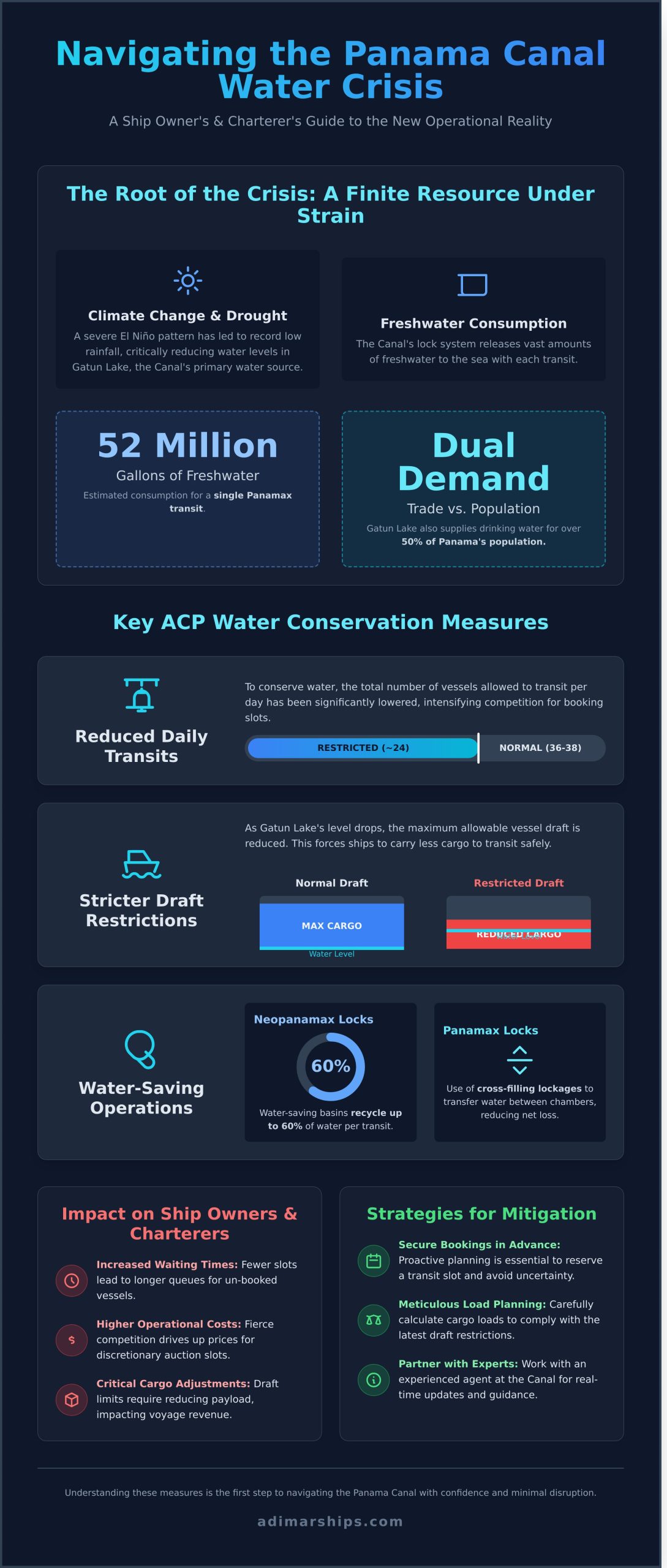
The Canal’s genius lies in its gravity-fed lock system. To lift a vessel, massive amounts of water are released from Gatun Lake into the lock chambers, raising the ship to the lake’s level. After transit, this water is discharged into the sea and lost from the system. A single Panamax vessel transit can consume an estimated 52 million gallons of freshwater. While the newer Neopanamax locks feature water-saving basins that recycle a portion, the net loss remains substantial.
The Role of Climate Change and Record Drought
The recent water crisis is a direct result of a prolonged drought, intensified by a strong El Niño weather pattern. This has led to a dramatic reduction in rainfall in the Canal’s watershed, causing Gatun Lake’s water levels to plummet to historic lows. Because the fundamental design of the Panama Canal relies on consistent tropical rainfall to replenish its system, these climatic shifts pose a recurring and serious challenge to its operational capacity and reliability.
Balancing Global Trade with National Water Security
The challenge is compounded by a critical dual demand. Gatun Lake is not just the engine of the Canal; it is also the primary source of drinking water for over half of Panama’s population, including its largest cities. The ACP holds the immense responsibility of managing this resource to sustain both the nation’s people and the flow of global commerce. This context underscores the necessity and severity of the current restrictions, framing them as a matter of national water security.
Key Water Conservation Measures Implemented by the ACP
To address the critical water shortages in Gatun and Alajuela Lakes, the Panama Canal Authority (ACP) has implemented a series of strategic actions. The primary goal is to achieve a delicate balance: conserving a finite resource while ensuring the Canal remains a reliable and efficient artery for global trade. These measures are not static; they are adjusted dynamically based on rainfall, lake levels, and weather forecasts. The challenges are compounded by complex climate patterns, and a deeper understanding of the impact of El Niño on canal water levels reveals the scientific basis for these proactive adjustments.
Reduced Daily Transit Slots
One of the most direct measures has been the reduction of daily transit slots. The Canal typically accommodates 36-38 vessels per day, but during prolonged dry periods, this number has been significantly lowered. This reduction immediately intensifies competition for the available slots, making the transit reservation system more crucial than ever. For ship owners and charterers, securing a booking well in advance is essential to avoid unpredictable waiting times and associated costs. A failure to plan can directly impact voyage profitability.
Draft Restrictions (TFW) Explained
The ACP has also enforced stricter draft restrictions. A vessel’s maximum draft-the vertical distance between the waterline and the bottom of the hull-is determined by the Tropical Fresh Water (TFW) level of Gatun Lake. As the lake’s water level drops, the ACP must reduce the maximum allowable draft to ensure safe passage. The direct consequence for shippers is clear: vessels must carry less cargo. This reduction in payload capacity per transit directly affects revenue and requires meticulous load planning to remain compliant and commercially viable.
Water-Saving Operational Changes
Behind the scenes, the ACP has optimized its operations to save water with every transit. These technical adjustments are key to understanding the full scope of the panama canal water conservation measures impact on daily capacity. Key changes include:
- Cross-filling Lockages: In the Panamax locks, water is transferred from one lock chamber to the adjacent one during leveling, effectively reusing a portion of the water instead of discharging it all into the sea.
- Water-Saving Basins: The Neopanamax locks utilize three large basins per lock chamber, which recycle up to 60% of the water used in each transit.
- Tandem Lockages: Whenever possible, two smaller vessels are transited together in a single lock chamber, saving an entire lockage of water.
The Direct Impact on Ship Owners, Charterers, and Global Supply Chains
The restrictions imposed by the Panama Canal Authority (ACP) are more than just operational hurdles; they have immediate and significant consequences for your bottom line. For ship owners and charterers, the panama canal water conservation measures impact three critical areas: your time, your costs, and your cargo. Understanding these tangible business consequences is the first step toward building a resilient transit strategy.
Increased Waiting Times and Transit Delays
The most visible effect of reduced transit slots is the growing queue of un-booked vessels at the canal’s entrance. Without a reservation, ships can face unpredictable waiting times that stretch from days into weeks, creating a cascade of disruptions. This uncertainty wreaks havoc on liner schedules, erodes supply chain predictability, and ultimately means lost revenue for every day spent at anchor instead of sailing. In an industry where timing is everything, these delays represent a direct and frustrating challenge.
Financial Implications: Surging Costs and Surcharges
The financial pressures are mounting from multiple directions. The scarcity of transit slots has created a high-stakes auction market where last-minute passage can cost millions of dollars. Simultaneously, the ACP’s draft restrictions force vessels to lighten their loads, meaning you pay more to transit while earning less from reduced cargo capacity. These challenges are compounded by direct fees, such as the Fresh Water Surcharge, which are part of the official Panama Canal Authority’s water conservation measures designed to manage water usage and demand.
Strategic Rerouting and Logistical Headaches
Faced with extreme delays and costs, some carriers are making the difficult decision to bypass the canal entirely. Rerouting through the Suez Canal or around the Cape of Good Hope avoids the immediate bottleneck but introduces its own set of complex trade-offs. This decision requires a careful calculation, weighing the certainty of a longer voyage and higher fuel costs against the uncertain delays and high fees at the Panama Canal. These last-minute logistical shifts demand expert coordination and place immense pressure on operational teams.
Strategies for Navigating the Panama Canal During Water Restrictions
While the challenges presented by water restrictions are significant, they are not insurmountable. With proactive planning and expert guidance, ship owners and charterers can mitigate delays and protect their bottom line. The key is to shift from a reactive stance to a strategic one, turning uncertainty into a manageable part of your voyage plan.
Prioritize Advanced Booking Above All Else
In the current environment, the Transit Reservation System is no longer a convenience-it is an essential tool for a timely transit. Waiting for arrival to secure a slot is a high-risk strategy that often leads to costly delays or expensive auction slots. To minimize the panama canal water conservation measures impact on your schedule, it is critical to book as far in advance as possible. Understanding the different booking periods and securing your slot early provides the certainty needed for efficient voyage planning.
Partner with an Expert Ship Agent on the Ground
Navigating the complexities of the Canal requires more than just monitoring official circulars. A reliable, on-the-ground ship agent is your most valuable asset. We act as your ‘eyes at the Canal,’ providing real-time intelligence on slot availability, wait times, and evolving regulations. An experienced agent manages the entire booking process, handles all local requirements with integrity, and anticipates potential issues before they become costly problems. Put your transit in our hands to eliminate confusion.
Optimize Stowage Plans for Draft Compliance
The Panama Canal Authority strictly enforces its Tropical Fresh Water (TFW) draft limits. Arriving with a non-compliant draft can result in the forced removal of cargo, leading to significant delays and unexpected expenses. The solution is proactive stowage planning. By working closely with port captains and stowage planners before loading, you can ensure your vessel’s cargo load, trim, and stability are optimized for the current draft restrictions, guaranteeing a smooth and compliant passage.
The Future of Water Management at the Panama Canal
While current transit restrictions and surcharges address immediate water shortages, the Panama Canal Authority (ACP) is focused on engineering long-term resilience. The challenges of recent years have made it clear that proactive, large-scale solutions are necessary to secure the waterway’s future reliability. For shippers, understanding these future developments is key to building a sustainable logistics strategy.
Long-Term Projects and New Water Sources
The ACP is actively exploring several multi-faceted solutions to augment its water supply. The most significant proposal involves the construction of a new reservoir on the Indio River, a massive undertaking designed to provide a new, independent water source for canal operations. Other engineering possibilities, such as advanced water-saving basins and non-traditional water sourcing technologies, are also under evaluation. These are not quick fixes; they represent multi-billion dollar investments that will require years of planning and construction to complete.
Adapting to a New Era of Climate Volatility
The core takeaway for the shipping industry is that climate variability is the new normal. The era of predictable transit conditions has been replaced by a more dynamic environment. For shippers, understanding the future panama canal water conservation measures impact means embedding flexibility and proactive risk management into every operational plan. Success will depend on access to timely, reliable data and the deep local expertise needed to interpret it.
In this evolving landscape, having a vigilant partner on the ground is not a luxury-it is essential for protecting your assets and maintaining schedule integrity. Stay ahead of the changes with a trusted partner. Contact Adimar today.
Expert Guidance Through the Canal’s New Reality
The water crisis at the Panama Canal has fundamentally changed the landscape of maritime transit. It is clear that these restrictions are not temporary and that the panama canal water conservation measures impact every aspect of a vessel’s journey, from booking and scheduling to operational costs. In this complex environment, having a reliable, expert partner on the ground is no longer a luxury-it is a necessity for a successful and cost-effective transit.
Don’t let uncertainty disrupt your supply chain. With over 20 years of specialized experience, Adimar Shipping is your trusted partner. We are experts in navigating complex transit regulations and booking systems, serving as your eyes at the Canal to provide timely communication and cost-conscious solutions. We handle the complexity with integrity so you can focus on your business.
Nominate Adimar as your trusted agent for a seamless Panama Canal transit. Navigate the future with a partner you can trust.
Frequently Asked Questions
How much has the daily transit capacity of the Panama Canal been reduced?
The Panama Canal Authority (ACP) has adjusted daily transit capacity in response to water levels. While the Canal can typically handle 36-38 vessels daily, this number has recently been reduced to approximately 24-27 transits. This reduction prioritizes the long-term operational sustainability of the waterway. These figures are subject to change based on rainfall, making it crucial for shippers to have the most current information for efficient and timely voyage planning.
What is the current maximum draft allowed for vessels transiting the Canal?
The maximum allowable draft is a critical and dynamic restriction. Recently, the maximum authorized draft for vessels in the Neopanamax locks was set at 44 feet (13.41 meters), a reduction from the normal 50-foot maximum. This directly impacts how much cargo a vessel can carry, requiring meticulous load planning to ensure compliance. Adherence to these draft restrictions is mandatory for a successful transit and to avoid costly penalties or delays.
Are the water conservation measures temporary or permanent?
These measures are officially temporary, as their implementation is directly linked to rainfall and the water levels of Gatun and Alhajuela Lakes. However, with changing climate patterns, these restrictions are becoming more frequent. While the ACP can lift them when conditions improve, shippers should consider the panama canal water conservation measures impact as a recurring logistical factor. Proactive, long-term planning is now essential for navigating the Canal efficiently throughout the year.
How does cross-filling in the Panamax locks actually save water?
Cross-filling is an innovative water-saving technique used in the two-lane Panamax locks. Instead of emptying all the water from a lock chamber out to sea as a vessel is lowered, a portion of that water is transferred, or “crossed,” into the adjacent chamber to help raise another vessel. This process effectively recycles a significant volume of fresh water with each transit, reducing the total amount drawn from Gatun Lake for each lockage cycle.
What are the main alternatives to using the Panama Canal if my vessel is rerouted?
If rerouting becomes necessary, the primary alternatives depend on your vessel’s origin and destination. For many Asia to U.S. East Coast routes, transiting through the Suez Canal is a common option, though it adds significant time to the voyage. Another strategy is to use an intermodal land bridge, where cargo is offloaded at a U.S. West Coast port and moved inland via rail or truck. Each alternative has distinct cost and timing implications that must be carefully evaluated.
How can a ship agent help me secure a transit slot more effectively?
A knowledgeable ship agent is your essential partner and your eyes at the Canal. We provide more than just administrative support; we offer a strategic advantage. By constantly monitoring the booking and auction systems, we can identify and secure last-minute or newly available transit slots that are often missed. Our direct communication with Canal authorities and deep understanding of operational nuances allow us to navigate the system with integrity and efficiency, saving you time and money.