
A single administrative oversight in your PCSOPEP documentation can trigger a $15,000 fine before your vessel even reaches the Miraflores Locks. In 2026, the Panama Canal Authority maintains a zero-tolerance policy for documentation errors and missed deadlines. Understanding the pcsopep non-compliance penalties panama is no longer just about regulatory box-ticking; it’s a critical financial necessity when a one-day delay for a Neo-Panamax vessel can cost over $65,000 in lost revenue.
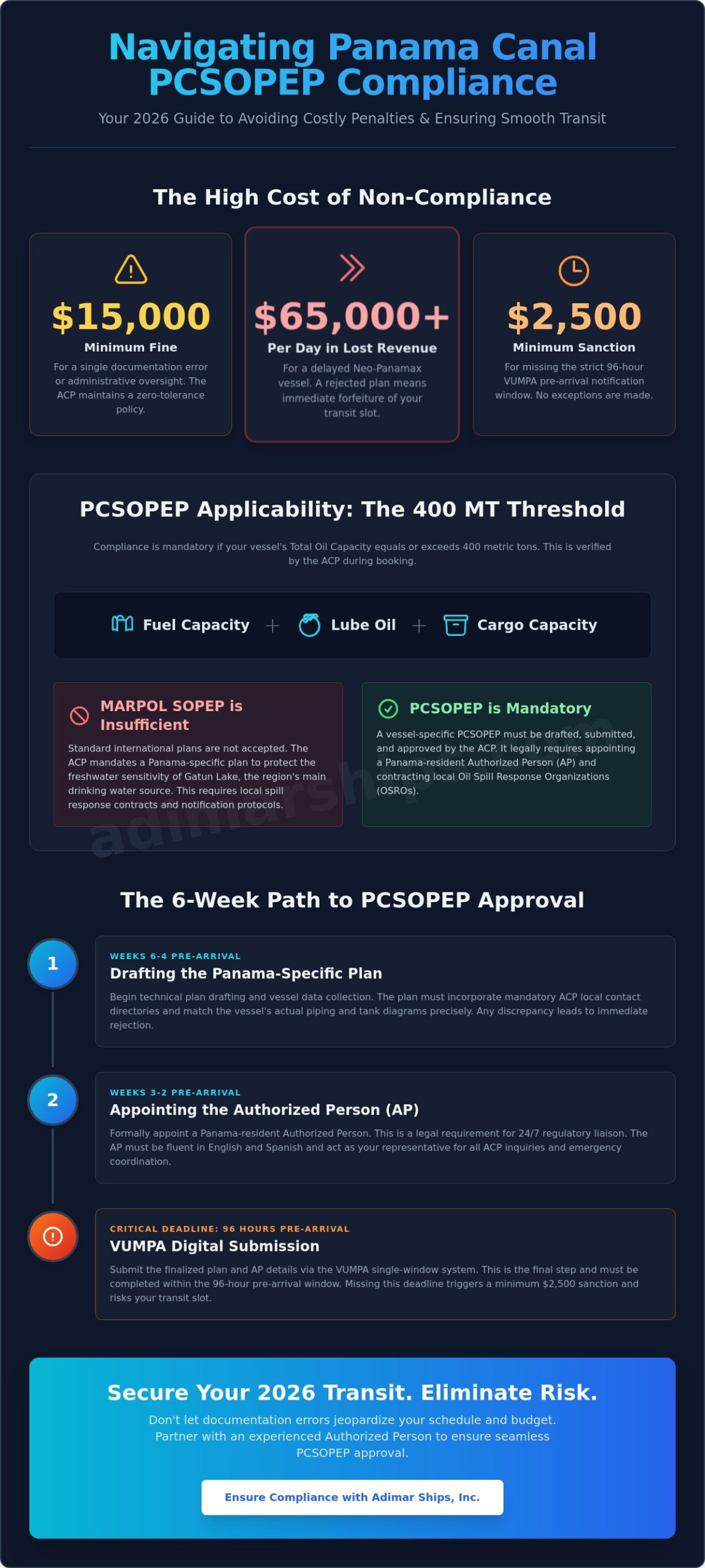
We recognize the frustration of seeing a standard MARPOL SOPEP rejected by the ACP or the anxiety of managing the strict 96-hour VUMPA notification window. You shouldn’t have to risk a minimum $2,500 sanction for a late submission. This guide provides a clear roadmap to mastering the PCSOPEP approval process and ensuring your vessel meets the 400 metric ton threshold requirements. We’ll explore how to secure a confirmed ACP Authorization Number and why appointing a dependable local Authorized Person is the most effective way to eliminate transit delays and protect your bottom line.
Key Takeaways
- Identify the specific documentation errors that trigger pcsopep non-compliance penalties panama and learn how to avoid the $15,000 minimum fine.
- Follow a precise 6-week chronological roadmap for technical plan drafting and vessel data collection to ensure a smooth ACP approval process.
- Master the 96-hour pre-arrival notification window within the VUMPA system to prevent zero-tolerance sanctions and costly transit delays.
- Determine your vessel’s compliance tier by understanding the 1,000 metric ton oil capacity threshold and its impact on emergency response requirements.
- Secure a reliable Panamanian Authorized Person to act as your local representative for 24/7 regulatory oversight and emergency coordination.
The Financial Risk: PCSOPEP Non-Compliance Penalties in 2026
The Panama Canal Shipboard Oil Pollution Emergency Plan (PCSOPEP) isn’t a generic safety recommendation. It’s a mandatory local mandate under Chapter IX of the Maritime Regulations for the Operation of the Panama Canal. For operators, the stakes in 2026 are exceptionally high. The Panama Canal Authority (ACP) has streamlined its enforcement through the digital VUMPA interface, leaving no room for administrative oversight. If your documentation is outdated or contains clerical errors, the pcsopep non-compliance penalties panama typically start at a baseline of $15,000.
This zero-tolerance approach means even minor discrepancies in tank capacities or contact details can trigger immediate administrative sanctions. The financial damage often extends far beyond the initial fine. A rejected plan results in the immediate forfeiture of your transit slot. When you consider that a one-day delay for a Neo-Panamax vessel can lead to over $65,000 in lost revenue, the cost of non-compliance becomes a major operational threat. Understanding the structure of pcsopep non-compliance penalties panama is essential for avoiding the minimum $2,500 sanction triggered by missing the 96-hour pre-arrival window.
Why Your MARPOL SOPEP is Legally Insufficient
Many operators mistakenly believe their international MARPOL SOPEP covers them for a canal transit. It doesn’t. The primary reason is the freshwater sensitivity of Gatun Lake, which serves as the main drinking water source for Panama. Open sea MARPOL requirements don’t address the specific spill response resources required for this delicate inland environment. The ACP mandates the formal appointment of Panama-resident spill response companies and local notification protocols. A global DPA cannot fulfill these duties alone; you must have a resident Authorized Person (AP) who is fluent in English and Spanish to manage regulatory inquiries on the ground.
The 400 Metric Ton Threshold
Compliance hinges on the 400 metric ton (MT) threshold. This isn’t a measure of your cargo alone. To calculate “Total Oil Capacity,” the ACP combines your fuel, lube oil, and cargo-carrying capacity. If that total equals or exceeds 400 MT, a valid PCSOPEP is required. The ACP verifies these figures during the booking process through VUMPA. While some non-oil-carrying vessels might assume they’re exempt, most modern merchant ships hit this limit based on bunker capacity alone. Accurate calculations are vital to avoid being barred from transit upon arrival in Panama Canal waters.
The Chronological Roadmap to PCSOPEP Approval
Securing a valid ACP Authorization Number is not a last-minute administrative task. It is a technical process that requires a disciplined timeline to ensure every detail aligns with the Official PCSOPEP Requirements. By following a structured roadmap, operators can effectively mitigate the risk of pcsopep non-compliance penalties panama that arise from administrative delays or technical rejections. This journey begins at least six weeks before your vessel arrives in Panama Canal waters.
Phase 1: Drafting the Panama-Specific Plan
Phase 1 focuses on technical plan drafting and vessel data collection. It is vital to incorporate the mandatory ACP local contact directories and ensure all information is consistent with the vessel’s actual piping and tank diagrams. The plan serves as a technical bridge between the vessel’s crew and the local Oil Spill Response Organizations (OSROs) stationed within Panama Canal waters. Any discrepancy between your ship’s physical layout and the submitted documentation will result in an immediate rejection by the ACP technical committee.
Phase 2: Appointing the Authorized Person (AP)
The formal appointment of a Panama-resident Authorized Person (AP) is a legal requirement for 24/7 availability. Your AP acts as the vigilant liaison with the ACP during the pre-arrival technical review. In 2026, it’s critical to verify AP credentials to ensure they meet the latest standards for emergency representation. Selecting an experienced PCSOPEP Authorized Person ensures that regulatory inquiries are handled with professional precision, preventing minor questions from escalating into costly delays.
Once the technical drafting and AP appointment are finalized, the process moves into Phase 3: digital submission via the VUMPA single-window system. This is where the 96-hour window becomes a critical factor. The ACP uses this interface to cross-reference your vessel’s data against their internal compliance database. If the submission is successful and meets all criteria, the process concludes with Phase 4: the receipt of the official ACP Authorization Number. This number is your vessel’s “green light” for transit, confirming that you have successfully navigated the complexities of the approval process.
Operators who attempt to rush this roadmap often find themselves facing the very pcsopep non-compliance penalties panama they sought to avoid. A single clerical error during the VUMPA submission or an incomplete contact directory can trigger a $15,000 fine. Working with a dedicated local partner allows you to delegate these specialized tasks, ensuring your documentation is robust and your transit remains on schedule.
Navigating VUMPA and the 96-Hour Pre-Arrival Rule
VUMPA (Ventanilla Única Marítima de Panamá) is the digital gatekeeper for every vessel entering Panama Canal waters. It serves as the single window for all maritime services, integrating documentation from the ACP, Customs, and Immigration into one platform. For operators, this system is the primary interface for 2026 compliance checks. If your data isn’t perfectly aligned within this portal, you risk immediate rejection and the associated pcsopep non-compliance penalties panama.
The 96-hour Pre-Arrival Notification (PAN) is a hard deadline. It’s not a suggestion. Missing this window triggers a minimum sanction of $2,500. To ensure a smooth arrival, you must synchronize your PCSOPEP approval with your overall Panama Canal transit schedule. Common digital filing errors, such as incorrect IMO numbers or references to expired OSRO (Oil Spill Response Organization) contracts, often lead to system flags that prevent your vessel from being scheduled for lockage.
Managing the 96-Hour Notification Window
Waiting until the 96-hour mark is the primary cause of transit delays. The technical review process takes time. If the ACP identifies a discrepancy at the last minute, you’ll likely miss your transit slot. Effective management requires constant coordination between the Master, the home office, and your local Panama agent. If your vessel’s ETA changes, you must update the VUMPA data immediately. This proactive communication prevents administrative friction and keeps your transit on track. We act as your vigilant, on-the-ground representative, ensuring every data point in VUMPA reflects your vessel’s current status.
Interpreting ACP Digital Feedback
The VUMPA interface provides real-time feedback, but interpreting these messages requires local expertise. A “Technical Deficiency” notice isn’t just a request for more information; it’s a warning that your transit is at risk. You must respond with rapid plan amendments to avoid full transit cancellation and the resulting demurrage costs. Once all deficiencies are cleared, the system will grant the final “Green Light” status. This digital confirmation is the only way to ensure your vessel enters the Miraflores or Cocoli Locks without facing pcsopep non-compliance penalties panama. By delegating this specialized task to a seasoned expert, you gain the operational freedom to focus on the voyage itself.
PCSOPEP Compliance Tiers: Classifying Your Fleet
The Panama Canal Authority uses a tiered system to determine the level of emergency response preparedness required for every vessel. This classification isn’t based on the physical size of the ship, but rather on its total oil carrying capacity. This includes all fuel, lubrication oils, and cargo. Miscalculating your vessel’s tier is a common administrative error that leads to pcsopep non-compliance penalties panama. Understanding where your fleet sits on this scale is the first step toward a secure transit.
The 1,000 metric ton (MT) line is the most critical boundary in the PCSOPEP framework. If your vessel’s total capacity crosses this threshold, your operational requirements and associated ACP fees shift significantly. For Neo-Panamax vessels, the massive bunker tanks almost always guarantee a Tier 2 or Tier 3 classification. Each tier carries specific annual renewal protocols that you must manage through the VUMPA system to maintain your “Green Light” status.
Tier 1: Requirements for Smaller Tonnage
Tier 1 applies to vessels with a total oil capacity of 400 MT or more but less than 1,000 MT. While these smaller vessels face less stringent personnel requirements, they must still adhere to standardized response equipment checklists. Operators in this category often benefit from per-transit authorizations, yet annual verification remains a best practice to avoid last-minute delays. We provide practical guidance for Tier 1 owners to ensure cost-effective compliance without sacrificing regulatory security. It’s about finding the balance between lean operations and total adherence to Chapter IX mandates.
Tier 2 & 3: Enhanced Requirements for Large Vessels
Vessels exceeding 1,000 MT fall into Tier 2, while those with even higher capacities move into Tier 3. In these categories, the role of a certified Oil Spill Response Organization (OSRO) is mandatory. You must have a formal contract in place with local responders who possess the personnel and resources to manage a significant event in Gatun Lake. These tiers also require higher financial guarantees and more complex emergency notification chains. Managing these enhanced requirements demands a partner who understands the local landscape and can act as your vigilant representative. To ensure your large-tonnage vessels are correctly classified and protected, you can request a tier assessment from our specialized team.
Failing to declare the correct capacity or attempting to transit with a Tier 1 plan when your vessel qualifies for Tier 2 will trigger immediate pcsopep non-compliance penalties panama. The ACP’s digital desk cross-references your VUMPA submission with historical vessel data. Discrepancies are flagged instantly, often resulting in a $15,000 fine and the loss of your scheduled transit slot. We handle these technical details for you, providing the peace of mind that comes from expert delegation.
Securing Your 2026 Transit with Adimar Shipping, Inc.
Generic agency services are no longer enough to protect your fleet from the evolving regulatory landscape of the Panama Canal. In 2026, compliance is a digital race against time where a single clerical error can trigger the pcsopep non-compliance penalties panama that start at $15,000. We move beyond basic paperwork to provide personalised PCSOPEP management for every vessel in your fleet. Our team at Adimar Shipping, Inc. provides vigilant local oversight, acting as your eyes and ears at the ACP’s digital desk to ensure your documentation is flawless before the 96-hour clock begins to tick.
By integrating our deep regulatory knowledge with expert Panama Canal ship agency services, we eliminate the friction that often leads to transit delays. We understand that your reputation and bottom line depend on a passage through the locks without administrative hurdles. Our 24/7 emergency readiness and long-standing local relationships allow us to solve problems before they impact your schedule, providing the security and peace of mind you need when delegating complex logistical tasks.
Proactive Compliance and Plan Audits
Adimar Shipping, Inc. doesn’t wait for the VUMPA window to open to identify potential issues. Our team performs comprehensive pre-audits of all vessel documentation to catch discrepancies in tank capacities or notification protocols. We ensure your pcsopep authorized person is always prepared for technical queries from ACP inspectors. This proactive bridge in communication prevents the “Technical Deficiency” notices that often lead to pcsopep non-compliance penalties panama. By delegating these technical audits to us, you ensure your vessel arrives with a confirmed “Green Light” status.
Acting as Your Local Office at the Canal
Confusion is the primary enemy of efficiency. Adimar Shipping, Inc. eliminates this by providing a single point of contact for all compliance and husbandry matters. If a technical deficiency is flagged mid-transit, our rapid response protocols go into immediate effect to resolve the issue without forfeiting your transit slot. We pride ourselves on ethical, transparent representation, protecting your interests through every mile of the canal. As your local partner, we function as an extension of your own team, ensuring that every transit is defined by reliability and professional precision rather than unexpected fines and administrative stress.
Ensuring a Seamless Transition through the Panama Canal
Successfully navigating the Panama Canal in 2026 requires more than just technical skill; it demands absolute regulatory precision. We have detailed how the VUMPA digital window acts as a zero-tolerance filter and why the financial risks associated with pcsopep non-compliance penalties panama make administrative errors a major operational liability. From calculating your correct compliance tier to maintaining updated contact directories, the burden of documentation is significant for any busy operator. A single oversight in your spill response resources can lead to forfeited transit slots and unexpected demurrage costs.
Delegating these specialized tasks to a seasoned local partner is the most effective way to eliminate transit delays and protect your vessel’s reputation. As an Authorized PCSOPEP Representative, Adimar Shipping, Inc. provides the vigilant 24/7 oversight and deep local knowledge of ACP regulations required for all vessel types. Delegate your PCSOPEP compliance to the experts at Adimar Shipping, Inc. to secure your 2026 transit schedule. We look forward to acting as your dependable extension on the ground, ensuring your fleet transits the Miraflores and Cocoli Locks with total confidence and zero administrative friction.
Frequently Asked Questions
Is my MARPOL SOPEP valid for a Panama Canal transit?
No, your MARPOL SOPEP is not sufficient for a transit. The Panama Canal Authority mandates a local PCSOPEP to address the unique freshwater sensitivity of Gatun Lake. This local plan requires the formal appointment of a Panama-resident Authorized Person and specific Oil Spill Response Organizations (OSROs) that are not included in standard international MARPOL documentation.
What is the penalty for arriving at the Panama Canal without an approved PCSOPEP?
Arriving without an approved plan triggers immediate sanctions. The pcsopep non-compliance penalties panama typically start at a baseline of $15,000 for administrative deficiencies. Additionally, missing the mandatory 96-hour pre-arrival notification window results in a minimum sanction of $2,500. These costs don’t include the financial impact of lost transit slots or vessel delays at the locks.
How long does the PCSOPEP approval process typically take in 2026?
You should allow at least six weeks for the full approval process. This timeframe includes technical drafting, vessel data collection, and the mandatory review period by the ACP technical committee. Attempting to rush this process often leads to clerical errors in the VUMPA system, which can cause last-minute rejections and significant operational disruptions for your fleet.
Who is legally allowed to serve as a PCSOPEP Authorized Person (AP)?
A PCSOPEP Authorized Person must be a resident of Panama who is fluent in both English and Spanish. This individual serves as your 24/7 emergency liaison and is legally responsible for coordinating with the ACP during a spill event. They must have deep knowledge of local maritime regulations to manage technical inquiries and ensure your vessel remains compliant with Chapter IX mandates.
What is the 96-hour rule for Panama Canal arrivals?
The 96-hour rule requires all vessels to submit valid documentation via the VUMPA portal at least 96 hours before arrival. This is a zero-tolerance deadline enforced by the ACP. Missing this window triggers automatic sanctions and can lead to the forfeiture of your scheduled transit slot, causing expensive delays for your entire voyage and lost revenue.
Do I need to submit a new PCSOPEP plan for every transit?
You don’t need a new plan for every transit if your vessel’s technical data remains unchanged. PCSOPEP approvals are generally valid for two years. However, you must ensure your ACP Authorization Number is active and that your local Authorized Person is still formally appointed in the VUMPA system before each entry into Panama Canal waters.
What is VUMPA and why must my ship agent use it for compliance?
VUMPA is the digital Single Window for Maritime Services in Panama. It integrates all documentation from the ACP, Customs, and Immigration into one platform. Your ship agent must use this interface because it’s the only official channel for 2026 compliance checks. If the VUMPA data doesn’t match your vessel’s physical layout, you risk pcsopep non-compliance penalties panama.
Can my vessel carry out a transit if the PCSOPEP plan is still pending approval?
No vessel is allowed to transit while its plan is pending approval. The ACP requires a confirmed Authorization Number before you enter the Miraflores or Cocoli Locks. If your plan is rejected or still under review, your vessel will be barred from transit until the technical deficiencies are corrected and the final status is granted in the VUMPA interface.