
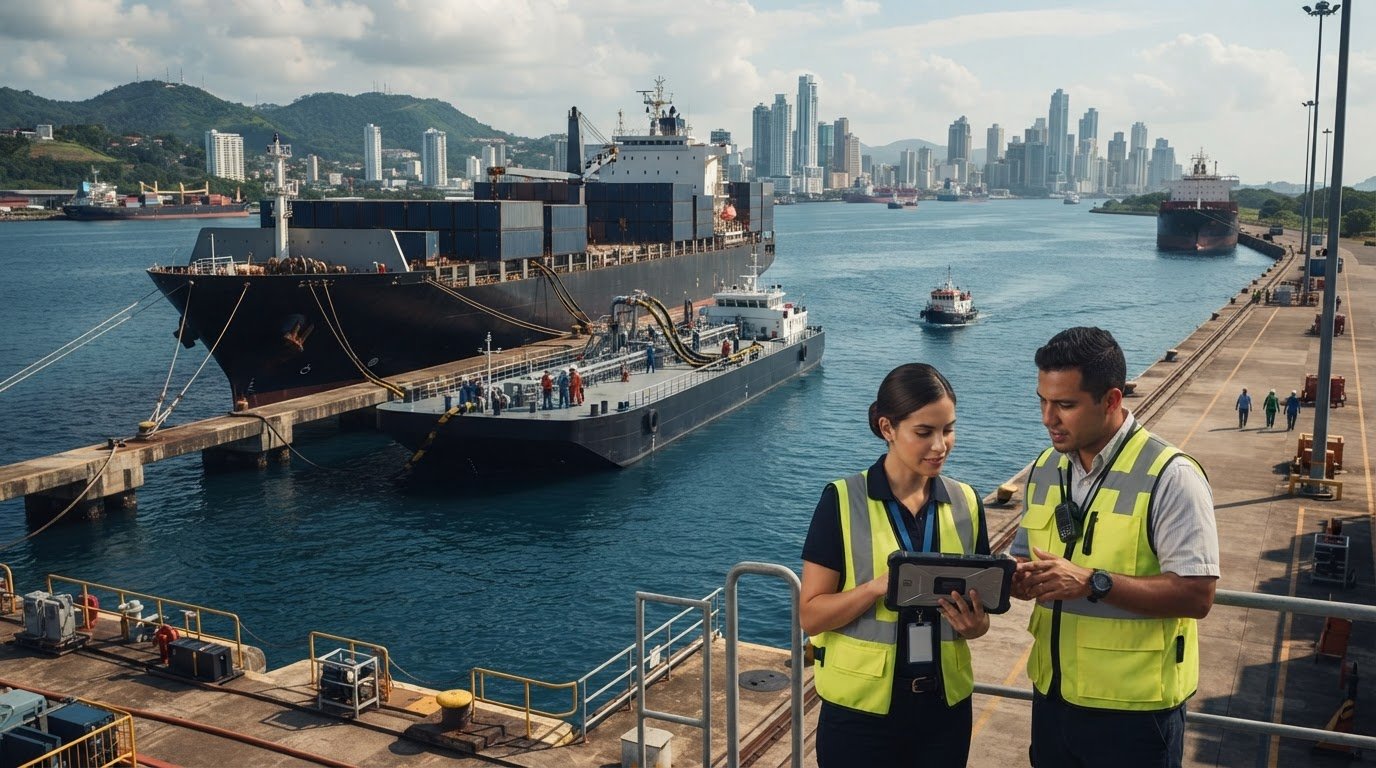
A bunker call can be ready on paper and still put pressure on a Panama transit if responsibilities aren’t clear. The right ship agent for bunker calls in Panama can help coordinate local arrangements, but shouldn’t be mistaken for the fuel supplier or a substitute for clearly assigned responsibilities.
Before appointing an agent, confirm what the agency will actually handle: supplier communication, schedule updates, document coordination, or only specific parts of the call. Keep the vessel’s schedule, port-call requirements, and the appointing party’s interests in view, especially when timing changes.
This guide explains how to define an agent’s scope before nomination, compare local coverage and communication, and confirm who is responsible for each part of the bunker operation. It also covers how bunker-call timing may connect with wider Panama Canal transit coordination. Adimar Shipping provides Panama-based ship agency services, including transit coordination and nominated agency. Confirm directly whether its available support matches your bunker-call requirements.
Key Takeaways
- Set a written scope so the ship agent, fuel supplier, vessel, and appointing party understand who is responsible for each task.
- Use a clear coordination sequence to keep agreed bunker-call timing aligned with the vessel’s wider Panama schedule.
- Compare a ship agent for bunker calls panama by checking local coverage, named contacts, response arrangements, reporting, and evidence of agreed capabilities.
- Before nomination, confirm authority to act, communication expectations, and responsibility for handling documents.
- Adimar Shipping provides Panama-based ship agency and nominated-agency services. Confirm directly whether its proposed support covers your specific bunker-call needs.
Why appoint a ship agent for bunker calls in Panama?
A bunker call has to fit around the vessel’s wider Panama schedule. The vessel may be coordinating a port call or preparing for a canal transit, and a change to one part of the plan can affect communications across the operation. A ship agent for bunker calls panama can represent the appointing party locally for tasks agreed in advance. The agent does not supply fuel, and its responsibilities should not be assumed.
The benefit is clearer local coordination, not a promise of lower costs or a guaranteed transit time. Before nomination, define the support required and ask the agency to confirm which tasks it can undertake. A precise scope gives the vessel, supplier, and commercial parties a shared reference when plans or timings change.
What does a ship agent do during a bunker call?
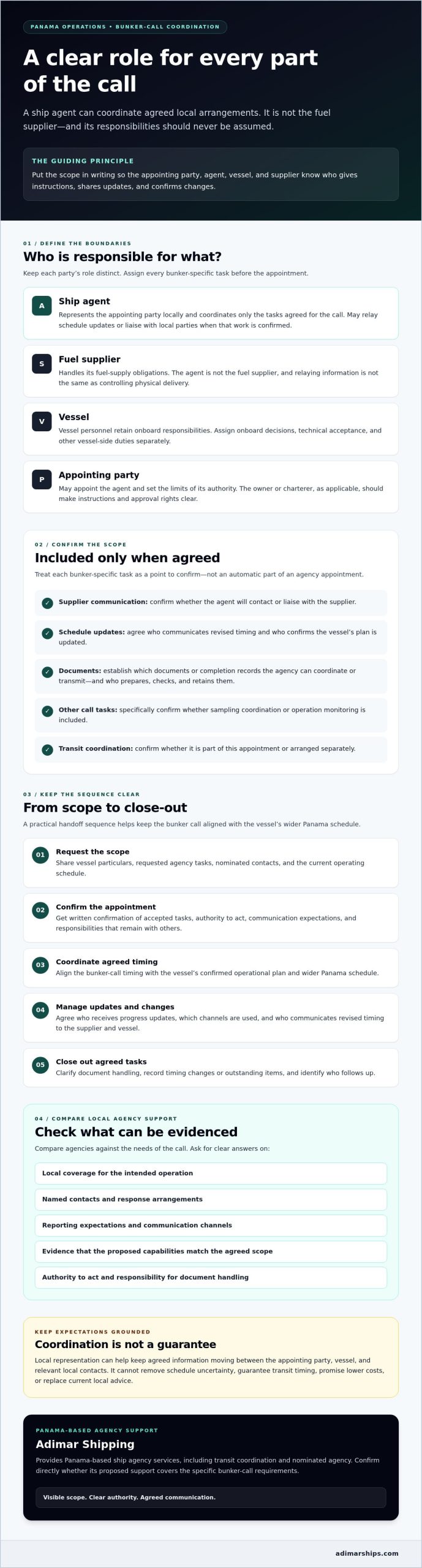
Depending on written instructions and confirmed capabilities, an agent may liaise with relevant local parties, relay schedule updates, or coordinate agreed timing with the vessel’s wider call. Treat each bunker-specific task as something to confirm, not as an automatic part of an agency appointment. In particular, establish whether supplier communication, documentation, sampling coordination, or operation monitoring is included.
Keep responsibilities distinct. The owner or charterer may appoint the agent and set the limits of its authority; the supplier handles its fuel-supply obligations; and the vessel’s personnel retain onboard responsibilities. Assign fuel contracting, technical acceptance, and onboard decisions separately. Agree who provides instructions, who receives updates, and who can approve changes.
A ship agent represents the appointing party locally and coordinates only the tasks agreed for the call. The agent is not the fuel supplier.
Why does local coordination matter in Panama?
Panama’s canal and port-call context makes schedule awareness important. Bunker arrangements need to be considered alongside the vessel’s confirmed operational plan, rather than treated as an isolated event. The Panama Canal connects the Atlantic and Pacific, but the relevant approach and local arrangements depend on the vessel’s actual operation. Confirm the intended location, timing, and communication path with the appointed agency and other responsible parties.
Local representation can help keep agreed information moving between the appointing party, vessel, and relevant local contacts. It cannot remove schedule uncertainty or replace current local advice. Its practical value depends on responsive communication, clear authority, and a scope that matches the call. Before appointment, ask what the agency will handle, what it will report, and which responsibilities remain with others.
How bunker-call agency coordination fits a Panama transit
Keep the process clear by treating the agent’s role as a defined handoff, not an assumption. A practical sequence is to request a scope, confirm the appointment, coordinate agreed timing, manage updates, and close out the agreed tasks. Confirm every bunker-specific task in writing. The appointing party, vessel, supplier, and agent should know who gives instructions, shares updates, and confirms changes.
Before the vessel’s bunker call
Start with the vessel’s particulars, requested agency scope, nominated contacts, and current operating schedule. Ask the agency to state in writing which tasks it accepts and which remain with the principal, vessel, or supplier. For example, don’t assume the agent will contact the supplier or coordinate documents unless that support is specifically confirmed.
Agree how schedule changes will be handled. Identify who communicates revised timing to the supplier and who confirms that the vessel’s plan has been updated. Establish whether transit-related coordination is included in this appointment or arranged separately. For current canal information, consult the Panama Canal Authority (ACP). The agent’s role is to relay or coordinate only the matters assigned to it.
During and after the agreed operation
Before the call, confirm whether the agency will relay progress updates, who will receive them, and which communication channels will be used. Relaying information is not the same as controlling physical delivery. The supplier remains responsible for its supply activity, while the vessel’s designated personnel handle onboard decisions and acceptance according to their assigned responsibilities.
Afterward, clarify which documents or completion records the agency can coordinate or transmit, and who is responsible for preparing, checking, and retaining them. Close-out should capture timing changes or outstanding items and identify who will follow up. Agree these responsibilities in advance rather than inferring them from the agent’s presence.
The agent coordinates only the agreed communications and tasks; the supplier delivers fuel, and the vessel’s assigned personnel make onboard acceptance decisions. This distinction helps the owner or charterer appoint a ship agent for bunker calls panama without confusing local coordination with fuel supply or vessel authority.
For more process context, see this Panama bunkering operations guide. Operators considering Panama-based agency support can also review Adimar Shipping’s ship agency services and confirm directly whether the agency can undertake the specific bunker-call tasks required.
How to compare ship agents for bunker calls in Panama
Don’t compare agencies on broad claims alone. A useful evaluation shows what each agency can confirm for your specific Panama operation, who will handle communication, and how the agreed work will be reported. Ask each candidate the same questions and request written confirmation so you can compare like with like rather than relying on assumed bunker-call capabilities.
Which service-scope questions should you ask?
First, ask whether the agency accepts bunker-call coordination appointments. Request a task-by-task scope and ask the agency to answer separately for supplier liaison, schedule coordination, document handling, and operation monitoring. Have each item marked as included, excluded, or subject to further agreement. Clarify which responsibilities stay with the principal, vessel, supplier, or any separately nominated agent.
| Criteria | Questions to ask | Evidence to request |
|---|---|---|
| Panama coverage | Can you confirm coverage for the vessel’s intended location and operation? | Written confirmation identifying relevant local coverage and any limits. |
| Named contacts | Who is the operational contact, and who is the escalation contact? | Contact list with roles and agreed communication channels. |
| Scope and accountability | Do you accept this appointment, and which bunker-specific tasks are included? | Written scope that distinguishes agency tasks from principal, vessel, and supplier responsibilities. |
| Response and reporting | What response arrangements can you confirm, and who receives time-sensitive updates? | Reporting sample or example of an operational update, with recipients and escalation route. |
| Charges and disbursements | How will third-party charges and disbursements be identified and reported? | Example of an itemized report or supporting-document process; don’t assume a particular fee structure. |
How can you assess transparency and local responsiveness?
Ask for a sample reporting format, ideally with sensitive details removed. Check whether it makes the status, timing, open items, and next contact clear. Confirm escalation contacts and response arrangements for the hours relevant to your operation. Don’t infer round-the-clock or out-of-hours availability unless the agency confirms it. For accountability, ask how the agency separates its coordination records from supplier documents and vessel decisions. The IMO’s Bunker Convention provides relevant international context, but it doesn’t establish the scope of an individual agency appointment.
A strong comparison weighs written scope, clear communication, accountability, and confirmed local coverage together. Choose the ship agent for bunker calls panama whose answers define the appointment before nomination, including what it cannot confirm or undertake.
What to confirm before appointing a Panama bunker-call agent
Before nomination, turn expectations into written instructions. A checklist helps the principal define the appointment and spot gaps, but it doesn’t replace current local advice or confirmation of applicable procedures. For wider schedule context, consult this Panama Canal transit guide, then verify current requirements for the vessel’s specific operation with relevant official sources and parties.
What information should the principal provide?
Give the agency enough detail to assess the request and confirm what it can undertake. Include:
- Vessel particulars and the intended call location, if confirmed.
- The call objectives, schedule constraints, and any known timing dependencies.
- The nominated parties, including vessel and supplier contacts where available.
- The names and contact details of people authorized to give instructions or approve changes.
- Written instructions defining the agency’s authority and its limits.
Ask what additional information the agency needs, how to submit updates, and which contact should receive revised instructions. Make clear that supplier selection, fuel contracting, technical decisions, and onboard acceptance must have designated decision-makers. Don’t assume these decisions fall within the agency’s authority simply because it is appointed locally.
What should the appointment confirmation record?
Before the ship agent for bunker calls panama appointment is finalized, request written confirmation of the agreed scope, responsible contacts, reporting expectations, and excluded services. List each requested task, such as supplier liaison, schedule coordination, or document handling, and ask the agency to confirm whether it accepts that task. Record what remains with the principal, vessel, supplier, or any separately appointed representative.
Set out how schedule changes and operational exceptions will be communicated: who sends the update, who must receive it, and how an unresolved issue is escalated. Agree which documents the agent may handle or transmit, and who prepares, reviews, and retains each record. These details provide a clear reference if the plan changes during the call.
Procedures can depend on the operation and may change. Verify relevant Panama Canal Authority (ACP), port, anchorage, or document requirements against current official guidance before relying on them. An appointment checklist helps define responsibilities; it doesn’t confirm that a particular local procedure applies.
Adimar Shipping is a Panama-based ship agency offering transit coordination and owner’s and charterer’s nominated-agency services. Discuss your agency scope with Adimar Shipping and confirm directly whether the team can undertake the specific bunker-call tasks you need.
Choosing Adimar Shipping for Panama agency support
Adimar Shipping is a Panama-based ship agency, not a confirmed bunker supplier or dedicated bunker-call agent. Its services include Panama Canal transit coordination, clearances, pilot and tug ordering, and transit documentation. These capabilities may be relevant when planning a vessel’s wider Panama operation, but they don’t automatically include bunker-specific coordination. Confirm the requested scope directly before making an appointment.
Which confirmed Adimar services may be relevant?
Adimar offers owner’s and charterer’s nominated agency. In that role, the agency represents the appointing party according to the agreed instructions and scope. Operators can discuss how transit coordination may fit alongside a planned call, while confirming which tasks are included and which remain with the vessel, supplier, or principal. For broader context, see the Panama ship agency guide.
How to discuss your bunker-call requirements with Adimar
Make the inquiry specific. Share the vessel’s schedule and intended location, the tasks you want considered, your nomination preference, and the relevant contacts. Ask Adimar to confirm in writing whether it can accept the appointment and what the proposed scope would include. Request clarity on exclusions, named contacts, reporting arrangements, and how schedule changes should be communicated.
Ask separately whether supplier liaison, timing updates, bunker-related documents, or operation monitoring are within the proposed scope. Don’t assume these services are available simply because transit or agency support is offered. The response should distinguish Adimar’s confirmed agency responsibilities from fuel supply, supplier obligations, and onboard technical decisions.
If you’re searching for a “ship agent for bunker calls panama,” use the inquiry to check service fit rather than assume a standard package exists. A clear written response helps the appointing owner or charterer decide whether Adimar’s confirmed Panama agency services align with the operation and what, if anything, needs to be arranged separately.
Once the requested scope is clear, Contact Adimar Shipping about Panama agency support to discuss the vessel’s requirements and confirm whether the proposed agency appointment is suitable.
Set a Clear Scope Before Your Next Panama Call
A well-defined appointment starts with clear responsibilities. Before nominating a ship agent for bunker calls panama, confirm in writing which coordination tasks the agency accepts, who handles supplier communication, and how schedule changes and updates will be managed. The agent represents the appointing party within the agreed scope; it doesn’t supply fuel or replace the supplier’s and vessel’s responsibilities.
Local experience can also support the vessel’s wider Panama operation. Adimar Shipping is a Panama-based ship agency with services that include transit clearance, pilot and tug ordering, and documentation coordination. Its owner’s and charterer’s nominated-agency services provide representation for the appointing party. Bunker-specific coordination isn’t confirmed as a standalone service, so ask the team to verify whether your requested tasks fit its current scope.
Share your vessel schedule, location, nomination preference, and required support, then request written confirmation of included tasks, exclusions, contacts, and reporting arrangements. Discuss your vessel’s Panama agency requirements with Adimar Shipping and clarify the fit before appointment. A transparent scope gives every party a stronger foundation for coordinated planning.
Frequently Asked Questions
What does a ship agent do during a bunker call in Panama?
A ship agent can represent the appointing party locally and coordinate tasks agreed in writing. Depending on confirmed scope, this may include relaying schedule updates or communicating with nominated contacts. The agent doesn’t supply fuel or automatically manage every part of the call. Before appointment, the principal, vessel, and supplier should agree who handles contracting, supplier decisions, technical acceptance, onboard actions, documents, and operational updates.
Can a Panama ship agent arrange bunker fuel for my vessel?
Don’t assume a ship agent supplies or arranges fuel. An agent is a local representative, while the fuel supplier’s role is separate. If you need agency support around a bunker call, ask whether the agency will undertake specific tasks, such as supplier liaison or schedule communication, and get its answer in writing. Adimar Shipping’s services don’t confirm bunker fuel supply or a dedicated bunker-call service.
How do I choose a ship agent for bunker calls in Panama?
Compare agencies on confirmed Panama coverage, named contacts, response arrangements, reporting, and a written task-by-task scope. Ask whether supplier liaison, timing coordination, document handling, and operation monitoring are included or excluded. Request an example of operational reporting and clarify how third-party charges and disbursements will be identified. A suitable ship agent for bunker calls in Panama should explain responsibilities clearly, including what remains with the principal, vessel, and supplier.
When should I appoint a local agent for a Panama bunker call?
Start discussions when you’re planning the call and can share the vessel’s schedule, intended location, and support needs. Early communication gives you time to confirm whether the agency accepts the appointment, define its scope, and align contacts with the vessel and supplier. Don’t rely on a standard lead time unless the agency confirms one for your operation. Check current local procedures separately as the plan develops.
Does a bunker-call agent coordinate with the Panama Canal Authority?
That depends on the appointment and the vessel’s operation. An agency may have separately confirmed Panama Canal transit coordination responsibilities, but this doesn’t automatically mean it coordinates bunker-specific matters with the Panama Canal Authority (ACP). Ask which transit-related tasks are included, who handles any required communications, and what remains outside scope. Verify current canal procedures and requirements through official guidance and the parties responsible for the vessel’s operation.
What information should I provide when requesting bunker-call agency support?
Share the vessel’s particulars, intended call location if known, schedule constraints, call objectives, nominated parties, and authorized decision-makers. Describe the tasks you want considered, such as supplier communication, schedule updates, or document coordination. Ask the agency what else it needs and how changes should be submitted. Include written instructions that define the agent’s authority, reporting contacts, and decisions that remain with the principal, supplier, or vessel.
Can the same agency represent the owner or the charterer during a bunker call?
An agency may be appointed to represent either the owner or the charterer, depending on the agreed nomination and instructions. Adimar Shipping offers owner’s and charterer’s nominated-agency services. Confirm who the principal is, whose interests the agent represents, and the limits of its authority in writing. If more than one party seeks representation, ask the agency to clarify whether it can accept each appointment and how responsibilities will be kept distinct.