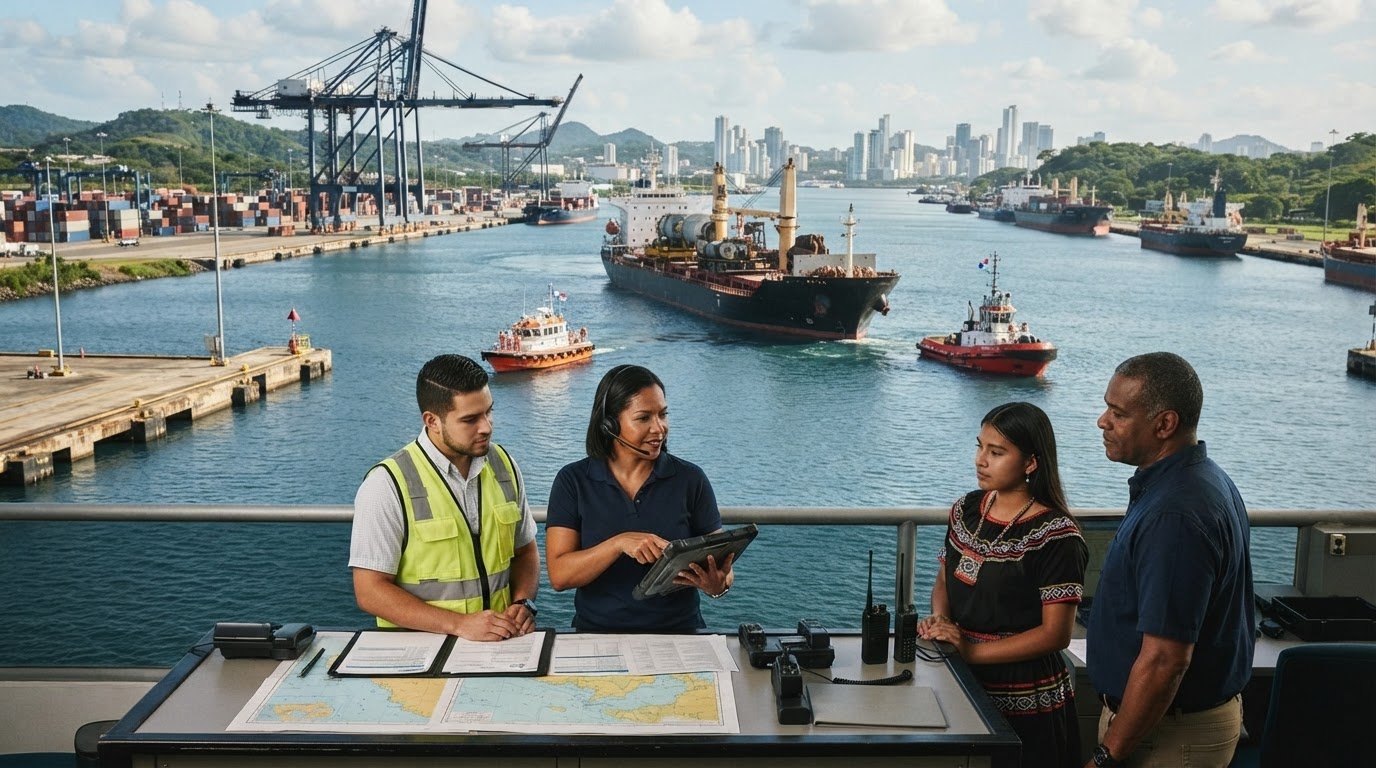


Could a vessel call lose time because each party assumes someone else is handling the next step? At Colón Container Terminal, clear coordination starts with knowing who is responsible for what. A ship agent for colon container terminal represents the vessel’s or appointing party’s interests and coordinates agreed arrangements, while the terminal manages its own facility and operations. Keeping those roles separate helps owners, charterers, and crews direct information to the right party.
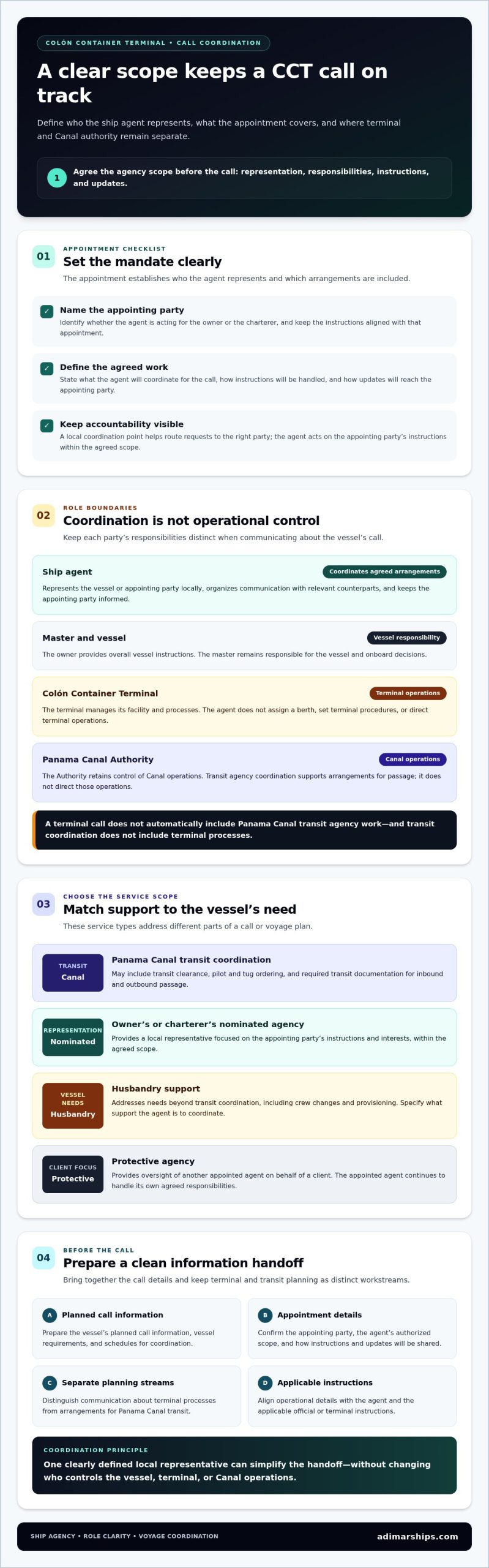
When documents, vessel requirements, and schedules involve multiple parties, a clear local point of coordination makes the handoff easier to manage. This guide explains what a ship agent can coordinate for a CCT call, how agency work differs from terminal operations, and what information to prepare. It also covers owner’s and charterer’s nominated agency, which gives the appointing party a local representative focused on its instructions and interests. Adimar Shipping, Inc. provides Panama Canal ship agency services, including transit clearance, pilot and tug ordering, and transit documentation. Use the steps below to define the scope of support for your vessel’s call and voyage.
Key Takeaways
- Define the agency appointment clearly so responsibilities, instructions, and accountability are understood before the call.
- A ship agent for colon container terminal can coordinate vessel-side arrangements, while terminal operations remain separate.
- Distinguish Panama Canal transit coordination from husbandry and nominated-agency representation to match support to your needs.
- Prepare the vessel’s planned call information and align operational details with the agent and applicable official or terminal instructions.
- Adimar Shipping, Inc. coordinates Panama Canal transit clearance, pilot and tug ordering, and required transit documentation from Panama.
What a ship agent does for a Colón Container Terminal call
A ship agent is the vessel’s local coordination representative. The agent helps the owner, charterer, or master communicate with relevant local counterparts and organizes arrangements included in the appointment. A ship agent for colon container terminal supports the vessel or appointing party, but does not operate the terminal or direct its decisions. Keeping that distinction clear helps each party route requests correctly and understand who is responsible for each part of the call.
A ship agent represents the vessel or appointing party and coordinates agreed arrangements; the terminal and the Panama Canal Authority retain control of their respective operations. This boundary matters at Colón, where a terminal call may also form part of a vessel’s wider Panama Canal voyage plan.
How the agent, vessel, and terminal roles differ
The owner provides the vessel’s overall instructions, while a charterer may appoint an agent to represent its interests under the relevant arrangement. The master remains responsible for the vessel and onboard decisions. The agent acts locally on the appointing party’s instructions, organizing communication and handling the agency scope agreed for the call. The terminal manages its facility and terminal processes.
For example, if vessel information or a schedule update needs to be passed to a local counterpart, the agent can help relay it and keep the appointing party informed. That coordination does not give the agent authority to assign a berth, set terminal procedures, or decide how terminal operations proceed. Port management involves coordinating various activities within a seaport. The agent contributes as a vessel representative within that wider port environment, not as the port or terminal operator.
When a CCT call connects with Panama Canal transit
A call at Colón Container Terminal and a Panama Canal transit can be linked in the vessel’s itinerary, but they are distinct planning matters. The terminal is responsible for its operations; Canal transit coordination concerns requirements and arrangements associated with the vessel’s passage through the Canal. Treating them as separate scopes prevents the assumption that a terminal appointment automatically includes transit agency work, or the reverse.
Adimar Shipping, Inc. is a Panama-based ship agency focused on Panama Canal vessel transits. Its Canal agency services include coordinating transit clearance, pilot and tug ordering, and required transit documentation for inbound and outbound passage. These services support the transit side of voyage planning, not CCT’s berthing decisions or terminal processes. For more detail on this separate planning stream, the Panama Canal transit guide explains key considerations for ship operators.
Before the call, owners, charterers, and masters can reduce crossed instructions by identifying the appointing party, defining the agent’s authorized scope, and separating terminal-related communication from Canal transit coordination. A clear division of responsibility gives each party a reliable point of contact while preserving the authority of the terminal, the Canal, and the vessel itself.
Which ship-agent services can support a Colón port call?
The right agency scope depends on what the vessel and appointing party need coordinated. A ship agent for colon container terminal may be engaged for defined tasks or appointed to represent an owner’s or charterer’s interests locally. The appointment should state who the agent represents, what work is included, and how instructions and updates will be handled.
For a call connected with Canal passage, separate transit coordination from services that address the vessel’s wider needs. The Panama Canal Authority outlines maritime services connected with Canal operations, while the agent coordinates the tasks included in its appointment.
Transit coordination and nominated agency
For Panama Canal transit, agency coordination can include transit clearance, pilot and tug ordering, and required inbound and outbound documentation. These arrangements relate to the transit, not control of the Canal’s operations or a container terminal’s processes. The Panama Canal Authority provides essential maritime services.
Nominated agency addresses a different need: having a local representative act on behalf of the party that appointed it. An owner’s nominated agent focuses on the owner’s instructions and interests; a charterer’s nominated agent represents the charterer within the agreed scope. The owner’s nominated agency guide explains how this appointment can support owners seeking local representation. Clear instructions distinguish the nominated agent’s role from those of other parties involved in the call.
Husbandry, protective agency, and PCSOPEP
Husbandry supports vessel and crew needs beyond transit coordination, including crew changes and provisioning. The appointment should specify the support requested and what the agent will coordinate, so the vessel and other parties understand their responsibilities. For more context on this category, see the ship husbandry services guide.
Protective agency provides oversight of another appointed agent on behalf of a client. It gives the client a local representative focused on its interests, while the appointed agent continues to handle its own agreed responsibilities. PCSOPEP authorized-person support is a separate service related to the Panama Canal Shipboard Oil Pollution Emergency Plan. Keep it distinct from general port-call coordination and define the requested scope clearly. The PCSOPEP authorized-person guide covers this role in more detail.
Before confirming an appointment, match each requested service to a responsible party. For example, list transit documentation and pilot and tug ordering under Canal coordination, then specify separately whether the appointment includes nominated-agency representation, husbandry, protective agency, or PCSOPEP authorized-person support. This practical split helps prevent gaps and crossed instructions. Operators planning Panama Canal agency support can review the coordination scope with Adimar Shipping, a Panama-based ship agency focused on Canal transits.
How to evaluate a ship agent for Colón Container Terminal
A useful evaluation starts with responsibilities, not a long service list. The right ship agent for colon container terminal should have a clearly defined appointment that matches the owner’s or charterer’s instructions and distinguishes vessel-side coordination from terminal operations. An agent can coordinate agreed services and relay information, but does not operate CCT, decide berthing, or control terminal processes.
Assess four areas: the fit between the services and the voyage, a defined scope, reliable communication, and accountability. Together, these show whether the agency arrangement supports the planned call or leaves tasks and reporting expectations unclear.
Assess scope, local coordination, and communication
Start by mapping the requested work to the vessel’s itinerary. If the call connects with a Canal transit, identify transit-related coordination separately from any additional vessel support. Adimar Shipping is based in Panama and coordinates Panama Canal transit clearance, pilot and tug ordering, and required transit documentation. This provides local agency support for those transit needs without suggesting responsibility for CCT’s operations.
Then establish how information will flow. The appointment should identify the agency contact, who provides instructions, which parties receive operational updates, and how changes or unresolved matters are escalated. These details are especially useful if the ETA, call plan, or documentation changes: the vessel and appointing party need to know where updates go and who is responsible for passing them on.
Local knowledge is valuable when it helps coordinate with relevant Panama counterparts and keeps the agency’s work aligned with the vessel’s instructions. Accountability makes that support practical. Document responsibilities and reporting expectations before the call, rather than leaving them to assumptions during a schedule change.
Compare nominated representation with general agency support
A general agency description may list tasks without stating whose interests the agent represents. Nominated agency makes that relationship explicit: an owner’s nominated agent represents the appointing owner’s stated interests, while a charterer’s nominated agent acts on the charterer’s instructions within the agreed scope. The appointment should name the represented party and clarify how its instructions guide the agent’s work.
Use a short comparison record to expose gaps before confirming the arrangement:
- Scope: Which transit, documentation, or separately requested vessel-support tasks are included?
- Represented party: Is the agent acting for the owner, charterer, or another appointing party?
- Updates: What information will be reported, to whom, and through which agreed channel?
- Escalation: Who should receive a decision request or unresolved issue?
Compare the answers with the appointment instructions, then record the boundaries between the agent’s role, the vessel’s responsibilities, and CCT’s terminal processes. A Panama-based agency partner such as Adimar Shipping can support vessel operators with defined Canal coordination, while a clear scope keeps everyone accountable for their part of the call.
What to prepare before a Colón Container Terminal vessel call
Good preparation starts with a clear appointment and a shared picture of the planned call. For a ship agent for colon container terminal, provide enough context to identify the requested coordination, the vessel’s schedule, and who is authorized to give instructions. Keep Canal transit documents distinct from information for other port-call arrangements. Align CCT-specific requirements with current terminal instructions, and coordinate transit requirements with the appointed agent and applicable official guidance.
Share vessel and appointment information early
Use this sequence to organize the handover. It helps the agent coordinate within the agreed scope and gives the vessel team a clear route for updates.
- 1. Define the appointment scope. Identify the appointing party and state whether the request covers Panama Canal transit coordination, owner’s or charterer’s nominated agency, husbandry, or a combination. Separate each service so no one assumes that one appointment automatically includes another.
- 2. Share planned call information. Provide the vessel’s identity, voyage context, and current estimated timing. Include the information the appointing party wants the agent to use when coordinating the call, and flag details that may change.
- 3. Set instruction and update lines. Name the person or team authorized to issue instructions, specify who should receive operational updates, and agree how material schedule changes will be communicated. This reduces the risk of separate parties acting on different versions of the plan.
- 4. Align the operational picture. Discuss the planned sequence with the agent and identify which items relate to Canal transit, other port-call arrangements, or terminal-specific processes. Follow applicable official and terminal instructions for the relevant activity.
Keep documentation and compliance tasks distinct
For a Canal transit, identify the required documents with the appointed agent and follow current official guidance for applicable submission processes and deadlines. Don’t assume a document needed for transit also covers a terminal or other port-call requirement. Keep each item tied to its purpose, responsible party, and submission route. Because procedures can change, use current CCT instructions rather than relying on an old call checklist.
PCSOPEP authorized-person arrangements are a separate compliance matter where applicable. Include the service in the appointment scope and coordinate relevant information through the appropriate channel. For broader context on Panama Canal transit planning, consult the Panama Canal transit guide.
Before the call, circulate one agreed summary of the appointment, vessel information, outstanding documents, update recipients, and items requiring follow-up. This gives the vessel, appointing party, and agent a practical reference without blurring their responsibilities. To coordinate Panama Canal agency support for your vessel, discuss your agency requirements with Adimar Shipping.
Coordinate your Panama Canal agency support with Adimar Shipping
For vessel operators planning a Panama Canal transit, local coordination can help keep instructions, documentation, and requested services organized. Adimar Shipping is a Panama-based ship agency focused on coordinating Canal transits. Its transit-agency support includes transit clearance, pilot and tug ordering, and required transit documentation. This work is distinct from Colón Container Terminal operations: Adimar coordinates the agency responsibilities within its appointment, while the terminal manages its own facility and processes.
A ship agent for colon container terminal should have a clearly understood scope, especially when a terminal call connects with a Canal transit. Adimar’s services also include nominated agency, husbandry, protective agency, and PCSOPEP authorized-person support. Defining which services are requested helps owners, charterers, and vessel teams understand how local representation fits into the wider voyage plan.
A local representative for owners and charterers
Nominated agency gives an owner or charterer a local representative aligned with that party’s interests and instructions. The appointment should make clear who the agent represents, which responsibilities are included, and how information will be shared. Adimar provides owner’s and charterer’s nominated agency, with coordination focused on the agreed scope and communication between the appointing party, vessel, and relevant Panama counterparts.
Other services address different needs. Husbandry supports vessel and crew requirements; protective agency provides oversight of another appointed agent on a client’s behalf; and PCSOPEP authorized-person support relates to a distinct compliance responsibility. These services are not interchangeable. Identifying the requested support up front helps keep responsibilities clear and avoids confusion about who is handling each matter.
Set out the vessel’s requirements and next steps
A concise handover gives the agency a practical starting point. Share the vessel’s identity, voyage context, estimated timing, appointing party, and the services requested. If the planned call includes Canal transit, distinguish transit coordination and documentation from separate husbandry or nominated-agency needs. Include the relevant instructions and identify who should receive updates or provide decisions.
Adimar coordinates the responsibilities assigned to it and keeps the handoff aligned with the vessel’s instructions. Current official requirements and terminal-specific procedures remain subject to the applicable authority or terminal guidance. A clear brief helps the appointed agency focus on its role without suggesting it controls Canal or terminal operations.
To discuss the agency support that fits your vessel’s Panama Canal plans, Discuss your Panama Canal ship-agency requirements with Adimar. Share the planned voyage and requested scope to start a focused conversation about local coordination.
Make your next port-call handoff clearer
Use the next call as a chance to turn agency coordination into a shared working plan. A concise brief can bring the appointing party’s priorities, vessel information, requested scope, and communication expectations together before tasks are underway. That gives each participant a practical reference and helps surface unclear responsibilities early, rather than during a schedule change.
Choosing a ship agent for colon container terminal is ultimately about establishing a dependable local coordination relationship, not transferring control of the terminal or the vessel. Clear instructions and an agreed reporting path help the agent represent the appointing party’s interests and keep assigned work aligned with the voyage plan.
Adimar Shipping can help define the agency support for your Panama Canal voyage and vessel requirements. Discuss your Panama Canal ship-agency requirements with Adimar to take the next step with a clearer plan for your call.
Frequently Asked Questions
Is a ship agent the same as Colón Container Terminal?
No. Colón Container Terminal is the terminal, while a ship agent represents a vessel or appointing client and coordinates agreed agency work. If a request concerns a terminal-controlled process, the agent can relay information or help clarify where it should go, but cannot make the terminal’s decision. For a smoother handoff, identify the responsible party for each open item and keep the agent’s authority within the appointment.
What does a ship agent do for a vessel calling at Colón Container Terminal?
A ship agent provides local coordination for the vessel or appointing party, with specific tasks determined by the agreed scope. For example, the agent may help route a vessel update or organize applicable documentation and arrangements. A ship agent for colon container terminal should not be assumed to handle every aspect of a port call automatically. List the requested tasks, identify who supplies instructions, and follow current CCT guidance for terminal-specific procedures.
Can one ship agent coordinate both a Colón call and Panama Canal transit?
Yes. Agency support can cover both related planning needs when the appointment includes them, but the terminal call and Canal transit remain separate operations. Adimar coordinates Panama Canal transit clearance, pilot and tug ordering, and transit documentation as part of its ship-agency work. For planning, map each task to the relevant part of the voyage so a terminal-related update is not mistaken for a Canal instruction or transit document.
What information should I send a ship agent before a Colón port call?
Send the vessel identity, voyage context, anticipated timing, appointing party, and a concise description of the requested agency scope. Identify who can authorize changes and who should receive updates. If timing shifts, provide the revised estimate and specify which earlier details have changed. This creates a useful record for coordination. For documents and deadlines, follow current official instructions rather than carrying assumptions forward from a previous call.
How do I choose between an owner’s and charterer’s nominated agent?
Choose according to whose interests the appointment is intended to represent. An owner’s nominated agent follows the owner’s instructions; a charterer’s nominated agent represents the charterer within the agreed mandate. If both parties are involved in the voyage, clarify the appointment against their agency instructions and contractual context before sending directions. Recording the represented party, authorized contacts, and reporting route helps prevent conflicting instructions during the call.
Does a ship agent control berthing or terminal operations at CCT?
No. CCT retains authority over its berthing decisions and terminal processes, and the Panama Canal Authority controls Canal operations. The agent’s role is to coordinate agreed vessel-side work and communicate relevant information, not decide the outcome. If a berth or operational issue arises, the agent can help route the inquiry and relay responses within its scope. Keep the decision-maker and escalation contact clear for each issue.
What is a PCSOPEP authorized person’s role?
PCSOPEP means Panama Canal Shipboard Oil Pollution Emergency Plan. An authorized-person service is a distinct compliance-related responsibility connected with a vessel’s Canal transit, not a terminal-handling or general husbandry task. If it applies to the voyage, include it as a separate item in the agency instructions and align the required information with current Panama Canal guidance. This keeps compliance coordination visible instead of burying it in general port-call correspondence.
Can a ship agent guarantee a delay-free Colón call?
No. An agent can coordinate agreed tasks and keep communication moving, but cannot control operational decisions or conditions that affect vessel schedules. Agree how the agent will report material changes, who can make decisions, and where unresolved issues should be escalated. These arrangements cannot guarantee a delay-free call, but they can help the parties respond with clear information and avoid confusion about the next action.