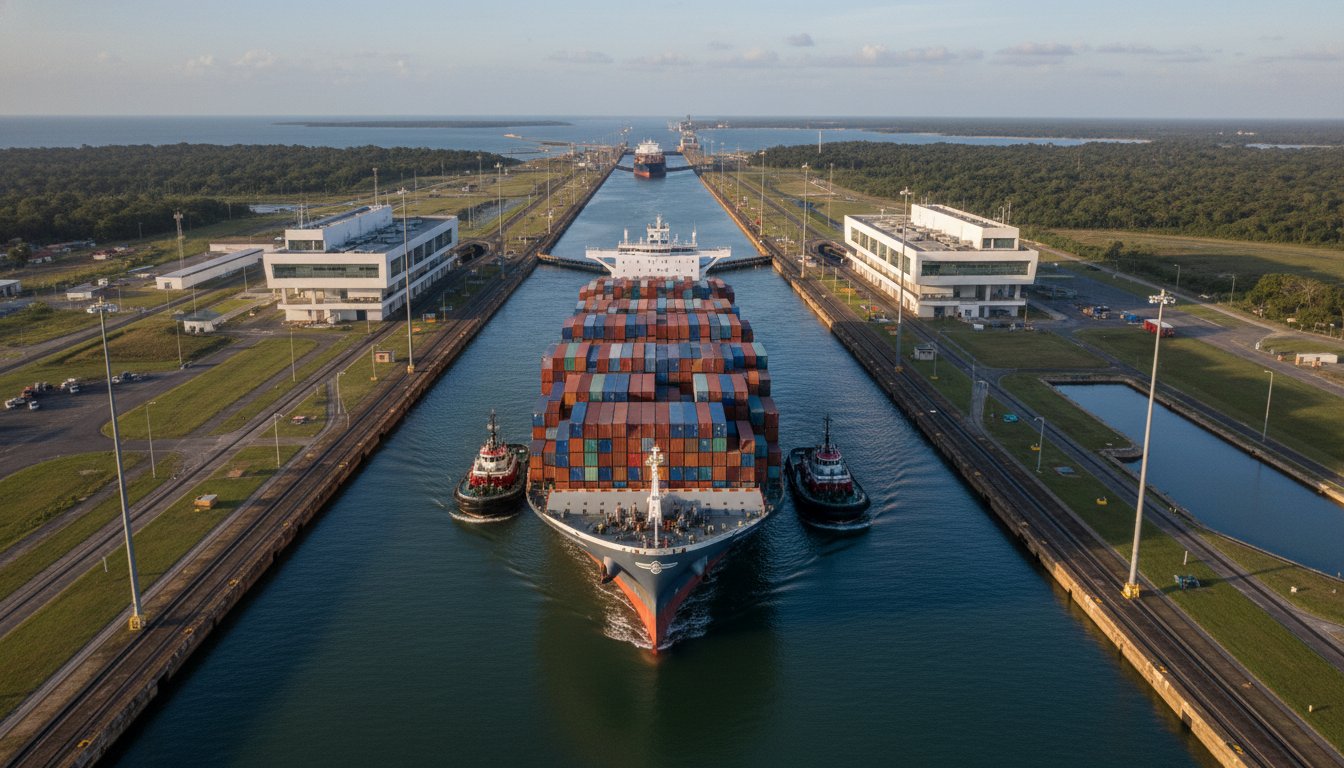

At the Panama Canal, every minute is critical. The last thing any ship operator needs is a costly transit delay or a significant fine because of a misstep in waste management. Yet, navigating the complex web of MARPOL and local regulations for sludge and garbage disposal in Panama ports can be a frustrating and uncertain process. Finding a reliable vendor and securing the correct documentation often feels like a gamble when your schedule is on the line.
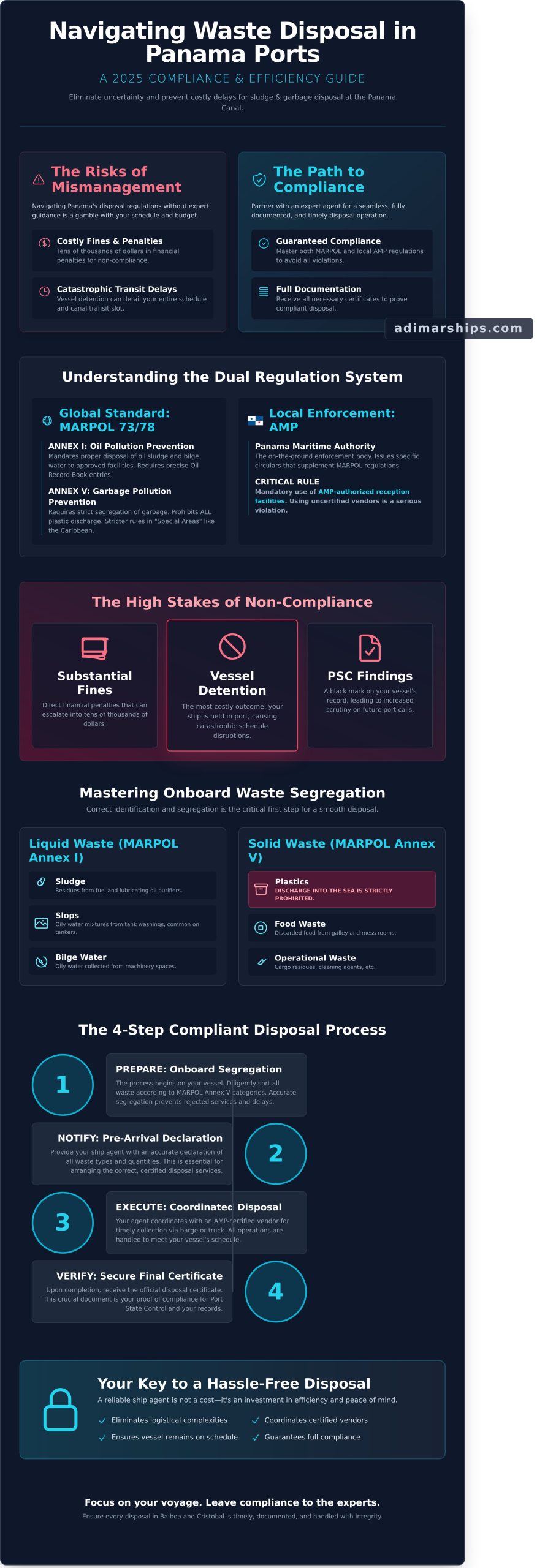
This is where confusion ends and clarity begins. This 2025 compliance guide is your expert resource for ensuring every disposal operation at key ports like Balboa and Cristobal is timely, fully documented, and handled with integrity. We’ll provide the essential information you need to eliminate uncertainty, prevent delays, and partner with a trusted agent. Put your transit in capable hands and focus on your core business, confident that your vessel remains fully compliant.
Key Takeaways
- Master both international MARPOL Annexes and specific Panamanian regulations to ensure every disposal is compliant and avoid costly fines.
- A successful sludge and garbage disposal panama ports operation hinges on a clear process, from mandatory pre-arrival notifications to securing the final disposal certificate.
- Proper onboard segregation of waste-especially oily sludge, plastics, and food waste-is the critical first step for a smooth and efficient disposal upon arrival.
- Partnering with an experienced local ship agent eliminates logistical complexities, coordinates certified vendors, and ensures your vessel remains on schedule.
Understanding Waste Disposal Regulations in Panama: MARPOL and Local Rules
For any vessel master or charterer, navigating Panamanian waters requires strict adherence to environmental regulations. Mismanagement of waste is not an option. As a leading flag state and the authority governing the Panama Canal, Panama rigorously enforces a dual layer of rules: the global MARPOL standards and specific local mandates from the Panama Maritime Authority (AMP). Understanding these regulations is critical, as failure to comply with protocols for sludge and garbage disposal in Panama ports carries significant financial and operational risks that can disrupt your entire voyage.
MARPOL Annex I & V: The Global Standard
The International Convention for the Prevention of Pollution from Ships, universally known as the MARPOL 73/78 international convention, is the primary global treaty governing marine pollution. Panama, as a signatory, strictly enforces its key annexes.
- Annex I focuses on preventing oil pollution, mandating the proper management and disposal of oil sludge and bilge water. Vessels must maintain a precise Oil Record Book and prove that all oily waste is discharged to an approved reception facility, not the sea.
- Annex V regulates garbage disposal, requiring crews to sort waste into specific categories (e.g., plastics, food waste, operational waste). Discharging plastics is completely prohibited, and strict rules apply to all other garbage, especially within the “Wider Caribbean Region,” which is a designated Special Area.
Panama Maritime Authority (AMP) Specific Requirements
While MARPOL provides the global framework, the Panama Maritime Authority (AMP) is the on-the-ground enforcement body. The AMP issues its own circulars and decrees that supplement international law, creating specific requirements for vessels calling at its ports or transiting the Canal. The most critical local rule is the mandatory use of AMP-authorized reception facilities for all waste disposal. Using uncertified providers is a serious violation and puts your vessel at immediate risk of non-compliance.
Consequences of Non-Compliance in Panamanian Waters
The AMP does not take violations lightly. The consequences of improper waste disposal are severe and designed to be a powerful deterrent. Ship owners and operators face:
- Substantial Fines: Financial penalties can quickly escalate into tens of thousands of dollars, directly impacting your voyage’s profitability.
- Vessel Detention: The most costly outcome. Your vessel can be held in port until the issue is resolved, causing catastrophic delays to your schedule and Canal transit.
- Port State Control (PSC) Findings: A non-compliance finding is recorded against your vessel, leading to a damaged reputation and increased scrutiny during future port calls worldwide.
Key Waste Categories: Identifying and Segregating Your Disposals
Efficient sludge and garbage disposal in Panama ports begins long before you arrive. Your crew’s diligence in correctly identifying and segregating waste onboard is the critical first step toward a smooth and compliant port call. An accurate declaration of all waste types and quantities to your port agent is not just a formality-it is essential for preventing costly delays, ensuring environmental compliance, and arranging the correct disposal services without complication. Misidentifying waste can lead to rejected services and potential fines.
Understanding the primary classifications is key. Vessel-generated waste is broadly divided into liquid, solid (garbage), and special hazardous categories, each with distinct handling requirements.
Liquid Waste: Sludge, Slops, and Bilge Water
Liquid wastes are typically generated from machinery operations and cargo handling. Declaring the correct type and estimated volume is crucial for arranging the appropriate collection barges or trucks. The main categories include:
- Sludge: Engine room residues, primarily from the purification of fuel and lubricating oils.
- Slops: Oily water mixtures resulting from tank washings, most commonly associated with tankers.
- Bilge Water: Oily water that collects in the machinery spaces and other compartments within the vessel.
Solid Waste: Garbage under MARPOL Annex V
Solid waste, regulated as “garbage” under MARPOL Annex V, must be carefully segregated onboard. A well-organized system for ship-generated waste management is not just a regulatory requirement; it’s a cornerstone of operational efficiency. Key categories include:
- Plastics: All forms of plastic, including synthetic ropes and fishing gear. Discharge into the sea is strictly prohibited.
- Food Waste: Discarded food from the galley, subject to specific disposal regulations depending on the vessel’s location.
- Domestic Waste: Paper products, rags, glass, metal, bottles, and similar materials.
- Operational Waste: Includes items like cooking oil and incinerator ash, which require special handling.
Hazardous Waste (Special Category)
Certain items require specialized disposal due to their hazardous nature. These materials cannot be mixed with general garbage or oily waste. Examples include used batteries, expired chemicals, medical waste, and expired pyrotechnics. Disposing of these items requires special arrangements and permits in Panama. It is vital to notify your agent well in advance with precise details on the type and quantity to ensure safe and compliant handling upon your arrival.
The Disposal Process in Panama Ports: A Step-by-Step Guide
Navigating the requirements for waste disposal can be complex, but a clear, systematic approach eliminates confusion and prevents costly delays. In Panama, the process is well-defined, whether your vessel is at anchorage or alongside a berth. A trusted ship agent is your essential partner, coordinating every detail to ensure a timely and compliant operation. Here is a practical, step-by-step guide to the process.
Step 1: Pre-Arrival Notification and Service Request
Proactive planning is the key to efficiency. You must notify your ship agent at least 48-72 hours before your vessel’s arrival. This advance notice is critical for your agent to schedule services with a government-certified provider without disrupting your operational timeline. Be prepared to provide the following essential details:
- Type of Waste: Specify MARPOL Annex (e.g., Annex I for oily sludge, Annex V for garbage).
- Estimated Quantity: Provide a close estimate in cubic meters (CBM) for sludge or metric tons (MT) for garbage.
- Vessel Location: State whether the service is required at anchorage (Atlantic or Pacific side) or alongside a specific berth.
Step 2: Coordination and On-Site Operations
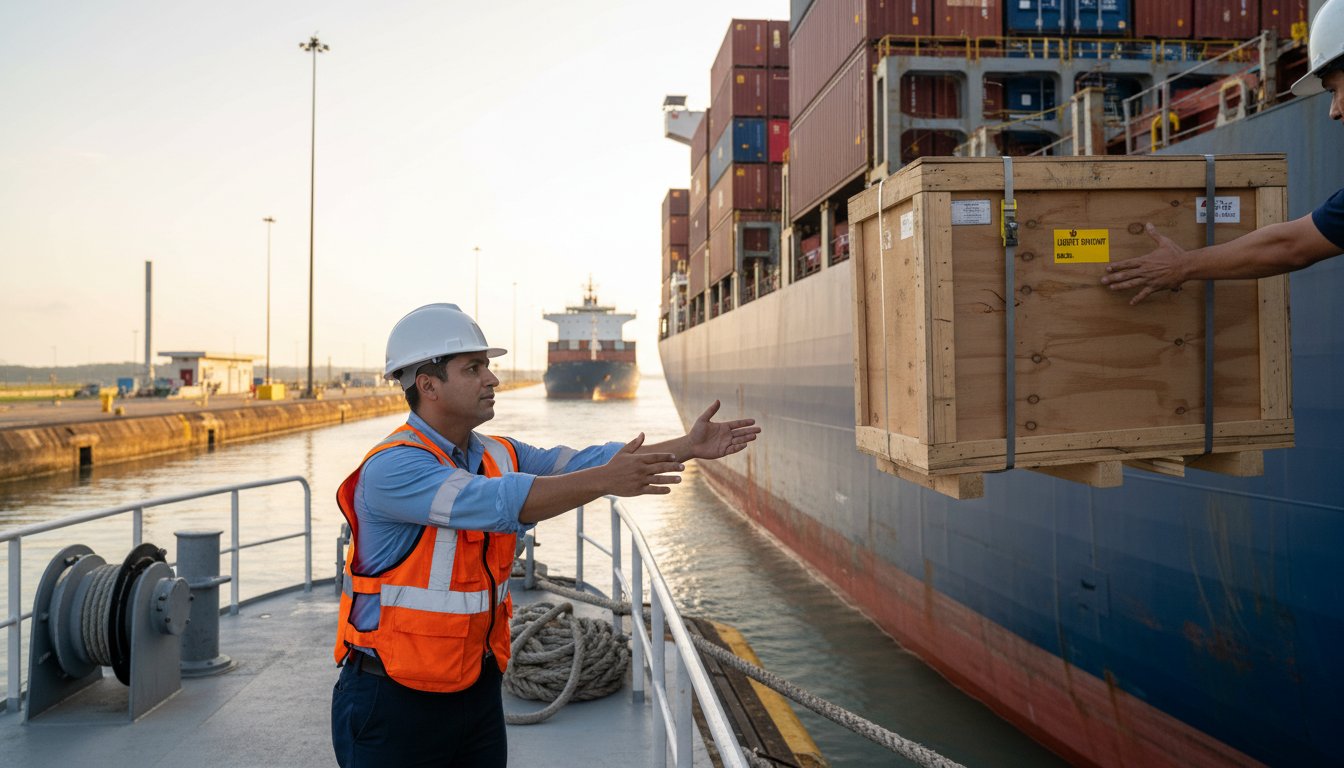
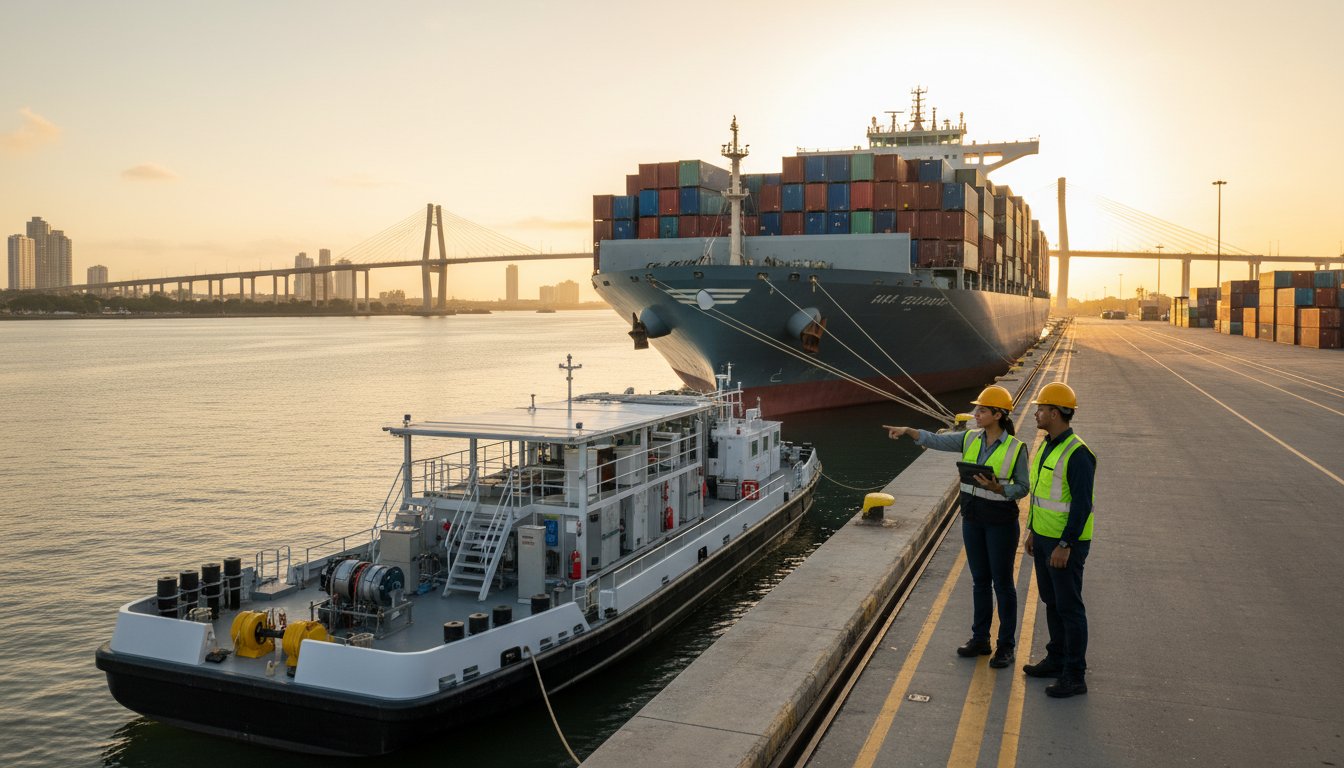
Once your request is submitted, your agent acts as your on-the-ground coordinator. They will arrange for a specialized disposal barge to meet your vessel at anchorage or a collection truck if you are at berth. During the operation, the ship’s crew plays a vital role in overseeing the process, ensuring safety protocols are strictly followed during hose connection for sludge removal or the transfer of garbage bins. Clear communication between the crew, the agent, and the service provider is paramount for a smooth execution.
Step 3: Measurement and Documentation
Transparency and compliance are non-negotiable. After the operation is complete, the quantity of waste removed is jointly verified. For sludge, this is typically done through tank soundings before and after the transfer. Upon completion, you will receive an official MARPOL disposal certificate. This document is not just a receipt; it is your official proof of compliant sludge and garbage disposal panama ports, essential for Port State Control inspections and maintaining your vessel’s environmental records. Ensure the Master signs and stamps the certificate and retains a copy onboard.
A reliable agent manages these steps with precision, ensuring your vessel remains on schedule. Put your transit in our hands-nominate Adimar Shipping, Inc. as your agent to eliminate the confusion.
Why a Ship Agent is Your Key to a Hassle-Free Disposal
Understanding the regulations and procedures for waste disposal is only half the battle. The other half is execution. While it’s possible for an operator to coordinate directly with local vendors, this approach is often fraught with communication delays, compliance risks, and unforeseen costs. In a high-stakes environment where time is money, a misstep can be frustrating and expensive.
This is where a trusted ship agent becomes your most valuable asset. An experienced agent acts as your local, on-the-ground team, transforming a complex logistical task into a simple, streamlined process. They eliminate the guesswork and serve as your single point of contact for all husbandry services, including efficient sludge and garbage disposal panama ports require.
Vetted Network of Certified Providers
A professional agent doesn’t just find any vendor; they maintain a curated network of reliable, cost-effective, and fully certified providers. We ensure every company we work with is approved by the Panama Maritime Authority (AMP), eliminating the risk of non-compliance and potential fines. By leveraging our long-standing relationships and high volume of operations, we can often secure more favorable rates than a vessel could achieve on its own.
Streamlined Coordination and Communication
Your Master and crew have more critical duties than coordinating waste collection. An agent takes this entire burden off their shoulders. We manage all communications between the vessel, the disposal company, and port authorities to ensure seamless service. As your local office, we handle the scheduling, confirm logistics, and troubleshoot any issues that arise, allowing your team to focus on preparing for a safe and timely transit.
Ensuring Compliance and Financial Transparency
Proper documentation is non-negotiable. Your agent ensures that all necessary paperwork, including the official MARPOL certificates, is correctly completed and delivered to the vessel without delay. Financially, the process is simplified. All service costs are managed transparently through your vessel’s Disbursement Account (DA), providing you with a clear, consolidated, and accurate record. This meticulous attention to detail guarantees both regulatory compliance and financial peace of mind. Put Adimar’s expertise in your hands for a seamless Panama transit.
Navigate Panama’s Waste Disposal with Confidence
As we have explored, navigating the complexities of waste disposal in Panama requires a firm grasp of both MARPOL and local regulations. Proper waste segregation and a clear understanding of the step-by-step process are not just best practices-they are essential for avoiding costly delays and penalties. Ultimately, efficient and compliant sludge and garbage disposal panama ports hinges on having an expert partner on the ground.
Don’t leave compliance to chance. For over 20 years, Adimar Shipping has served as the trusted partner for vessel operators at the Panama Canal. We eliminate the confusion by managing the entire process through our vetted network of fully certified and insured disposal providers. As your single point of contact for all husbandry and transit needs, we ensure your operations remain seamless and efficient.
Nominate Adimar Shipping to manage your vessel’s waste disposal and ensure full compliance. Let us be your eyes at the Panama Canal, so you can focus on your voyage ahead.
Frequently Asked Questions
Can waste disposal be done at the Panama Canal anchorage, or must the vessel be at berth?
Yes, waste disposal services can be efficiently arranged at both the Atlantic and Pacific anchorages. This is a common and practical option for vessels awaiting transit or orders. Coordinating with a trusted agent ensures that certified barges and collection services meet your vessel at the designated anchorage point, minimizing delays. This process avoids the need for berthing, saving both critical time and port costs, which is crucial to your operational schedule.
What are the typical costs for sludge and garbage disposal services in Panamanian ports?
Costs are variable, depending on the volume and type of waste. For garbage, expect prices to range from $350 to $500 per cubic meter. Sludge disposal is typically priced per metric ton, often starting around $150 to $250, but can fluctuate based on market conditions and the specific MARPOL provider. We provide transparent, itemized quotes to ensure there are no surprises, helping you manage your budget effectively and predictably.
How much advance notice is required to arrange for sludge removal in Balboa or Cristobal?
To ensure timely and smooth service, we recommend providing at least 48 hours of advance notice for sludge removal in either Balboa or Cristobal. This allows sufficient time to coordinate with certified MARPOL reception facilities, schedule barge availability, and secure any necessary clearances from port authorities. While we can accommodate requests on shorter notice, providing ample time guarantees the most efficient and cost-conscious service, preventing potential delays to your vessel’s schedule.
What happens if my vessel generates more waste than was initially declared to the agent?
If your vessel generates more waste than initially declared, it is crucial to inform your agent immediately. We understand that estimates can change. We will quickly coordinate with the disposal provider to update the service order and arrange for the collection of the additional volume. While this may incur extra costs based on the provider’s tariff, transparent communication allows us to manage the situation efficiently and prevent any compliance issues or delays for your vessel.
Are there significant differences in disposal procedures between the Atlantic and Pacific ports?
The fundamental procedures for sludge and garbage disposal panama ports are consistent between the Atlantic (Cristobal) and Pacific (Balboa) sides, as both are governed by the same national regulations and MARPOL standards. The core process of declaration, coordination with a certified provider, and collection via barge or truck remains the same. Minor logistical differences may exist in provider availability or anchorage specifics, but as your expert agent, we manage these details seamlessly on your behalf.
Is it possible to dispose of international catering waste in Panama?
Yes, international catering waste (often called “international garbage” or “Category 1” waste) can be disposed of in Panama, but it requires special handling due to strict quarantine regulations. This type of waste must be segregated and managed by a specifically authorized provider for incineration. As your trusted partner, we ensure full compliance with all Panamanian Agricultural Quarantine Service (SECUAGRO) requirements, arranging for proper collection and certified destruction of this material.