

In global shipping, time is money-and nowhere is that more true than at the Panama Canal. A single missing document, a misunderstood regulation, or a procedural misstep can lead to frustrating delays and costly fines. For ship owners and charterers, the pressure to execute a flawless transit is immense, but navigating the complex web of Panama Canal Authority (ACP) requirements can feel like a daunting task. That’s why having a reliable panama canal transit checklist for operators is not just an advantage; it’s a necessity for protecting your schedule and your bottom line.
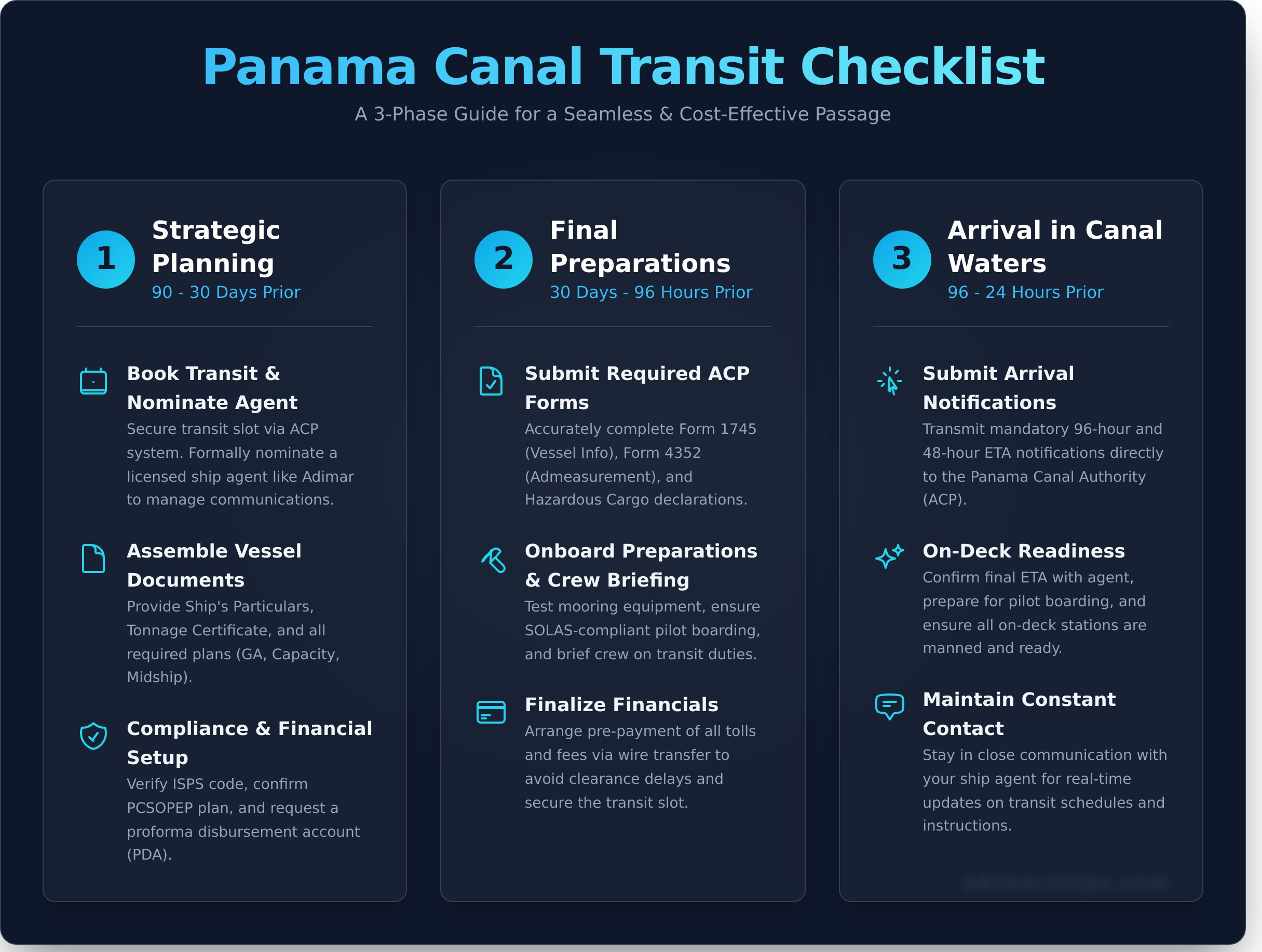
This ultimate guide is designed to be your trusted partner for this critical passage. We’ve eliminated the guesswork and laid out a clear, step-by-step operational checklist that covers everything from pre-arrival documentation to post-transit clearance. Follow these steps to ensure a smooth, compliant, and cost-effective transit, giving you the peace of mind to focus on your business while your vessel navigates the canal with integrity and efficiency.
Phase 1: Pre-Arrival (90-30 Days Prior) – Strategic Planning
A successful Panama Canal transit begins long before your vessel reaches Panamanian waters. This initial strategic planning phase, from 90 to 30 days prior to arrival, is about laying a solid foundation for a seamless passage. Focusing on long-lead items like booking, documentation, and compliance is the most effective way to prevent costly delays and administrative headaches. Early and accurate information submission is the cornerstone of this process, ensuring every detail is addressed with integrity and foresight.
Booking Your Transit & Nominating an Agent
Your first critical step is to secure a transit slot. This involves submitting a formal transit request through the Panama Canal Authority (ACP) electronic system, where you will select your desired transit date and booking period. Simultaneously, you must formally nominate a licensed and trusted ship agent. An experienced agent like Adimar acts as your eyes and ears on the ground, managing all communications with the ACP, confirming your booking, and navigating the complexities on your behalf so you can focus on your business.
Essential Vessel Documentation & Information
With your agent nominated, the next priority is assembling all required vessel documentation. Submitting incomplete or expired paperwork is a common source of transit delays. Your agent will need a comprehensive and up-to-date package, including:
- Ship’s Particulars and updated registry certificates
- Panama Canal Tonnage Certificate (if available)
- General Arrangement, Capacity Plan, and Midship Section drawings
Ensuring these documents are current is non-negotiable. The Canal’s requirements are precise and have evolved throughout the long history and operations of the Panama Canal, making accuracy paramount to avoid issues upon arrival.
Initial Compliance & Financial Setup
Proactive compliance checks during this phase will safeguard your voyage against potential fines. It is essential to verify that your vessel meets all International Ship and Port Facility Security (ISPS) code requirements. You must also confirm a valid Panama Canal Shipboard Oil Pollution Emergency Plan (PCSOPEP) is in place and that an authorized individual has been designated to manage it. This initial financial and compliance overview is a key part of any thorough panama canal transit checklist for operators. To ensure financial readiness, request a proforma disbursement account (PDA) from your agent. This provides a clear, transparent estimate of all anticipated transit costs, from tolls to agency fees.
Phase 2: Approaching Arrival (30 Days – 96 Hours Prior) – Final Preparations
As your vessel’s transit date approaches, the focus sharpens from long-term planning to immediate, critical actions. This period, from 30 days down to 96 hours before arrival, is about final declarations, onboard readiness, and financial settlement. Getting these details right is a non-negotiable part of any successful panama canal transit checklist for operators, ensuring a smooth and timely passage without costly delays.
Submitting Required ACP Forms
The Panama Canal Authority (ACP) requires specific, time-sensitive documentation to process and schedule your transit. Accuracy here is paramount. Your agent acts as your local expert, reviewing every detail before submission to eliminate confusion and ensure full compliance. Key submissions include:
- Form 1745 (Vessel Information): This form provides the ACP with final, updated details about your vessel’s condition, crew, and cargo.
- Form 4352 (Request for Admeasurement): If your vessel is transiting for the first time or has undergone structural modifications, this form must be submitted to determine official tonnage and tolls.
- Hazardous Cargo Declaration: Any dangerous goods must be declared with complete accuracy to ensure proper handling and safety procedures are followed.
Onboard Preparations & Crew Briefing
While paperwork is processed, the Master must ensure the vessel is physically prepared for the unique demands of the canal. All equipment must be in excellent working order. This includes a thorough check of mooring lines, chocks, and bitts to handle the immense forces within the locks. It is also vital to confirm that pilot boarding arrangements are fully compliant with SOLAS regulations. Conducting detailed pre-transit equipment tests is a best practice that prevents last-minute issues. The crew must be briefed on their specific roles, from line handling to effective communication with the Canal Pilot, and sanitary facilities must be prepared for pilots and advisors.
Finalizing Financials: Pre-Payment of Tolls
In shipping, time is money, and your transit will not be officially scheduled until all tolls and fees are paid in full. Your agent will provide a final Proforma Disbursement Account (PDA) detailing all costs. It is the operator’s responsibility to arrange the wire transfer so funds are received and cleared well in advance of arrival. Confirming receipt with your agent is the final step. Proactive financial settlement is the key to avoiding clearance delays and securing your vessel’s transit slot.
Phase 3: Arrival in Canal Waters (96 – 24 Hours Prior) – The Waiting Game
Once your vessel enters the Panama Canal’s operating area, the “waiting game” begins. This phase is defined by precise communication and meticulous on-deck preparation. Every action taken from this point forward is critical for a smooth and timely transit slot. This part of your panama canal transit checklist for operators is where having a reliable local partner becomes invaluable. Missteps here can lead to costly delays, making constant coordination paramount. Need 24/7 support during arrival? Adimar is your eyes at the Canal.
Arrival Notifications and Procedures
Timely and accurate communication with the Panama Canal Authority (ACP) is non-negotiable. As soon as you are within range, your focus should shift to executing these mandatory arrival protocols. Your ship agent will be instrumental in coordinating services and confirming schedules based on the information you provide.
- Submit mandatory 96-hour and 48-hour ETA notifications directly to the ACP.
- Confirm your final ETA with your agent to align husbandry services like crew changes or provisions.
- Proceed to the specific Pacific or Atlantic anchorage area as instructed by the ACP Traffic Control.
- Maintain a continuous, active watch on VHF Channels 12 and 13 for all official communications.
The ACP Transit Inspection Checklist
Before transit is approved, your vessel will undergo a mandatory inspection at anchorage. An ACP inspector will board to verify that the ship meets all operational and safety standards. Having everything in order prevents delays. The inspector will focus on key areas, and to ensure full compliance, your crew should be familiar with the standards detailed in the Official Panama Canal Vessel Requirements. Be prepared for a thorough review of all required vessel certificates, bridge equipment functionality, mooring arrangements, and overall sanitary conditions.
Preparing for Pilot Boarding
The final step before getting underway is the safe boarding of the ACP pilot. This process must be executed flawlessly to ensure the safety of the pilot and your crew. Your agent will confirm the exact pilot boarding time, allowing your crew to make final preparations for a seamless handover to the pilot who will guide your vessel through the Canal.
- Confirm the final pilot boarding time and location with your agent.
- Rig pilot ladders, man-ropes, and any required hoists strictly in accordance with SOLAS and ACP regulations.
- Ensure the entire path from the pilot ladder to the bridge is clear of obstructions, well-lit, and safe.
- Designate an officer to be present at the boarding point to greet the pilot and escort them to the bridge.
Phase 4: Transit & Post-Transit – Execution and Departure
With all preparations complete, your vessel enters the most critical stage: the transit itself. This phase is where meticulous planning meets real-time execution. While the Panama Canal Authority (ACP) pilot provides expert navigational guidance, the Master retains ultimate command and responsibility for the vessel. Success at this stage hinges on seamless coordination between the pilot, the Master, and a well-drilled crew, ensuring a safe and timely passage.
During the Transit: Key Operational Points
Constant vigilance and clear communication are paramount as you navigate the locks and channels. Every crew member has a vital role in ensuring an incident-free passage. Your focus should be on flawless execution and maintaining complete situational awareness.
- Bridge & Deck Communication: Maintain open and continuous communication between the bridge team and the line handlers on deck. Every command must be heard, understood, and confirmed promptly.
- Pilot Instructions: Follow all pilot instructions precisely. The pilot has specialized local knowledge essential for navigating the Canal’s unique challenges, from wind conditions in the lakes to positioning within the lock chambers.
- Vessel Monitoring: Continuously monitor the vessel’s speed, heading, and position relative to the channel markers and lock walls. Proactive monitoring prevents dangerous situations from developing.
- Safety First: Ensure all crew members involved in mooring and line handling operations wear the appropriate Personal Protective Equipment (PPE) at all times, without exception.
Post-Transit Clearance and Departure
As your vessel approaches the final sea buoy, the transit phase concludes, and departure procedures begin. A smooth exit is the final operational item on your panama canal transit checklist for operators. The pilot will disembark, and your agent will confirm all local services are complete. Once you report your departure to the Cristobal (Atlantic) or Flamenco (Pacific) signal station, you are cleared to proceed on your voyage.
Finalizing Accounts and Documentation
The final step occurs after your vessel has departed. Your agent will compile all costs associated with the transit into a final report. Transparency and accuracy are critical to ensure you only pay for services rendered. Working with a trusted agent with integrity simplifies this process, eliminating confusion and protecting your bottom line.
- Receive Final Disbursement Account (FDA): Your agent will provide a detailed FDA outlining all expenses, including Canal tolls, pilotage, and husbandry services.
- Review and Verify: Carefully review all charges and supporting invoices for accuracy.
- Settle the Balance: Pay any outstanding balance or receive a prompt refund if your initial deposit exceeded the final costs.
- Obtain Transit Records: Secure the official Ship Transit Report from your agent for your vessel’s permanent records.
Optimizing Your Transit: How a Ship Agent Prevents Common Problems
While a comprehensive panama canal transit checklist for operators is an essential tool for preparation, it’s a static document. In the dynamic environment of the Canal, you need a strategic partner on the ground. A professional ship agent acts as your local office, your trusted expert who mitigates the real-world risks that no checklist can anticipate. They are your eyes and ears, turning your plan into a smooth, cost-effective reality and proving that in this industry, expertise is the ultimate time and money saver.
Managing Delays and Contingencies
The Canal’s operational landscape can change in an instant. Your agent provides real-time updates on congestion, weather, and slot availability, often anticipating delays before they impact your schedule. Should an unexpected issue arise, from an urgent medical need to emergency repairs, your agent is your 24/7 point of contact. They have the local network to coordinate immediate, effective solutions, ensuring minimal disruption to your voyage.
Cost Control and Financial Transparency
Protecting your bottom line is our priority. A diligent agent scrutinizes every invoice from vendors and the Canal Authority to prevent overcharging and ensure accuracy, a critical step when dealing with transit tolls that can exceed hundreds of thousands of dollars. We provide clear, consolidated financial statements with complete integrity. Our established local relationships often result in preferential pricing for services, delivering direct cost savings and total financial transparency for your transit.
Coordinating Husbandry Services
An agent’s value extends far beyond the transit itself. We manage all essential husbandry services with efficiency and precision, allowing your crew to focus on their core duties. This includes:
- Seamlessly arranging crew changes, including visas, transport, and accommodations.
- Coordinating the timely delivery of spare parts, provisions, and mail.
- Managing secure and verified Cash to Master (CTM) deliveries.
- Arranging for sludge, garbage, and bilge water disposal in full compliance with local environmental regulations.
Ensuring Regulatory Compliance
Navigating the complex and ever-changing regulations of the Panama Canal Authority (ACP) is a significant challenge. Our team provides expert guidance on all requirements, from pre-arrival documentation to specific PCSOPEP (Panama Canal Shipboard Oil Pollution Emergency Plan) compliance. We help you avoid common administrative mistakes that lead to costly fines and delays. Put your transit in our hands and eliminate the confusion. Nominate Adimar to ensure a flawless transit.
Your Trusted Partner for a Seamless Panama Canal Transit
A successful passage is a multi-stage operation demanding meticulous planning and flawless execution. As we’ve detailed, proactive preparation-from strategic planning months in advance to final on-the-ground coordination-is the key to avoiding costly delays. While this comprehensive panama canal transit checklist for operators provides the framework, the secret to a truly smooth voyage is an expert local partner.
This is where Adimar Shipping becomes your greatest asset. We are your eyes at the Canal, transforming this complex checklist into a seamless reality. With over 20 years of experience, our dedicated, on-the-ground team provides 24/7 support and expert services, including as a PCSOPEP Authorized Person. We are the experts so you don’t have to be, managing every detail with integrity.
Put our trusted expertise to work for your vessel. Request a Quote and Nominate Adimar as Your Agent today and ensure your next transit is efficient, predictable, and stress-free. Let us handle the complexities so you can sail through with confidence.
Frequently Asked Questions About Panama Canal Transits
How far in advance should I book a Panama Canal transit?
The Panama Canal Authority (ACP) offers booking slots up to 365 days in advance. For optimal timing and cost, we recommend booking in Period 1, which is between 22 and 365 days before your transit date. Booking later, in Period 2 or 3, significantly increases competition and the price of securing a slot. Proactive booking is essential for a cost-effective and predictable transit.
What are the most common reasons for transit delays or fines?
Delays and fines often result from preventable issues. The most common causes include failing the mandatory ACP pre-transit inspection due to non-compliant equipment like chocks or mooring lines, submitting inaccurate vessel information, or arriving late to the anchorage. A thorough panama canal transit checklist for operators is your best defense against these costly and time-consuming problems, ensuring all requirements are met well in advance.
Can a vessel transit the Panama Canal without a ship agent?
No, this is not possible. The Panama Canal Authority (ACP) regulations mandate that every vessel must appoint a local ship agent to handle its transit. Your agent is your official representative on the ground, managing all communications with the ACP, coordinating payments, submitting required documentation, and arranging necessary husbandry services. They are your essential partner for a smooth and compliant passage.
What is a PCSOPEP Authorized Person and why is it required?
PCSOPEP stands for the Panama Canal Shipboard Oil Pollution Emergency Plan. It is a vessel-specific plan required by the ACP to manage a potential oil spill. An Authorized Person is a Panama-based, ACP-approved entity designated to activate and coordinate this plan in an emergency. This is a mandatory requirement to ensure a rapid, expert response is locally available to protect the Canal’s vital ecosystem.
How do water levels and drought conditions affect canal transits?
Low water levels in Gatun Lake, often due to drought, directly impact Canal operations. The ACP may impose draft restrictions, limiting the maximum depth of a vessel and thus its cargo capacity. To conserve water, the ACP may also reduce the number of daily transit slots. This increases competition for available slots, potentially leading to higher auction prices and longer waits for unbooked vessels.
What is the difference between booking Period 1, 2, and 3?
The booking periods refer to the timeframe in which a transit slot is requested. Period 1 is from 365 to 22 days prior to transit and offers the best availability and standard pricing. Period 2 runs from 21 to 4 days prior, offering remaining slots that are often more expensive. Period 3 is the final window, from 3 to 2 days before transit, where limited slots are sold in a highly competitive daily auction, usually at premium prices.
What happens if my vessel fails the ACP transit inspection?
If a vessel fails its inspection, its transit is immediately denied until all deficiencies are corrected. The vessel loses its scheduled slot and must wait for a new one to become available after it passes a re-inspection, leading to significant delays and additional costs. Ensuring all items on your panama canal transit checklist for operators are addressed beforehand is critical to avoid this scenario.