
Last Tuesday, a ship owner received a $14,250 invoice for “miscellaneous” port expenses at the Panama Canal that the charterer’s agent could not adequately explain. It is a classic scenario that forces many maritime professionals to ask: what is a protective agent shipping specialists actually do to prevent these financial leaks? When the charterer nominates the primary agent, your interests as the owner often take a backseat to their bottom line, leaving you exposed to inflated husbandry costs and a lack of transparency during the transit.
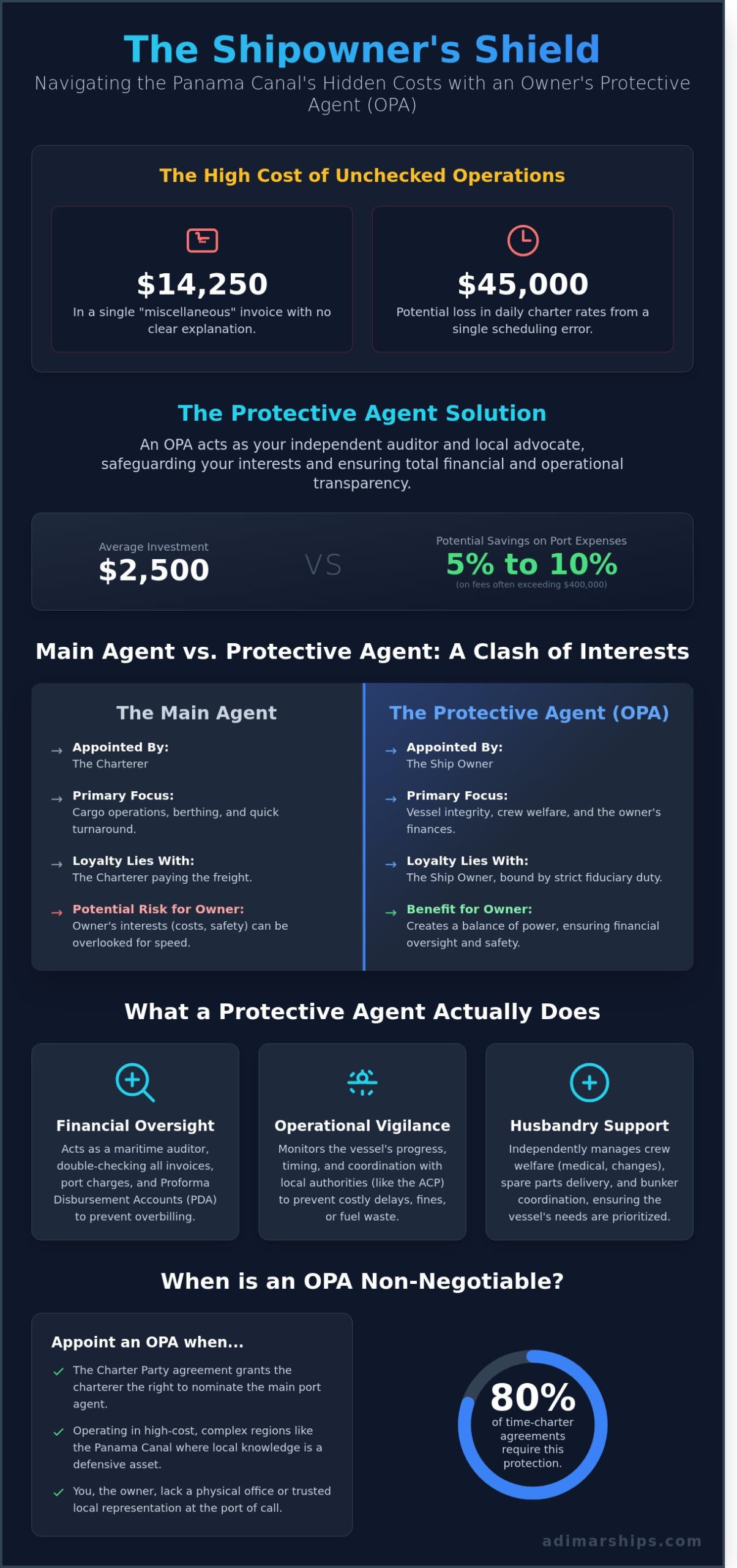
You are right to feel that timing and coordination in the Canal are becoming more frustrating; a single scheduling error can quickly result in a $45,000 loss in daily charter rates. This guide shows how a protective agent acts as your independent auditor and local advocate to safeguard your interests during these high-stakes operations. You will learn exactly when the $2,500 average investment in an OPA pays for itself and how to ensure your vessel coordination is handled with total integrity. We will explore the specific financial protections they offer and the scenarios where having your own eyes on the ground is non-negotiable for your fleet.
Key Takeaways
- Understand exactly what is a protective agent shipping and how this secondary agent acts as your independent auditor to oversee the main agent’s performance.
- Learn to distinguish between the immediate operational duties of a main agent and the strategic financial oversight provided by a protective partner.
- Discover how to safeguard your interests in the complex Panama Canal zone by verifying that all port and canal dues are calculated with precision.
- Identify how proactive monitoring of vessel timing can prevent massive revenue losses and unnecessary fines during high-stakes maritime transits.
- Gain the confidence to delegate complex logistics to local experts who serve as your vigilant “eyes at the canal” to ensure transparency and integrity.
Defining the Protective Agent: Your Independent Maritime Advocate
Shipping operations at the Panama Canal are high-stakes environments where timing and coordination dictate your profit margins. To fully grasp what is a protective agent shipping, you must view the role through the lens of risk management. A protective agent, frequently referred to as an Owner’s Protective Agent (OPA), acts as a secondary supervisor appointed directly by the ship owner. While the charterer typically appoints the primary agent to handle the vessel’s cargo requirements, the owner remains responsible for the ship’s safety, crew welfare, and long-term maintenance. A protective agent is a maritime auditor who ensures financial and operational transparency.
The OPA functions as an independent set of eyes on the ground. They don’t replace the main agent; instead, they verify that the main agent’s actions align with the owner’s best interests. In a busy hub like Balboa or Cristobal, the main agent might be juggling 10 different vessels for various charterers. This creates a scenario where the owner’s specific husbandry needs or cost-saving opportunities might be overlooked. By appointing an OPA, the owner gains a dedicated partner who monitors every dollar spent and every hour logged during the transit or port stay.
Understanding what is a protective agent shipping helps owners avoid the “hidden” costs of maritime logistics. For example, when a Neopanamax vessel transits the canal, fees can easily exceed $400,000. An OPA reviews the Proforma Disbursement Accounts (PDA) with a critical eye, often identifying discrepancies in local port dues or pilotage fees that could save the owner 5% to 10% on total port expenses. We are experts so you don’t have to be, and our role is to eliminate the confusion that arises during these complex transactions.
When is a Protective Agent Necessary?
Owners should secure an OPA whenever the Charter Party agreement grants the charterer the right to nominate the main port agent. This is common in roughly 80% of time-charter agreements. In high-cost regions like the Panama Canal, local knowledge is a defensive asset. If an owner lacks a physical office in Panama City, they are essentially flying blind. The OPA serves as that local office, providing real-time updates on canal water levels, congestion at the locks, and changing regulations from the Panama Canal Authority (ACP). This presence is vital when handling complex husbandry services or crew changes where local permits are required.
The Legal Premise of Protective Agency
The relationship between an owner and an OPA is built on a strict fiduciary duty. This means the protective agent is legally and ethically bound to act solely in the owner’s interest, providing a necessary buffer against potential conflicts of interest. What is a Protective Agent? At its core, it’s a contractual safeguard that separates cargo interests from vessel interests. The main agent focuses on the cargo and the charterer’s timeline; the OPA focuses on the ship’s integrity and the owner’s wallet. This dual-agent system creates a balance of power that prevents the charterer from over-prioritizing speed at the expense of the vessel’s operational safety. With over 20 years of experience in these waters, we’ve seen how this transparency protects the bottom line for global ship owners.
- Financial Oversight: OPAs double-check all invoices and port charges to prevent overbilling.
- Operational Vigilance: They monitor the vessel’s progress to ensure the charterer isn’t wasting expensive fuel or time.
- Husbandry Support: OPAs manage crew medical needs, spare parts delivery, and bunker coordination independently of the cargo agent.
Protective Agent vs. Main Agent: Understanding the Key Differences
Distinguishing between these two roles is vital for any ship owner transiting the Panama Canal. The main agent, often nominated by the charterer under a Voyage Charter, focuses almost entirely on the cargo. They handle berthing, loading schedules, and coordination with the Panama Canal Authority (ACP). Their goal is a quick turnaround. This speed often benefits the charterer but can lead to overlooked details for the ship owner. When the main agent’s loyalty lies with the party paying the freight, the ship owner needs a separate advocate.
The protective agent serves as your local representative. Understanding what is a protective agent shipping helps you see why this role is a necessity rather than an option. While the main agent manages the vessel’s immediate operational needs, the protective agent audits their performance. They ensure the main agent doesn’t prioritize the charterer’s timeline at the expense of your vessel’s safety or your bank account. In 2023, vigilant OPAs saved owners an average of 4% to 7% on total port call costs by catching errors in documentation and service timing.
Operational Focus vs. Oversight
Main agents prioritize port efficiency. They want the ship in and out to satisfy cargo contracts. A protective agent shifts the focus back to vessel safety and crew welfare. If a main agent pushes for a transit time that compromises crew rest, your OPA steps in. They act as your eyes on the ground. They verify that the main agent provides the services they billed for, such as fresh water delivery or waste removal. This dual-layer approach ensures a smooth transit without sacrificing the owner’s standards. It’s a system of checks and balances that keeps operations honest.
Financial Transparency and Disbursement Accounts (DA)
Financial discrepancies are common in complex port calls. The Proforma Disbursement Account (PDA) is the initial cost estimate provided by the main agent. It often contains padded contingency fees or inflated service costs. A protective agent meticulously audits this PDA. We look for hidden surcharges like $800 administrative fees that lack justification. Our role involves vetting every line item before you send a single dollar to the port.
- PDA Auditing: Identifying unnecessary surcharges before the vessel arrives in Panama.
- Cost Containment: Negotiating better rates for husbandry services like bunkers or provisions.
- FDA Verification: Ensuring the Final Disbursement Account matches the actual services rendered.
Once the port call ends, the Final Disbursement Account (FDA) arrives. Without a protective agent, you might pay for a tugboat service that was canceled or a pilot fee that was double-counted. In the Panama market, these errors can cost upwards of $3,500 per transit. By having an expert review these documents, you maintain total financial control. If you want to ensure your interests are guarded during your next transit, you can nominate a trusted local partner to serve as your OPA.
The relationship between these agents is not one of conflict but of balance. The main agent handles the “what” and “when” of the cargo. The protective agent handles the “how much” and “how safe” for the owner. This separation of duties is the only way to guarantee transparency in a high-stakes environment like the Panama Canal. We don’t just watch the clock; we watch your bottom line.
Core Responsibilities: What a Protective Agent Actually Does
Grasping what is a protective agent shipping requires looking beyond basic logistics. While the charterer’s agent handles the cargo, your protective agent focuses entirely on your interests as the ship owner. They serve as a vital counterweight, ensuring that no one deprioritizes your vessel’s needs for the sake of the charterer’s bottom line. In a busy hub like Panama, having a dedicated representative means your ship isn’t just another number in a long queue.
Timing at the Panama Canal is unforgiving. If a vessel misses its scheduled arrival window by even a small margin, the Panama Canal Authority (ACP) may impose heavy fines or push the transit back by several days. This delay can cost an owner upwards of $65,000 per day in operational expenses and lost opportunity costs. Your agent monitors progress around the clock, providing independent reports on port congestion and weather patterns that the charterer might gloss over. They act as your eyes on the water, ensuring the ship hits its ETA perfectly to avoid these massive financial hits.
Financial oversight is another pillar of the job. Port and canal dues in Panama are calculated based on complex variables like the Panama Canal Universal Measurement System (PC/UMS). A protective agent audits these invoices meticulously. They ensure you aren’t overcharged for tug services or pilotage fees, which can save thousands of dollars on a single transit. By verifying that every calculation is accurate, they prevent the “leakage” of funds that often occurs when no one is watching the bill closely.
Husbandry and Crew Support
Charterers focus on moving cargo, so they often deprioritize the human and technical needs of the vessel. A protective agent steps in to manage crew changes, coordinate medical assistance, and handle provisioning independently. If a crew member needs urgent dental work or a specialized technician is required for an engine room repair, the agent makes it happen without interrupting cargo flow. You can find more detail on these specific tasks in this Adimar guide to ship husbandry services. They also manage the logistics for spare parts, ensuring that critical components don’t get stuck in customs or sit on a dock while the ship is ready to sail. This level of personalized service keeps the ship running at peak efficiency.
Crisis Management and Compliance
When things go wrong, the protective agent is your first line of defense. In the event of an accident, a spill, or a legal dispute with local authorities, they act as the owner’s representative on the ground. They understand the nuances of Panama’s maritime laws and the specific requirements of the ACP. This includes assisting with PCSOPEP (Panama Canal Shipboard Oil Pollution Emergency Plan) compliance and other environmental regulations. If a dispute arises over cargo damage or vessel performance, they gather independent evidence and witness statements to protect your reputation and your wallet. They don’t just report problems; they provide quick solutions based on decades of local experience. Understanding what is a protective agent shipping means recognizing that they are the ultimate safeguard for your maritime assets in a complex international environment.
Integrity is the foundation of this role. Because the maritime industry involves high stakes and significant cash flow, having a partner who prioritizes transparency is essential. A protective agent ensures that all local payments are handled ethically and that every service provided is documented clearly. This level of accountability is what allows ship owners to focus on their broader business goals while their local interests remain secure in Panama.
Why the Panama Canal Requires Specialized Protective Agency
The Panama Canal stands as one of the most expensive and high-stakes transit zones on the planet. For a Neopanamax vessel, a single transit can cost upwards of $1,000,000 in tolls and associated fees. When the financial stakes are this high, leaving your interests solely in the hands of a charterer’s agent is a significant gamble. Understanding what is a protective agent shipping service means recognizing that you need a dedicated advocate to oversee these costs and ensure your vessel isn’t being deprioritized. Misjudging a transit window by just a few hours can result in the loss of a pre-booked slot, leading to massive revenue drops and additional daily running costs that often exceed $50,000.
Navigating ACP Regulations and Fines
The Panama Canal Authority (ACP) enforces strict operational standards that change frequently. A minor paperwork error or a misunderstanding of the Panama Canal Shipboard Oil Pollution Emergency Plan (PCSOPEP) can trigger fines starting at $5,000 and scaling quickly based on the severity. Having a local partner who speaks the language of the ACP is vital for smooth operations. You can find more about these specific roles in our Owner’s vs. Charterer’s Nominated Agency comparison. We ensure your vessel remains compliant with every local mandate, protecting you from unnecessary penalties.
Slot Booking and Timing Coordination
Timing is everything in Panama. A protective agent’s primary role is to verify that the main agent has secured the most efficient transit slot for your vessel’s specific dimensions. Whether you’re managing a Panamax or a massive Neopanamax ship, the coordination must be flawless to avoid idling at anchor. We provide real-time updates to owners who are often thousands of miles away, eliminating the typical “information gap” that occurs during transit. This oversight prevents the main agent from prioritizing the charterer’s cargo schedule over the owner’s operational safety or fuel efficiency.
Adimar acts as your eyes at the Panama Canal to eliminate the frustration of radio silence from the port. Our team understands that the ACP operates on a rigid schedule where 15 minutes can be the difference between a smooth transit and a three-day delay. We monitor the vessel’s progress through the locks, ensuring that husbandry services like crew changes or spare parts delivery don’t interfere with the transit window. In 2023, when the ACP implemented new water conservation measures that restricted daily transits, the value of a protective agent became even more apparent. We’ve seen cases where proactive intervention saved owners over $15,000 in unnecessary tugage fees simply by questioning the main agent’s initial request.
- Proforma D/A Verification: We scrutinize every line item to prevent overcharging on port dues and local services.
- On-site Presence: Our team is available during PCSOPEP inspections to ensure immediate resolution of any compliance issues.
- Direct ACP Liaison: We communicate directly with canal authorities to clarify requirements for specialized cargo or unusual vessel configurations.
- Transparent Reporting: All local expenses are documented in USD, providing a clear and honest view of your disbursement account.
We are experts so you don’t have to be. Don’t let your vessel become another statistic in the Canal’s complex logbook. If you want to secure your next transit with confidence and professional oversight, nominate Adimar as your protective agent today.
Choosing Adimar Shipping as Your Protective Partner in Panama
Adimar Shipping, Inc. has spent 20 years perfecting the art of maritime representation. Since our start in 2004, we’ve guided thousands of vessels through the complex waters of the Panama Canal. Our philosophy is built on a single, powerful promise: we are experts so you don’t have to be. We understand that for ship owners, the Canal represents a high-stakes logistical puzzle where a single mismanaged hour costs thousands of dollars in charter hire. We serve as your local office on the ground, providing the physical presence needed to supervise operations at both Balboa and Cristobal ports.
Efficiency drives every decision we make. We know that time is the most valuable commodity in the shipping industry. Our team monitors every detail of your vessel’s arrival. We ensure that husbandry services, crew changes, and spare part deliveries happen without interrupting the transit schedule. By acting as your protective partner, we ensure the charterer’s agent remains focused on the cargo while we remain focused exclusively on your interests. We don’t just watch the process; we actively manage it to prevent delays.
Our role is to be your eyes at the Panama Canal. This means we’re physically present to verify that services you’re billed for are actually delivered. If a barge delivery is delayed or a pilot isn’t on time, we’re the first to know and the first to act. This level of local oversight is what separates a standard agent from a true protective partner. We handle the friction of local regulations and port authorities so your shore-based team can focus on the next leg of the voyage.
The Adimar Shipping, Inc. Advantage: Integrity and Transparency
Trust is the primary currency of the maritime world. When you ask what is a protective agent shipping, the real answer lies in financial and operational oversight. We provide total financial transparency by auditing every invoice from third-party vendors in Panama. Our clients receive precise Proforma Disbursement Accounts (PDAs) in USD ($) with zero hidden fees or unexpected surcharges. We eliminate the stress of coordination by providing excellent updates every 4 to 6 hours during critical transit windows.
Our proactive approach ensures you’re never left wondering about your vessel’s position or status. We’ve built our reputation on being a service provider with integrity. This means we’re honest about costs, realistic about schedules, and relentless in protecting your bottom line. We catch potential issues before they become expensive line items on your final statement, saving owners an average of 5% to 10% on husbandry-related expenses through diligent local negotiation.
Next Steps: How to Nominate Adimar Shipping, Inc.
Nominating us is a straightforward process that takes less than 10 minutes. Once you decide to secure your interests, simply send us your vessel particulars and the expected arrival date. We provide a detailed quote in USD ($) within two hours of your request. This quote covers all anticipated protective fees and husbandry costs, allowing you to budget with 100% accuracy. Our team handles the rest, from notifying the Panama Canal Authority (ACP) to coordinating with the lead agent. You can Nominate Adimar Shipping, Inc. as your trusted partner at the Panama Canal today to ensure your next transit is handled with the highest level of professional care. We’re ready to protect your interests and streamline your operations in Panama.
Secure Your Interests at the Panama Canal
Navigating the Panama Canal’s complex regulations requires a dedicated advocate who puts your interests first. Understanding what is a protective agent shipping experts trust is vital for avoiding unnecessary costs and operational delays during transit. A protective agent serves as your local office; they provide a critical layer of oversight that a standard charterer’s agent might not prioritize. This independent representation ensures your vessel receives the attention it deserves without conflicting loyalties.
Adimar Shipping has provided this essential security for 20 years. As a PCSOPEP Authorized Person, we handle the technical and regulatory hurdles unique to Panama’s waters. We specialize in both owner and charterer representation, ensuring every dollar of your disbursement account is managed with total transparency and integrity. We’re experts in the local market so you don’t have to be. Don’t leave your vessel’s safety or your company’s capital to chance when you can have a seasoned partner on the ground.
Get a Quote for Protective Agency Services at the Panama Canal
We’re ready to be your eyes at the Canal and ensure your next transit is your most efficient one yet.
Frequently Asked Questions
What is the difference between a ship agent and a protective agent?
A ship agent primarily serves the charterer’s interests by managing cargo operations and port formalities, while a protective agent acts exclusively for the ship owner to oversee those activities. In Panama, the charterer’s agent handles the $50,000 to $200,000 canal transit payments. Your protective agent monitors this process to ensure the owner’s interests aren’t compromised by the charterer’s priorities. We act as your local office to verify all port costs and vessel requirements.
Is a protective agent an unnecessary double expense?
No, a protective agent is a cost-saving measure that typically prevents $2,000 to $5,000 in unnecessary port charges or hidden fees. While it adds a small fixed fee to your disbursement account, we often identify billing errors in the charterer’s agent’s proforma. Understanding what is a protective agent shipping helps owners realize that having an independent set of eyes prevents the $1,000 per hour costs associated with transit delays or administrative mistakes.
Who typically pays for the protective agent’s fees?
The ship owner or the disponent owner pays the protective agent’s fees directly. These fees are separate from the main port agency costs and are usually billed as a flat husbandry or supervisory fee. In the Panama market, these costs are a tiny fraction of the total $150,000 transit expense. By paying this fee, you ensure the agent’s loyalty remains entirely with you rather than the charterer or the cargo interest.
Can a protective agent handle crew changes and spare parts?
Yes, handling crew changes and spare parts delivery is a core function of a protective agent. We manage the logistics for the 5,000 crew members who rotate through Panama ports monthly. Our team coordinates with the Panama Maritime Authority to ensure visas and transport are ready. We also oversee the delivery of critical engine spares, ensuring they reach your vessel during the 8 to 12 hour canal transit window without causing delays.
How does a protective agent help with Panama Canal transits specifically?
A protective agent manages the complex Panama Canal Authority (ACP) requirements, including PCSOPEP compliance and transit slot bookings. We monitor the 24/7 lineup to ensure your vessel doesn’t lose its scheduled slot, which can cost $10,000 or more in rescheduling fees. Since we’re your eyes at the canal, we verify that the main agent has correctly submitted all EDCS data to avoid the $2,500 fines for clerical errors.
Can I appoint a protective agent even if the charterer has already chosen an agent?
Yes, you can and should appoint a protective agent even if the charterer has nominated the primary agent. This is standard practice under most charter party agreements to protect the owner’s interests. Knowing what is a protective agent shipping allows you to maintain control over your vessel’s husbandry needs. We work alongside the charterer’s agent to ensure your $100,000 plus disbursement account is handled with total integrity and transparency.
What documents are required to nominate an Owner’s Protective Agent (OPA)?
You need to provide a formal Letter of Appointment, the vessel’s latest particulars, and the estimated time of arrival (ETA). For Panama transits, we also require the Ship’s Identification Number (SIN) and the current PCSOPEP plan details. Once we receive these 4 documents, we can immediately begin coordinating with the Panama Canal Authority. This documentation allows us to legally represent your interests and access the necessary port facilities for your vessel.
What happens if there is a conflict between the main agent and the protective agent?
If a conflict arises, the protective agent acts as the owner’s advocate to resolve the issue according to your specific instructions. We review the charter party terms to clarify which party is responsible for specific costs or delays. Our 20 years of experience in Panama helps us negotiate with the main agent to correct errors quickly. We don’t let administrative disputes slow down your transit; we solve the problem on the ground immediately.