

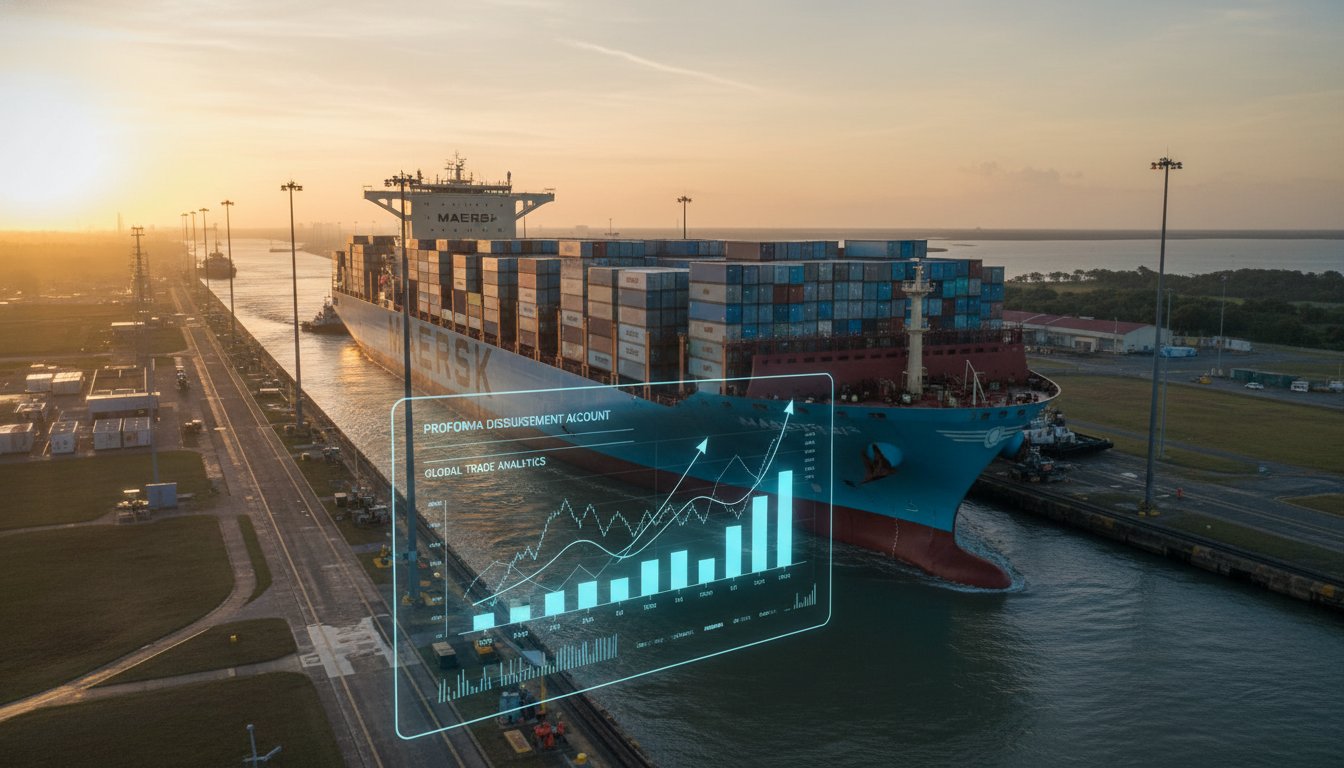
Receiving a quote for your vessel’s transit can feel more like deciphering a code than a clear financial plan. The fear of hidden fees, unexpected surcharges, and budget overruns is a constant source of stress for ship owners and charterers. A lack of transparency in a proforma disbursement account panama can turn a routine transit into a costly and frustrating experience. It leaves you questioning which fees are mandatory and makes it nearly impossible to compare quotes from different agents with any real confidence.
In the world of shipping, time is money, and surprises are expensive. That’s why we’ve created this comprehensive breakdown. We believe in integrity and transparency. In this guide, we will demystify every line item on your PDA, from canal tolls and admeasurement fees to security charges and agency fees. You will gain the clarity needed to forecast your voyage expenses accurately, select a trustworthy agent, and ensure your vessel experiences a smooth, delay-free transit through the Panama Canal.
What is a Proforma Disbursement Account (PDA) in Shipping?
A Proforma Disbursement Account (PDA) is a detailed, itemized estimate of all costs and fees a vessel is expected to incur during a specific port call or transit. In essence, it is a comprehensive financial forecast for the entire operation. Prepared by a local shipping agent, the PDA’s primary purpose is to allow the ship owner or charterer to budget accurately and transfer the necessary funds in advance.
This pre-funding is critical. It ensures that all port authorities, canal fees, and service providers are paid on time, preventing costly delays. For complex and high-value passages like the Panama Canal, where expenses can run into hundreds of thousands of dollars, the PDA is not just a formality-it is an indispensable financial tool.
Why a PDA is Essential for Panama Canal Transits
Timing and coordination are everything at the Panama Canal, and financial readiness is the foundation of a smooth transit. Misjudging costs can lead to significant operational and financial setbacks. A meticulously prepared proforma disbursement account Panama agents provide serves several vital functions:
- Financial Roadmap: It provides a clear and transparent breakdown of all anticipated expenses, from canal tolls and tugboat services to security fees and pilotage.
- Advance Funding: It enables owners and charterers to arrange and remit the exact funds required, ensuring liquidity upon the vessel’s arrival.
- Prevents Delays: Insufficient funds are a primary cause of transit delays. A funded PDA ensures all payments are made promptly, keeping your vessel on schedule.
- Agent Comparison: The PDA is a critical document for evaluating and comparing the costs, transparency, and efficiency of different ship agents.
Proforma DA vs. Final DA: Understanding the Difference
It’s crucial to distinguish between the proforma and final accounts. While they are related, they serve different purposes in the port call process.
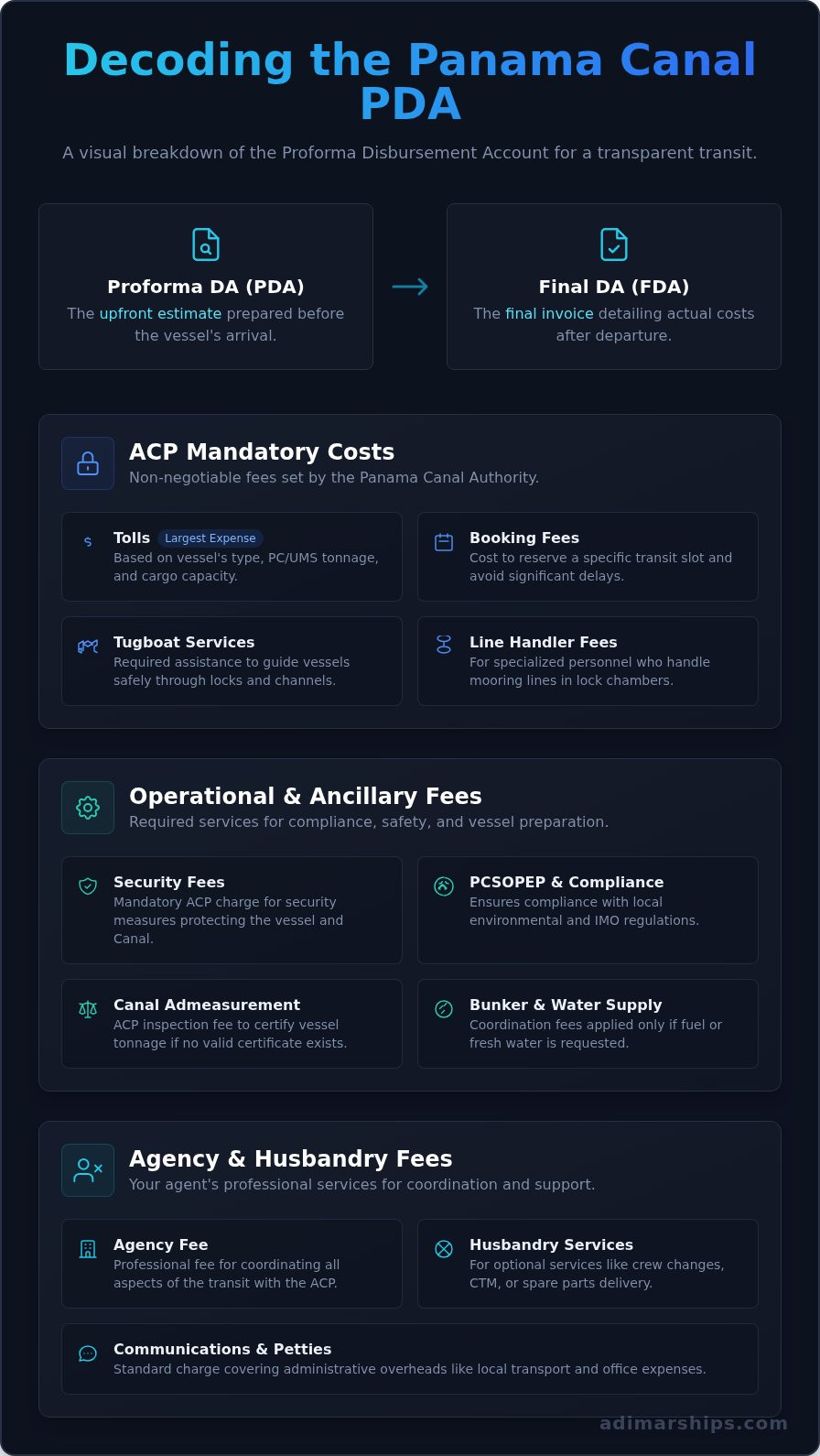
The Proforma Disbursement Account (PDA) is the upfront estimate created before the vessel’s arrival, based on its specific details and the planned operations. The Final Disbursement Account (FDA) is the final invoice issued after the vessel has departed, detailing the actual costs incurred.
Variances between the PDA and FDA are common, often due to unforeseen circumstances such as changes in canal tariffs, unexpected husbandry services (e.g., crew changes or medical needs), or additional launch boat services. A trusted agent will always provide a detailed reconciliation in the FDA, explaining any differences with complete transparency.
An Itemized Breakdown: What’s Inside a Panama Canal PDA?
A detailed proforma disbursement account panama can seem complex, but it’s a transparent roadmap for your vessel’s transit costs. At Adimar Shipping, we believe in complete clarity, so you can see exactly where every dollar is allocated. Understanding this document is the first step toward an efficient, cost-conscious transit.
Costs are generally divided into three main categories: mandatory fixed charges from the Canal Authority, essential operational fees, and your agent’s service fees for coordination and husbandry.
Panama Canal Authority (ACP) Mandatory Costs
These are non-negotiable fees set directly by the Panama Canal Authority (ACP). As your agent, we process these payments on your behalf, but we have no control over the amounts. They are the foundation of any transit budget.
- Tolls: By far the largest expense, this fee is calculated based on your vessel’s type, measurement system (PC/UMS), and cargo capacity or displacement.
- Booking Fees: The cost to reserve a specific transit slot, which helps avoid significant delays. This varies based on the vessel size and booking period.
- Tugboat Services: Charges for the required tugboat assistance that guides vessels safely through the locks and narrow channels of the Canal.
- Line Handler Fees: The cost for the specialized personnel who board your vessel to handle the mooring lines inside the lock chambers.
Operational & Ancillary Service Fees
This category covers a range of required and optional services that ensure your vessel is compliant and prepared for its journey. These costs can vary based on your vessel’s specific condition and requests.
- Security Fees: A mandatory ACP charge for security measures implemented to protect the vessel and the Canal during transit.
- PCSOPEP & Compliance: Costs for the Panama Canal Shipboard Oil Pollution Emergency Plan (PCSOPEP). This plan ensures your vessel complies with local environmental rules and International Maritime Organization regulations.
- Canal Admeasurement: A fee for an ACP inspection to measure the vessel and certify its tonnage, if it does not have a valid PC/UMS certificate.
- Bunker & Water Supply Coordination: Service fees applied only if the vessel requests coordination for receiving fuel or fresh water supplies.
Agency & Husbandry Fees
This section outlines the costs for the expert services your shipping agent provides. It reflects the value of having a trusted partner on the ground to manage every detail of your transit.
- Agency Fee: The agent’s professional fee for coordinating all aspects of the transit, from scheduling with the ACP to managing documentation and communications.
- Husbandry Services: Charges for any requested services beyond the basic transit, such as crew changes, delivery of cash to master (CTM), or coordinating spare parts delivery.
- Communications & Petties: A standard charge covering administrative overhead, including communications, local transportation, and other minor office expenses.
True transparency in a proforma disbursement account panama is the hallmark of a trusted partner. Request a transparent PDA for your next transit.
The PDA Process: From Initial Request to Final Settlement
Navigating the financial requirements for a Panama Canal transit can seem complex, but the process is structured and predictable when managed by an experienced agent. The lifecycle of a proforma disbursement account panama involves clear steps and responsibilities for both the vessel operator and the local agent, ensuring a smooth flow of funds from initial estimate to final reconciliation. We see ourselves as your local office at the Canal, here to eliminate confusion and manage this process with integrity.
Step 1: Requesting and Receiving the PDA
The process begins when the vessel operator or charterer nominates an agent and requests a PDA. To create an accurate estimate, your agent will require key information, including the vessel’s ETA, required services, and all relevant certificates. A skilled agent then calculates all anticipated costs, referencing the official Panama Canal Authority Maritime Tariff List for tolls and fees, and leveraging local knowledge for husbandry and third-party services. Typically, you should request your PDA as early as possible and can expect to receive the detailed proforma within 24 hours.
Step 2: Funding the Disbursement Account
Pre-payment is a non-negotiable requirement. The Panama Canal Authority (ACP) mandates that all transit costs must be remitted in full before a vessel is assigned a slot. This is not an agent policy, but a firm rule of the Canal. Operators must ensure funds are cleared in the agent’s account at least 96 hours prior to the vessel’s arrival. Failure to meet this deadline can have significant consequences, including:
- Loss of the vessel’s transit slot
- Significant operational delays
- Potential rescheduling fees
In an industry where time is money, timely funding is critical for an efficient and cost-effective transit.
Step 3: Post-Transit Reconciliation and the Final DA
Once the transit is complete, your agent’s work continues. We act on your behalf to pay all third-party invoices, from tugboats and line handlers to inspections and supplies. We then meticulously compile the Final Disbursement Account (DA). This document provides a transparent, itemized breakdown of all actual expenses, supported by original invoices and receipts. The final step is settlement. If the initial funds exceeded the actual costs, the balance is promptly refunded. If costs were higher than anticipated, a request for the difference is made with full documentation. This commitment to transparency ensures you only pay for the services you receive.
How to Evaluate a PDA to Choose the Right Ship Agent
A Proforma Disbursement Account (PDA) is more than a simple cost estimate; it is a direct reflection of a shipping agent’s expertise, transparency, and integrity. In the dynamic environment of Panamanian ports and the Canal, the quality of your agent’s PDA can be the difference between a smooth, cost-effective transit and an expensive, frustrating experience. A well-structured PDA shows that an agent is organized, knowledgeable, and respects your investment.
When you receive a proforma disbursement account panama, you are getting a preview of the service you can expect. Treat it as a critical vetting tool to select a trusted partner for your operations.
Hallmarks of a High-Quality PDA
A professional and reliable agent will always provide a PDA that is clear, detailed, and easy to understand. Look for these key indicators of quality:
- Transparency: Every single cost, from Panama Canal Authority (ACP) tariffs and tolls to launch boat services and crew change expenses, is clearly itemized. There should be no ambiguity.
- Accuracy: Estimates are not guesses. They are calculated based on the latest official tariffs, extensive local knowledge, and direct experience with similar vessels and transits.
- Clarity: An experienced agent includes notes to explain variable costs, such as pilotage or tugboat fees, and clarifies any potential extra charges that could arise during the port call.
- Professional Format: The document itself is well-organized, free of errors, and presented in a format that is easy to read and digest.
Red Flags to Watch Out For
Conversely, a poorly prepared PDA can reveal an agent’s inexperience or lack of transparency. Be cautious if you see any of the following warning signs:
- Lump Sum Fees: Vague, bundled costs like “General Port Dues” with no detailed breakdown are a major red flag. This practice can be used to hide inflated charges.
- Unusually Low Agency Fee: If an agency fee seems too good to be true, it probably is. Some agents use a low fee to secure your business, only to overcharge on other services.
- Missing Mandatory Costs: A PDA that omits required costs, such as security fees or sanitation dues, demonstrates a critical lack of local expertise.
- Slow Response Time: If an agent is slow to provide a PDA or answer your questions, it often indicates the poor level of communication and service you can expect during operations.
Asking the Right Questions
To protect your interests and ensure a seamless port call, it’s crucial to vet potential agents with direct questions. A trustworthy agent will welcome the inquiry. Before nominating your agent, ask:
- How do you manage and communicate variances between the PDA and the Final Disbursement Account (FDA)?
- Can you provide references from operators with vessels similar to mine?
- What is your specific experience handling my vessel type (e.g., LNG carrier, bulk carrier, tanker) at the Panama Canal?
Your goal is to find a dependable, on-the-ground partner who acts as an extension of your team. Partner with an agent known for integrity and transparency.
Navigate Your Panama Canal Transit with Confidence and Clarity
Understanding the components of a Proforma Disbursement Account is the first step toward a smooth and cost-effective Panama Canal transit. As we’ve explored, a detailed PDA is more than an estimate; it’s a reflection of your ship agent’s transparency and commitment. By carefully evaluating each line item, you can avoid unexpected costs and ensure your funds are managed efficiently. Choosing the right partner to prepare your proforma disbursement account panama is critical to protecting your vessel’s interests.
At Adimar Shipping, we build our service on a foundation of integrity and financial transparency. With over 20 years of dedicated experience, we act as your eyes at the canal, safeguarding your operations every step of the way. We eliminate the confusion so you can focus on your business. Don’t leave your transit to chance; partner with a team you can trust.
Get a clear and accurate Proforma Disbursement Account for your vessel.
Frequently Asked Questions About Your PDA
How accurate is a Proforma Disbursement Account?
An expertly prepared proforma disbursement account in Panama is highly accurate, based on the latest Panama Canal Authority (ACP) tariffs and your vessel’s specific details. As your trusted agent, we meticulously calculate all anticipated costs, including tolls, security charges, and standard agency fees. While it is an estimate, our extensive experience ensures the PDA reflects the true costs as closely as possible, providing you with a reliable financial forecast for your vessel’s transit and minimizing unexpected expenses.
What happens if the actual transit costs are higher or lower than the PDA?
Transparency is a cornerstone of our service. After the transit, we issue a Final Disbursement Account (FDA) that details all actual expenditures with supporting invoices. If the actual costs are lower than the pre-funded PDA amount, the remaining balance is promptly refunded to you. Should unforeseen circumstances lead to higher costs, we will provide a clear invoice for the difference, ensuring you have a complete and verifiable record of all expenses for the transit.
Why do I need to send funds to the agent before the transit?
Pre-funding the PDA is a mandatory requirement set by the Panama Canal Authority (ACP). The ACP requires all tolls and transit-related fees to be paid in US Dollars before a vessel is allowed to transit. As your agent, we must have these funds on hand to remit to the ACP on your behalf, securing your vessel’s transit slot without delay. This process ensures a smooth, efficient passage and compliance with all local regulations, protecting your valuable time and assets.
Can the Panama Canal tolls and fees be negotiated?
The tolls and official fees levied by the Panama Canal Authority (ACP) are based on a fixed tariff structure and are strictly non-negotiable. However, an experienced agent provides value by managing all other variable costs with maximum efficiency. We ensure that all ancillary services, such as launch boat services or crew changes, are handled in a cost-conscious manner. Our role is to optimize the expenses you can control, ensuring your overall transit is as economical as possible.
How far in advance should I request a PDA for a Panama Canal transit?
To ensure a seamless operation, we recommend requesting your proforma disbursement account panama at least two to three weeks prior to your vessel’s estimated arrival. This provides ample time for you to review the estimate, arrange the transfer of funds, and for us to make all necessary pre-arrival arrangements with the Panama Canal Authority. Early planning eliminates last-minute stress and is key to a timely and efficient transit, aligning with our commitment to proactive and reliable service.
What is the difference between an Owner’s Protective Agent (OPA) and a nominated agent’s DA?
A nominated agent is appointed by the charterer and handles the full transit, with their Disbursement Account (DA) covering all canal costs. An Owner’s Protective Agent (OPA), like Adimar Shipping, is appointed directly by the shipowner to supervise the nominated agent. The OPA’s role is to protect the owner’s interests, verify all costs, and ensure efficiency. The OPA’s DA is much smaller, typically covering only their supervisory fee and any specific services requested directly by the owner.