
For ship owners and charterers, time is money. Sifting through the dense, 100-plus pages of the Panama Canal Authority’s latest publication for critical data can feel like a waste of both. You need to understand the key trends impacting your vessel’s transit-from water levels to new regulations-but without the time-consuming analysis.
As your trusted partner at the Panama Canal, we’ve done the heavy lifting for you. This essential breakdown of the latest acp panama annual report translates complex statistics into the actionable intelligence your operations require. We cut through the noise to focus on what truly matters: key trends in vessel traffic, toll revenues, and the all-important water level challenges that directly impact your transit costs and scheduling.
Consider this your expert briefing, designed to give you a clear strategic advantage. You will learn how the canal’s performance will shape your voyage planning and help you make more informed, cost-effective decisions for your fleet in the year ahead.
What is the ACP Annual Report and Why It’s Crucial for Your Business
For any ship owner, charterer, or logistics professional, navigating the complexities of global trade means staying ahead of market shifts. The Panama Canal is a critical artery in this system, and the official acp panama annual report serves as its yearly health check. More than just a collection of statistics, this document provides a transparent account of the Canal’s performance, financial health, and strategic direction. Understanding its contents is not just an academic exercise-it’s a vital tool for forecasting costs, planning routes, and making informed business decisions.
While the report itself is dense with raw data, our analysis is designed to eliminate the confusion. We distill the key takeaways into actionable insights, saving you time and helping you focus on what matters most: your business.
Understanding the Role of the ACP
At the heart of this entire operation is the Panama Canal Authority (ACP), the autonomous agency of the Panamanian government tasked with managing and operating the Canal. The ACP’s mandate is clear: to ensure the safe, efficient, and profitable transit of vessels. Its decisions on toll structures, water conservation measures, and infrastructure investments have a direct and significant impact on global supply chains, influencing everything from transit times to operational costs for vessels worldwide.
Key Sections of a Typical Annual Report
Sifting through the complete acp panama annual report can be a time-consuming task. The document is comprehensive, typically broken down into several key areas that provide a full picture of the fiscal year’s activities. A professional summary is the most efficient way to grasp the critical information, which often includes:
- Financial Statements: Detailed revenue, expense, and profitability figures, often reported in U.S. dollars, which reflect the Canal’s commercial performance.
- Operational Statistics: Data on total transits, average wait times, vessel sizes, and Panama Canal Net Tonnage (PC/UMS).
- Cargo and Trade Route Data: Analysis of the types of cargo moved and the primary trade routes served, offering a snapshot of global economic trends.
- Capital Projects and Maintenance: Updates on major investments, such as water management systems, dredging, and infrastructure modernization.
- Environmental and Social Initiatives: Reports on sustainability efforts, watershed conservation, and community engagement.
As your trusted partner at the Panama Canal, we’ve done the heavy lifting to bring you the highlights that will directly affect your operations in the coming year.
Analysis of Key Performance Metrics from the Latest Report
For ship owners and charterers, the numbers behind the Panama Canal’s operations are more than just statistics-they are critical indicators of efficiency, cost, and future planning. The latest acp panama annual report provides a clear picture of the waterway’s health and operational trends. Understanding these key metrics allows you to anticipate changes and make informed decisions, because in shipping, timing and foresight are everything.
Transit and Tonnage Statistics
The report highlights a dynamic operational landscape. Key figures include:
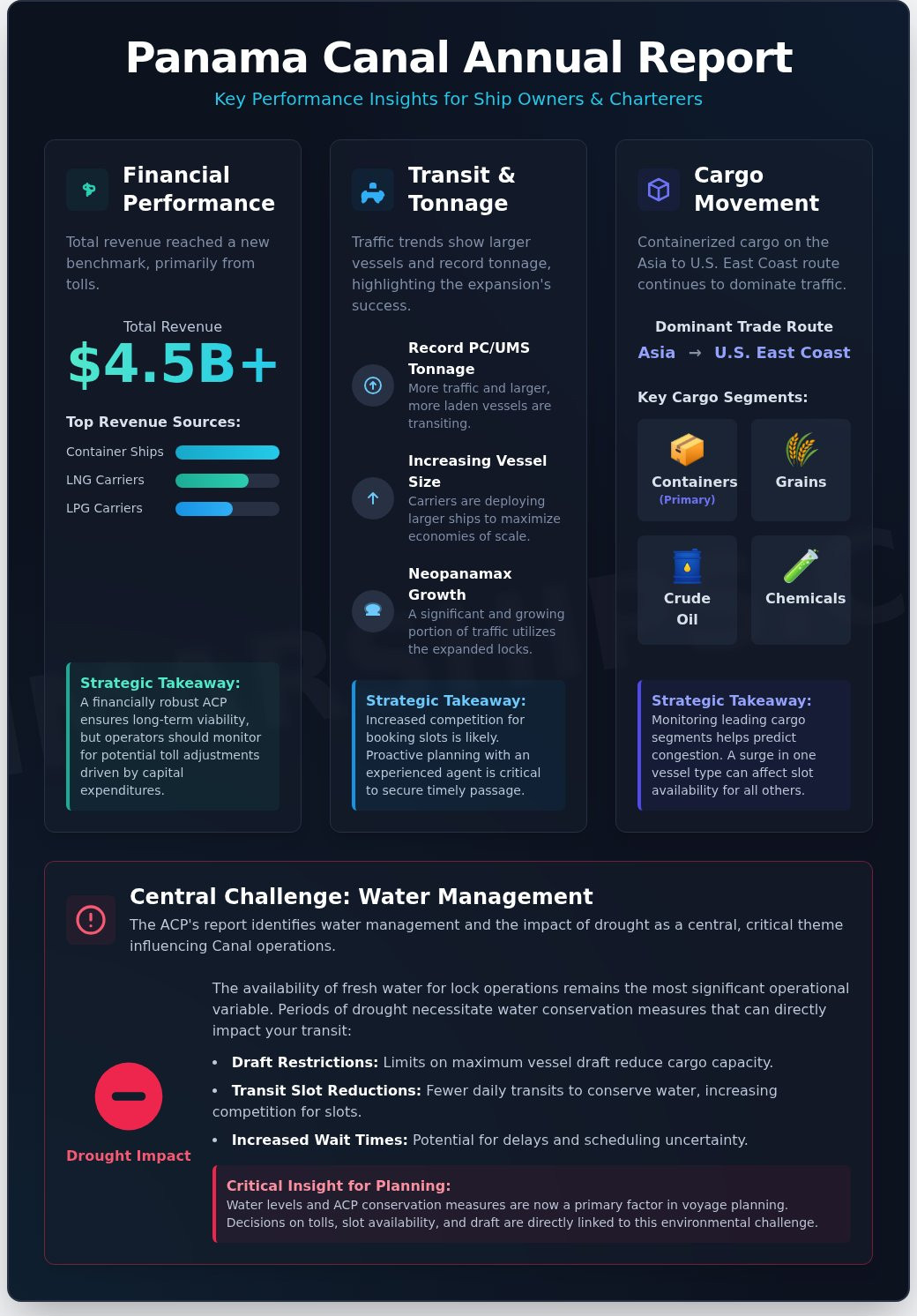
- Total Transits: The fiscal year saw a notable number of transits, with Neopanamax vessels continuing to represent a significant and growing portion of traffic, underscoring the success of the Canal expansion.
- PC/UMS Tonnage: Total Panama Canal Universal Measurement System (PC/UMS) tonnage reached a record high, reflecting not just more traffic but larger, more laden vessels utilizing the waterway.
- Vessel Size Trends: The average vessel size transiting the Canal has steadily increased, a direct result of carriers deploying larger ships to maximize economies of scale on routes serving the U.S. East Coast.
What this means for you: Higher overall tonnage and a greater share of Neopanamax transits can signal increased competition for booking slots. Proactive planning and working with an experienced agent are more critical than ever to secure timely passage.
Financial Performance and Revenue
The Canal’s financial strength directly impacts its investment in infrastructure and future toll structures. The total revenue for the fiscal year, primarily from tolls, reached a new benchmark of over $4.5 billion. Container ships remain the largest source of revenue, followed by LNG and LPG carriers. These strong financial results, detailed in the official ACP Annual Reports, enable significant capital investments in water management systems and modernization projects aimed at ensuring long-term operational reliability.
What this means for you: A financially robust ACP is good for the Canal’s long-term viability. However, operators should stay vigilant, as strong performance and major capital expenditures can sometimes precede adjustments to the toll and fee structure.
Cargo Movement by Segment
The flow of goods reveals much about global trade dynamics. The latest acp panama annual report shows that containerized cargo, particularly on the Asia to U.S. East Coast trade lane, continues to dominate. There was also a significant volume of grains, crude oil, and chemicals. Shifts in these segments, often driven by global economic conditions or geopolitical events, can influence traffic patterns.
What this means for you: Monitoring the leading cargo segments helps predict potential congestion. A surge in a specific vessel type, like LNG carriers, can affect transit times and slot availability for all other segments. This data helps you anticipate bottlenecks and adjust schedules accordingly.
Major Challenges & Strategic Initiatives Outlined by the ACP
Beyond the transit numbers and revenue figures, the acp panama annual report provides a crucial narrative on the strategic direction of the Canal. For ship owners and charterers, understanding the challenges identified by the Panama Canal Authority (ACP) is essential, as these priorities directly influence future operational policies, toll structures, and the overall transit experience.
Water Management and Drought Impact
A central theme of the report is the ongoing challenge of water sustainability. Unpredictable rainfall patterns have led to lower-than-average water levels in Gatun and Alajuela Lakes, the primary sources for Canal operations. In response, the ACP has implemented a series of water-saving measures, most notably draft restrictions, which can limit a vessel’s maximum cargo load. The report details long-term initiatives, including studies for new reservoir projects, to secure a reliable water supply for decades to come.
Navigating these dynamic draft restrictions requires an expert agent on the ground to avoid costly delays and penalties. Trust Adimar to guide you.
Modernization and Infrastructure Projects
To enhance efficiency and safety, the ACP continues to invest heavily in modernizing its infrastructure. The annual report highlights key capital projects planned or underway, including:
- Acquisition of new tugboats to improve maneuverability and assistance for Neopanamax vessels.
- Upgrades to lock control systems to streamline operations and reduce transit times.
- Implementation of advanced traffic management technology for better scheduling and resource allocation.
While these projects are designed to deliver long-term benefits, they can occasionally cause short-term scheduling adjustments. A proactive local agent is vital for managing these potential disruptions.
Market Competitiveness and Global Trends
The report also analyzes the Canal’s position within the global trade landscape, acknowledging competition from the Suez Canal and US intermodal systems. The ACP addresses how geopolitical shifts and evolving trade routes impact traffic. The Canal’s strategy to maintain its value proposition is vital not just for the waterway but for Panama’s entire economy, a point reinforced by a recent International Monetary Fund report on Panama which analyzes the performance of state-owned enterprises. To stay competitive, the ACP plans to focus on service reliability, transparent pricing, and promoting the all-water route’s environmental benefits.
How to Leverage These Insights for Your Transit Planning
The numbers and trends within the acp panama annual report are more than just historical data; they are powerful indicators that can directly inform your business strategy. For ship owners and charterers, understanding these details is the key to a cost-effective and efficient transit. Misjudging timing or budget can be costly, but with expert analysis, you can turn these public insights into a competitive advantage.
At Adimar, we are experts so you don’t have to be. We perform this deep analysis for every client, translating raw data into actionable intelligence. Here’s how we leverage these insights to protect your interests.
Forecasting Costs and Budgeting for Tolls
A spike in revenue from a specific vessel segment, such as Neopanamax container ships, can signal future toll adjustments by the Canal Authority. We analyze these revenue trends to help you anticipate and budget for these changes. Similarly, data on high-demand periods allows us to advise on budgeting for auction slots, preventing costly last-minute bids. Our Proforma Disbursement Accounts (PDAs) are not just estimates; they are meticulously calculated forecasts based on this market intelligence, ensuring financial transparency and predictability for your voyage.
Optimizing Transit Schedules and Avoiding Delays
Time is money, and delays at the Canal can have significant financial repercussions. We analyze the traffic data in the report to identify patterns of congestion, allowing you to plan your arrivals during less busy periods. Furthermore, we monitor the report’s notes on water levels and planned maintenance projects, which directly impact waiting times and draft restrictions. As your trusted partner, we use this foresight to secure timely booking slots and manage your schedule proactively, minimizing idle time and maximizing your operational efficiency.
Strategic Risk Management
The annual report can also highlight potential operational risks, from impending water conservation measures to shifts in Canal regulations. Acknowledging these risks is the first step; having a contingency plan is the next. As your protective agent, we are your eyes at the Panama Canal, mitigating the financial and operational risks associated with unforeseen disruptions. We manage the complexities on the ground so you can focus on your business with confidence.
Protect your interests at the Canal. Appoint Adimar as your agent today.
Navigating Forward: Turning ACP Insights into Action
The latest acp panama annual report offers more than just statistics; it provides a clear roadmap of the Canal’s operational landscape, highlighting evolving transit patterns and the Authority’s strategic responses to challenges like water conservation. For ship owners and charterers, understanding these key performance indicators and future initiatives is crucial for mitigating risks and optimizing voyage costs. The data confirms that proactive, informed planning is the key to a successful transit.
But you don’t have to navigate these complexities alone. With over 20 years of experience as a trusted Panama Canal agent, Adimar Shipping translates these high-level insights into practical, on-the-ground solutions for your vessel. We are experts in navigating ACP regulations and operational changes, ensuring your transit is handled with the integrity and cost-conscious efficiency your business deserves.
Let us be your expert eyes at the Canal. Request a Proforma DA today.
Partner with Adimar and navigate the Panama Canal with confidence and clarity.
Frequently Asked Questions
Where can I download the official ACP Panama Annual Report?
The official report is available for public access directly from the Panama Canal Authority (ACP) website. You can typically find it in the “Publications” or “Financial Reports” section. The ACP provides these documents as downloadable PDF files, usually in both English and Spanish. This ensures transparency and allows stakeholders worldwide to review the Canal’s performance. For the most current version, always refer to the official ACP portal to avoid outdated or third-party information.
What is the fiscal year for the Panama Canal Authority?
The Panama Canal Authority (ACP) operates on a fiscal year that runs from October 1st to September 30th. This is different from a standard calendar year. For example, the 2023 Annual Report covers all activity and financial data recorded from October 1, 2022, through September 30, 2023. Understanding this timeframe is crucial for accurately interpreting the operational statistics, revenue figures, and transit data presented in the report and comparing performance year-over-year.
How has the Panama Canal drought impacted vessel transits and costs?
Recent drought conditions have significantly lowered water levels in Gatun Lake, the main reservoir for the Canal. In response, the ACP has been forced to implement transit restrictions, reducing the number of daily booking slots and lowering the maximum permissible vessel draft. This has created a backlog, leading to longer waiting times for non-booked vessels and driving up costs through highly competitive auction slots for those needing to secure a timely passage for a fee that can reach millions of dollars.
What is the difference between Panamax and Neopanamax transits in the report?
Panamax vessels are ships built to the maximum dimensions of the original Canal locks. Neopanamax vessels are larger ships that can only transit through the expanded locks inaugurated in 2016. The acp panama annual report distinguishes between these two categories because they represent different traffic streams and revenue sources. Analyzing the data for each helps stakeholders understand market trends, the success of the Canal expansion, and the shifting dynamics of global maritime trade routes.
Does the annual report provide a forecast for future toll increases?
The annual report is a review of the past fiscal year’s performance and does not typically contain a specific forecast for future toll increases. While it may discuss market outlooks and strategic plans, formal announcements about toll structure modifications are communicated separately. The ACP provides these updates to the maritime industry through official advisories and circulars, often after a period of consultation with shipping lines and relevant parties to ensure transparency and predictability.
What is PC/UMS and how is it calculated for canal tolls?
PC/UMS stands for the Panama Canal Universal Measurement System, a metric used to determine a portion of a vessel’s transit tolls. It is a mathematical formula that calculates the total volumetric capacity of a vessel. Tolls are then assessed based on this PC/UMS tonnage, but the final cost is also influenced by other critical factors, including the vessel segment and whether the ship is in a laden (carrying cargo) or ballast (empty) condition upon arrival.