
Budgeting for a Panama Canal transit can be a frustrating and time-consuming task. For ship owners and charterers, decoding dense official tariffs to understand the true panama canal fees 2024 often leads to uncertainty, a fear of hidden surcharges, and budgets that miss the mark. With new regulations and fluctuating water levels constantly changing the financial landscape, this challenge has never been greater.
We believe that time is money, and clarity is crucial. That’s why we’ve created this complete cost breakdown-your roadmap to financial confidence. We will break down every single cost component, from tolls and booking fees to security charges and other maritime service fees, into a simple, transparent format. You won’t just see the numbers; you’ll understand the ‘why’ behind them, allowing you to plan your transit with the accuracy and integrity your business demands.
Understanding the 2024 Panama Canal Toll Structure
Navigating the complexities of Panama Canal transit costs requires a clear understanding of the current fee structure. For 2024, the Panama Canal Authority (ACP) continues its phased implementation of an updated toll system, designed to reflect vessel capacity and market demand more accurately. This year, the primary factors influencing the total cost of transit are not just the vessel’s size and cargo, but also dynamic conditions like fluctuating water levels in Gatun Lake, which can impact the number of daily transits and add surcharges.
The total cost is a combination of fixed tolls, variable surcharges (like the Freshwater Surcharge), and other maritime service fees for services such as tugboats and line handlers. Understanding the updated panama canal fees 2024 is essential for accurate voyage planning and budgeting, ensuring a smooth and cost-efficient transit.
How Tolls are Calculated: PC/UMS Explained
The foundation of the Panama Canal’s toll calculation is the Panama Canal Universal Measurement System (PC/UMS). This is a unique volumetric measurement that determines a vessel’s total usable volume or earning capacity. Unlike standard measurements like Gross Tonnage (GT) or Net Tonnage (NT), which are used by other maritime authorities, PC/UMS is specifically tailored for the canal. Every vessel transiting the waterway must be measured and certified under this system, as its PC/UMS net tonnage is the primary basis for calculating its toll.
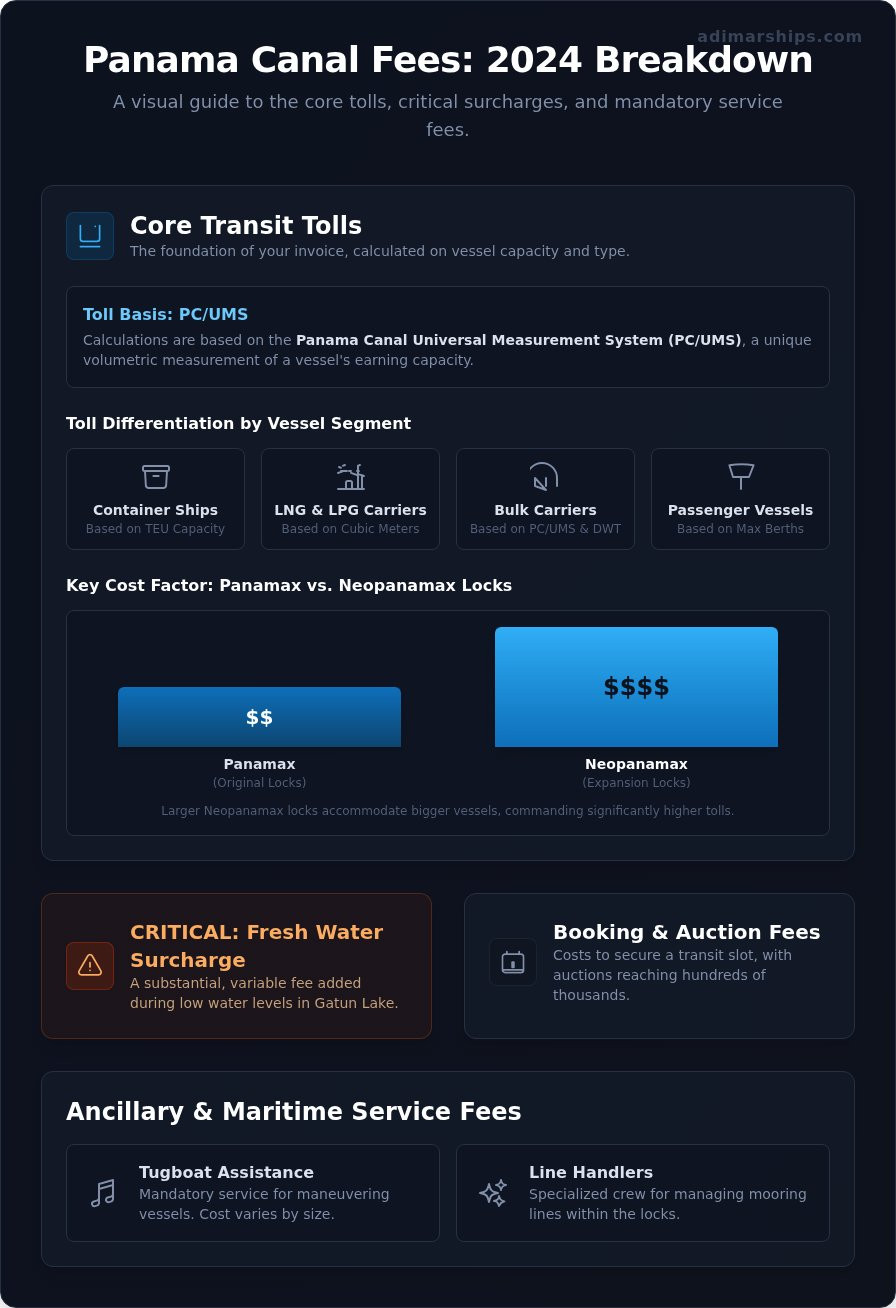
Toll Differentiation by Vessel Segment
The ACP does not apply a one-size-fits-all toll. Instead, fees vary significantly based on the vessel’s market segment, recognizing the different economic values and operational characteristics of each. This targeted approach ensures a more equitable pricing model. Key segments include:
- Container Ships: Tolls are calculated based on the vessel’s total twenty-foot equivalent unit (TEU) carrying capacity.
- LNG & LPG Carriers: Fees are based on cubic meters of cargo capacity.
- Bulk Carriers: Tolls are determined by the vessel’s PC/UMS tonnage and its deadweight tonnage capacity.
- Passenger Vessels: Pricing is based on the maximum number of berths or passenger capacity.
Panamax vs. Neopanamax Locks: A Key Cost Factor
A vessel’s dimensions directly determine which set of locks it will use-and this is a major factor in its final cost. The canal features two distinct lock systems, a direct result of the History of the Panama Canal and its subsequent 2016 expansion. The original, smaller Panamax locks accommodate vessels up to 294 meters in length and 32.3 meters in beam. The larger Neopanamax locks can handle much larger ships, and as a result, command significantly higher tolls due to the greater cargo capacity and value of the vessels they serve.
A Detailed Breakdown of Core Transit Tolls & Surcharges
Moving beyond a single price tag, the total cost of a Panama Canal transit is a sum of several distinct charges. Understanding each component is crucial for accurate budgeting and avoiding costly surprises, as misjudging your costs can be as damaging as misjudging your timing. As your trusted partner at the Canal, we are experts so you don’t have to be. Here, we break down the core costs that make up the bulk of your invoice.
Fixed and Variable Toll Components
The foundation of your transit cost is the toll itself, which has two main parts. The fixed toll is calculated based on your vessel’s capacity-either its Panama Canal/Universal Measurement System (PC/UMS) tonnage or, for container ships, its Twenty-foot Equivalent Unit (TEU) capacity. The variable toll is then applied based on the vessel’s status. A fully laden vessel carrying cargo will pay a higher rate than one transiting in ballast (empty). For a complete and detailed schedule, the Panama Canal Authority provides the Official Panama Canal Maritime Tariffs. It’s also worth noting that frequent container lines may qualify for discounts through the ACP’s Loyalty Program.
The Critical Fresh Water Surcharge
One of the most significant factors impacting the Panama Canal fees 2024 is the Fresh Water Surcharge. This fee was implemented by the Panama Canal Authority (ACP) to manage water consumption during periods of low water levels in Gatun and Alajuela Lakes, which are fed by rainfall. The charge is variable and directly linked to the operational water level of Gatun Lake on the day of transit. This surcharge is a substantial and mandatory expense, adding a significant layer to the total transit cost that shipowners must factor into their voyage calculations.
Booking and Auction Slot Fees
Timing is everything, and securing your transit slot comes at a price. The standard Transit Reservation System allows you to book a slot in advance for a fixed fee, providing certainty for your schedule. However, when demand outstrips supply or for last-minute transits, the ACP offers a limited number of slots via a high-stakes auction. These auction fees are not trivial; depending on market conditions and vessel type, they can add hundreds of thousands of dollars to your transit cost, reflecting the immense commercial value of a guaranteed and timely passage.
Ancillary & Maritime Service Fees You Must Account For
Calculating the total cost of a Panama Canal transit goes far beyond the base toll. A significant portion of the expense comes from mandatory ancillary and maritime service fees. Overlooking these non-negotiable charges is a common and costly mistake for charterers and ship owners. A complete understanding of the panama canal fees 2024 structure requires a detailed look at these essential services.
This is where an experienced ship agent becomes invaluable. We are your eyes at the Panama Canal, ensuring every fee is anticipated, verified, and efficiently managed. Put your transit in our hands, and we will eliminate the confusion, preventing unexpected costs that disrupt your budget.
Operational Service Charges
These fees cover the hands-on services required to move your vessel safely and efficiently through the waterway. They are variable and depend on your vessel’s size, type, and specific transit requirements. Key operational charges include:
- Tugboat Assistance: Mandatory for guiding and maneuvering vessels in the locks and approach channels. The cost is based on vessel size and the number of tugs required.
- Line Handlers: A specialized crew that boards your vessel to handle the mooring lines inside the lock chambers, ensuring the ship remains secure.
- Locomotive Fees: For vessels using the original Panamax locks, electric locomotives (or “mules”) are used to guide the ship. This is a standard charge for these transits.
- Pilotage Fees: A Panama Canal Authority (ACP) pilot takes navigational control of your vessel for the entire transit, a non-negotiable safety requirement.
Safety, Security, and Environmental Fees
Compliance with international and local regulations is paramount. These fees ensure your vessel meets the strict safety and environmental standards of the Panama Canal. Failing to prepare for these can lead to costly delays and fines. Important fees in this category include the Vessel Security Charge for ISPS code compliance and the PCSOPEP fee, which covers the Canal’s oil spill contingency plan.
Administrative and Other Charges
The final layer of costs involves administrative processing, financial guarantees, and potential penalties. The Canal Authority may charge an admeasurement fee to officially determine a vessel’s tonnage, which directly impacts the rates found in the Official Panama Canal Tolls tariff. Additionally, a bank transit guarantee is often required as a buffer for any unforeseen expenses. Inaccurate paperwork or non-compliance with Canal regulations can result in significant fines, reinforcing the need for a detail-oriented agent to manage your transit flawlessly.
How to Estimate Your Total Panama Canal Transit Costs
Calculating your vessel’s transit cost is more than just looking up the base toll. A precise budget requires a clear understanding of all potential charges. For ship owners and charterers, creating an accurate financial forecast is essential to protect your voyage’s profitability. Misjudging the total expense can lead to significant operational and financial challenges.
To demystify the process, we’ve broken down the key components. While the complete structure of Panama Canal fees 2024 is complex, this framework provides a practical way to anticipate your final bill.
Sample Calculation: A Hypothetical Panamax Vessel
To make these costs tangible, let’s consider a simplified example for a standard Panamax vessel. Remember, these are illustrative figures; your actual costs will vary based on your vessel’s specific measurements (PC/UMS), cargo, and transit booking.
Toll (based on PC/UMS tonnage): $420,000
Freshwater Surcharge: $5,500
Booking Slot Reservation Fee: $35,000
Ancillary Maritime Services (tugs, line handlers, security): $12,000
Estimated Total: $472,500
This example shows how quickly additional mandatory fees add up, increasing the base toll by over 10%. Effective planning must account for every line item.
Common Factors That Inflate Your Final Bill
Poor planning introduces financial risk. Several variables can unexpectedly increase your total transit costs, turning a profitable journey into a loss. Being aware of these factors is the first step in mitigating them.
- Transit Delays: Extended waiting times at anchorage incur daily costs and disrupt schedules.
- Additional Resources: Certain vessel types, weather conditions, or operational issues may require extra tugs or line handlers at your expense.
- Emergency Services: Unforeseen repairs or assistance will be billed separately and can be substantial.
- Penalties and Fines: Arriving late for your booked slot, providing incorrect vessel information, or failing to meet Canal requirements can result in costly penalties.
The Importance of a Proforma Disbursement Account (PDA)
A Proforma Disbursement Account (PDA) is the single most important tool for budgeting your transit. It is a detailed, itemized estimate of all anticipated expenses, prepared by your shipping agent. Before transit, you deposit funds to cover this estimate, ensuring all payments to the Canal Authority and local vendors are handled smoothly and without delay.
An inaccurate PDA can lead to cash flow problems or transit disruptions. This is why partnering with an experienced, trustworthy agent is critical. A seasoned agent provides a precise PDA, preventing surprises and protecting your bottom line. They are your eyes at the Canal, managing the details so you can focus on your business. Need an accurate PDA for your next transit? Request a quote from Adimar.
Partner with an Expert to Navigate Fees and Ensure a Smooth Transit
Understanding the Panama Canal’s intricate fee structure is one thing; managing it effectively is another. As this guide shows, the sheer number of variables-from vessel size and PC/UMS tonnage to water surcharges and booking slots-creates significant financial risk. A single miscalculation or missed deadline can lead to thousands of dollars in unexpected costs, delays, and compliance fines. This is precisely why partnering with an experienced ship agent isn’t a luxury; it’s essential for a predictable and cost-effective transit.
A dedicated agent acts as your local team, transforming the complex web of payments and regulations into a streamlined, manageable process. They are your eyes and ears at the Canal, protecting your interests and ensuring every detail is handled with precision.
Your Agent’s Role in Managing Canal Payments
Your ship agent serves as the single, trusted intermediary between your vessel and the Panama Canal Authority (ACP). We handle the entire financial workflow, providing clarity and accountability. This includes:
- Coordinating the timely pre-payment of all required tolls, fees, and security deposits directly to the ACP.
- Serving as your sole point of contact for all financial transactions, eliminating confusion and administrative burden.
- Meticulously reconciling the final ACP invoice against the initial Proforma Disbursement Account (PDA) to ensure every charge is accurate and justified.
How Adimar Optimizes Your Costs
At Adimar, our mission is to provide more than just standard agency services-we deliver peace of mind and tangible value. We are experts so you don’t have to be. We proactively manage the evolving panama canal fees 2024 structure to protect your bottom line by:
- Ensuring timely booking reservations to secure standard transit slots, helping you avoid the high costs of last-minute auction slots.
- Verifying all vessel information and documentation with painstaking detail to prevent costly errors and non-compliance penalties.
- Providing completely transparent, detailed PDAs with no hidden markups or surprise charges, upholding our core value of integrity.
Don’t leave your transit to chance. As your trusted partner at the Panama Canal, we eliminate the confusion and allow you to focus on your business. Put your transit in our hands. Nominate Adimar as your agent today.
Your Trusted Partner for a Cost-Effective Transit
Calculating your total transit cost through the Panama Canal involves more than just the basic tolls. As we’ve detailed, a precise budget must account for a complex web of surcharges, maritime service fees, and other ancillary costs. Understanding the full picture of the panama canal fees 2024 is the first step toward a predictable and efficient voyage, but it can be a daunting task for any operator.
This complexity is why having an experienced partner on the ground is not a luxury-it’s a necessity. With over 20 years of dedicated experience, Adimar Shipping serves as your trusted, expert eyes at the Canal. We provide transparent Proforma Disbursement Account (PDA) management to eliminate costly surprises and ensure your resources are allocated efficiently. We are experts so you don’t have to be.
Don’t let intricate fee structures disrupt your operations. Let Adimar handle the complexity. Get a precise transit cost estimate today. Partner with us and focus on what you do best-managing your business-while we ensure your transit is smooth and cost-effective.
Frequently Asked Questions About Panama Canal Fees
What is the average cost for a ship to transit the Panama Canal in 2024?
There is no single “average” cost, as fees vary significantly based on the vessel’s type, size (measured in PC/UMS tonnage), and cargo. For example, a large Neopanamax container ship could face total costs from $400,000 to over $1,200,000. This total figure includes the base toll, booking fees, and ancillary charges. A clear understanding of the complete breakdown of Panama Canal fees 2024 is essential for accurate voyage planning, and a trusted agent can provide a transparent, detailed cost estimate.
How are Panama Canal transit fees paid?
All transit fees must be prepaid in full, in US Dollars, to the Panama Canal Authority (ACP) at least 48 hours prior to the scheduled transit. This is managed through a pre-funded account established with the ACP. As your ship agent, we handle this entire financial process on your behalf. We ensure sufficient funds are in place and all payments are processed correctly and on time, allowing you to avoid the risk of financial delays and focus on your operations.
Why is the fresh water surcharge so high this year?
The significant increase in the fresh water surcharge is a direct result of historically low water levels in Gatun and Alajuela Lakes, which supply the Canal’s locks. Prolonged drought conditions, intensified by the El Niño phenomenon, have forced the Panama Canal Authority to implement this measure to manage water resources. The surcharge helps fund water-saving initiatives and reflects the critical need for conservation to ensure the Canal’s continued operational reliability for all transiting vessels.
Can a vessel transit the Panama Canal without a reservation?
While it is technically possible to arrive without a reservation and wait for an opening, it is highly discouraged. These “first-come, first-served” transits are subject to extremely long and unpredictable waiting times, which can last for days or even weeks. In an industry where time is money, such delays are incredibly costly. Securing a booked transit slot is the only way to guarantee a timely and efficient passage, protecting your schedule and budget from expensive uncertainty.
Do yachts and small recreational boats pay the same tolls as large ships?
No, small vessels do not pay the same tolls. The Panama Canal Authority has a distinct and simplified fee structure for non-commercial, recreational vessels that is based on their length overall (LOA). For instance, a vessel under 50 feet pays a fixed toll, while vessels in brackets like 50-80 feet or 80-100 feet have different set rates. This separate system makes transit accessible and financially predictable for smaller craft navigating the waterway.
What happens if a vessel arrives late for its scheduled transit slot?
Arriving late for a scheduled transit slot results in the immediate forfeiture of that reservation. The vessel loses its place in the queue and must wait for the next available un-booked opening, which can lead to significant and costly delays. In some cases, the only alternative is to participate in a high-cost auction for a new slot. Proactive coordination with an experienced agent is the best way to ensure your vessel meets its arrival deadline, protecting your schedule and bottom line.