

In the high-stakes world of maritime logistics, a Panama Canal transit should be a calculated maneuver, not a financial gamble. Yet for many ship owners and charterers, the fear of hidden costs, confusing fee structures, and unexpected budget overruns can cause significant stress. A lack of clarity can lead to costly delays and disputes, turning a profitable voyage into a source of frustration. This is precisely why a transparent and detailed proforma disbursement account panama canal is not just important-it’s essential for a smooth and profitable passage.
In this complete guide, we will eliminate the confusion. We are here to provide the clarity you need to navigate these financial waters with confidence. We’ll break down every potential line item, from official Canal tolls to agency fees, empowering you to accurately budget your transit and compare quotes with integrity. Put your transit in our hands, and let us ensure your vessel’s passage is managed efficiently and without any costly surprises.
What is a Proforma Disbursement Account for a Panama Canal Transit?
A Proforma Disbursement Account (PDA) is a detailed, itemized estimate of all anticipated costs associated with a vessel’s transit through the Panama Canal. Think of it as a comprehensive financial blueprint for the entire operation. While a basic toll calculator can give you a single number, a proforma disbursement account panama canal provides a complete picture, including canal tolls, booking fees, tugboat services, pilotage, line handlers, and agency fees. Its purpose is to enable accurate budgeting, secure necessary pre-funding, and ensure flawless operational planning for a timely and efficient passage.
The PDA: Your Financial Blueprint for a Successful Transit
The term ‘Proforma’ simply means it’s a preliminary invoice provided before the service is rendered. This document is your financial roadmap, outlining every expected expense so there are no surprises. The Panama Canal Authority (ACP) operates on a strict pre-payment basis. To avoid costly delays or the risk of losing your transit slot, all tolls and transit-related fees must be paid in advance. The PDA is the tool that facilitates this critical pre-funding process, ensuring your vessel is financially cleared for passage long before it arrives.
Why a PDA is Non-Negotiable at the Panama Canal
Successfully navigating the Panama Canal is impossible without pre-payment, and the PDA is the mechanism that makes this happen. The ACP requires guaranteed funds to cover tolls and booking fees before confirming a transit slot. Beyond the ACP, your trusted shipping agent uses the funded PDA to confirm and pay for essential third-party services. This financial security guarantees that resources are allocated for your vessel, including:
- Tugs and Pilots: Confirmed and scheduled for your arrival.
- Line Handlers: Reserved to assist your vessel through the locks.
- Ancillary Services: Any additional husbandry services are covered.
In short, a properly managed and funded PDA provides the financial assurance required by all parties, transforming a complex process into a smooth, coordinated, and successful transit.
Deconstructing the Panama Canal PDA: A Detailed Breakdown of Costs
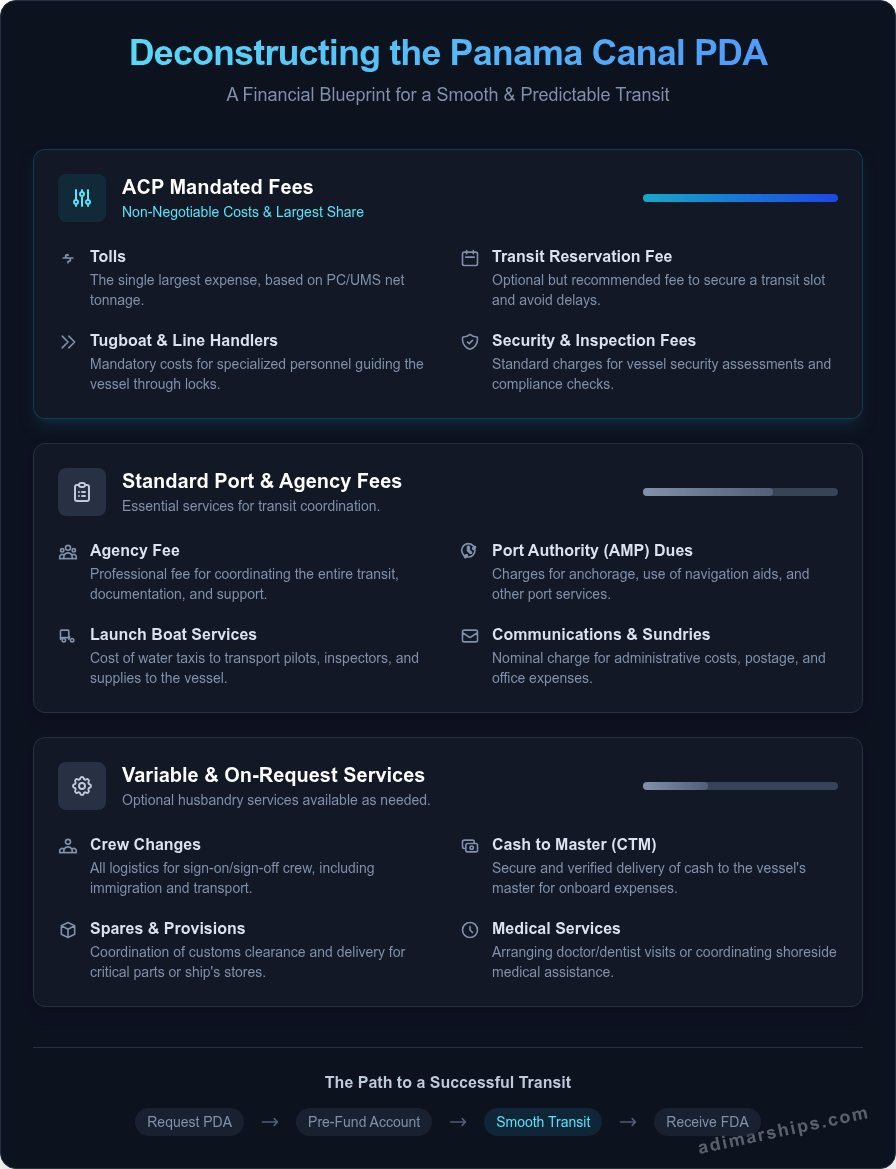
Understanding a proforma disbursement account panama canal transit involves breaking down the various costs that contribute to the final figure. A transparent and trusted agent provides a clearly itemized PDA, ensuring there are no surprises. This detailed estimate allows for accurate budgeting and efficient financial planning. To illustrate, a typical Panamax vessel can expect a range of fees, but the core components remain consistent. This section details the most common line items you will see, grouped into three main categories.
Category 1: Panama Canal Authority (ACP) Mandated Fees
These are the non-negotiable costs set directly by the Panama Canal Authority and represent the largest portion of your PDA. They are calculated based on official vessel measurements and transit requirements. For a deeper analysis of these charges, a resource like the Panama Canal Transit Fees Explained guide offers excellent clarity on the complex toll structure. Key ACP fees include:
- Tolls: The single largest expense, calculated based on the vessel’s Panama Canal Universal Measurement System (PC/UMS) net tonnage.
- Transit Reservation Fee: An optional but highly recommended fee to secure a specific transit slot, avoiding potential delays that cost time and money.
- Tugboat & Line Handler Charges: Mandatory costs for the specialized tugs and personnel required to guide your vessel safely through the locks.
- Security & Inspection Fees: Standard ACP charges covering vessel security assessments and compliance checks.
Category 2: Standard Port and Agency Fees
Beyond the canal itself, every port call incurs standard operational fees. These costs cover the essential services required to manage your vessel’s arrival, waiting period, and transit coordination. Your agent bundles these into the PDA for a single, seamless transaction.
- Agency Fee: The agent’s professional fee for coordinating the entire transit, from documentation to on-the-ground support.
- Port Authority (AMP) Dues: Charges levied by the Panama Maritime Authority for anchorage, use of navigation aids, and other port services.
- Launch Boat Services: The cost of water taxis used to transport pilots, inspectors, and any necessary supplies to and from the vessel at anchorage.
- Communications & Sundries: A nominal charge for administrative costs, including communications, postage, and other miscellaneous office expenses.
Category 3: Variable & On-Request Husbandry Services
This category includes services that are not part of a standard transit but are frequently requested by ship operators. A reliable agent acts as your local partner to facilitate these needs efficiently, adding the associated costs to the PDA upon request.
- Crew Changes: All logistics for sign-on/sign-off crew, including immigration clearance, transportation, and hotel accommodations.
- Cash to Master (CTM): The secure and verified delivery of cash to the vessel’s master for onboard expenses.
- Spares & Provisions Delivery: Coordination of customs clearance and delivery for critical spare parts or ship’s stores.
- Medical Services: Arranging for doctor or dentist visits to the vessel or coordinating shoreside medical assistance for crew members.
The Process: From PDA Request to Final Disbursement Account (FDA)
Navigating the financial aspects of a Panama Canal transit is a structured process built on communication and trust. The journey from an initial cost estimate to the final settled account involves clear responsibilities for both the ship operator and the agent. When handled with integrity, this lifecycle ensures a smooth, predictable, and efficient port call, eliminating confusion and costly surprises.
Here is a step-by-step breakdown of the process, from the initial request to the final reconciliation.
Step 1: Requesting and Analyzing Your PDA
The process begins when the ship operator or charterer requests a proforma disbursement account panama canal transit from their nominated agent. To create an accurate estimate, the agent requires key documents:
- Vessel’s Panama Canal Shipboard Oil Pollution Emergency Plan (PCSOPEP)
- International Tonnage Certificate (ITC-69)
- Vessel’s estimated time of arrival (ETA)
Once you receive the PDA, review it carefully. A trustworthy agent provides a clearly itemized list of anticipated costs, such as canal tolls, tug services, and agency fees. Be wary of vague terms like “miscellaneous” or “sundries.” This is your opportunity to ask questions and ensure you understand every line item before committing.
Step 2: Funding the Disbursement Account
Agents require pre-funding of the PDA before the vessel’s arrival because they must pay significant third-party costs on your behalf, most notably the Panama Canal Authority (ACP) tolls. These payments are often due before the vessel even reaches canal waters. Timely funding is critical; typically, funds should be remitted at least 72 hours before arrival.
Delayed funding is not an option. It can result in the loss of your confirmed transit slot, forcing the vessel to wait for a new opening. These delays lead to significant financial losses from demurrage and disrupted schedules. In shipping, time is money, and prompt funding protects your bottom line.
Step 3: Reconciliation with the Final Disbursement Account (FDA)
After the transit is complete, your agent will compile the Final Disbursement Account (FDA). The FDA is not an estimate; it is the final, audited statement of all actual costs incurred during the port call. The key to transparency is that the FDA is supported by all original third-party invoices, from the ACP transit invoice to launch boat service receipts.
The FDA is then reconciled against the pre-funded PDA. If the actual costs were less than the amount funded, your agent will promptly refund the balance. If costs exceeded the estimate (e.g., due to unforeseen husbandry services), a supplementary invoice will be issued for the difference. A professional agent, like Adimar Shipping, ensures this final step is handled with complete transparency and integrity.
How a Trusted Ship Agent Prevents Hidden Costs and Delays
The accuracy of a proforma disbursement account panama canal transit depends entirely on the experience and integrity of your ship agent. An agent is not merely a service provider; they are your financial partner on the ground, acting as your eyes and ears to protect your interests. A detailed, realistic PDA is the first sign of a trustworthy agent who prioritizes transparency over securing a nomination with an unrealistically low estimate. At Adimar, we see ourselves as an extension of your team, dedicated to ensuring your transit is both smooth and financially predictable.
The Danger of ‘Low-Ball’ Quotes
Some agents may present an incomplete PDA to appear more cost-effective. This tactic often omits or underestimates variable costs like launch services, security, or potential transit delays. The result is a final disbursement account that is significantly higher than the initial estimate, leading to unexpected cash calls and frustrating budget overruns. Adimar is committed to providing comprehensive, realistic estimates from the start, ensuring you have a clear financial picture for your voyage planning.
Proactive Financial Management and Communication
A successful Panama Canal transit requires more than just an accurate initial estimate; it demands constant oversight. As your trusted partner, we provide:
- Timely Updates: If unforeseen circumstances arise that affect costs, you will be the first to know. We believe in proactive communication to prevent surprises.
- Efficient Fund Management: We manage your funds diligently to ensure all payments to the Canal Authority, pilots, and service providers are made on time, preventing any service interruptions or delays.
- A Single Point of Contact: You will have a dedicated contact for all financial queries, eliminating confusion and providing clear, consistent answers.
Your Partner in Cost-Efficiency
Our role extends beyond simple accounting. With decades of local experience, we actively seek opportunities to enhance your cost-efficiency. We leverage our network to secure competitive pricing for husbandry services and advise on operational decisions that can minimize variable costs during transit. Our goal is to protect your bottom line with integrity and expertise. Put your transit in our hands and let us eliminate the financial uncertainty. Request a transparent PDA from Adimar for your next transit.
Navigate Your Panama Canal Transit with Financial Clarity
Navigating the Panama Canal successfully begins with a clear understanding of your costs. As we’ve explored, the Proforma Disbursement Account is the financial roadmap for your vessel’s transit, not just an estimate. A detailed, accurate PDA prevents unexpected fees and operational delays, while a vague one creates risk. The difference between a smooth passage and a frustrating one often comes down to the expertise and integrity of your chosen ship agent.
For a truly transparent proforma disbursement account panama canal transit, you need a partner on the ground who values financial integrity. With over 20+ years of dedicated experience, Adimar Shipping acts as your trusted eyes and ears at the Canal. We are experts so you don’t have to be, providing the clarity you need to budget effectively and transit efficiently. Our reputation is built on the promise of no hidden costs.
Ready to experience a seamless transit free from financial surprises? Request a Transparent PDA for Your Next Panama Canal Transit and let our team put their expertise to work for you. We’ll handle the complexities so you can focus on your business.
Frequently Asked Questions
What is the difference between a Proforma Disbursement Account (PDA) and a Final Disbursement Account (FDA)?
A Proforma Disbursement Account (PDA) is a detailed cost estimate your ship agent provides before a transit. It must be pre-funded to cover all anticipated expenses, from tolls to line handlers. In contrast, the Final Disbursement Account (FDA) is the actual invoice issued after the transit is complete. The FDA reconciles all real costs against the pre-funded PDA, detailing any credits due back to you or additional charges incurred, ensuring full financial transparency.
How far in advance do I need to pay the PDA for a Panama Canal transit?
To ensure a smooth and timely transit, the PDA must be fully funded at least 96 hours (4 days) before your vessel’s arrival at the Panama Canal. This is a strict requirement from the Panama Canal Authority (ACP) to secure your transit slot and confirm all necessary arrangements. Timely payment is critical to prevent costly delays. As your trusted partner, we manage this process diligently to protect your schedule and your bottom line.
Are Panama Canal tolls always the biggest expense on the PDA?
In most cases, yes. The Panama Canal Authority (ACP) tolls typically represent the single largest line item on a standard transit PDA. However, this can change. For instance, if you secure a transit slot through a high-priced auction during periods of congestion, the auction fee could easily exceed the toll cost. Extensive husbandry services can also add significant expense, which is why a detailed and transparent PDA from your agent is so important for accurate budgeting.
What happens if the actual transit costs are lower than the pre-funded PDA?
Integrity is our promise. If the final costs on the Final Disbursement Account (FDA) are lower than the amount you pre-funded in the PDA, the remaining balance is promptly refunded to you. This can occur if, for example, estimated security costs were lower than anticipated. We provide a fully itemized FDA so you can clearly see all actual expenses and the exact amount of your refund. This commitment to transparency is how we build lasting trust.
Can I get a PDA that includes optional husbandry services like a crew change?
Absolutely. A comprehensive proforma disbursement account panama canal transit can and should be customized to your vessel’s specific needs. We can integrate any required husbandry services directly into your PDA, including crew changes, delivery of spares, sludge removal, or medical assistance. This provides you with a single, consolidated estimate for all port call activities, simplifying your accounting and ensuring all services are coordinated efficiently for a seamless operation in Panamanian waters.
Why do agency fees vary between different Panama Canal ship agents?
Agency fees reflect an agent’s level of experience, service quality, and scope of support. A lower fee might indicate a basic service with limited communication or problem-solving capabilities. A reputable agent’s fee covers 24/7 expert oversight, proactive communication, and the ability to swiftly handle unforeseen issues. When selecting an agent, consider the value of their expertise and reliability-a smooth, well-managed transit is always more cost-effective than one plagued by preventable delays.
How does a last-minute transit booking affect the costs on a PDA?
Last-minute bookings almost always increase the costs detailed in a PDA. With standard transit slots fully booked, you will likely need to secure a slot through the ACP’s daily auction system, which can add hundreds of thousands of dollars to your expenses. You may also face higher costs for ancillary services arranged on short notice. Proactive planning with your agent is the most effective way to manage costs and avoid these significant last-minute premiums.