
For ship owners and charterers, a Panama Canal transit is a high-stakes operation where time is money. Misjudging the latest regulations can lead to frustrating delays, unexpected costs, and significant operational risk. As the maritime landscape evolves, keeping track of every official notice from the Panama Canal Authority (ACP) can be a complex and demanding task. This is particularly true when preparing for the updated panama canal vessel requirements 2026, where a lack of clarity can leave you vulnerable to non-compliance.
We are experts so you don’t have to be. As your trusted partner at the Canal, we’ve created this complete guide to eliminate the confusion. Here, we consolidate everything you need to know-from vessel dimensions and environmental rules to documentation checklists-into one clear, actionable resource. Our goal is to provide you with the confidence and clarity needed to plan a smooth, efficient, and fully compliant transit, protecting your schedule and your bottom line.
Core Vessel Requirements: Dimensions, Mooring, and Visibility
Navigating the locks and channels of this vital waterway demands strict adherence to physical and operational standards set by the Panama Canal Authority (ACP). A seamless passage through the historic Panama Canal depends on meeting these foundational requirements before your vessel even arrives. Missteps here can lead to costly delays or even denial of transit. As your trusted partner, we ensure you are fully prepared by breaking down the core standards every vessel must meet.
Vessel Dimensions and Draft Limitations
The Canal operates two sets of locks, each with distinct size limitations. Understanding which set your vessel will use is the first step. The newer, larger Neopanamax locks accommodate the majority of modern commercial traffic, while the original Panamax locks serve smaller vessels.
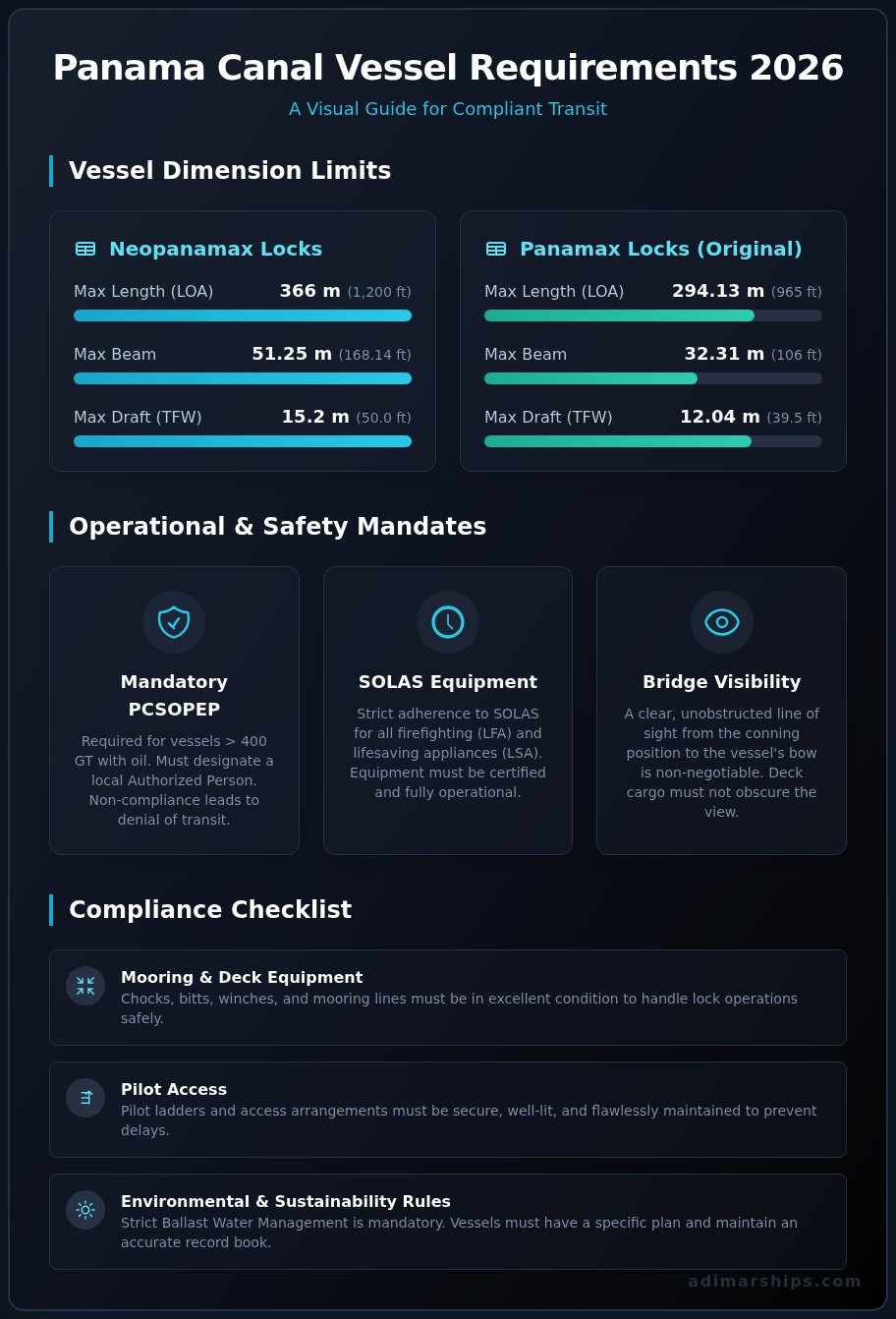
- Neopanamax Locks: Maximum length (LOA) of 366 meters (1,200 feet), a maximum beam of 51.25 meters (168.14 feet), and a maximum Tropical Fresh Water (TFW) draft of 15.2 meters (50.0 feet).
- Panamax Locks: Maximum length of 294.13 meters (965 feet), beam of 32.31 meters (106 feet), and draft of 12.04 meters (39.5 feet) TFW.
Any protrusions, such as bridge wings, cranes, or cargo gear, that extend beyond the vessel’s hull are strictly regulated. These must be declared and approved to prevent contact with the lock structures. Meeting these physical specifications is a non-negotiable part of the panama canal vessel requirements 2026.
Mooring and Deck Equipment Standards
Once inside the locks, your vessel is under the complete control of the Canal’s locomotive and line handling teams. Proper mooring equipment isn’t just a recommendation; it’s a critical safety requirement. Your vessel must be equipped with a specific number and configuration of chocks and bitts, all in excellent condition, to handle the powerful mooring lines. High-quality mooring lines, winches, and heaving lines are mandatory for secure positioning. Additionally, safe and compliant pilot boarding facilities, including a proper ladder and shelter, are essential for the ACP personnel who will guide your transit.
Navigational Bridge Visibility
Safety and control are paramount. The ACP mandates a clear, unobstructed line of sight from the bridge’s conning position to the vessel’s bow. This rule directly impacts how deck cargo can be stowed, especially on container ships and vessels carrying project cargo. No container or piece of equipment can obscure the pilot’s view. While modern aids like AIS and ECDIS are required and essential for situational awareness, they do not replace the non-negotiable requirement for direct visual navigation from the bridge.
Safety and Emergency Preparedness Regulations
The Panama Canal Authority (ACP) enforces some of the world’s most stringent safety protocols. Compliance is not optional; it is the fundamental requirement for protecting your crew, your vessel, and the Canal’s vital ecosystem. Meeting the panama canal vessel requirements 2026 for safety and emergency preparedness is critical for a smooth, delay-free transit.
Mandatory PCSOPEP Compliance
Every vessel over 400 GT carrying oil as cargo or fuel must have a Panama Canal Shipboard Oil Pollution Emergency Plan (PCSOPEP). This plan is a specific supplement to the standard SOPEP/SMPEP and details the vessel’s response procedures for a potential spill within Canal waters. A key requirement is the designation of an Authorized Person in Panama who can act on the owner’s behalf. An incomplete or non-compliant plan will lead to costly delays or denial of transit. Navigating these local requirements can be complex. Adimar provides authorized PCSOPEP services to ensure your compliance.
Firefighting and Lifesaving Appliances (LSA)
Beyond local regulations, all vessels must strictly adhere to international SOLAS standards for firefighting and lifesaving appliances. ACP inspectors will meticulously verify that all equipment is certified, fully operational, and readily accessible. Common inspection points include:
- Fire pumps, hydrants, and hoses
- Portable and fixed fire extinguishers
- Lifeboats, life rafts, and their launching mechanisms
- Immersion suits and lifejackets
The ACP regularly updates its specific inspection criteria, often in line with broader environmental and sustainability rules outlined in official notices. Failure to meet these standards is a serious deficiency that can halt your operations.
Gangways and Pilot Access Arrangements
The safety of Canal pilots and personnel during boarding is paramount. The ACP has strict standards for pilot ladders, accommodation ladders, and combination arrangements. All access points must be secure, well-maintained, and properly illuminated, with man-ropes available. Deficiencies in this area are a leading cause of transit delays. Common issues include worn or painted-over ropes, cracked steps, improper rigging, and inadequate lighting. Ensuring your access arrangements are flawless is a simple but crucial step in preparing for your Canal transit.
Environmental and Sustainability Rules for 2026
The Panama Canal is more than a marvel of engineering; it is a critical part of a unique and sensitive ecosystem. The Panama Canal Authority (ACP) enforces stringent environmental regulations to protect these vital watersheds. For ship owners and charterers, understanding and adhering to these rules is a non-negotiable part of a successful transit. These protocols are a core component of the panama canal vessel requirements 2026, ensuring that global commerce does not come at the cost of local environmental integrity.
Navigating these standards requires diligence and preparation. From managing ballast water to controlling emissions and waste, every vessel must demonstrate its commitment to sustainable operation. Failure to comply can result in significant fines, costly delays, and even denial of transit.
Ballast Water Management
To prevent the introduction of invasive aquatic species into Gatun Lake and the surrounding ecosystem, the ACP mandates strict ballast water management procedures. Vessels must have a vessel-specific Ballast Water Management Plan and maintain an accurate Ballast Water Record Book. Compliance is typically achieved through either a fully operational, type-approved Ballast Water Management System (BWMS) or by conducting a full ballast water exchange in the open sea before arrival. ACP authorities may conduct inspections and take samples to verify compliance.
Fuel and Emissions Standards
In line with global maritime efforts to reduce air pollution, the Panama Canal strictly enforces IMO 2020 regulations. All vessels transiting the Canal must use fuel with a sulfur content not exceeding 0.50% m/m. The ACP actively verifies compliance through onboard inspections and fuel sample analysis. For the most up-to-date information, vessel operators should always reference the official Panama Canal Authority Notices to Shipping for specific directives. Furthermore, vessels must control stack emissions, as any visible smoke while in Canal waters can be penalized, reflecting the comprehensive nature of the panama canal vessel requirements 2026 for clean air.
Waste, Sewage, and Garbage Disposal
The discharge of any pollutants into Panama Canal waters is strictly prohibited. This zero-discharge policy applies to all forms of waste. Key requirements include:
- Untreated Sewage: Discharge is forbidden. Vessels must use an approved and operational sewage treatment plant or have adequate holding tank capacity for the entire transit.
- Garbage and Solid Waste: No garbage may be thrown overboard. All waste must be stored in sealed, leak-proof containers for disposal at shore-based facilities.
- Oily Residues: Any discharge of oil or oily mixtures is a serious violation. Oily water separators and retention systems must be fully functional and properly documented.
Coordinating with a trusted local agent for the efficient use of shore-based reception facilities is essential for seamless compliance.
Documentation, Pre-Arrival, and Administrative Procedures
Successfully navigating the Panama Canal is about more than just physical compliance; it’s about mastering the administrative process. Missteps in paperwork or missed deadlines can lead to significant delays and costly penalties. In the world of canal transits, time is money, and meticulous preparation is the key to a predictable and efficient passage. Understanding these administrative procedures is a core component of the panama canal vessel requirements 2026.
Required Pre-Arrival Information and Forms
Timeliness is non-negotiable. The Panama Canal Authority (ACP) requires all vessels to submit a pre-arrival notification at least 96 hours before arrival. This initial step is followed by a series of critical forms that must be accurately completed and submitted to your ship agent. Key documents include:
- The Ship Information and Quarantine Declaration Form
- Complete Crew and Passenger Lists
- Dangerous Goods Manifest (if applicable)
- Panama Canal Shipboard Oil Pollution Emergency Plan (PCSOPEP)
Failure to provide this information on time can jeopardize your vessel’s transit schedule.
Transit Booking, Tolls, and Fees
Securing a transit slot requires navigating the ACP’s Transit Reservation System. Bookings can be made well in advance, and doing so is highly recommended to guarantee a specific transit date. The cost of transit is a combination of several charges, including tolls calculated on the Panama Canal Universal Measurement System (PC/UMS) tonnage, transit security charges, and other ancillary fees. All payments must be arranged in advance, typically by establishing a credit account with the ACP, ensuring funds are available before arrival.
Mandatory Onboard Certificates and Plans
During the pre-transit inspection, ACP officials will verify that all statutory certificates are valid and onboard. This is a non-negotiable checkpoint. Ensure your vessel has all required documentation readily accessible, including the International Oil Pollution Prevention (IOPP) and International Air Pollution Prevention (IAPP) certificates, along with updated vessel plans and diagrams. This paperwork burden can be complex and time-consuming. Let Adimar handle the paperwork. We are experts so you don’t have to be.
Anticipated Changes for 2026: What to Expect
The maritime landscape is constantly shifting, and the Panama Canal is no exception. As we look towards 2026, the Panama Canal Authority (ACP) is adapting to global trade demands, technological advancements, and pressing environmental challenges. For ship owners and charterers, understanding these upcoming changes is not just about compliance-it’s about protecting your schedule and your bottom line. Staying ahead of evolving regulations is key to future-proofing your operations.
The core of these changes revolves around efficiency, sustainability, and data. The ACP is moving towards a more dynamic operational model where a vessel’s history and environmental performance play a larger role in its transit experience. The future of panama canal vessel requirements 2026 will be defined by adaptability and proactive management.
The New Risk-Based Vessel Inspection Model
The ACP is transitioning from traditional inspections to a more intelligent, risk-based model. This data-driven approach means inspections will be tailored based on a vessel’s historical data, including its compliance record, maintenance history, and performance during previous transits. This rewards operational excellence and proactive management, a principle mirrored in other industries-from structural building inspections by firms like Schippers Bouwconsult BV to management-level support in aviation by companies like Air Tech Consulting.
Potential Toll and Fee Adjustments
The toll structure is under continuous review to reflect current operational realities. Future pricing will likely become more dynamic, influenced by a range of factors:
- Seasonal water levels and availability
- Booking slot demand and vessel size
- A vessel’s environmental footprint and water-saving technologies
We anticipate the potential introduction of new fees for specialized services or incentive programs that reward greener, more efficient ships, aligning costs more closely with resource usage.
Enhanced Water Conservation Measures
Recent droughts have made water conservation a top operational priority, directly impacting transit planning through potential draft restrictions. The ACP is implementing water-saving techniques like cross-filling in the Neopanamax Locks, which, while essential for the Canal’s long-term viability, can affect transit times. In this new reality, precise draft reporting and strategic scheduling have become more critical than ever to ensure a smooth passage.
Successfully navigating this new environment requires deep local knowledge and proactive planning. As your trusted partner at the Panama Canal, Adimar Shipping ensures you are always ahead of the curve, turning potential challenges into efficient, predictable transits.
Your Partner for a Successful 2026 Panama Canal Transit
Navigating the Panama Canal successfully in the coming years demands proactive preparation. As we’ve detailed, compliance extends beyond vessel dimensions and mooring to encompass stringent safety, environmental, and administrative protocols. Staying ahead of the evolving panama canal vessel requirements 2026 is the key to avoiding costly delays and ensuring a smooth passage through this critical waterway.
You don’t have to manage these complexities alone. With over 20 years of specialized experience, Adimar Shipping acts as your expert eyes and ears at the Panama Canal. As an authorized PCSOPEP provider, we eliminate confusion and manage every detail with the integrity and precision your operations deserve. Let our team be your trusted partner on the ground, turning potential challenges into a seamless transit.
Ensure a seamless 2026 transit. Nominate Adimar as your trusted Panama Canal agent.
Frequently Asked Questions About Panama Canal Transit
What are the maximum vessel dimensions for Neopanamax locks in 2026?
The maximum dimensions for vessels transiting the Neopanamax locks are a key part of the panama canal vessel requirements 2026. Your vessel must not exceed a length overall (LOA) of 366 meters (1,200 feet) and a beam of 51.25 meters (168 feet). The maximum allowable draft is 15.2 meters (50 feet) in Tropical Fresh Water (TFW). Adhering to these strict parameters is the first step to ensuring a smooth and predictable transit through the Canal.
Is a PCSOPEP plan mandatory for every vessel transiting the Panama Canal?
Yes, a Panama Canal Shipboard Oil Pollution Emergency Plan (PCSOPEP) is mandatory for most vessels. Specifically, any toll-paying vessel with a 400 metric ton or more carrying capacity for oil as cargo or fuel requires an authorized PCSOPEP. This is a non-negotiable requirement from the Panama Canal Authority (ACP) to ensure environmental protection. Failure to have an approved plan will prevent your vessel from transiting, causing costly delays and complications for your operation.
What are the most common reasons for a vessel failing an ACP inspection?
Vessels most commonly fail ACP inspections due to deficiencies in mooring equipment. This includes worn-out ropes, inoperable winches, or improperly sized chocks and bitts. Other frequent issues are non-compliant pilot ladders and shelters, faulty sanitation systems, or discrepancies between the vessel’s declared information and its actual condition. Proactive maintenance and a pre-arrival check by a trusted agent can help identify and rectify these common issues before they become expensive problems at the Canal.
How far in advance should I book a Panama Canal transit slot?
For optimal planning and cost efficiency, we recommend booking your transit slot as early as possible. The Panama Canal Authority (ACP) booking system opens its first period 365 days in advance. While other booking periods open closer to the transit date, securing a slot early, especially during peak season, protects you from scheduling uncertainty and potentially higher auction fees. Planning ahead is crucial to avoid delays and ensure your transit aligns perfectly with your commercial commitments.
What happens if my vessel is found to be non-compliant with environmental regulations?
Non-compliance with the Panama Canal’s stringent environmental regulations results in significant penalties. Your vessel could face substantial fines, be required to perform corrective actions before transit is allowed, or in severe cases, be denied passage entirely. These delays can be incredibly costly. Ensuring your vessel meets all regulations, particularly regarding ballast water management and emissions, is not just about compliance-it’s about protecting your schedule and bottom line.
Can a ship agent help reduce the risk of transit delays?
Absolutely. An experienced ship agent is your most valuable asset in preventing transit delays. We act as your eyes and ears at the Canal, managing all communication with the ACP, coordinating inspections, and ensuring all documentation is flawless. By proactively identifying potential issues with your vessel’s compliance or paperwork, a trusted agent solves problems before they can impact your schedule. This expert oversight allows you to focus on your business, confident that your transit is in capable hands.