

In the world of global shipping, time is money, and nowhere is this truer than at the entrance to the Panama Canal. The official booking system can feel like a maze of complex rules and confusing interfaces, where a single misstep can lead to costly delays or a lost transit slot. The uncertainty surrounding booking periods, competition for slots, and the intricacies of the auction system adds significant stress to your operations. But it doesn’t have to be that way.
That is precisely why we have developed this definitive panama canal booking system guide. As your trusted partner at the Canal, we believe you shouldn’t have to be an expert in the ACP’s platform to secure a timely passage. This step-by-step walkthrough is designed to eliminate the confusion and empower you to manage your bookings with confidence. Follow along to master the reservation process from start to finish, ensuring your vessel’s journey is predictable, on-schedule, and cost-effective.
Understanding the Panama Canal Transit Reservation System: The Basics
In global shipping, predictability is profit. Misjudge your timing, and you lose money. The Panama Canal, a critical artery of maritime trade, would be a point of constant uncertainty without a system to manage its immense traffic. This is the core purpose of the Transit Reservation System, managed by the Panama Canal Authority (ACP). The system transforms a potentially chaotic, first-come, first-served queue into a predictable and orderly schedule, allowing ship operators to maintain tight commercial timelines.
Securing a reservation guarantees a specific transit date, a stark contrast to arriving without one and facing unpredictable, often lengthy, waiting times. For any commercial vessel, a confirmed booking slot is not a luxury-it is essential for operational efficiency. This section of our panama canal booking system guide will break down the foundational elements every operator must understand.
Before proceeding, it’s vital to know these key terms:
- Transit Reservation (Booking Slot): A confirmed reservation for a vessel to transit the Canal on a specific date.
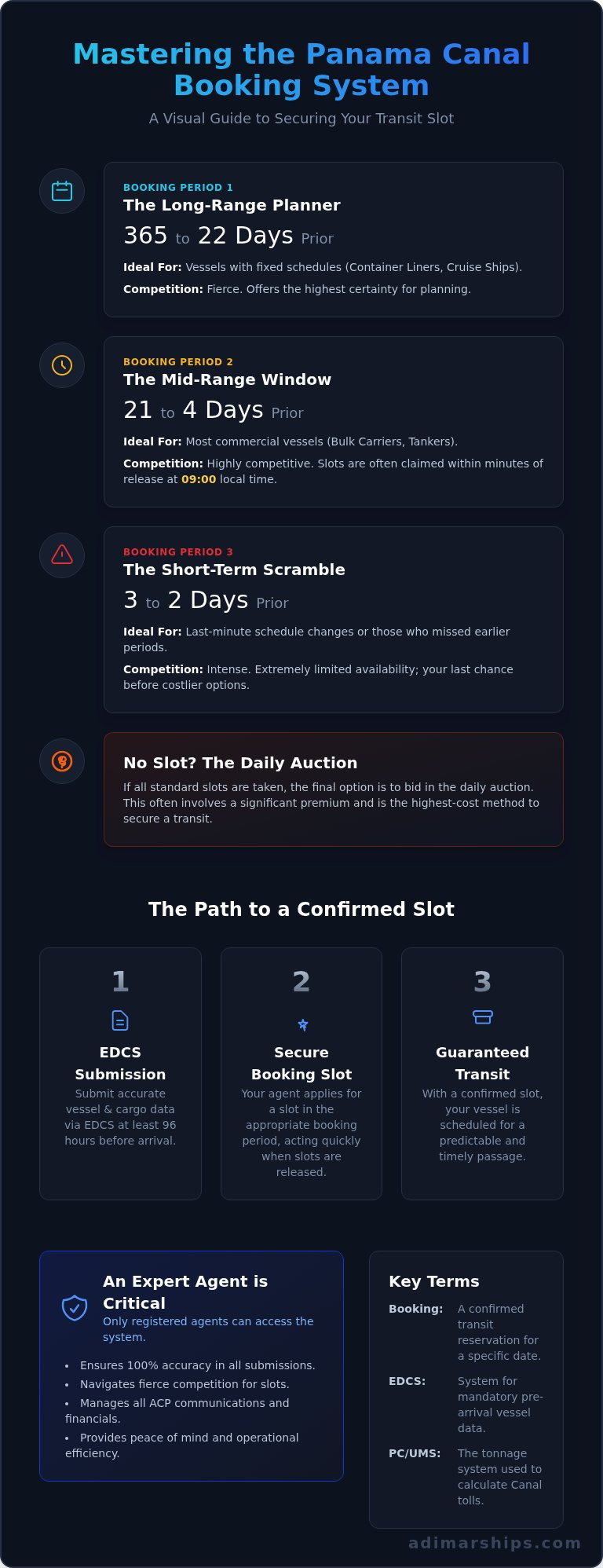
- EDCS (Electronic Data Collection System): The ACP’s system for submitting mandatory pre-arrival information about the vessel, its cargo, and its crew.
- PC/UMS (Panama Canal/Universal Measurement System): The specific tonnage measurement system used by the ACP to calculate a vessel’s tolls.
Who Can Book a Transit Slot?
Direct access to the booking system is restricted. Only shipping agents or vessel representatives who are officially registered and approved by the ACP can secure a reservation. Your ship agent acts as your official, on-the-ground representative, handling all communications and procedures with the Canal authorities. This requirement underscores the need for a trusted, experienced local partner who can navigate the system with integrity and efficiency.
Key Components of the Booking System
The reservation process is managed through a dedicated online portal. Your agent uses this system to submit transit requests, manage vessel information, and handle financial transactions. Success depends on providing precise data. The system categorizes vessels primarily by size-Panamax (fitting the original locks) and Neopanamax (for the larger, newer locks)-and requires accurate details like Length Overall (LOA), Beam, and PC/UMS tonnage to secure the correct slot and calculate fees. This process involves booking fees and financial guarantees, which must be managed correctly to avoid costly penalties or loss of your slot.
The Three Booking Periods Explained: Timing Your Reservation
In the high-stakes world of maritime logistics, timing is everything. The Panama Canal Authority (ACP) manages the immense demand for transit slots through a structured, tiered system designed to balance predictability with flexibility. Think of it like booking a flight: the further in advance you secure your spot, the greater your certainty and control over your schedule. Understanding this framework is the first step in any successful panama canal booking system guide.
Slots are released daily at 09:00 hours local Panama time, and navigating the three distinct booking periods is critical to securing a timely and cost-effective transit. The entire framework is managed through the official Panama Canal Transit Reservation System, which aims to provide an orderly process for all vessels. While the exact number of slots can fluctuate based on water levels and operational needs, the ACP generally offers a set number for both the Panamax and Neopanamax locks.
Booking Period 1: The Long-Range Planner
This initial period opens from 365 down to 22 days prior to your desired transit date. It is primarily designed for vessels with fixed, predictable schedules, such as container liners and cruise ships. Competition for these slots is fierce, as they offer the highest degree of certainty for long-term operational planning. Securing a reservation this far in advance allows operators to lock in their transit date and avoid last-minute uncertainty.
Booking Period 2: The Mid-Range Window
Running from 21 down to 4 days before transit, this is the most common and competitive window for many commercial vessels, including bulk carriers and tankers. Most standard transit slots are awarded during this period. Success here requires diligence and speed, as available slots are often claimed within minutes of their release. This is where having a vigilant agent-your eyes at the Canal-becomes invaluable for monitoring the system and acting decisively.
Booking Period 3: The Short-Term Scramble
This final standard booking window occurs from 3 down to 2 days prior to transit. It represents the last chance to secure a reserved slot without entering the high-cost auction system. Availability is extremely limited, and demand is intense from operators who were unable to book in earlier periods or had last-minute schedule changes. Failing to secure one of these few remaining slots often means facing a significant wait time or paying a premium in the daily auction.
A Step-by-Step Guide to Securing Your Transit Slot
Navigating the Panama Canal’s booking process requires precision where a single mistake can lead to costly delays. This practical walkthrough, a key part of our complete panama canal booking system guide, demonstrates the value of having an expert agent manage each critical step for a smooth and timely transit. The entire process underscores why a trusted partner who manages bookings daily is an invaluable asset to your operations.
Step 1: Pre-Arrival Information & EDCS Submission
The foundation of a successful transit is accurate and timely information. The Panama Canal Authority (ACP) requires all data to be submitted through its Electronic Data Collection System (EDCS) at least 96 hours before arrival. Submitting incomplete or incorrect data is a common reason for booking rejections. Your agent ensures all details are meticulously entered, including:
- Vessel particulars (LOA, beam, draft)
- Detailed cargo information (type, tonnage)
- Accurate Estimated Time of Arrival (ETA)
- Last and next port of call
Errors in the EDCS submission can cascade into significant operational and financial setbacks. We verify every detail to prevent this.
Step 2: Requesting the Transit Reservation
With pre-arrival data correctly submitted, your agent can request a transit slot. Using the official ACP reservation system, we secure a booking for your desired date, ensuring all vessel details match the EDCS submission perfectly. The system is dynamic, and slots are limited. Our team’s daily experience allows us to efficiently manage multiple vessel bookings, navigate confirmation protocols, and handle any necessary cancellations or adjustments with agility and foresight.
Step 3: Managing Payments and Guarantees
Financial compliance is non-negotiable. Securing a slot requires a booking fee and a deposit to cover transit tolls, all priced in U.S. Dollars. Instead of you managing complex international transfers, your agent handles all payments through an established account with the ACP. We ensure your funds are sufficient and posted on time, avoiding the risk of your slot being canceled due to financial holds. This is a critical part of our commitment to integrity and efficiency.
The process is intricate, and the stakes are high. Missteps are not an option when time is money. Put your transit in our hands and eliminate the confusion.
Navigating the Transit Slot Auction System
When a vessel arrives without a pre-booked transit slot, or when scheduling conflicts arise, the Panama Canal’s Transit Slot Auction System provides a crucial, albeit competitive, alternative. This system is a high-stakes marketplace for last-minute passage, designed for ship operators who need to secure a transit time and cannot afford to wait in the non-booked queue. It’s a dynamic and often costly component of the canal’s operations where deep market knowledge is essential to protect your bottom line. Auction slots are periodically offered for both the Panamax and the larger Neopanamax locks, depending on availability.
How the Auction Process Works
The Panama Canal Authority (ACP) typically holds daily auctions for available slots. The process is managed electronically, with bids submitted by a licensed shipping agent on behalf of the vessel operator. A key feature of this system is the ‘second-price’ auction rule: the winning bidder pays the amount of the second-highest bid, plus a small administrative fee. This mechanism encourages bidders to bid their true maximum value.
Auction prices are highly volatile and influenced by several factors:
- Demand and Congestion: High vessel traffic and long waiting queues directly drive prices up.
- Seasonality: Peak seasons for specific trade routes can create intense bidding wars.
- Vessel Type: High-value cargo or specialized vessels, like LNG carriers, often bid aggressively, impacting the entire market.
Occasionally, a “special” auction slot may become available on short notice due to a last-minute cancellation, requiring quick and decisive action.
Strategies for Successful Bidding
Success in the auction system isn’t about having the deepest pockets; it’s about having the best information. This is a core part of any effective panama canal booking system guide. Bidding without a clear understanding of current market conditions is a direct path to overpaying-sometimes by hundreds of thousands of dollars. An experienced agent acts as your eyes at the Canal, analyzing daily traffic, vessel types in the queue, and historical bidding data to advise on a bid that is both competitive and cost-conscious.
Entering the auction involves significant financial risk, as a winning bid is a binding commitment. Therefore, establishing a clear budget and risk tolerance is paramount before placing any offer. Navigating these complexities requires a trusted partner on the ground. Rely on our expertise for strategic auction bidding.
Common Booking Mistakes and How an Expert Agent Prevents Them
In the high-stakes environment of Canal transits, simple administrative errors can lead to costly delays and lost opportunities. Time is money, and a misstep in the booking process can have significant financial consequences. This section provides insider knowledge on the most frequent mistakes operators make and illustrates how a dedicated ship agent acts as your first line of defense, ensuring a smooth and efficient transit.
These challenges are not unique to the shipping industry; many businesses struggle with legacy systems or off-the-shelf software that isn’t tailored to their specific, high-stakes workflows. If you’re interested in how custom-built platforms solve these kinds of complex operational problems, you can visit API Pilot for examples of tailored business solutions.
Error 1: Inaccurate Vessel Information
The Problem: Submitting a booking request with even slightly incorrect data for the vessel’s Length Overall (LOA), beam, or Panama Canal/Universal Measurement System (PC/UMS) tonnage is a common pitfall. The Canal Authority’s systems are precise and will flag any discrepancies.
The Agent Solution: A professional agent maintains a comprehensive and meticulously updated database of your fleet’s particulars. Before any submission, we cross-verify every detail against official records, eliminating the risk of booking rejection, unexpected re-measurement fees, and disruptive delays.
Error 2: Missing Deadlines and Cut-Off Times
The Problem: The Panama Canal booking system operates on strict, non-negotiable deadlines. Failing to submit the required Electronic Data Collection System (EDCS) information or the booking request itself before the cut-off time means a guaranteed missed opportunity.
The Agent Solution: We are your eyes at the Panama Canal, operating 24/7 to monitor booking periods and deadlines. Our team ensures all documentation is submitted well ahead of schedule, securing your vessel’s slot and preventing the costly scenario of being forced into the competitive auction period.
Error 3: Mismanaging Transit Funds
The Problem: A transit can be halted before it even begins if there are insufficient funds in the vessel’s deposit account to cover tolls and booking fees. The Panama Canal Authority (ACP) will not process a request without the required pre-payment.
The Agent Solution: We provide transparent, proactive fund management. Our team gives you a clear and accurate proforma disbursement account (PDA), monitors your balance, and provides timely notifications to ensure it is always sufficiently funded. This prevents the disastrous outcome of having a booking cancelled and losing your place in line.
Navigating these complexities is the core of our service. By entrusting your transit to an experienced partner, you transform this complex panama canal booking system guide from a source of potential frustration into a predictable, streamlined process. We are experts so you don’t have to be. Put your transit in our hands and focus on your core business, confident that every detail is managed with integrity and precision.
Your Partner for a Seamless Panama Canal Transit
Mastering the Panama Canal’s Transit Reservation System is a critical task where timing and precision are everything. Success hinges on understanding the distinct booking periods, strategically navigating the auction system, and avoiding common procedural errors that can lead to costly delays. We trust this panama canal booking system guide has provided the clarity you need to approach the process with confidence.
However, knowledge is only the first step. Executing a flawless booking requires constant vigilance and deep expertise. This is where Adimar becomes your most valuable asset. With over 20 years of dedicated experience as a Panama Canal ship agent, we provide expert management of all ACP systems and procedures. Our team offers 24/7 personalized service, acting as your eyes at the Canal to proactively prevent delays and reduce operational costs.
Don’t leave your transit to chance. Let our integrity and experience ensure your vessel’s passage is smooth and efficient. Nominate Adimar as your trusted agent for a seamless Panama Canal transit.
Frequently Asked Questions About the Panama Canal Booking System
What happens if I need to cancel or change my Panama Canal booking?
Canceling or changing a booking requires careful adherence to the Panama Canal Authority (ACP) deadlines to avoid significant fees. Cancellations made more than 96 hours before the transit date typically incur a fee, which increases substantially as the transit date approaches. As your agent, we manage this entire process, ensuring timely communication with the ACP to modify your booking, process substitutions, or cancel when necessary while minimizing your financial exposure and operational disruption.
Can a vessel transit the Panama Canal without a reservation?
Yes, a vessel can transit without a reservation, but it is not recommended. These vessels are handled on a first-come, first-served basis and are subject to unpredictable and often extensive waiting times, which can last for days or even weeks. This uncertainty directly impacts your schedule and budget. Securing a booked slot is the most efficient and cost-effective way to ensure a timely and predictable transit, protecting your voyage’s profitability.
How much does it cost to book a transit slot, excluding tolls?
The base booking fee for a standard transit slot varies by vessel size and lock type but typically starts around $35,000. However, this cost can escalate dramatically during periods of high demand. Exceptional or last-minute slots are often sold via auction, where prices can exceed several hundred thousand dollars. We provide transparent, cost-conscious guidance to help you secure the most economical booking option available for your specific transit requirements.
What is the difference between booking for the Neopanamax and Panamax locks?
The primary difference is vessel size. The Neopanamax locks accommodate larger vessels with greater beam and draft, while the original Panamax locks serve smaller ships. The booking systems and fees are also distinct. Neopanamax slots are fewer and in higher demand, often requiring booking further in advance. Understanding the specific requirements for each lock system is critical for a smooth transit, a process we expertly manage for our clients.
How does vessel substitution work in the booking system?
The ACP allows for a booked vessel to be substituted with another, provided certain conditions are met. The substitute vessel must typically belong to the same operator and have similar or smaller dimensions than the original ship. This request must be submitted within a specific timeframe before the scheduled transit. We handle these substitutions efficiently, providing you with crucial operational flexibility when your fleet schedules change unexpectedly, ensuring your slot is not lost.
What are the peak seasons for Panama Canal traffic and booking?
Peak season generally runs from August through November, driven by container ships positioning for the holiday retail season. Another busy period occurs from January to March, coinciding with the grain export season from the U.S. Gulf to Asia. During these times, booking slots become highly competitive and more expensive. Proactive planning is essential, and as your trusted partner, we help you navigate this complex panama canal booking system guide to secure slots well in advance. For those interested in the maritime world beyond commercial transit, you can read more about other activities in the wider Gulf and Caribbean region.
Is it possible to secure a booking slot on very short notice?
While challenging, it is possible through special auctions held by the ACP for last-minute or unfilled slots. These slots are limited and command premium prices due to high demand. Securing one requires constant monitoring and immediate action. Our 24/7 presence and deep familiarity with the auction process allow us to act swiftly on your behalf, giving you the best possible chance to secure a transit slot even with minimal lead time.