

In the high-stakes world of Panama Canal transits, where time is money, every decision directly impacts your bottom line. The debate over full agency vs protective agency in Panama is more than just a logistical choice; it’s a critical decision that can safeguard your financial interests, prevent costly delays, and ensure a smooth passage. Are you concerned about a potential conflict of interest when an agent is nominated by another party? Do you worry about the transparency of your disbursement account and the risk of hidden fees?
You are not alone. As your trusted partner and eyes at the Canal, we believe in providing clarity with integrity. This guide is designed to eliminate the confusion. We will break down the precise responsibilities, benefits, and potential pitfalls of each agency model. By the end, you will have the confidence to make a cost-effective, secure, and strategically sound decision for your vessel’s next transit, protecting your assets every step of the way.
Key Takeaways
- Understand that a Full Agent executes your Panama Canal transit, while a Protective Agent acts as your dedicated watchdog to supervise the process and protect your interests.
- Clarify the full agency vs protective agency panama decision by comparing their core allegiance, scope of duties, and impact on your final transit costs.
- Identify specific high-risk scenarios where appointing a protective agent is a non-negotiable step to secure your vessel and investment.
- Learn why proven integrity is the most critical factor in your choice, ensuring transparency and preventing costly surprises regardless of the agency type you need.
The Foundation: What is a Full Agency at the Panama Canal?
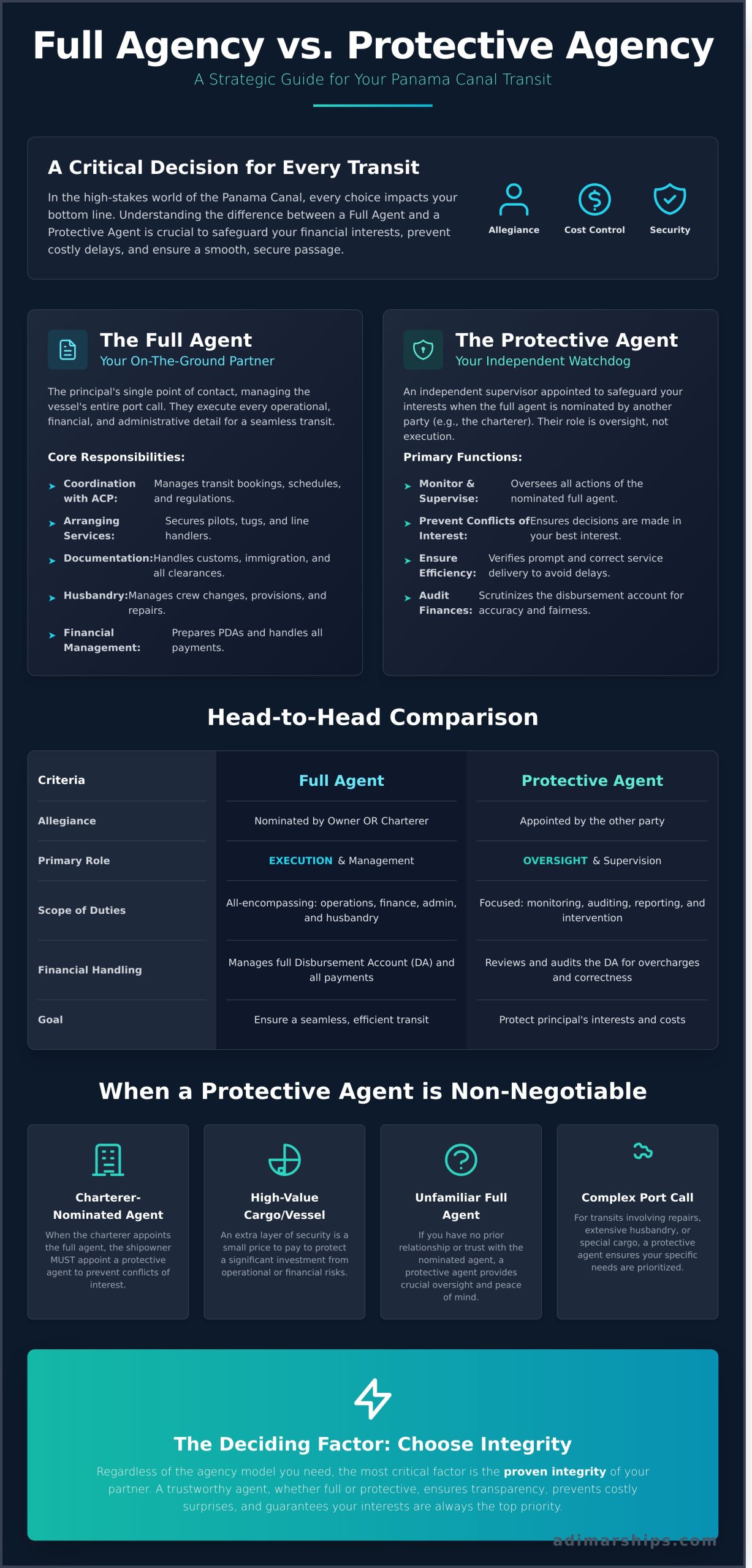
When a vessel prepares for a Panama Canal transit, the full agent is the principal’s single, most vital partner on the ground. Nominated by either the ship owner or the charterer as stipulated in the charter party, this agent acts as the vessel’s dedicated local office for the entire duration of the call. They are the primary, authorized representative entrusted with managing every operational, financial, and administrative detail. The core function of any shipping agency is to represent the principal’s interests, and in a full agency capacity, this responsibility is all-encompassing and direct.
Think of them as an extension of your own team, serving as your eyes and ears to ensure a seamless and efficient passage. This comprehensive appointment is the traditional and most common form of agency for Canal transits.
Core Responsibilities of a Full Agent
A full agent’s duties are extensive, designed to eliminate confusion and manage the complex logistics on your behalf. Their hands-on responsibilities are proactive, not reactive, and cover every stage of the port call. Key tasks include:
- Coordination with the ACP: Liaising directly with the Panama Canal Authority (ACP) for booking transit slots, managing schedules, and ensuring all canal regulations are strictly met.
- Arranging Essential Services: Securing and scheduling all mandatory services, including pilots, tugboats, and line handlers required for a safe passage through the locks.
- Documentation and Clearances: Handling the extensive paperwork, customs declarations, immigration clearances, and all other administrative formalities with Panamanian authorities.
- Overseeing Husbandry Services: Managing all vessel needs beyond the transit itself, such as crew changes, delivery of provisions and spare parts, arranging repairs, and coordinating medical assistance.
Financial Management and Communication
Beyond operations, the full agent serves as the financial and communication hub. This centralization is critical for transparency and control, ensuring there are no costly surprises. Understanding these financial duties is a key part of the full agency vs protective agency Panama discussion. Functions in this area involve:
- Pro-forma Disbursement Account (PDA): Preparing a detailed estimate of all port costs and transit fees in USD, managing the funds, and providing a final, transparent disbursement account upon completion.
- Vendor and Authority Payments: Handling all payments to the ACP, local vendors, and service providers on behalf of the principal, ensuring timely settlement of all obligations.
- Single Point of Contact: Acting as the central communication channel between the ship’s master, owners, charterers, and all local entities, providing regular updates and immediate solutions.
In essence, the full agent carries the full weight of responsibility, allowing principals to focus on their core business with the confidence that their vessel and crew are in expert hands.
The Oversight: What is a Protective Agency in Panama?
While a full agent manages a vessel’s entire port call, a protective agent serves a different, more focused role: oversight. A protective agency acts as an independent watchdog, appointed to safeguard the interests of a principal when the full agent has been nominated by another party in the charter agreement. This is a common scenario for shipowners whose charterers have appointed their own preferred agent.
Think of a protective agent as your trusted eyes and ears on the ground in Panama. Their primary responsibility is not to execute port operations, but to ensure the nominated full agent performs their duties with complete fairness, efficiency, and transparency. This second layer of supervision is crucial in the complex dynamic of full agency vs protective agency panama, providing peace of mind that your assets and finances are secure.
Primary Functions of a Protective Agent
A protective agent’s mission is to proactively defend your interests. They provide a critical check and balance on the full agent’s activities to ensure a smooth and cost-effective port call. Their key functions are to:
- Monitor and Supervise: They closely oversee all activities of the nominated full agent, from pre-arrival planning to post-departure documentation, ensuring every step is handled correctly.
- Prevent Conflicts of Interest: By representing only one principal (e.g., the owner or the charterer), they eliminate potential conflicts, ensuring decisions are made in your best interest, not for the convenience or benefit of another party.
- Ensure Operational Efficiency: In a place where time is money, like the Panama Canal, a protective agent works to prevent unnecessary delays, verifies the accuracy of the Statement of Facts, and ensures the vessel’s turnaround is as swift as possible.
Financial Scrutiny and Reporting
One of the most valuable roles a protective agent plays is financial oversight. They do not typically handle funds directly, but they meticulously audit all transactions to protect you from overcharges or billing errors. This scrutiny is fundamental to understanding the differences in the full agency vs protective agency panama comparison. Their financial role includes:
- Auditing the Pro-forma Disbursement Account (PDA): Before you transfer funds, a protective agent reviews the PDA for accuracy, challenging any questionable or inflated fees.
- Verifying Invoices and Port Costs: They ensure all third-party vendor invoices and official port costs are legitimate and correctly applied. Every charge must be justified and align with official tariffs and Panama Canal Authority regulations.
- Reporting Discrepancies: They immediately report any financial discrepancies or cost-saving opportunities to you, providing a transparent and detailed account of all expenses.
Head-to-Head Comparison: Full Agency vs. Protective Agency
Understanding the core differences between a full agent and a protective agent is the first step toward making a cost-effective and secure decision for your vessel’s transit. While both roles are critical in port operations, they serve distinct functions with different loyalties and responsibilities. The debate of full agency vs protective agency panama often comes down to who you need representing your direct interests on the ground.
To clarify these roles, here is a direct, at-a-glance comparison:
| Feature | Full Agency | Protective Agency |
|---|---|---|
| Primary Allegiance | To the party that nominated them (often the charterer), while serving the vessel’s operational needs. | Exclusively to the principal who appointed them (e.g., the ship owner or operator). |
| Scope of Work | Hands-on operational management: arranging pilots, tugs, documentation, husbandry, and all port services. | Supervisory and advisory: monitoring the full agent, reviewing costs, and reporting back to the principal. |
| Cost Structure | A comprehensive agency fee covering all coordination and operational tasks. | A smaller, typically fixed fee for oversight, auditing, and advisory services. |
| Key Purpose | To execute the entire port call or Canal transit efficiently. | To protect the principal’s financial and operational interests. |
Allegiance and Primary Duty
The most critical distinction lies in allegiance. A Full Agent is appointed to manage the vessel’s call, but their contractual duty is to the entity that nominated them-often the charterer. This can create a potential conflict of interest, as the charterer’s priority (speed) may not align with the owner’s priority (cost control). A Protective Agent, however, has a single-minded focus: to serve and protect the interests of the principal who appointed them, ensuring transparency and integrity throughout the process.
Scope of Work and Authority
A Full Agent is the operational commander on the ground. They have broad authority to arrange all necessary services, from submitting documentation to the Panama Canal Authority (ACP) to coordinating bunkering and crew changes. Their role is to ensure the entire operation adheres to local regulations and international maritime traffic standards to prevent costly delays. In contrast, a Protective Agent acts in a supervisory capacity. They do not execute tasks but rather monitor, advise, and audit the work of the full agent, acting as your trusted eyes and ears at the Canal.
Cost Structure and Fees
At first glance, appointing a protective agent may seem like an added expense. The Full Agency fee is a standard, comprehensive charge for managing the port call. The Protective Agency fee is a separate, smaller fee for oversight. However, this is where the “time is money” principle becomes vital. An effective protective agent can generate significant savings by verifying invoices, challenging questionable charges in the Disbursement Account (DA), and ensuring the most efficient service providers are used, more than justifying their modest fee.
Crucial Scenarios: When You Absolutely Need a Protective Agent
Choosing between a full and protective agent is not just a matter of service level; it’s a strategic decision based on risk. While a full agent is sufficient for many routine transits, certain situations demand the dedicated oversight that only an Owner’s Protective Agent (OPA) can provide. Think of an OPA not as an extra cost, but as an insurance policy-an investment in protecting your assets and your bottom line. Understanding the core differences in the full agency vs protective agency panama debate helps you identify when this investment is non-negotiable.
When the Charterer Nominates the Agent
This is the most common reason to appoint an OPA. The charterer’s nominated agent, while professional, has a primary commercial relationship with the charterer. Their priority might be a faster turnaround to minimize charter costs, which may not align with the owner’s interest in vessel safety or operational efficiency. A protective agent works exclusively for you, the owner. They are your trusted eyes at the Panama Canal, ensuring your interests-from accurate disbursement accounts to proper vessel handling-are always the top priority.
Navigating Unfamiliar Ports or Agents
Entering the Panama Canal zone with a nominated agent you have no history with can be a significant risk. You have no established trust or understanding of their operational integrity. A protective agent provides a vital layer of security and local expertise. They can independently verify the nominated agent’s activities, scrutinize the proforma disbursement account (PDA), and ensure all canal regulations are met without unnecessary expenses. This is crucial in a complex environment like Panama, where local knowledge prevents costly missteps.
High-Value Cargo or Complex Operations
When the stakes are high, a second set of expert eyes is invaluable. For vessels carrying high-value cargo, undergoing critical repairs, or executing complex crew changes, an OPA provides an essential layer of oversight. They ensure sensitive operations are managed correctly and protect you from potential disputes. Key aspects of this protection include:
- Independently verifying the Statement of Facts.
- Monitoring operations to prevent claims related to vessel or cargo damage.
- Ensuring all husbandry services are delivered on time and at a fair price.
In these scenarios, the cost of a small error far outweighs the fee for a protective agent. When weighing full agency vs protective agency panama for a high-stakes transit, an OPA is the prudent choice for risk management. If these situations resonate with your operational needs, appointing a trusted partner to protect your interests is a sound business decision.
Choosing Your Partner in Panama: Why Integrity is Non-Negotiable
Understanding the operational differences is the first step, but the ultimate success of your vessel’s transit hinges on the partner you choose on the ground. The debate over full agency vs protective agency panama often overlooks the most critical factor: the character and competence of your local representative. Whether you require comprehensive support or diligent oversight, the core qualities of a premier shipping agent remain the same.
Your agent must be a trusted steward of your interests, demonstrating unwavering integrity, deep-rooted local expertise, and a commitment to absolute transparency. In a strategic chokepoint like the Panama Canal, where time is money and delays are costly, you cannot afford anything less.
The Adimar Advantage: Your Eyes and Ears at the Canal
For over 20 years, Adimar Shipping, Inc. has served as a dedicated partner for owners and charterers transiting the Panama Canal. Our sole focus is ensuring your vessel’s passage is smooth, predictable, and cost-effective. We leverage our long-standing relationships with Canal authorities and local vendors to proactively solve problems before they impact your schedule. We don’t just process paperwork; we act as a true extension of your team, providing the vigilance and local knowledge you need to operate with confidence.
Transparent Financials and Communication
We believe trust is built on clarity. Our commitment to you includes providing clear, accurate, and timely disbursement accounts (DAs) with no hidden fees or surprises. Proactive communication is standard practice, ensuring you are informed at every critical stage of the transit, from pre-arrival planning to post-departure accounting. Our reputation for integrity is your assurance that your funds and interests are being managed with the highest level of professional oversight. When you need a partner whose actions align with their words, the choice is clear.
Nominate Adimar as your trusted agent for the Panama Canal.
Your Trusted Partner for a Seamless Panama Canal Transit
Navigating the complexities of the Panama Canal requires a clear understanding of your agency options. While a full agency manages day-to-day operations, a protective agency serves as your dedicated advocate, safeguarding your financial interests and ensuring transparency. The critical decision in the full agency vs protective agency panama debate ultimately hinges on your need for direct oversight and control, especially when the full agent is appointed by the charterer.
In a waterway where time is money and integrity is paramount, you need more than just an agent; you need a partner. With over 20 years of specialized experience at the Panama Canal, Adimar Shipping acts as your dedicated ‘eyes and ears’ on the ground. Our reputation is built on unwavering integrity and complete financial transparency, giving you the peace of mind that your vessel and interests are protected every step of the way.
Don’t leave your transit to chance. Request a quote and secure your trusted partner at the Panama Canal.
Frequently Asked Questions
What is the difference between an Owner’s Protective Agency (OPA) and a Charterer’s Protective Agency (CPA)?
Both are supervisory roles, but they represent different parties. An Owner’s Protective Agency (OPA) is appointed by the shipowner to protect their interests when the charterer has nominated the full agent. Conversely, a Charterer’s Protective Agency (CPA) is appointed by the charterer when the shipowner nominates the full agent. Each ensures their principal’s financial and operational interests are safeguarded during the port call or Panama Canal transit, providing crucial oversight and transparency.
Can the same company act as both the full agent and the protective agent on a single port call?
No, this creates a direct conflict of interest and is not standard industry practice. The fundamental role of a protective agent is to independently supervise the work and financial accounts of the full agent on behalf of a different principal. A single company cannot effectively audit itself. Having separate, independent agents for each role is essential to ensure proper checks, balances, and the integrity of the entire port call operation for all parties involved.
How is a protective agent’s fee structured compared to a full agency fee?
A protective agency fee is typically a fixed, pre-agreed lump sum. This reflects their supervisory and auditing role, which has a more defined scope. In contrast, a full agency fee is higher because it covers the comprehensive operational workload of arranging all port services, coordinating with authorities like the Panama Canal Authority (ACP), and managing large financial transactions through the Disbursement Account. The fixed fee for a protective agent provides cost certainty for their principal.
Does a protective agent also handle husbandry services like crew changes or provisions?
Generally, the full agent is responsible for arranging all hands-on husbandry services. The protective agent’s primary function is to supervise these activities. They act as your eyes on the ground, ensuring that services like crew changes, provision delivery, or cash to master are performed correctly, on time, and at a fair market cost. They will intervene and report to their principal if the full agent’s arrangements are not satisfactory or cost-effective.
What is a Disbursement Account (DA) and how does each type of agent interact with it?
The Disbursement Account (DA) is the final, itemized invoice of all costs incurred during a vessel’s port call, including canal tolls, port fees, and vendor charges. The full agent prepares and manages the DA, handling all payments. The protective agent’s critical role is to meticulously review and audit the full agent’s DA, checking every line item for accuracy and fairness before their principal approves the final payment. This oversight prevents overcharging and ensures financial transparency.
Is a protective agent required by the Panama Canal Authority (ACP)?
No, the Panama Canal Authority (ACP) does not require a vessel to have a protective agent. The ACP mandates that every transiting vessel must appoint a registered shipping agent (full agent) to handle official formalities and guarantee payments. The choice to appoint a protective agent is a commercial decision made by a shipowner or charterer to protect their interests. This is a key consideration in the full agency vs protective agency Panama dynamic, providing a vital layer of security.