
In the high-stakes world of maritime logistics, a single misstep during a panama canal transit for tankers can mean thousands of dollars lost to demurrage, unexpected vessel deficiencies, or steep fines for non-compliance. For ship owners and charterers, the anxiety surrounding frequently changing ACP regulations and strict PCSOPEP requirements is a constant operational challenge. A smooth, predictable passage can often feel more like a matter of luck than a guarantee.
But it doesn’t have to be. As your trusted partner with over 20 years of integrity-driven service at the Canal, Adimar Shipping, Inc. is here to eliminate the confusion. This comprehensive 2026 guide is your definitive resource for mastering the complexities of tanker transits. We’ll provide the expert, on-the-ground insights you need to navigate everything from Neopanamax slot auctions to environmental compliance, empowering you to achieve the predictable costs and seamless, delay-free transit you depend on.
Key Takeaways
- Understand the mandatory PCSOPEP and Authorized Person (AP) requirements to ensure your vessel is compliant and avoids costly transit delays.
- Analyze the critical differences between Panamax and Neopanamax locks to optimize your passage based on vessel size, draft, and the upcoming 2026 toll structure.
- Mastering the booking and auction system is essential, as a well-planned Panama Canal transit for tankers is critical to your commercial success.
- Learn why an experienced local agent is your most valuable asset for navigating complex regulations and ensuring a transparent, efficient passage with integrity.
The High Stakes of Panama Canal Transit for Tankers in 2026
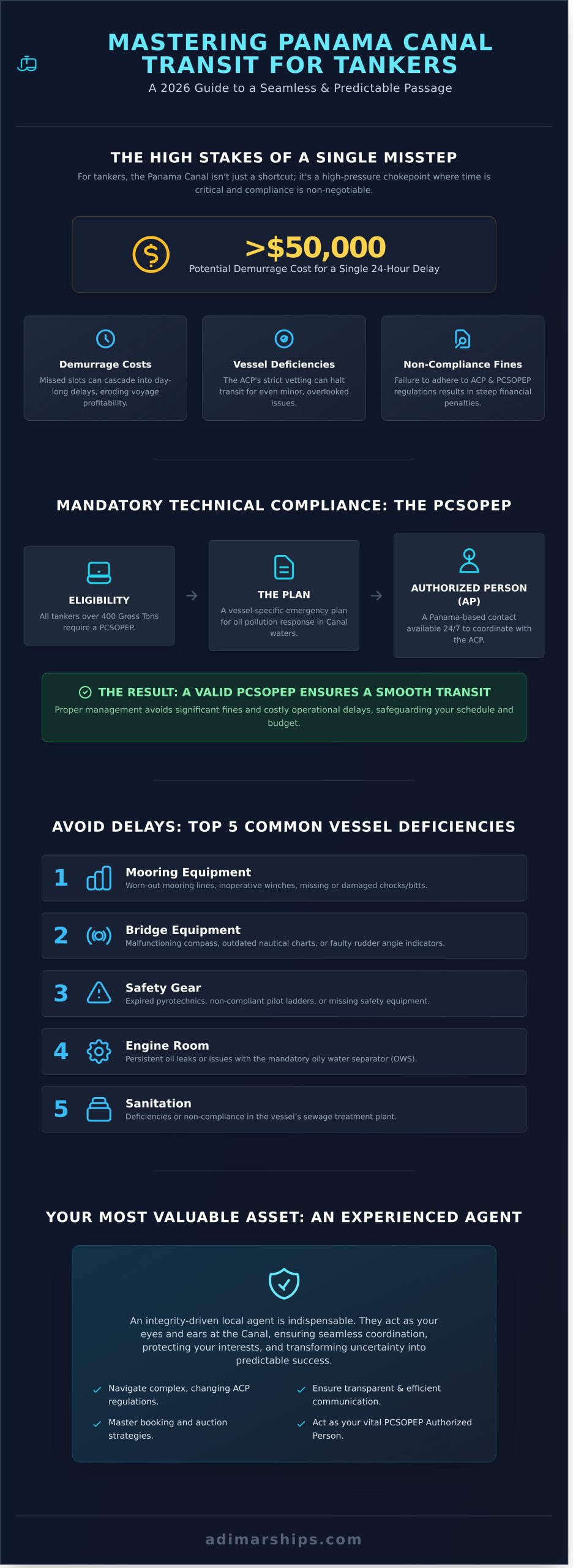
For ship owners and charterers, a panama canal transit for tankers is not just another voyage; it’s a high-stakes, specialized operation requiring meticulous planning. Unlike container ships or dry bulk carriers, vessels transporting liquid bulk cargo-such as crude oil, chemicals, LNG, and LPG-are placed under intense scrutiny by the Panama Canal Authority (ACP). In an industry where time is money, a single 24-hour delay can result in demurrage costs exceeding $50,000. This financial pressure makes the role of an experienced Panama Canal Ship Agent essential. They act as the indispensable coordinator, ensuring seamless communication and compliance between the vessel and the ACP.
Why Tanker Logistics Differ from Standard Cargo
The inherent risk of hazardous cargo elevates every aspect of a tanker’s transit. Safety protocols are stricter, and transit priority can be affected by the vessel’s condition and cargo type. The ACP employs a stringent “vessel deficiency matrix” specifically for tankers, where even minor issues can lead to costly delays. Furthermore, requirements like “gas-free” certificates for certain repairs or inspections must be perfectly timed. These rigorous standards are the modern evolution of over a century of learning, which is detailed in the extensive Panama Canal history and operations, making expert navigation of these rules non-negotiable.
The Economic Impact of Transit Efficiency
With tanker charter rates in 2026 continuing their volatile upward trend, maximizing efficiency is paramount. Transit efficiency is the perfect synchronization of a vessel’s arrival, inspection, and entry into its assigned transit slot. When this coordination fails, the financial consequences are immediate and severe. A missed slot doesn’t just mean a few hours of waiting; it can cascade into a full day or more, directly eroding the voyage’s profitability. Understanding the nuances of scheduling and preparation is key to protecting your investment. For a broader overview of the process, see our general Panama Canal Transit Guide.
Technical Compliance: PCSOPEP and Tanker-Specific Regulations
Navigating the Panama Canal is more than a matter of scheduling; for tankers, it demands rigorous technical and environmental compliance. A successful Panama Canal transit for tankers hinges on meticulous preparation and adherence to the Panama Canal Authority’s (ACP) stringent rules. At the core of these requirements is the Panama Canal Shipboard Oil Pollution Emergency Plan (PCSOPEP), a vessel-specific plan that outlines immediate response actions in the event of an oil spill within Canal waters.
The ACP is continuously updating its environmental standards. Looking ahead to 2026, operators can expect further alignment with MARPOL Annex VI, focusing on stricter emissions controls and enhanced energy efficiency measures. Staying current with these evolving rules is critical. For the most up-to-date information, vessel operators should always reference the official Panama Canal tanker regulations issued by the ACP.
The Role of the PCSOPEP Authorized Person
Every tanker over 400 gross tons must designate a Panama-based Authorized Person (AP) who is available 24/7. This individual or company is the vessel’s first point of contact for the ACP during a pollution emergency. As your trusted partner, Adimar Shipping acts as this vital AP, ensuring your PCSOPEP is not only approved but always up-to-date. Failure to maintain a valid plan or accessible AP can result in significant fines and costly transit delays.
Vetting and Inspections: Avoiding Deficiencies
Before transit, ACP inspectors conduct a thorough vetting process. An Owner’s Protective Agency (OPA) is invaluable during this stage, safeguarding your interests and ensuring a smooth inspection. To prevent delays, masters should address common issues before arrival. The top deficiencies typically found include:
- Mooring Equipment: Worn-out mooring lines, inoperative winches, or missing chocks/bitts.
- Bridge Equipment: Malfunctioning magnetic compass, outdated charts, or faulty rudder angle indicators.
- Safety Gear: Expired pyrotechnics or non-compliant pilot ladders.
- Engine Room: Oil leaks or issues with the oily water separator.
- Sanitation: Deficiencies in the vessel’s sewage treatment plant.
By proactively managing these details, you ensure your vessel is prepared for a seamless and efficient Panama Canal transit for tankers, avoiding the costly consequences of non-compliance.
Panamax vs. Neopanamax: Choosing the Right Locks for Liquid Bulk
Selecting the right set of locks for your vessel is a critical decision that directly impacts cost, payload, and scheduling for any panama canal transit for tankers. The choice between the original Panamax locks and the larger Neopanamax locks (Cocoli and Agua Clara) depends entirely on your vessel’s dimensions and cargo strategy.
Understanding the fundamental differences is the first step to an efficient transit:
- Panamax Locks (Original): Designed for vessels up to 294.13m (965 ft) in length, 32.31m (106 ft) in beam, and with a tropical freshwater draft of 12.04m (39.5 ft).
- Neopanamax Locks (Expanded): Accommodate larger vessels up to 366m (1,201 ft) in length, 51.25m (168 ft) in beam, and with a maximum draft of 15.2m (50 ft), though this is often restricted.
Navigating these options requires expert planning, especially with evolving regulations and environmental factors. The 2026 dry season, for example, is expected to bring significant draft restrictions that will directly reduce tanker payloads. These water level issues are a primary cause of Panama Canal transit delays, making the Transit Reservation System more critical than ever. Booking slots, categorized by vessel size (e.g., “Regulars” for vessels under 91 ft beam, “Supers” for larger vessels), become highly competitive during these periods.
Neopanamax Tanker Operations
For Suezmax and other large tankers, the Neopanamax locks present unique operational requirements. Unlike the original locks which use locomotives, vessels in the Cocoli and Agua Clara locks are maneuvered exclusively by two tugboats-one at the bow and one at the stern. Furthermore, stringent visibility requirements for vessels with a large air draft or wide beam may necessitate an additional Canal pilot on board to ensure safe passage.
Toll Calculations for Liquid Bulk
The upcoming 2026 toll structure modification introduces significant changes. The system will shift from PC/UMS tonnage to a more dynamic model based on vessel capacity and cargo status. For laden tankers, tolls will be calculated based on the vessel’s deadweight tonnage (DWT) capacity plus a per-ton charge for actual cargo carried. For tankers in ballast, the toll will be based on a percentage of the vessel’s DWT. Additionally, all transits are subject to a “Fresh Water Surcharge,” a variable fee that increases as the water level of Gatun Lake drops. For a clear and updated cost analysis, see this Panama Canal Fees Breakdown.
Managing the Schedule: Booking Slots and Auction Strategies
In the high-stakes environment of the Panama Canal, time is money. Misjudge your timing, and you lose. A successful panama canal transit for tankers depends on a proactive scheduling strategy that minimizes delays and protects your bottom line. Simply arriving and waiting is not a viable commercial strategy for high-value cargo.
The Panama Canal Authority (ACP) operates a sophisticated booking system to manage traffic. Understanding how to navigate this system is the difference between a profitable voyage and costly, frustrating delays. Your ship agent is your essential partner in this process, providing the local expertise to secure the best possible outcome.
How to Book a Tanker Transit Slot
Securing a transit slot in advance is the most cost-effective way to ensure a timely passage. The process requires precision and foreknowledge of your vessel’s schedule.
- Step 1: Early Nomination of a Ship Agent. Nominate your agent as soon as your voyage is fixed. This allows them to prepare all pre-arrival requirements and advise on the best booking strategy.
- Step 2: Submission via VUMPA. Your agent will use the Vessel User Maritime Portal for Arrivals (VUMPA) to submit all required documentation and manage your booking request.
- Step 3: Strategic Booking Period Selection. The ACP offers three booking periods, each with different slot availabilities and fees. An experienced agent can help you select the optimal period based on your vessel’s ETA and market conditions.
The Auction Strategy for Tankers
What happens if you miss the booking periods or need to transit urgently? The ACP offers a limited number of slots via a daily auction. While this comes at a premium, it can be a powerful tool to avoid even greater financial losses.
Consider this scenario: A tanker is facing $50,000 per day in demurrage costs and is at risk of missing its laycan, a penalty of $150,000. Waiting in the non-booked queue could mean a 5-day delay, costing $250,000. In this case, winning an auction slot with a $100,000 bid is a clear financial victory. Your agent acts as your eyes at the Canal, advising the Master and owners if the auction is a prudent commercial decision based on real-time waiting times and potential costs.
Ultimately, the cost of “waiting in line” for a tanker-including fuel, crew costs, and severe commercial penalties like demurrage-far outweighs the cost of a booked or auctioned slot. Proactive management is key. Put your transit in our hands, and we will eliminate the confusion with personalized, cost-conscious service.
Adimar Shipping: Your Eyes at the Panama Canal for Tanker transits
Navigating the complexities of a panama canal transit for tankers requires more than just an agent; it demands a dedicated partner on the ground. For tanker owners and charterers, where stakes are high and delays are costly, Adimar Shipping serves as your eyes at the Canal. Our entire operation is built on two pillars: absolute Integrity in our actions and complete Transparency in our communication. We are experts so you don’t have to be, eliminating the confusion and ensuring your high-value asset is protected every step of the way.
Personalized Service for High-Value Assets
Consider us your local office in Panama City. With over 20 years of experience, we have cultivated deep-rooted relationships with Panama Canal Authority (ACP) officials and local service providers. This allows us to anticipate challenges and secure quick solutions. As your Owners & Charterers Nominated Agent, we work exclusively to protect your interests, ensuring fair costs and efficient handling, independent of any other parties involved in the voyage.
Beyond Transit: Husbandry and Support
A successful transit is about more than just crossing from one ocean to another. The time spent at anchorage is a critical window for essential vessel support. Adimar coordinates a full suite of husbandry services to maximize your vessel’s time and efficiency, including:
- Crew Changes: We manage all logistics for safe and timely crew rotations at either the Pacific or Atlantic anchorages, handling immigration and transportation seamlessly.
- Spare Parts & Supplies: We coordinate the swift delivery of critical spare parts, provisions, or technical equipment directly to your vessel, preventing costly delays to your schedule.
- Cash to Master (CTM): We facilitate the secure and verified delivery of funds to your vessel’s master.
Don’t leave your investment and schedule to chance. By nominating Adimar as your agent, you gain a trusted partner committed to protecting your bottom line. Let us manage the complexities on the ground so you can focus on your business. Get a Quote for Your Tanker Transit Today and experience the peace of mind that comes with having a true expert on your side.
Navigate Your 2026 Panama Canal Transit with Confidence
As we look towards 2026, successfully managing a panama canal transit for tankers requires meticulous planning and deep expertise. From mastering the complex booking and auction system to ensuring flawless technical and PCSOPEP compliance, the stakes for your schedule and budget have never been higher. A successful transit is not just about passage; it’s about precision, foresight, and proactive problem-solving.
Don’t leave your high-value transit to chance. With over 20 years of specialized experience, Adimar Shipping is your trusted partner on the ground in Panama City. As your authorized PCSOPEP person, we ensure immediate environmental compliance, while our dedicated team acts as your “eyes at the canal” to manage every detail. We provide the integrity and efficiency your operation demands, eliminating confusion so you can focus on your business.
Put our proven expertise to work for your fleet. Nominate Adimar Shipping as your Panama Canal Tanker Agent today and secure a smooth, predictable, and cost-effective passage.
Frequently Asked Questions About Panama Canal Transit for Tankers
How much does it cost for a tanker to transit the Panama Canal in 2026?
The cost for a Panama Canal transit for tankers is dynamic and depends on several factors, including the vessel’s Panama Canal Universal Measurement System (PC/UMS) net tonnage, cargo type, and booking slot fees. The Panama Canal Authority (ACP) may also adjust tolls. For an accurate, up-to-date projection for 2026, a detailed proforma disbursement account (PDA) is essential. As your trusted partner, we provide transparent, cost-conscious estimates to help you budget effectively for every transit.
What is the maximum draft for a tanker in the Neopanamax locks?
The maximum authorized draft for the Neopanamax locks is officially 15.2 meters (50.0 feet) in Tropical Fresh Water (TFW). However, this figure is highly dependent on the water levels of Gatun Lake, which fluctuate with rainfall. The Panama Canal Authority (ACP) frequently issues advisories adjusting the maximum draft. We constantly monitor these updates to ensure your vessel remains in full compliance, preventing costly delays and ensuring a smooth, predictable passage for your tanker.
Is PCSOPEP mandatory for all tankers transiting the canal?
Yes, a Panama Canal Shipboard Oil Pollution Emergency Plan (PCSOPEP) is a mandatory requirement for all tankers transiting the waterway with a capacity of 400 metric tons or more of oil as cargo or fuel. This plan must be authorized by the Panama Canal Authority (ACP) before arrival. Navigating these regulations can be complex; we manage the entire PCSOPEP submission and approval process on your behalf, ensuring your vessel meets all compliance requirements without issue.
How long does a typical tanker transit take from sea to sea?
While the physical passage through the locks and lakes typically takes 8 to 10 hours, the total time from arrival at the sea buoy to clearing the canal on the other side is usually around 24 hours for a pre-booked vessel. This includes waiting time for the pilot, Canal transit, and other operational procedures. Unbooked vessels can face significantly longer waits. Efficient coordination is key to minimizing this time, which is a core part of our service as your agent.
Can a tanker transit the Panama Canal without a pre-booked slot?
Yes, a tanker can transit on a first-come, first-served basis without a pre-booked slot. However, this is a high-risk strategy that often results in significant and unpredictable delays, potentially lasting several days. In the shipping industry, time is money, and these waiting periods can be extremely costly. We strongly advise securing a booking slot to guarantee a timely and efficient transit, protecting your schedule and your budget from unnecessary expenses.
What are the most common reasons for tanker transit delays?
The most common reasons for delays include adverse weather conditions like dense fog, unscheduled lock maintenance, and high vessel traffic. Other significant factors are non-compliance issues, such as an unapproved PCSOPEP or failure to meet visibility requirements from the bridge. Arriving without a booked slot is the largest controllable cause of delay. As your local agents, we proactively manage these variables to mitigate risks and ensure your transit proceeds as smoothly as possible.
Does the Panama Canal accept LPG and LNG tankers in both lock sets?
This depends on the type of gas carrier. Liquefied Natural Gas (LNG) tankers are restricted exclusively to the larger Neopanamax locks due to their size and specific safety protocols. Liquefied Petroleum Gas (LPG) carriers, however, have more flexibility. Depending on their beam and draft, they may be able to utilize either the Neopanamax or the original Panamax locks. We ensure your vessel is scheduled for the correct and most efficient lock set for its specifications.
What is the role of the Authorized Person in a PCSOPEP plan?
The Authorized Person is a critical, Panama-based representative designated within the PCSOPEP. This individual or company holds the legal authority to act on the vessel owner’s behalf during an oil spill emergency. Their primary role is to activate the plan, contract spill response resources, and make necessary financial commitments without delay. As your trusted partner, Adimar Shipping is fully qualified and prepared to serve as your designated Authorized Person, providing 24/7 readiness and peace of mind.