
Last Tuesday, a fleet manager in Hamburg discovered a $14,200 discrepancy in their vessel’s transit records six weeks after the ship left Balboa. It’s a common frustration where unexpected ACP surcharges and opaque husbandry fees turn a routine transit into a financial headache. You likely agree that waiting months for a clear picture of your expenses is unacceptable for modern shipping operations. We understand that time is money, and these delays affect your bottom line.
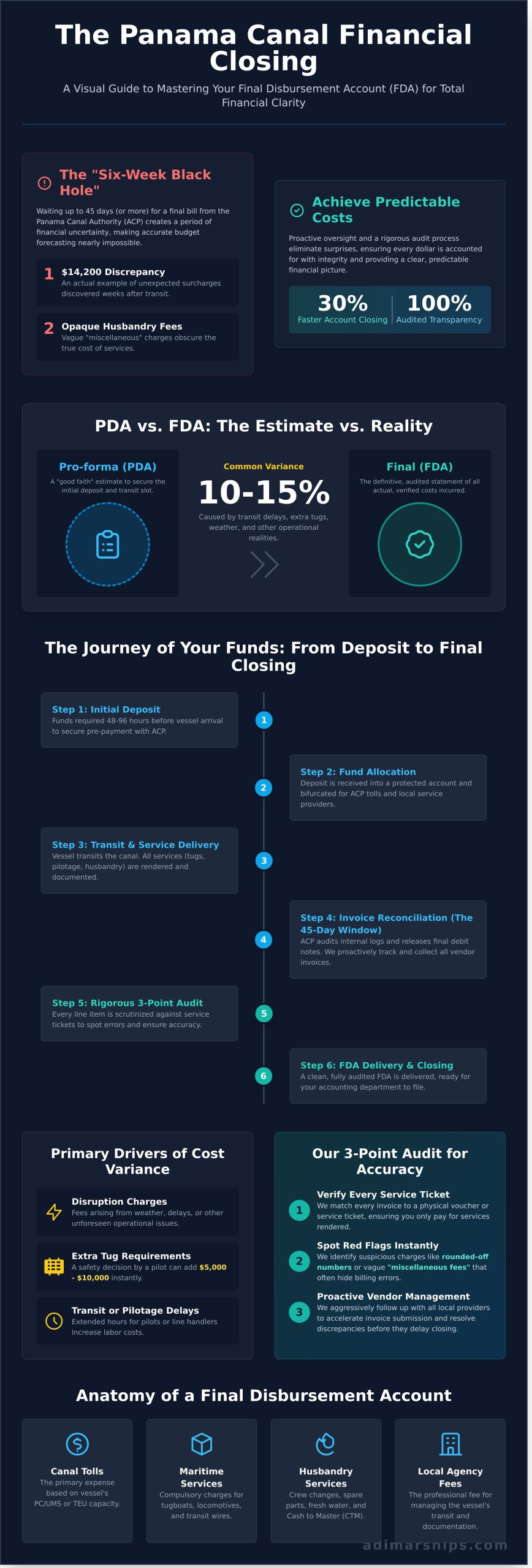
This guide helps you take control of the financial closing process so you can audit your final disbursement account panama with total confidence. We’ll show you how to reconcile pro-forma estimates against actual costs and identify the 15% of line items where most billing errors occur. By following these steps, you’ll achieve predictable costs and close your vessel accounts 30% faster than the industry average. We are your eyes at the Panama Canal, ensuring every dollar is accounted for with integrity.
Key Takeaways
- Understand the critical reconciliation process between your initial Pro-forma estimates and actual vessel costs to ensure total financial clarity.
- Learn to navigate Panama’s banking requirements and mandatory ACP advance payments to secure your transit slot without administrative delays.
- Identify the primary drivers of cost variance, such as disruption charges, to better manage and predict your final disbursement account panama.
- Master a professional 3-point audit strategy to verify service tickets and spot red flags like rounded-off numbers or vague “miscellaneous” fees.
- Discover how proactive local oversight can eliminate the “six-week black hole” of financial closing through aggressive vendor management and transparency.
What is a Final Disbursement Account (FDA) in Panama?
Completing a Panama Canal transit involves a complex web of financial transactions that don’t end when the ship reaches the opposite ocean. The final disbursement account panama is the definitive, audited statement of all costs a vessel incurs during its stay in Panamanian waters. It represents the “moment of truth” for ship owners and charterers. It’s not just a simple invoice; it’s a comprehensive reconciliation that closes the financial loop on a voyage. Without a finalized FDA, a vessel’s port call remains an open liability on the company’s books.
The FDA functions as a rigorous audit. It compares the initial estimates against actual, verified invoices issued by the Panama Canal Authority (ACP) and various local service providers. For a standard Neo-Panamax vessel, these costs can range from $150,000 to over $1,000,000, making precision non-negotiable. At Adimar, we see ourselves as your local office. We ensure every line item, from the smallest launch hire to the largest toll fee, is backed by a physical voucher and matches the agreed-upon rates.
Key components of a standard FDA include:
- Canal Tolls: The primary expense based on the vessel’s PC/UMS net tonnage or TEU capacity.
- Maritime Services: Compulsory charges for tugboats, locomotives, and transit wires.
- Husbandry Services: Costs for crew changes, spare parts delivery, and fresh water supply.
- Local Agency Fees: The professional fee for managing the vessel’s requirements and documentation.
The 6-Week Rule: Understanding the Panama Timing
You won’t receive a final bill the moment your ship exits the canal. The ACP typically takes up to 45 days to release the official debit notes for transit charges. This delay happens because the canal operates on a bank guarantee system. Agents must post a significant financial bond before the vessel arrives. The ACP then takes several weeks to audit their own internal logs for tug usage and pilotage hours before issuing the final charge. We track every pending invoice daily during this 45-day window. This proactive monitoring prevents “surprise” bills from appearing three or four months later, which can disrupt your year-end financial reporting.
PDA vs. FDA: Why Estimates and Reality Often Differ
The Pro-forma Disbursement Account (PDA) is a “good faith” estimate used to secure the initial deposit. However, reality at the canal is fluid. A 12-hour transit delay or an extra tug requirement due to weather can easily create a 10% to 15% variance between the estimate and the final disbursement account panama. If a pilot decides a vessel needs an additional escort tug for safety, that’s an immediate $5,000 to $10,000 difference. We also pay close attention to the Cash to Master (CTM) reconciliation. If the Captain receives $20,000 in cash for crew wages, that exact amount must be balanced against the delivery receipts and the original wire transfer to ensure the books are perfectly square.
Accuracy in the FDA is the only way to protect your bottom line. We use our 20 years of experience to scrutinize every ACP charge, often catching errors in tug time or line-handler counts that would otherwise cost our clients thousands of dollars. By the time you receive the FDA from Adimar, it’s a “clean” document, ready for your accounting department to file without further questions.
The Journey of Your Funds: From Deposit to Final Closing
Managing a final disbursement account panama requires absolute precision from the moment your wire transfer reaches our local accounts. In Panama, the US Dollar is the official currency for all maritime and commercial transactions. This eliminates the headache of currency fluctuations but demands strict adherence to local banking windows. Your funds follow a specific path: they are first received into a protected operations account before being bifurcated into payments for the Panama Canal Authority (ACP) and local service providers.
Timing is everything in the shipping industry. We typically require the initial deposit to be confirmed at least 48 to 96 hours before the vessel arrives at the Cristobal or Balboa pilot stations. This lead time is necessary because the Canal operates on a strict “pre-payment” basis. We act as your local office, ensuring that every cent is accounted for and that no vessel is held at anchor due to a simple administrative delay in the banking system.
ACP Financial Requirements and Bank Guarantees
The ACP mandates 100% advance payment of tolls and basic transit fees before a slot is finalized. They rely on the official maritime tariffs to calculate these costs based on the vessel’s PC/UMS net tonnage. Beyond the base toll, the Authority utilizes a “vessel’s guarantee” to cover variable expenses like extra tugboat assistance or line handlers. We maintain a clean financial standing with the ACP on your behalf, managing these deposits to prevent any operational holds.
Capturing Third-Party Vendor Invoices
Our team serves as your eyes at the Panama Canal, coordinating with dozens of local vendors including launch operators, provisioners, and waste disposal teams. Every service provided must be backed by a “service ticket” signed by the Master or a high-ranking officer. We verify these physical tickets against the final digital invoices to prevent “ghost charges.” We also ensure the 7% ITBMS (local sales tax) is correctly applied only to taxable services, keeping your final disbursement account panama compliant with local tax laws.
Once the vessel clears Panamanian waters and continues its voyage, the reconciliation phase begins. This is not an instantaneous process. The ACP typically takes 15 to 30 days to issue their final statement of costs. During this window, we perform a rigorous internal audit. We gather every receipt, from a $300 launch fee to a $6,000 sludge removal charge, and match them against the initial Proforma Disbursement Account (PDA).
If the final costs are lower than the initial deposit, we facilitate the immediate return of the surplus. In 2023, approximately 68% of our managed transits resulted in a refund to the ship owner. If unforeseen delays or additional tug requirements caused a deficit, we provide the documented proof required for a supplemental payment request. This transparent approach to financial management is why many owners nominate Adimar as their agent to handle their complex transit logistics. We eliminate the confusion by providing a clear, line-by-line breakdown of where every dollar went, ensuring your books are closed with total integrity.
Common Cost Drivers in a Panama Final Disbursement Account
While a Pro Forma Disbursement Account (PDA) provides a reliable roadmap, the reality of maritime operations often leads to variations in the final disbursement account panama. Understanding these cost drivers is essential for ship owners who want to avoid budget overruns. We see ourselves as your local office at the Panama Canal; our job is to ensure you aren’t surprised by the final bill. The difference between an estimate and the final invoice usually stems from operational realities that only surface once the vessel is in Panamanian waters.
Unexpected transit delays are the leading cause of variance, accounting for nearly 65% of all PDA to FDA discrepancies. If a vessel misses its scheduled arrival window, the ripple effect on the final disbursement account panama can be staggering. These delays trigger additional anchorage fees and can lead to the forfeiture of booking deposits. When a vessel arrives late, it loses its slot and must wait for a new opening, which increases the daily agency fees and operational overhead.
The “Disruption Charge” is another common line item that catches many operators off guard. The Panama Canal Authority (ACP) applies this fee when a vessel’s deficiency or a crew’s inability to meet maneuver requirements causes a delay in the canal’s flow. Depending on the vessel’s size and the severity of the delay, these charges can range from $5,000 to over $100,000 for Neo-Panamax ships. It’s a penalty designed to keep the canal moving efficiently, making it vital to have an agent who ensures your vessel is compliant before arrival.
Sanitary inspections and Port State Control (PSC) fees also fluctuate. While basic port dues are predictable, the costs for a Ministry of Health (MINSA) inspection can vary based on the time of day and the specific requirements of the vessel’s previous ports of call. Similarly, every vessel over 400 gross tons must have a PCSOPEP (Panama Canal Shipboard Oil Pollution Emergency Plan). The fee for the “Authorized Person” (AP) is a mandatory integration in the disbursement, ensuring a local representative is available 24/7 to coordinate with the ACP in case of an environmental incident.
ACP Surcharges and Ancillary Costs
Tugboat usage is a primary variable. The ACP determines the number of tugs required based on the vessel’s length, beam, and the prevailing weather. If wind speeds exceed 15 knots, the Canal may mandate additional tugs for safety. These rates are clearly defined in the Official Panama Canal Tariffs, yet they can fluctuate if the transit takes longer than anticipated. Locomotive wires also add up quickly. Each wire used to steady a vessel in the locks carries a specific fee, and larger vessels often require 8 or more wires per transit. Booking slot fees are fixed, but if you transit without a booking, you’ll pay a Variable Transit Fee based on current demand.
Husbandry and Crew-Related Expenses
Crew changes in Panama involve complex logistics. Beyond basic transportation, you’ll see charges for shore passes, which typically cost around $150 per person, and immigration visas. Launch hire for crew or “Cash to Master” (CTM) deliveries can range from $400 to $800 per trip depending on the anchorage location. It’s also vital to track the ITBMS. This 7% VAT applies to most non-exempt maritime services in Panama. While international freight is often exempt, local husbandry services like security, medical assistance, or land transportation are not. These taxes must be accurately reflected in your final disbursement to ensure full compliance with Panamanian law.
How to Audit Your Panama FDA for Accuracy and Transparency
Auditing a final disbursement account panama requires a sharp eye and a systematic approach. You shouldn’t simply look at the bottom line. Instead, perform a 3-point check. This involves aligning the initial Proforma Disbursement Account (PDA) with the physical service tickets and the final FDA. If your PDA estimated a transit cost of $145,000 and your final bill is $158,000, you need to identify the exact service ticket that justifies that $13,000 difference. It’s about closing the loop between what was promised, what was delivered, and what is being charged.
Watch for red flags that indicate a lack of transparency. Generic “miscellaneous” fees or perfectly rounded numbers like $1,000.00 are major warning signs. In the Panama maritime market, legitimate invoices from the Panama Canal Authority (ACP) or local vendors almost always include specific cents, such as $1,245.68. If you see flat fees without supporting documentation, the agency might be padding the bill. You should always request the original ACP “Statement of Charges” for every single transit. This official document is the only way to verify that the tolls and maritime services billed to you match what the Canal Authority actually collected.
We’ve seen how a second set of eyes changes the outcome. Hiring an Owner’s Protective Agent (OPA) provides a layer of security. An OPA doesn’t just process paperwork; they act as your “eyes at the Panama Canal” to challenge discrepancies in real-time. They can verify if a pilot stood by for 2 hours or 30 minutes before the agent even drafts the final account. This proactive oversight often saves owners between 3% and 5% on total port call costs by catching errors before they’re finalized.
Essential Documentation for Every Audit
Your audit is only as strong as your paper trail. You must secure the ACP official transit invoice, known locally as the “Debit Note,” which details every cent of the transit tolls. For husbandry services, ensure you have signed delivery receipts for bunkers, fresh water, and provisions. These must match the quantities listed on the final disbursement account panama. Finally, look for a detailed breakdown of agency attendance fees. Professional agents should separate communication costs from their standard service fee to ensure you aren’t paying for hidden overhead.
Spotting Discrepancies in Port and Canal Fees
Toll calculations rely on the “Vessel Transit Profile” stored in the ACP’s ADRES system. If your vessel’s dimensions or TTA (Total Tonnage Allowance) are recorded incorrectly by even 1%, it can lead to thousands of dollars in overcharges. Check your launch service logs carefully. Launch times are frequently billed in 1-hour increments, so a 10-minute delay in pickup shouldn’t result in an extra hour of billing. Service providers must provide timestamped tickets to prove exactly when a launch boat arrived and departed the vessel’s side. If you notice pilotage standby hours that don’t align with the Master’s log, dispute them immediately.
Don’t let hidden fees eat into your voyage profits. Nominate Adimar Shipping as your trusted partner to ensure every dollar of your disbursement account is accounted for with total integrity.
Adimar’s Commitment: Integrity in Financial Management
We believe that trust is the most valuable currency in the maritime industry. Our “Eyes at the Canal” philosophy isn’t just a catchy slogan. It’s a proactive operational standard that ensures total financial transparency for every vessel we represent. When you transit the Isthmus, you’re dealing with a high volume of third-party vendors, from tugboat operators to specialized technicians. Without a vigilant partner, these costs can spiral out of control. We act as your primary line of defense, scrutinizing every invoice to ensure it aligns with the services actually rendered on deck.
The “6-week black hole” is a common frustration for ship owners. This is the period after a transit where funds seem to vanish into a vacuum of pending paperwork and unverified claims. We’ve eliminated this uncertainty. Our team uses a proactive vendor management system that requires real-time reporting. By the time your vessel clears the breakwater at Colón or Balboa, we’ve already begun the reconciliation process. This speed doesn’t just provide clarity. It protects your cash flow by closing the final disbursement account panama significantly faster than the industry average.
ACP billing is notoriously complex. The Panama Canal Authority uses a sophisticated set of variables to calculate tolls and transit fees, which can lead to confusion for international accounting teams. We eliminate this headache with personalized service. We don’t use automated, one-size-fits-all templates. Instead, we manually review each charge against the current ACP tariff regulations. Most importantly, the Adimar Shipping, Inc. guarantee is simple: we never apply hidden markups on third-party services. If a vendor charges $1,500 for a repair, you pay $1,500. Our value is in our service, not in padding your bills.
Why Experience Matters in Disbursement Accounting
Adimar Shipping, Inc. leverages 20 years of local expertise to protect your bottom line. We know the nuances of Panamanian maritime law and ACP regulations better than anyone else. In October 2023, our accounting team identified a $5,240 billing error involving incorrect tugboat usage fees for a Panamax bulk carrier. Because we challenged the charge immediately with documented proof from the master, the client saved thousands. We also maintain deep relationships with local banks in Panama City. These connections allow us to expedite the return of surplus funds, often cutting weeks off the standard waiting period for wire transfers.
Your Local Office at the Panama Canal
We don’t just act as your agent; we serve as your local office on the ground. This means we verify every penny spent by visiting the vessel and speaking directly with service providers. Our reporting isn’t rigid. We customize our financial formats to match your specific corporate accounting needs, whether you require digital spreadsheets or integrated API data. This level of detail ensures your internal audits are seamless and stress-free. To experience this level of transparency, nominate Adimar Shipping, Inc. as your agent and secure financial peace of mind for your next transit. We take the confusion out of the final disbursement account panama so you can focus on your core business operations.
Master Your Canal Finances with Confidence
Managing a final disbursement account panama doesn’t have to be a source of stress for your operations. Successful transits rely on identifying hidden cost drivers early and maintaining a rigorous audit process to ensure every $1 spent aligns with actual services rendered. Transparency is the bedrock of a profitable maritime strategy.
Adimar Shipping brings over 20 years of proven integrity to the Panama Canal. As an authorized PCSOPEP representative, we’ve spent two decades refining our processes to protect your interests. Our dedicated local accounting team focuses on rapid FDA closing, ensuring you don’t wait months for financial resolution. We act as your eyes on the ground, catching billing discrepancies before they impact your budget. You can trust our experts to handle the complex paperwork so you can focus on your fleet’s next destination. Our team is ready to streamline your financial operations today.
Get a Transparent Quote for Your Next Panama Transit
We’re excited to help you achieve a seamless and cost-effective journey through the Isthmus.
Frequently Asked Questions
How long does it take to receive the Final Disbursement Account in Panama?
You can typically expect to receive your final disbursement account panama within 60 to 90 days after your vessel completes its transit. This duration is largely determined by the Panama Canal Authority (ACP) and their internal processing time for final utility and toll charges. Our team works to gather all local vendor invoices within the first 30 days to ensure there aren’t any unnecessary delays once the ACP data is released.
Why is the final bill often higher than the pro-forma estimate?
Final bills often exceed the pro-forma estimate because the initial quote assumes a standard transit without operational delays or extra requirements. If your vessel needs an additional tug at $5,000 per hour or incurs wait-time charges due to arrival delays, these costs are added to the final tally. We monitor these real-time changes during the transit so you aren’t surprised by the final figures when the account closes.
What is the ITBMS tax and does it apply to all shipping services?
The ITBMS is Panama’s 7% Value Added Tax that applies to most local goods and services. Under Law 8 of 2010, international maritime services like canal tolls and ocean freight are exempt from this tax. You’ll still see it applied to specific husbandry items such as crew shore transport, local repairs, or supplies purchased within Panamanian territory.
Can I transit the Panama Canal without a bank guarantee?
No, you can’t transit the canal without providing a bank guarantee or a cash deposit that covers 100% of the estimated tolls. The ACP requires these funds to be fully cleared in their account at least 48 hours before the vessel’s scheduled arrival. We manage these financial requirements as your agent to ensure your ship isn’t held at the entrance for payment issues.
What happens if there is a discrepancy in the ACP Statement of Charges?
If we find a discrepancy, we file a formal claim with the ACP within 30 days of the invoice date. We cross-reference the Statement of Charges with the vessel’s deck logs and pilot reports to verify tug usage and transit times. Our experience with the ACP’s billing department helps us resolve these errors quickly to secure credits or refunds for your account.
Does Adimar provide a breakdown of husbandry costs in the FDA?
We provide a detailed, line-by-line breakdown of every husbandry cost incurred during your vessel’s stay. Your final disbursement account panama will include original copies of all third-party receipts for services like waste removal, fresh water delivery, or medical assistance. This transparency ensures you have a clear audit trail for every dollar spent while your ship is under our care.
How are ‘Cash to Master’ funds handled in the final accounting?
Cash to Master (CTM) requests are treated as a direct debit from your initial pre-funding deposit. Once we deliver the physical currency to the captain, we obtain a signed and stamped receipt for the exact amount. We include a digital copy of this receipt in your preliminary reports and the original document in the final accounting package to confirm the delivery.
Is it possible to receive an FDA in less than six weeks?
Receiving an FDA in under 42 days is rare for canal transits because the ACP’s billing cycle is standardized across all agents. For husbandry-only calls or bunkering stops that don’t involve a canal transit, we often finalize accounts within 15 to 20 days. We prioritize prompt settlements with local vendors to get the final paperwork to your accounting department as fast as the system allows.