


On January 15, 2024, a bulk carrier operator discovered that misinterpreting a single paragraph in an ACP Advisory resulted in a $45,000 daily loss while waiting for a rescheduled slot. It’s a high-stakes scenario that proves why a professional panama canal transit advisory service is your most valuable asset on the bridge. You’re likely already frustrated by the dense technical jargon and the constant fear that a sudden draft restriction update will throw your entire 2026 schedule into chaos. We are experts so you don’t have to be.
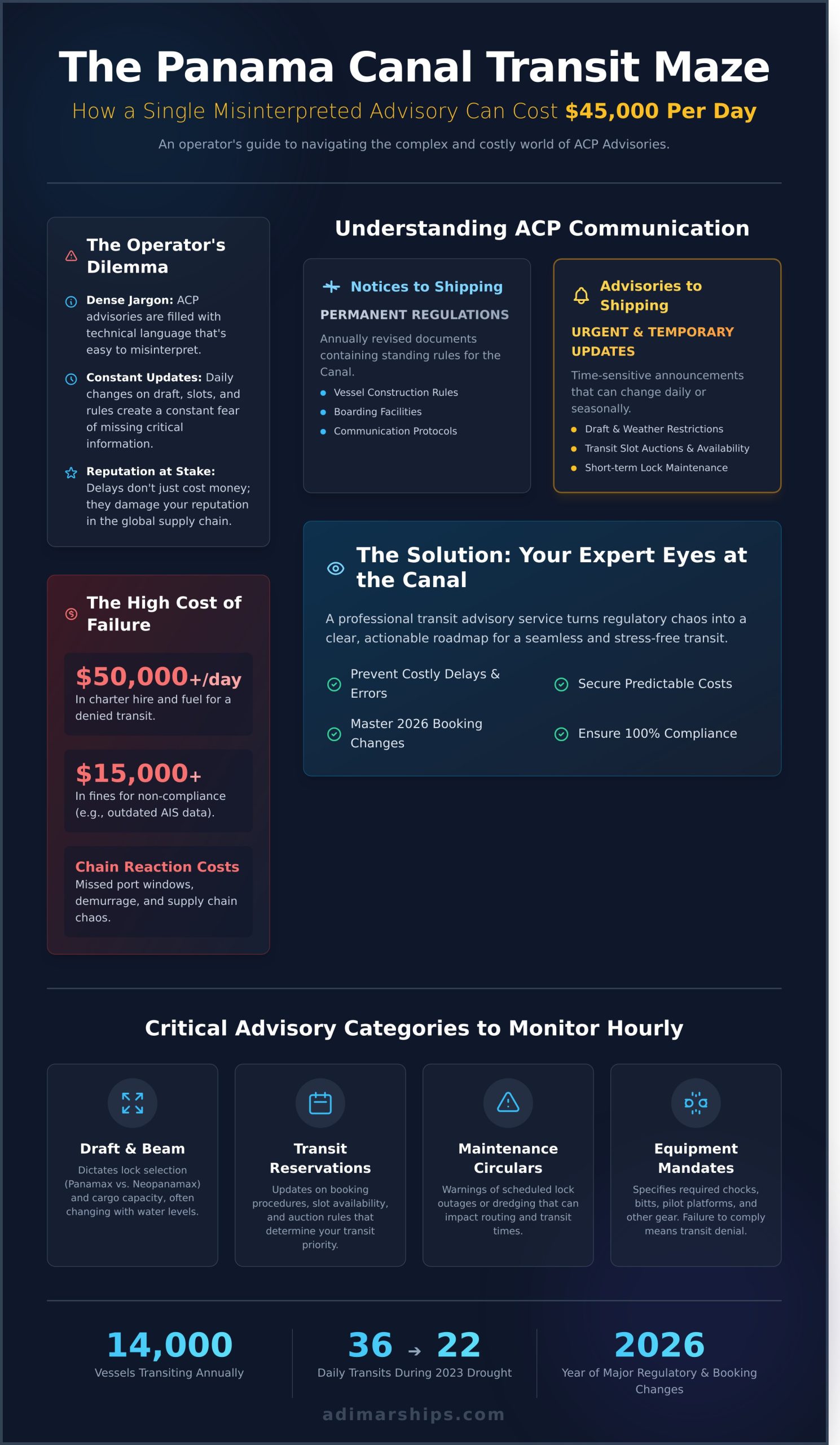
We understand that in the shipping industry, time isn’t just money; it’s your reputation. Our team acts as your eyes at the Panama Canal, translating complex regulations into clear, actionable steps that save your vessel time and stress. You’ll master the complexities of the 2026 booking changes and learn how to secure predictable costs while avoiding every compliance fine. We will examine the specific ACP adjustments coming your way and provide a roadmap for zero-stress transits.
Key Takeaways
- Understand the critical role of ACP Advisories to Shipping in ensuring the permanent neutrality and safe operation of your vessel through the Panama Canal.
- Learn how a specialized panama canal transit advisory service interprets complex draft and beam restrictions to prevent costly transit delays and booking errors.
- Discover how to calculate the real-world impact of missed port windows on your fuel consumption and demurrage costs in the “Time is Money” maritime corridor.
- Master a practical framework for filtering daily ACP notices and verifying vessel equipment against the newest 2026 regulatory mandates.
- Find out how leveraging local “eyes and ears” at the Canal can eliminate confusion and turn raw regulatory data into a seamless, stress-free transit.
What is a Panama Canal Transit Advisory and Why Does It Matter?
The Autoridad del Canal de Panamá (ACP) communicates through a specialized system known as Advisories to Shipping. These documents serve as the primary regulatory channel for every vessel intending to cross the isthmus. They aren’t merely suggestions or newsletters; they are official mandates that carry the force of law within the Canal Zone. Engaging a professional panama canal transit advisory service ensures you never miss a critical update that could halt your voyage. These advisories provide the real-time data needed to manage the complex logistics of the Panama Canal, ensuring that the waterway remains safe and efficient for the 13,000 to 14,000 vessels that transit annually.
Advisories are essential for maintaining the Permanent Neutrality and Operation of the Canal. This international treaty obligation requires the ACP to provide fair and non-discriminatory access to all nations. To uphold this, the ACP uses advisories to announce changes in draft limits, tugboat requirements, and transit slot availability. For example, during the severe drought of late 2023, the ACP issued daily advisories to reduce daily transits from 36 to 22. Without these constant updates, the maritime industry would face total chaos at the locks. The advisory system keeps the global supply chain moving by providing a transparent framework for all operators.
These documents dictate every financial and technical aspect of a transit. They outline toll rate adjustments, such as the 2024 modifications to the Fresh Water Surcharge, and specify mandatory equipment upgrades. If the ACP determines that a specific type of pilot ladder or mooring chock is no longer safe, they release an advisory. Shipowners then have a strict timeline to comply. Understanding the distinction between different ACP publications is vital for compliance:
- Notices to Shipping: These are permanent regulations revised annually. They contain standing rules on vessel construction, boarding facilities, and communication protocols.
- Advisories to Shipping: These are temporary or urgent updates. They cover seasonal draft restrictions, auction dates for transit slots, and short-term maintenance schedules for the locks.
The Authority Behind the Advisory: Understanding the ACP
The ACP is the autonomous legal entity of the Republic of Panama in charge of the waterway. Their role is to manage maritime traffic while protecting the watershed. As we approach 2026, regulations are becoming more dynamic than in previous decades. This shift is due to the $2 billion water management system projects and the integration of new Neo-Panamax lock technologies. For a ship master, an advisory is a legal order. Ignoring a mandate regarding the Panama Canal Shipboard Oil Pollution Emergency Plan (PCSOPEP) can lead to immediate detention by canal authorities.
The High Stakes of Canal Communication
The cost of a communication breakdown is staggering. A single missed advisory regarding bow thruster requirements or visibility standards can lead to a transit denial. This forces a vessel to wait in the anchorage, costing the owner upwards of $50,000 per day in charter hire and fuel. In 2023, several vessels faced fines exceeding $15,000 for failing to update their AIS data as mandated by recent advisories. Our panama canal transit advisory service monitors these changes hourly to protect your bottom line. The ACP Advisory system is the heartbeat of canal logistics.
Critical Types of Advisories and Their Impact on Your Voyage
Misjudge your timing and you lose. It’s a harsh reality for ship owners who ignore the daily flow of operational updates. A professional panama canal transit advisory service provides more than just data; it offers a strategic roadmap through the shifting regulations of the Panama Canal Authority (ACP). Missing a single update on equipment mandates or draft restrictions can result in $50,000 or more in daily standing charges or missed delivery windows.
Advisories generally fall into four high-impact categories. First, draft and beam restrictions dictate whether your vessel can utilize the Neopanamax locks, which accommodate beams up to 160 feet, or the smaller Panamax locks. Second, transit reservation system updates change how slots are booked. Third, maintenance circulars warn of scheduled lock outages or dredging in the Culebra Cut. Finally, equipment mandates specify the required number of chocks and bitts or the exact configuration of pilot platforms. We are your eyes at the Panama Canal, ensuring your vessel meets these technical requirements before it arrives at the breakwater.
- Draft Limits: Fluctuations are based on the Gatun Lake level; even a six-inch change impacts cargo volume.
- Equipment Compliance: The ACP frequently updates requirements for boarding facilities; non-compliance leads to immediate transit denial.
- Maintenance Windows: Scheduled outages can reduce daily transit capacity from 36 vessels to 24 or fewer.
Water Level Advisories: The Gatun Lake Factor
Gatun Lake is the lifeblood of the canal. As we look toward 2026, the ACP is implementing more aggressive water management protocols to stabilize the maximum allowable draft at 50 feet. However, seasonal rainfall patterns remain the primary driver of capacity. During the dry season, which typically runs from January to May, the ACP may reduce the number of daily transit slots to conserve water. Deep-draft vessels must plan their voyages months in advance. We help you interpret these seasonal trends so you don’t find your vessel “light-loaded” or stuck at anchor waiting for a draft increase that isn’t coming. If you’re planning a voyage for the next quarter, you can request a personalized transit assessment to see how current lake levels affect your cargo capacity.
The Transit Reservation Auction System
When standard booking periods are full, the “Slot Auction” becomes your only path forward. These auctions are highly competitive and rely on daily notices released by the ACP, often at 09:00 local time. Interpreting these advisories requires quick action; they signal the availability of slots that opened due to cancellations or increased operational efficiency. Interpreting these notices is a core function of our panama canal transit advisory service, ensuring you don’t overpay for a slot. We act on your behalf to analyze these daily notices and execute bids based on real-time market data. A well-timed bid can save a vessel seven days of waiting time. Our role as your agent is to provide the transparency you need to decide if the auction cost outweighs the expense of a delayed arrival. We manage the numbers so you can focus on your business.
The Commercial Impact: Why Timing and Coordination are Critical
Misjudge your timing and you lose. In the high-stakes environment of the Panama Canal, the “Time is Money” philosophy isn’t just a cliché; it’s a daily reality for every ship owner and charterer. A professional panama canal transit advisory service bridges the gap between raw data and actionable intelligence. When a vessel sits idle in the Pacific or Atlantic anchorage, the meter is running. These costs aren’t just numbers on a spreadsheet. They represent lost opportunities and eroded margins that can’t be recovered through standard operations.
Coordination errors are often the result of misinterpreting complex scheduling notices. While the data might be public, the strategy for navigating it isn’t. Professional advisors look beyond the immediate schedule to identify potential bottlenecks before they manifest as costly delays. This foresight allows for precision in arrival times, ensuring that your vessel isn’t burning fuel unnecessarily or missing its slot due to a simple administrative oversight.
Demurrage and the Price of Mismanagement
The financial penalties for poor coordination are steep. For a Neo-Panamax vessel, daily hire rates in the current market can range from $65,000 to $100,000. A 24-hour delay doesn’t just cost the daily rate; it triggers a domino effect of missed port windows and disrupted supply chains. Our team uses early advisory detection to help captains implement “slow steaming” strategies. By adjusting speed just 36 hours before arrival, a vessel can save upwards of $8,500 in fuel costs while still meeting its revised transit window. We’ve seen proactive management save clients over $25,000 per transit compared to reactive, last-minute adjustments.
Staying ahead of the curve is vital because regulations change frequently. For instance, staying informed about the new requirements for Panama Canal transit ensures your vessel isn’t rejected at the last moment due to non-compliant boarding facilities or specific equipment updates. Professional interpretation prevents these frustrating errors that often stem from a “DIY” approach to maritime logistics.
Protecting the Owners and Charterers Interests
Effective management requires a partner on the ground. When you choose an Owners Nominated Agency like Adimar, you’re hiring a local office that understands the nuances of ACP tariffs. We don’t just accept fee calculations at face value. We verify every charge against the latest 2024 tariff schedules to ensure you aren’t overpaying. Our role is to provide total transparency, acting as your eyes and ears at the canal to challenge any unfair delay assessments or administrative discrepancies that might arise during the process.
Many operators believe that monitoring the ACP website is enough. It’s a common misconception. While the website provides the “what,” it rarely explains the “why” or the “what next.” A panama canal transit advisory service interprets the subtext of official notices. We look at historical congestion patterns, current water levels, and tugboat availability to give you a realistic picture. Reading a website won’t tell you how a sudden weather shift in the Gatun Lake will impact the queue for the next 72 hours. We provide that expertise so you don’t have to be the expert yourself. Our goal is to eliminate confusion and replace it with a clear, cost-effective path through the waterway.
A Practical Framework for Navigating ACP Regulations
Managing a vessel’s passage through the Isthmus requires more than reading an occasional email. A professional panama canal transit advisory service acts as a filter for the constant stream of data flowing from the Panama Canal Authority (ACP). In 2023 alone, the ACP issued over 40 Advisories to Shipping. Most of these don’t apply to every hull. We help you ignore the noise and focus on the 5% of updates that impact your specific draft, beam, or cargo type. This precision prevents your team from becoming overwhelmed by irrelevant data.
Pre-arrival verification starts 96 hours before your ship hits the breakwater. You must check equipment against the latest mandates, such as the revised mooring requirements for Neopanamax locks found in the Op’s Notice N-1-2024. Choosing a booking slot isn’t just about price; it’s about timing. During the 2024 water conservation measures, transit slots were reduced by nearly 40% at certain points. A smart strategy analyzes Gatun Lake levels, which ideally sit near 85 feet, to decide if a 1st period booking is safer than a 3rd period gamble. We look at these variables daily so you don’t have to.
Conditions change fast on the water. Sudden fog in the Culebra Cut or unscheduled maintenance at the Miraflores Locks can delay a transit by 12 hours or more. We provide real-time adjustments, communicating directly with the ACP to secure your position or adjust your approach speed to save fuel. This level of panama canal transit advisory service ensures that your vessel remains a priority in the queue, even when the unexpected happens.
The Pre-Transit Checklist for 2026
By 2026, compliance will focus heavily on environmental and safety updates. Ensure your PCSOPEP (Panama Canal Shipboard Oil Pollution Emergency Plan) authorized person is verified and active. Pilot ladders must meet the latest safety advisories, specifically ISO 799-1:2019 standards, to avoid costly rejections. We also verify that cargo declarations align with the newest 2025 emissions standards. Missing one document can lead to fines exceeding $5,000 or a total loss of your transit slot.
Leveraging Local Expertise for Smooth Passage
Being on the ground in Panama City gives us a tactical advantage. Digital alerts tell you there’s a delay; our team tells you why and how long it will actually last. We combine these digital insights with physical husbandry services to handle crew changes or spare parts delivery during the transit window. You can use our vessel agency services to automate these compliance steps. We see ourselves as your local office, ensuring your interests are protected 24/7. Our presence eliminates the confusion that often comes with remote management.
Don’t leave your transit to chance in an evolving regulatory environment. Contact Adimar Shipping for a personalized transit quote and let our experts handle the details.
Adimar Shipping: Your Expert Eyes and Ears at the Canal
Misjudge your timing at the Panama Canal and you lose. In an industry where daily charter rates for a Neo-Panamax vessel can exceed $100,000, every hour spent idling in the bay is a direct hit to your bottom line. Since our founding in 2003, Adimar Shipping, Inc. has acted as the local office for global maritime leaders, providing a panama canal transit advisory service that replaces uncertainty with precision. We don’t just relay information. We translate raw Panama Canal Authority (ACP) data into successful transits.
Our team brings over 20 years of experience to the table. We’ve seen every change in regulation, every fluctuation in Gatun Lake water levels, and every shift in the booking system. This deep historical knowledge allows us to anticipate bottlenecks before they happen. We operate with a commitment to integrity and quality that ensures your interests are always the priority. You get transparent reporting and timely communication every single time. There aren’t hidden fees or unexpected delays because we’ve already accounted for the variables.
The “Adimar Shipping, Inc. Advantage” is simple: we are experts so you don’t have to be. Managing a transit involves a mountain of paperwork, strict environmental compliance like PCSOPEP, and constant coordination with tugs and pilots. We eliminate this confusion through personalized, 24/7 advisory monitoring. While your crew focuses on safe navigation, we handle the logistics. We serve as your vigilant eyes and ears on the ground, ensuring your vessel moves through the locks without a hitch.
Personalized Service for Global Maritime Leaders
We recognize that a container ship has different needs than a bulk carrier or a luxury tanker. That’s why we tailor our advisory reporting to your fleet’s specific requirements. As your protective agent, we oversee the smallest details of the transit process. This includes verifying port costs in USD and ensuring all husbandry services are executed efficiently. In one case from early 2024, we helped a client avoid a $15,000 rescheduling fee by identifying a documentation error 12 hours before their scheduled slot. Our proactive problem-solving keeps your business moving forward while we handle the friction of the Canal.
Start Your Seamless Transit Today
Efficiency at the Panama Canal doesn’t happen by accident. It requires a partner who understands the local landscape and maintains a strong relationship with the ACP. You can nominate Adimar Shipping, Inc. as your trusted partner by contacting our operations team directly. We provide comprehensive quotes that cover transit agency fees and our specialized panama canal transit advisory service with total transparency. Don’t leave your schedule to chance. Reach out to our team to Get a Quote and Put Your Transit in Our Hands. We are ready to secure your slot and protect your interests 24 hours a day, 365 days a year.
Secure Your 2026 Transit Strategy Today
Navigating the evolving 2026 ACP landscape requires more than just reactive planning. Every hour lost at the locks translates to significant operational costs that can exceed $50,000 per day for certain vessel classes. By integrating a dedicated panama canal transit advisory service into your voyage planning, you gain the foresight needed to manage fluctuating slot availability and water level restrictions. We’ve seen how miscalculating a single advisory notice can derail a tight schedule and impact your entire supply chain.
Adimar Shipping brings over 20 years of local expertise directly to your fleet operations. As an authorized PCSOPEP representative, we don’t just relay information; we interpret it to protect your bottom line. We have a proven record of reducing transit delays by providing the real-time data you need to make informed decisions. We’re your eyes at the Panama Canal so you don’t have to worry about the fine print of changing regulations.
Nominate Adimar as your Panama Canal Ship Agent to ensure your vessels move with precision and integrity. Let’s make your next transit your most efficient one yet.
Frequently Asked Questions
What is the difference between an ACP Advisory and a Notice to Shipping?
An ACP Advisory provides temporary updates regarding immediate operational changes like draft limits or booking slot availability. A Notice to Shipping (NTS) contains permanent regulations and long-term technical requirements for all vessels. We monitor both daily because a single overlooked detail in an NTS can delay your transit by 48 hours or more.
How often does the Panama Canal Authority issue new transit advisories?
The Panama Canal Authority typically issues new advisories 1 to 2 times per week under normal conditions. During periods of water scarcity or heavy maintenance, this frequency increases to every 2 or 3 days. We act as your eyes at the canal to catch these updates the moment they’re released so your voyage plan stays accurate.
Can I book a Panama Canal transit slot without a local ship agent?
No, Panama Canal regulations require every vessel to have a licensed local representative to handle all official bookings and payments. Article 10 of the Maritime Regulations mandates this local presence for legal and operational accountability. Adimar Shipping handles these 24/7 bookings to ensure you don’t lose your spot in the queue due to administrative errors.
What are the current draft restrictions for Neopanamax vessels in 2026?
Projected maximum drafts for Neopanamax vessels in 2026 sit at 50.0 feet (15.24 meters) during the peak rainy season. If Gatun Lake levels drop below 82 feet, the ACP may reduce this limit to 44.0 feet. Our team tracks these levels hourly because a 1 foot difference in draft can mean 2,000 tons of cargo must be offloaded.
How do advisories affect the cost of a Panama Canal transit?
Advisories directly impact costs by changing the number of available booking slots, which can trigger expensive auctions. When a panama canal transit advisory service identifies a reduction in daily transits from 36 to 24, auction prices often spike from $50,000 to over $1,000,000. We help you navigate these fluctuations to keep your transit cost-conscious and efficient.
What happens if my vessel does not comply with a newly issued advisory?
Non-compliance usually results in an immediate $5,000 fine and the loss of your scheduled transit window. Your vessel will be moved to the end of the queue, which can lead to a 5 to 10 day wait at the anchorage. We eliminate this confusion by verifying your vessel’s specifications against every new rule before you arrive at the breakwater.
How does Adimar Shipping monitor advisories for its clients?
We use a 24-hour monitoring system that alerts our team within 15 minutes of any official ACP communication. Once an advisory is issued, we send a personalized summary to your operations desk within 30 minutes. This speed allows you to adjust cargo loads or reroute vessels before it’s too late to change course.
Is the PCSOPEP requirement covered under the standard advisory service?
The Panama Canal Shipboard Oil Pollution Emergency Plan (PCSOPEP) is a separate regulatory filing, but our panama canal transit advisory service ensures it is fully verified 96 hours before arrival. Vessels over 400 gross tons must have an approved plan and a designated response coordinator on the ground. We manage these filings to ensure your vessel meets the 100% compliance mark every time.