

What if a single clerical error in your Panama Canal Ship Oil Pollution Emergency Plan costs your company $15,000 in fines before your vessel even reaches the Miraflores Locks? You likely feel the pressure of the Panama Canal Authority’s strict regulations, especially when that 96-hour notification deadline is ticking down. It’s frustrating to manage complex Tier classifications while trying to keep your schedule on track. We understand that in this industry, time is money and uncertainty is a liability.
You deserve a transit that’s efficient and free of legal hurdles. This 2026 compliance guide will help you master the mandatory PCSOPEP requirements, avoid costly penalties, and explain why a local Authorized Person is your most critical asset for a successful voyage. We’ll walk you through the specific Tier 1 and Tier 2 criteria and provide a clear roadmap for your next canal entry. We’re your eyes at the Panama Canal, and we’ll make sure you’re prepared for every regulation so you can focus on your business.
Key Takeaways
- Understand the mandatory ACP requirements for vessels with over 400 MT oil capacity to ensure your transit remains compliant with Chapter IX maritime regulations.
- Learn why your international MARPOL SOPEP is insufficient for transit and how to identify the specific “Panama-only” elements required for your vessel’s Tier classification.
- Master the submission process for your Panama Canal Ship Oil Pollution Emergency Plan, including how to meet the critical 96-hour pre-arrival notification deadline to avoid costly delays and fines.
- Discover why a local Authorized Person (AP) is your most critical asset for 24/7 coordination and how their local expertise protects your interests and financial guarantees.
What is the Panama Canal Ship Oil Pollution Emergency Plan (PCSOPEP)?
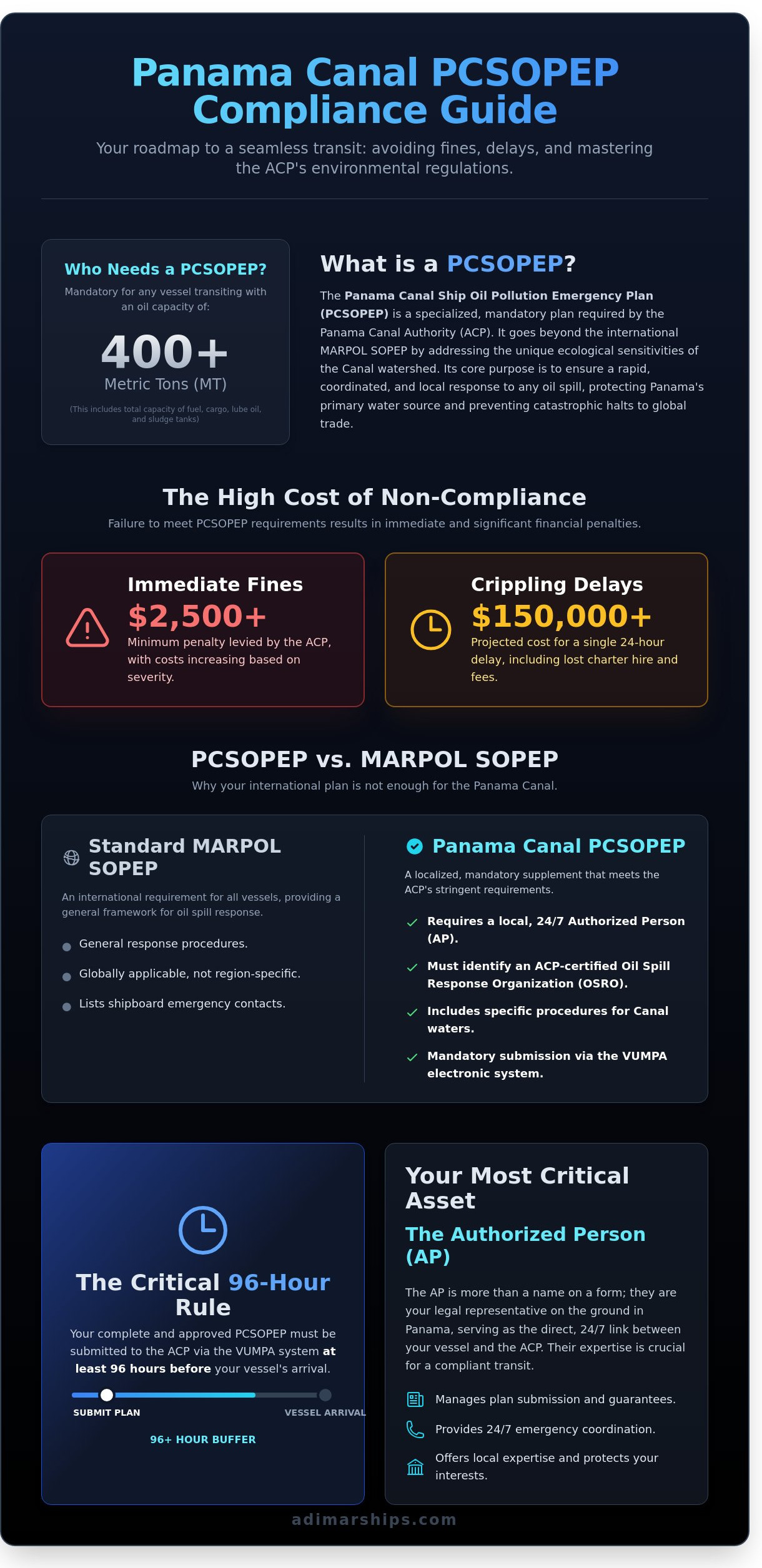
The Panama Canal Ship Oil Pollution Emergency Plan (PCSOPEP) is a mandatory environmental safeguard for any vessel transiting the waterway with an oil carrying capacity of 400 metric tons (MT) or more. This threshold includes both fuel and cargo. While global maritime law requires a standard Ship Oil Pollution Emergency Plan (SOPEP), the Panama Canal Authority (ACP) mandates this localized version to address the unique ecological sensitivities of the Isthmus. We’ve been your eyes at the Panama Canal for 20 years, and we’ve seen how the ACP prioritizes this plan to protect the Gatun Lake watershed, which serves as the primary water source for over 50% of Panama’s population.
The legal framework for this requirement is found in Chapter IX of the Maritime Regulations for the Operation of the Panama Canal. It’s not enough to have a general international plan. The ACP requires a Panama Canal Ship Oil Pollution Emergency Plan that specifically identifies a local Authorized Person (AP) and a certified Oil Spill Response Organization (OSRO). The core objective is to ensure a rapid local response to oil pollution incidents within Canal waters. Because the Canal is a confined space, an oil spill could halt global trade for days if not managed within the first few hours. We’re experts so you don’t have to be, and we ensure your plan meets every specific local criterion.
The Consequences of Non-Compliance
Arriving at the Panama Canal without a valid, ACP-approved plan or a designated Authorized Person leads to immediate complications. The ACP can levy fines starting at $2,500, but these costs often climb significantly depending on the severity of the oversight and the vessel’s history. Beyond the initial fine, your vessel will be barred from transit until compliance is met. This means dropping anchor and waiting while your competitors move ahead. In the maritime world, time is money, and misjudging your timing can be a very expensive mistake.
Operational delays are the most damaging part of non-compliance. If your plan isn’t approved, your vessel loses its scheduled transit slot, which often leads to a backlog of several days. For a standard vessel, the financial impact of a 24-hour delay in 2026 is projected to exceed $150,000 when accounting for lost charter hire and rescheduling fees. These costs don’t include the reputational damage with charterers or the potential for increased port fees while waiting for clearance at the Atlantic or Pacific entrances.
The Evolution of Panama Pollution Regulations
The ACP implemented these specific rules decades ago to transition from a reactive to a proactive environmental stance. Since the original regulations were established, the framework has evolved to meet modern environmental threats and the increased size of vessels transiting the Neo-Panamax locks. The Panama Canal Authority acts as both the regulator and the enforcer, and they don’t just check paperwork; they verify that the personnel and resources listed in your Panama Canal Ship Oil Pollution Emergency Plan are reachable and ready to act at a moment’s notice.
Key updates heading into 2026 focus on digital compliance and the verification of response times. The ACP now requires that every plan is submitted through their VUMPA (Single Window for Maritime Electronic Arrival) system at least 96 hours before arrival. They’ve also increased the frequency of unannounced drills to ensure that the Authorized Persons listed in the plans are reachable 24/7. We pride ourselves on being a partner with integrity, so we make sure our clients are prepared for these audits long before they reach the breakwater. Our role is to eliminate the confusion with personalized service, ensuring your transit remains on schedule and fully compliant.
Understanding PCSOPEP Tiers and Vessel Classifications
The Autoridad del Canal de Panamá (ACP) enforces a strict tiered system to manage environmental risks during every transit. Your vessel’s classification isn’t just a label; it dictates exactly how much you’ll pay in fees and which response resources you must have ready. This system ensures that if a spill occurs, the response is proportional to the potential impact. Miscalculating your tier can lead to significant financial penalties or even a denial of transit, which is why precision is vital from the moment you submit your initial documentation.
Accurate calculation of your vessel’s oil carrying capacity is the first step in creating a valid Panama Canal Ship Oil Pollution Emergency Plan. You must include the maximum capacity of all fuel tanks, lube oil tanks, sludge tanks, and any oil cargo tanks. It’s the total volume, not the current amount on board, that matters. This requirement aligns with broader U.S. Federal Regulations for the Panama Canal which set the standard for vessel response plan readiness. Failure to account for even a small sludge tank can push a vessel into a higher tier, causing unexpected costs at the last minute.
Tier S and Tier 1: Small to Medium Vessels
Tier S applies to vessels with a carrying capacity between 400 MT and 1,000 MT. These are often smaller coastal traders or specialized craft. If your vessel falls into Tier 1, your capacity is between 1,000 MT and 7,000 MT. While these tiers have lower participation fees, you still need full documentation, including a valid International Oil Pollution Prevention (IOPP) certificate and a designated shore-based coordinator. Missing a single document can delay your transit by 24 hours or more, costing you thousands in idle time. Since the 2016 Canal expansion, the ACP has increased its scrutiny of these smaller vessels to ensure they meet modern safety standards.
Tier 2 and Tier 3: Large Scale Compliance
Vessels in Tier 2 (7,000 MT to 15,000 MT) and Tier 3 (exceeding 15,000 MT) face the most rigorous standards. Nearly 100% of tankers and Neopanamax container ships fall into these categories. Tier 3 vessels must demonstrate immediate access to massive response resources as part of their Panama Canal Ship Oil Pollution Emergency Plan requirements. This often involves contracts with certified Oil Spill Response Organizations (OSROs) in Panama. These larger vessels pay higher participation fees to the ACP to maintain high-readiness equipment like boom barges and skimmers. The complexity increases here because you must prove your vessel can coordinate with local authorities within a two-hour window of an incident.
Our team acts as your local office at the Panama Canal, helping you navigate these specific tiers so you don’t overpay or fail an inspection. We’ve spent 20 years managing these technical details for owners and charterers. If you’re unsure where your fleet stands, you can consult with our specialized agents to verify your classification before arriving at the Cristobal or Balboa anchorages. We provide the clarity you need to keep your transit on schedule and within budget.
PCSOPEP vs. MARPOL SOPEP: Why Your Global Plan Isn’t Enough
Many operators assume their vessel is ready for transit because they carry a MARPOL-compliant SOPEP. This is a costly mistake that often leads to delays at the de Lesseps building. While the International Maritime Organization (IMO) sets the global baseline for pollution prevention, the Panama Canal Authority (ACP) operates under a different set of local mandates. The ACP treats the canal as a freshwater resource, not just a waterway. Because the canal provides drinking water to approximately 2 million Panamanian residents, the Panama Canal Ship Oil Pollution Emergency Plan requires specific local safeguards that international standards simply don’t address.
The primary difference lies in the scope of authority. A standard SOPEP focus is onboard response and general reporting to coastal states. In contrast, the PCSOPEP is a tactical document that integrates your vessel into the Panamanian National Contingency Plan. If you arrive at the Pacific or Atlantic breakwaters without an ACP-approved plan, your vessel won’t receive a transit schedule. This isn’t just a paperwork exercise; it’s a legal requirement under the Maritime Regulations for the Operation of the Panama Canal, specifically Chapter IX.
Localized Response vs. Global Strategy
Global plans are designed for the high seas, but the Panama Canal requires immediate, shore-based action. Your Panama Canal Ship Oil Pollution Emergency Plan must include a signed contract with a local Oil Spill Response Organization (OSRO). These entities, such as Ocean Pollution Control (OPC), maintain specialized equipment at both ends of the canal. Unlike MARPOL, which allows for general “best efforts” in response, the ACP mandates that your plan coordinates specifically with these local teams. Spanish-language communication is the standard for emergency services in Panama. A global plan written only in English can create a dangerous lag during the first 60 minutes of an incident.
Mandatory Plan Components for Panama
The ACP requires several unique elements that you won’t find in a standard IMO template. These components ensure that the vessel is ready to act within the specific geography of the Isthmus. Key requirements include:
- The Authorized Person (AP): This is the most critical difference. Every vessel must designate an AP who resides in Panama. This individual acts as the 24/7 liaison between the ship and the ACP. They have the legal and financial authority to commit up to $1 million in immediate cleanup funds without waiting for head office approval.
- ACP Signal Station Protocols: Your plan must list specific communication channels for the Flamenco and Cristobal signal stations. Standard GMDSS procedures are not enough; you must follow the ACP’s “Vessel Traffic Service” (VTS) requirements.
- Tiered Response Levels: Panama uses a three-tier system based on the volume of the spill. Your plan must detail exactly how the crew will transition control to local authorities once a spill exceeds Tier 1 (vessel only) capabilities.
Adimar Shipping views the PCSOPEP as your vessel’s “local passport.” We ensure your plan is not only compliant but active. Since the ACP updated its electronic data collection system in 2022, plan validity is checked digitally 96 hours before arrival. If your local agent hasn’t verified the “Statement of Compliance” in the ACP’s VUMPA system, your transit will be suspended. We are your eyes at the Panama Canal, ensuring these technical details don’t turn into expensive operational hurdles. We are experts so you don’t have to be, protecting your schedule and your reputation.
Compliance Checklist: The 96-Hour Rule and Submission Process
The Panama Canal Authority (ACP) enforces a strict 96-hour notification rule for all vessels over 400 gross tons. This isn’t a suggestion. It’s a hard requirement. You must submit your Panama Canal Ship Oil Pollution Emergency Plan through the VUMPA (Ventanilla Única Marítima de Panamá) system at least four days before your arrival at Canal waters. If you’re coming from a nearby port where the voyage is less than 96 hours, you must submit the plan before leaving that last port of call. Misjudging this timing results in immediate delays. We’ve seen vessels held at anchor for 24 to 48 hours simply because their documentation wasn’t logged in time.
Submitting the plan involves more than just uploading a file. You need to ensure your Authorized Person (AP) and Oil Spill Removal Organization (OSRO) contracts are active. The ACP maintains an updated list of approved providers. If your chosen OSRO isn’t on that list, the system will flag your application. Most rejections happen because of clerical errors. A common mistake is a mismatch between the vessel’s name on the International Oil Pollution Prevention (IOPP) certificate and the name on the PCSOPEP submission. Even a minor typo can trigger a “Plan Deficient” status in the ACP database.
Documentation Required for Submission
To secure approval, your digital package must include Form 4398 and specific technical drawings. You’ll need the General Arrangement Plan, Tank Capacity Plan, and Midship Section Plan. The ACP requires these to be high-resolution. For the upcoming 2026 cycle, the ACP is transitioning to a mandatory ISO-standardized PDF/A format for all digital submissions to ensure long-term data integrity. You must also provide a valid contract with an Authorized Person who resides in Panama. This person acts as your legal liaison during an incident. Without this local connection, your Panama Canal Ship Oil Pollution Emergency Plan is legally void.
Timeline for Approval and Renewals
The ACP typically requires 30 days to review and approve a brand-new plan. Don’t wait until the week of your transit to start this. Once approved, the plan is valid for four years, but you must complete an annual confirmation. This yearly check ensures your OSRO and AP contacts haven’t changed. We recommend tracking your expiration dates 90 days in advance. Missing a renewal deadline can lead to hefty penalties. You can learn more about Avoiding Common Compliance Fines in Panama to keep your operational costs down.
Verifying your status is easy through the ACP’s Vessel Status Query tool. Your agent should check this 48 hours before arrival. If the status shows “Not Ready,” you still have a small window to fix errors before the 24-hour pre-transit cutoff. We are your eyes at the Panama Canal, and we make sure these technicalities don’t slow you down. Our team monitors the VUMPA portal daily to catch potential flags before they become official rejections.
The Role of the Authorized Person (AP): Why Adimar is Your Best Partner
Under the Panama Canal Authority (ACP) regulations established in 2004, every vessel exceeding 400 gross tons must designate an Authorized Person (AP) who resides within the Republic of Panama. This isn’t a mere administrative checkbox or a secondary contact. Your AP is your legally mandated representative, required by law to be available 24/7/365 to act on your behalf. When an incident occurs, the ACP doesn’t spend time tracking down owners in London or managers in Tokyo. They contact the AP immediately. If your representative isn’t reachable or lacks the local authority to make split-second decisions, your vessel faces immediate detention and escalating fines.
Adimar Shipping, Inc. takes this responsibility seriously because we understand the high stakes of maritime transit. Our role as your AP involves three critical pillars: coordination, communication, and financial guarantees. In the event of a spill, we are the primary liaison between your vessel’s master and the ACP’s Pollution Control section. We provide the immediate financial backing the ACP requires to initiate cleanup efforts. Without a verified AP ready to acknowledge and guarantee these costs, which can easily reach $500,000 for even moderate containment efforts, your ship stays exactly where it is. We protect your interests by ensuring that response efforts are efficient and that costs don’t spiral out of control due to poor communication or local delays.
Our “eyes at the Canal” philosophy is the foundation of our pollution emergency preparedness. We don’t just manage paperwork from a distance. We maintain a physical presence and a deep network of local contacts. This proximity allows us to verify the situation on the water rather than relying solely on third-party reports. It’s this level of vigilance that transforms a standard service into a genuine partnership, ensuring your Panama Canal Ship Oil Pollution Emergency Plan is more than just a document in a binder; it’s a living, breathing response strategy.
Beyond Compliance: Real-World Incident Management
During an emergency, Adimar coordinates directly with ACP pilots and tug operators to manage the ground reality. Integrity is our core value, especially when managing spill costs. In a 2022 incident involving a minor hydraulic leak on a bulk carrier, our rapid response prevented a full vessel detention. By providing immediate financial guarantees and clear data to the ACP, we saved the charterer over $65,000 in potential off-hire time and port penalties. We ensure the Panama Canal Ship Oil Pollution Emergency Plan is executed precisely, preventing unnecessary expenses while maintaining full regulatory compliance.
Choosing Adimar as Your PCSOPEP Authorized Person
With 20 years of experience navigating the specific demands of the Panama Canal, Adimar offers more than just a signature on a form. We function as your local office in Panama, providing the personalized service that large, impersonal agencies can’t match. We are experts so you don’t have to be. We handle the stress of ACP compliance and the complexities of local regulations so you can focus on your fleet’s global operations. Our team is ready to provide the security and reliability your business demands.
Ready to secure your transit? Nominate Adimar as your PCSOPEP Authorized Person today to ensure your vessel is protected by the most reliable team in Panama.
Secure Your 2026 Panama Canal Transit Today
Navigating the strict requirements of the Panama Canal Authority (ACP) requires more than just a standard MARPOL plan. Owners must strictly adhere to the 96-hour submission rule and ensure their vessel is correctly categorized under the proper Tier classification to avoid costly delays. Because global SOPEP plans don’t meet these specific local requirements, having a dedicated Panama Canal Ship Oil Pollution Emergency Plan is the only way to guarantee a smooth transit through the waterway as we approach 2026.
Adimar Shipping has spent over 20 years serving as your eyes at the Panama Canal. We understand that time is money; misjudging your timing can lead to ACP fines starting at $2,500 or even total transit cancellation. Our team acts as your Authorized Person (AP), providing 24/7/365 support to eliminate confusion and keep your operations moving. We’re experts so you don’t have to be.
Get a Quote for PCSOPEP Authorized Person Services
Put your transit in our hands and sail with confidence through 2026 and beyond.
Frequently Asked Questions
Is a PCSOPEP mandatory for all ships transiting the Panama Canal?
Yes, a Panama Canal Ship Oil Pollution Emergency Plan is mandatory for all vessels with a carrying capacity of 400 gross tons or more. This requirement follows ACP Regulation Article 4, which ensures every transit meets strict environmental safety standards. If your vessel falls below this tonnage, you’re exempt, but 95% of commercial traffic must comply. We handle the paperwork so you don’t have to worry about regulatory roadblocks.
What is the “Authorized Person” (AP) and why do I need one?
The Authorized Person is a Panama-based representative who acts as a 24/7 liaison between your vessel and the Panama Canal Authority. You need an AP because the ACP requires a local point of contact who can initiate emergency response actions and guarantee payments for cleanup costs. They’re your local eyes on the ground. Without an AP, your vessel won’t receive the necessary transit clearance.
How far in advance must I submit my PCSOPEP to the Panama Canal Authority?
You must submit your plan at least 96 hours before your vessel arrives at Panama Canal waters. The ACP needs this lead time to verify your oil spill response provider contracts and ensure your AP is properly registered. Late submissions often lead to transit delays or daily fines. We recommend starting the process 14 days early to account for any technical corrections required by the authorities.
Can I use my standard MARPOL SOPEP for a Panama Canal transit?
No, a standard MARPOL SOPEP doesn’t satisfy the specific requirements of the Panama Canal Authority. While your MARPOL plan covers international waters, the PCSOPEP includes localized sections for Panama-based Oil Spill Response Organizations and your designated Authorized Person. You must have a Canal-specific supplement or a standalone plan that references local ACP regulations to avoid being turned away at the locks.
What are the different PCSOPEP Tiers and how do I know which one my ship falls into?
Ships fall into one of three Tiers based on their total oil carrying capacity, including fuel and cargo. Tier 1 covers vessels carrying 400 to 1,000 metric tons of oil. Tier 2 applies to those with 1,000 to 30,000 metric tons. Tier 3 is for tankers or large ships carrying over 30,000 metric tons. Knowing your capacity is vital because it determines your mandatory response resource requirements.
What happens if my vessel arrives at the Panama Canal without an approved PCSOPEP?
Your vessel will be denied entry to the Canal and may face fines starting at $2,500 for non-compliance. The ACP won’t schedule your transit until a valid plan is uploaded and an Authorized Person is confirmed. This results in costly idling time and missed delivery windows. We’ve seen delays cost operators over $50,000 per day in charter hire and fuel costs.
How often does a PCSOPEP need to be updated or renewed?
You must renew your plan every 4 years to remain compliant with ACP regulations. You’ll need to update it immediately if you change your ship’s name, owner, or Authorized Person. Even a small change in contact details requires a formal revision. We track these deadlines for our clients so their Panama Canal Ship Oil Pollution Emergency Plan never expires unexpectedly.
Does the PCSOPEP fee cover the cost of an actual oil spill cleanup?
No, the annual PCSOPEP fee only covers administrative compliance and the readiness of response organizations. If a spill occurs, the ship owner is 100% responsible for the actual costs of cleanup, equipment deployment, and environmental remediation. These costs can easily exceed $1,000,000 depending on the volume of the leak. The plan ensures you have the right resources ready, but it isn’t an insurance policy.