
One single administrative oversight in your PCSOPEP filing can trigger fines exceeding $10,000 before your vessel even reaches the first set of locks. You likely understand that meeting the pcsopep requirements panama canal is the most critical hurdle for a smooth transit, yet the 2026 updates from the ACP have left many operators feeling uncertain. It’s frustrating to manage complex coordination with local authorities when the stakes are this high and every hour of delay impacts your bottom line.
We see ourselves as your local office and your eyes at the Panama Canal, so we’ve simplified the process for you. We are experts so you don’t have to be. This guide breaks down exactly what you need to stay compliant, explains the essential role of the Authorized Person (AP), and provides a clear checklist for your next voyage. You’ll learn how to eliminate administrative delays and ensure your vessel moves through the waterway with total confidence and zero surprises.
Key Takeaways
- Understand the updated legal framework of the ACP Notice to Shipping N-12-2026 to ensure your vessel meets every mandatory pollution emergency standard.
- Master the core pcsopep requirements panama canal authorities demand for 2026, including the essential four-year plan validity check.
- Avoid expensive transit delays by mastering the 96-hour submission deadline and the specific documentation required before arrival.
- Identify the legal mandates for your Authorized Person (AP) to ensure they meet the ACP’s strict residency and 24/7 availability criteria.
- Utilize our expert 2026 compliance checklist to verify your plan’s status and confirm your local representation is fully active and registered.
What is PCSOPEP and Why is it Mandatory for the Panama Canal?
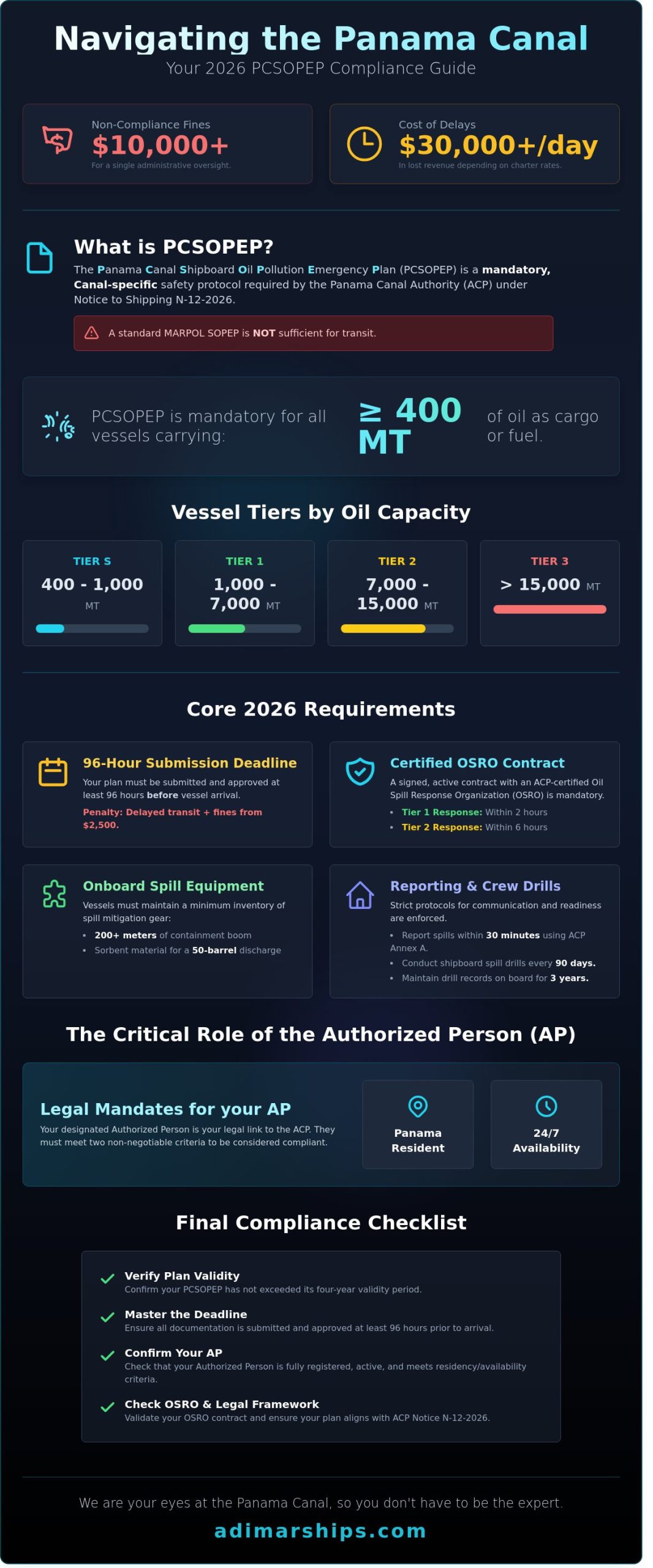
The Panama Canal Shipboard Oil Pollution Emergency Plan (PCSOPEP) is a specialized safety protocol required for vessels transiting the waterway. It’s not just a suggestion; it’s a strict legal mandate under the ACP Notice to Shipping N-12-2026. If your vessel carries 400 metric tons (MT) or more of oil as cargo or fuel, you must have an approved plan on file. We’ve seen many operators arrive at the canal thinking their standard MARPOL SOPEP is sufficient. It’s not. The pcsopep requirements panama canal demand a canal-specific response strategy that includes local resources and authorized personnel.
Arriving without a valid, ACP-approved PCSOPEP leads to immediate delays and financial penalties. Fines for non-compliance often start at $2,500 for administrative errors but can escalate rapidly if a vessel is barred from transit or requires emergency plan development at the pier. Time is money in maritime logistics. A 24-hour delay can cost charterers upwards of $30,000 in lost revenue depending on current daily hire rates. We act as your eyes at the canal to ensure these documents are verified long before your vessel reaches the breakwater. We are experts so you don’t have to be.
The Core Objective of the ACP Regulations
The primary goal is protecting the Gatun Lake watershed. This body of water provides the drinking water for 2.1 million people in Panama and facilitates the canal’s lock operations. By enforcing strict pcsopep requirements panama canal, the ACP ensures every vessel has a pre-verified communication link with the Canal Authority. This standardizes emergency response so that, in the event of a spill, local resources are deployed within minutes. It eliminates the confusion that happens during a crisis by pre-identifying the Oil Spill Response Organization (OSRO) and the local Authorized Representative (AR).
Vessel Categories Under PCSOPEP
The ACP classifies vessels into tiers based on their oil carrying capacity. This isn’t just about what’s in the cargo hold; it includes all fuel and lubricants on board. Understanding your category is vital for compliance.
- Tier S: For vessels with an oil carrying capacity of 400 MT to 1,000 MT.
- Tier 1: For vessels with an oil carrying capacity of 1,000 MT to 7,000 MT.
- Tier 2: For vessels with an oil carrying capacity of 7,000 MT to 15,000 MT.
- Tier 3: For vessels with an oil carrying capacity exceeding 15,000 MT.
Tankers face the most rigorous scrutiny, but non-tanker vessels with large bunker tanks often fall into Tier 1 or 2. Small craft carrying less than 400 MT are typically exempt from the formal PCSOPEP filing, though they must still comply with basic pollution prevention rules. We help you determine your exact tier to ensure you don’t overpay for services you don’t need or, worse, fail an inspection.
Core PCSOPEP Requirements: A 2026 Deep Dive
Meeting the pcsopep requirements panama canal isn’t just about paperwork; it’s about operational readiness. The Panama Canal Authority (ACP) enforces a strict 96-hour rule. This means your plan must be submitted and approved at least 96 hours before your vessel reaches canal waters. If you miss this window, expect your transit to be delayed or face a fine starting at 2,500 USD. We’ve seen these costs spiral when combined with lost charter time.
Documenting Your Emergency Preparedness
A valid plan must include a detailed inventory of shipboard spill mitigation equipment. This includes at least 200 meters of containment boom and enough sorbent material to handle a 50-barrel discharge. You’ll need clear communication protocols with the ACP Marine Traffic Control Center. Your report must trigger within 30 minutes of any actual or probable discharge. It’s vital to follow the ACP’s specific Annex A template for these reports. Many operators fail because they use generic international forms instead of the Canal-specific versions.
The OSRO and Clean-up Resource Requirements
Every vessel must have a signed contract with an ACP-certified Oil Spill Response Organization (OSRO). These organizations provide tier-based resources. Tier 1 requires an immediate response within 2 hours. Tier 2 extends this to 6 hours for larger spills. Staying compliant with pcsopep requirements panama canal means your OSRO contract must be active and verified through the ACP digital portal before your arrival. You must verify that your OSRO has the specific skimmers and personnel capacity for your vessel’s oil carrying capacity. Integrating the OSRO into your vessel’s response plan ensures that your crew knows exactly who to call when every second counts.
Don’t forget the human element. Crews must conduct shipboard spill drills every 90 days. Records of these exercises must stay on board for 3 years. The ACP inspectors often check these logs during the pre-transit inspection. If your documentation is messy, your transit is at risk. We act as your local office at the Panama Canal to ensure your records meet every specific ACP standard before the inspector steps on deck.
- Submission Deadline: Minimum 96 hours prior to arrival.
- Drill Frequency: Every 3 months (90 days).
- Record Retention: 3 years of logs kept on board.
- OSRO Certification: Must be ACP-authorized for the current year.
The Critical Role of the Authorized Person (AP)
The Panama Canal Authority (ACP) mandates that every vessel transiting the waterway designates a local Authorized Person (AP). This isn’t a mere administrative formality; it’s a legal cornerstone of your vessel’s spill response plan. The ACP requires the AP to maintain legal residency in Panama and guarantee 24/7/365 availability. If an incident occurs, the ACP won’t wait for a shipowner in a different time zone to wake up. They demand a local representative who can initiate the response within the strict timelines dictated by the pcsopep requirements panama canal. The AP must be reachable every second of the year, including holidays, as the Canal never sleeps.
The AP serves as the primary liaison between the shipowner and the ACP during an oil spill or environmental threat. This individual holds the authority to commit the shipowner’s funds and make immediate, binding decisions regarding cleanup operations. Because the AP carries this level of financial and operational responsibility, the ACP monitors their performance closely. The AP must have the legal capacity to sign contracts for cleanup services that can exceed $1,000,000 in immediate mobilization costs. A delay in decision-making can lead to catastrophic fines or the total suspension of transit privileges.
Selection Criteria for a Reliable AP
Technical expertise is non-negotiable. An effective AP must possess a deep understanding of oil spill response equipment and maritime logistics specific to the Isthmus. They should demonstrate fluency in the ACP’s 2026 operational procedures and have a documented history of coordination with local authorities. In our 20 years of operation, we’ve seen that the best APs are those who maintain a direct, transparent relationship with the ACP’s environmental division. Relying on an inexperienced individual puts your vessel at risk of non-compliance during the critical 2026 audit cycle.
The AP vs. Your General Ship Agent
It’s vital to distinguish between your commercial ship agent and your AP. While a general agent handles husbandry, crew changes, and cargo, the AP represents your compliance and environmental liability. Integrity is the most vital trait here. You’re trusting this person with your reputation and your checkbook during a crisis. We see ourselves as your local office, ensuring your interests are protected at all times. Understanding Why a Panama Canal Ships Agent is Your Most Valuable Asset helps clarify how these roles complement each other to ensure a seamless transit under the strict pcsopep requirements panama canal. We are your eyes at the Panama Canal so you don’t have to worry about the details.
2026 Compliance Checklist: Avoiding Fines and Delays
Navigating the Panama Canal is a high-stakes operation where timing is everything. For 2026, the Panama Canal Authority (ACP) has intensified its focus on digital verification through the VUMPA system. Meeting pcsopep requirements panama canal isn’t just about keeping a binder on the bridge; it’s about real-time data accuracy and active registration. Your plan must undergo a full review every 4 years. If your last approval date was before June 2022, you must submit a revision now to avoid an administrative fine, which typically starts at $2,500 for non-compliance.
The ACP boarding officer’s physical inspection is the final hurdle. They verify that the crew understands the notification procedures and that your Authorized Person (AP) is reachable 24/7. Since January 2024, the ACP has conducted random communication drills. If your AP doesn’t answer the initial call from the Canal’s Marine Operations Center, your vessel’s safety rating can drop, negatively impacting your future transit priority. We are your eyes at the Panama Canal, ensuring these small details don’t become massive bottlenecks.
Pre-Arrival Documentation Audit
Consistency saves time and money. Boarding officers compare your PCSOPEP data directly against your International Oil Pollution Prevention (IOPP) certificates. Any discrepancy in tank capacities over 2% can lead to a “Condition of Entry” delay while the data is rectified. To ensure a smooth process, follow these steps:
- Verify that tank capacities in the VUMPA portal match the vessel’s technical drawings exactly.
- Ensure the AP’s local Panama contact information is laminated and posted on the bridge and in the engine control room.
- Confirm that your pcsopep requirements panama canal documentation includes the most recent 2025 ACP amendments.
For a broader look at operational readiness beyond oil pollution plans, see our Panama Canal Transit: The Complete Guide for Ship Operators.
Common Pitfalls and How to Avoid Them
Expired Oil Spill Response Organization (OSRO) contracts are the leading cause of transit denials. These contracts must remain valid for the entire duration of your stay in Canal waters, including time spent at anchor. Another frequent error is failing to update the AP when vessel schedules shift by more than 12 hours. Data from 2024 shows that 15% of vessels faced delays because their initial transit request didn’t match the actual oil capacity on board upon arrival. Accurate reporting prevents these avoidable fines.
- Double-check OSRO expiration dates 30 days before your ETA.
- Maintain a direct line with your AP to relay schedule changes instantly.
- Report any changes in fuel type or quantity if they deviate by more than 5% from the initial declaration.
We are experts so you don’t have to be. Nominate Adimar as your agent to ensure your compliance is handled with integrity and precision.
Adimar Shipping: Your Eyes at the Panama Canal
Managing a transit at the Panama Canal involves more than just moving a vessel between two oceans. It requires absolute precision. For over 20 years, Adimar Shipping has served as the on-the-ground extension for ship owners and charterers. We understand that every hour spent waiting is a drain on your bottom line. Meeting the 2026 pcsopep requirements panama canal mandates requires a partner who doesn’t just read the manual but lives the operation daily. We are experts so you don’t have to be. Our team provides 24/7/365 coverage to ensure your vessel meets every regulatory hurdle without a hitch.
Miscalculating your timing or paperwork leads to frustration and unnecessary costs. We eliminate this confusion through personalized service. We don’t just process documents; we coordinate with the Panama Canal Authority (ACP) to protect your interests. Our role as your Authorized Person (AP) means we’re ready to respond to any emergency or compliance query the moment it arises. You can focus on your core business while we handle the complexities of the waterway.
- Two decades of specialized maritime experience in Panama.
- Constant availability to handle emergency coordination and compliance.
- Direct communication that removes the guesswork for charterers.
- Proactive monitoring of changing ACP regulations and pcsopep requirements panama canal updates.
Why Integrity Matters in Panama Canal Compliance
Adimar Shipping prides itself on being a service provider defined by integrity. We act as your local office, ensuring that every solution we propose is cost-conscious and transparent. We don’t believe in hidden fees or vague reporting. Our goal is to save you money by preventing delays and avoiding fines through meticulous preparation. For a deeper look at why this role is vital, see our PCSOPEP Authorized Person: A Complete Guide.
Beyond PCSOPEP: Holistic Transit Management
Our expertise doesn’t stop at oil spill response plans. We combine compliance with full husbandry services to reduce transit friction. Whether you need to coordinate crew changes, schedule bunkering, or deliver critical spare parts, we handle the logistics simultaneously. This integrated approach ensures that your vessel remains productive. We see what you can’t from across the globe, acting as your eyes and ears at the locks. Get a quote for PCSOPEP AP services from Adimar Shipping today to secure your 2026 transit schedule.
Secure Your 2026 Panama Canal Transit Today
Navigating the complex pcsopep requirements panama canal for 2026 isn’t just a paperwork exercise; it’s a critical step to protect your vessel from costly delays and fines. You need an Authorized Person who understands the exact nuances of the Panama Canal Authority regulations. Adimar Shipping provides 24/7/365 local availability to ensure your ship remains compliant at every stage of the journey. We’ve spent 20+ years acting as the local eyes for global ship owners and charterers. We’re experts so you don’t have to be.
Our team acts as an extension of your office, providing the transparency and integrity your fleet deserves. We handle the technical details so you can focus on your core business operations. Don’t leave your transit to chance when you can have a seasoned partner on the ground. Nominate Adimar as your PCSOPEP Authorized Person today to guarantee a smooth, efficient passage through the waterway. Your next successful transit starts with the right local partner by your side.
Frequently Asked Questions
Is PCSOPEP mandatory for all vessels transiting the Panama Canal?
Yes, a PCSOPEP is mandatory for all vessels over 400 gross tons or those carrying oil as cargo. This regulation ensures every ship has a verified emergency plan before entering the waterway. If your vessel falls below this tonnage and isn’t carrying bulk oil, you’re exempt. However, 95% of commercial transits must comply with these pcsopep requirements panama canal to avoid costly delays at the locks.
What happens if my vessel arrives without a valid PCSOPEP or Authorized Person?
Your vessel will face immediate denial of transit and potential fines starting at $2,500. The Panama Canal Authority won’t schedule a pilot until you appoint a local Authorized Person and submit a valid plan. You’ll likely be sent to an anchorage, incurring daily costs that can exceed $5,000 in port fees. We act as your eyes at the canal to prevent these expensive logistical bottlenecks.
How often does a PCSOPEP plan need to be updated or re-submitted?
You must re-submit your plan every 2 years for official Panama Canal Authority approval. If you change the vessel’s name, owner, or technical operator, you must update the document within 30 days of the change. Keeping these records current is vital for smooth operations. We manage these deadlines for our clients to ensure 100% compliance during every 2026 transit and avoid last minute stress.
Can a non-Panamanian company act as the Authorized Person for my vessel?
No, the Authorized Person must be a resident of the Republic of Panama and officially registered with the canal authorities. This individual acts as the legal link between your ship and the local response teams during an oil spill. They must be available 24 hours a day to coordinate efforts. Adimar Shipping provides this essential local presence, ensuring you meet all pcsopep requirements panama canal with a trusted partner.
What is the difference between Tier 1, Tier 2, and Tier 3 PCSOPEP requirements?
These tiers represent the oil carrying capacity of your vessel and dictate the required response resources. Tier 1 applies to ships carrying less than 1,000 barrels of oil. Tier 2 covers vessels with 1,000 to 7,000 barrels; Tier 3 is for those exceeding 7,000 barrels. Each level requires a different fee structure and specific equipment availability. We’re experts in these categories, so you don’t have to be.
How much are the fines for PCSOPEP non-compliance in 2026?
Fines for non-compliance typically range from $2,500 to $15,000 per violation in the 2026 season. If you provide false information or fail to notify the authorities of a plan change, the penalty often hits the $10,000 mark. Beyond the fine, the cost of a missed transit slot can exceed $50,000 for a Neo-Panamax vessel. We focus on integrity and precision to keep your budget on track and secure.
Do I need a separate PCSOPEP if I already have a MARPOL SOPEP?
Yes, a standard MARPOL SOPEP isn’t sufficient for a Panama Canal transit because it lacks local response specifics. While they share similar goals, the PCSOPEP includes requirements like the nomination of a Panama-based Authorized Person and local contact details. You must maintain a separate, approved plan alongside your international documents. We’ve seen 15% of new clients struggle with this distinction, so we simplify the integration process for your fleet.
How do I nominate Adimar Shipping as my Authorized Person for the Panama Canal?
You can nominate us by submitting a formal Letter of Authorization through the Panama Canal Authority’s digital VUMPA system. Simply contact our team to receive the specific wording and company details required for the filing. We’ve handled these nominations for over 20 years, providing the reliability you need. Once the authority confirms the appointment, we’ll serve as your local office for all emergency coordination and regulatory compliance.