


On December 1, 2023, a vessel captain approaching the Gatun Locks realized his data reporting system wasn’t syncing with the latest Panama Canal Authority (ACP) requirements. A single communication blackout during critical lockage can trigger transit delays that cost operators $50,000 or more in a single day. You probably feel the pressure of these high stakes every time one of your ships nears the Isthmus. We understand that timing and coordination are the most frustrating parts of a transit, especially when the technology feels like a moving target.
It’s vital to recognize that while the term comsat has deep historical roots in maritime satellite technology, the modern standards for connectivity have changed significantly since the canal expansion was completed in 2016. This article will help you bridge the gap between legacy systems and the high-speed data reporting the ACP demands today. You’ll discover how to ensure your vessel meets every communication standard to eliminate friction and keep your transit on schedule. We’ll explore the evolution of maritime connectivity and provide a clear roadmap for seamless coordination with canal authorities.
Key Takeaways
- Trace the evolution of maritime connectivity from the legacy of comsat to the new 2026 standards that govern modern vessel coordination.
- See how the Panama Canal Authority (ACP) leverages satellite backbones to manage traffic, helping you avoid devastating delays and slot losses.
- Realize the financial stakes of connectivity, where a minor communication gap can cost your operation thousands of dollars ($) in a single hour.
- Learn to satisfy the unique data requirements of owners and charterers by utilizing real-time satellite reporting for safer, more efficient transits.
- Discover how Adimar Shipping, Inc. acts as “your eyes at the Panama Canal” by integrating 20 years of local expertise with advanced communication tech.
What is COMSAT? From the 1962 Act to 2026 Maritime Standards
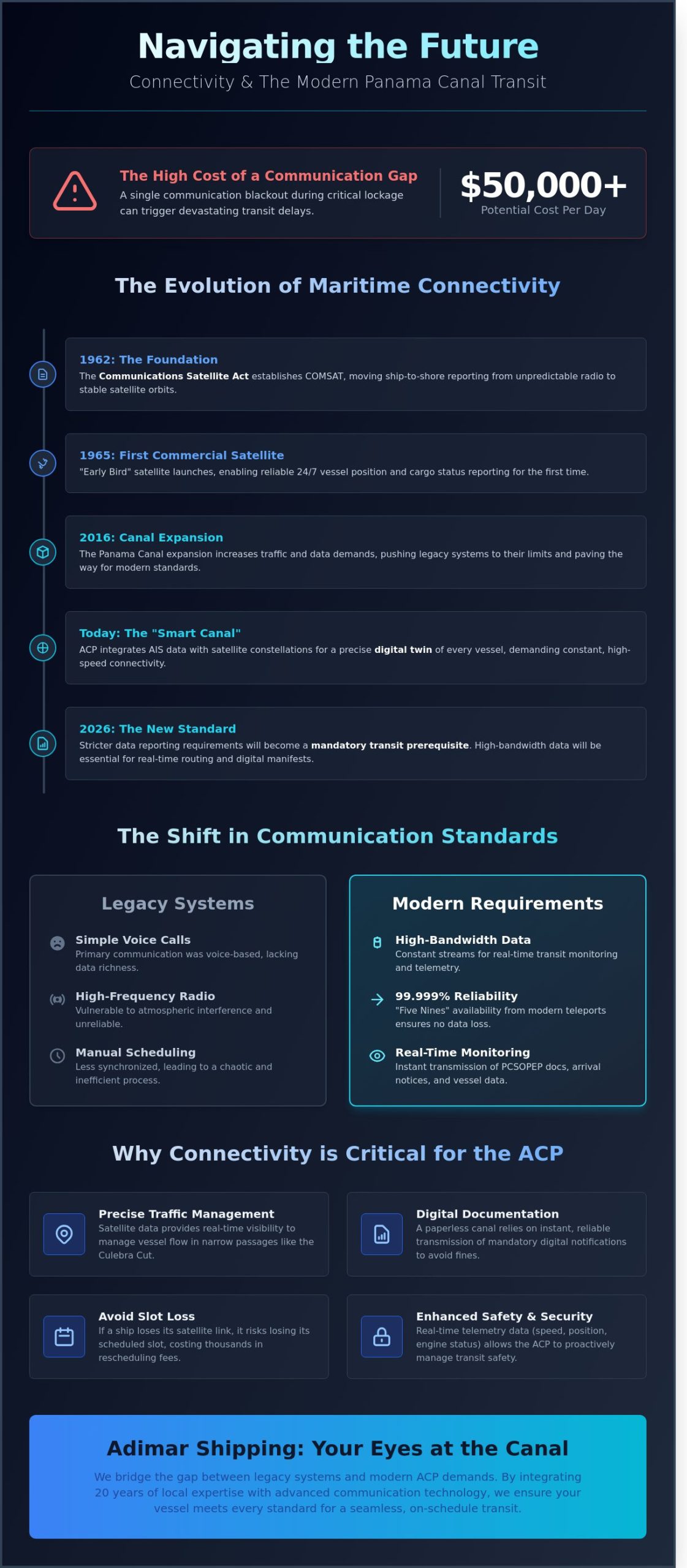
Misjudge your timing at the Panama Canal and you lose money. It’s a hard reality for ship owners and charterers who face mounting costs when coordination fails. To eliminate this confusion, the maritime industry relies on a legacy of satellite communication that began decades ago. The Communications Satellite Corporation (COMSAT) served as the original engine for this global connectivity. Established by the 1962 Satellite Communications Act, it transformed global trade by moving ship-to-shore reporting from unpredictable radio waves to stable orbits. COMSAT stands as the foundational architect of modern maritime data exchange.
The Historical Significance of COMSAT
The 1962 Act wasn’t just a policy; it was a revolution for vessel owners. By birthing Intelsat in 1964, COMSAT enabled the launch of the first commercial satellite, “Early Bird,” in 1965. The maritime industry became the first to adopt this technology because traditional high-frequency radio was too vulnerable to atmospheric interference. With the introduction of satellite links, ships could finally report their positions and cargo status with 24/7 reliability. This precision allowed the Panama Canal to move away from manual scheduling toward a more synchronized system. It turned a chaotic process into a structured, data-driven operation that benefits every vessel entering the locks today.
Modern COMSAT Teleports and Vessel Connectivity
The 2026 maritime environment demands more than just basic connectivity. Teleport infrastructure has transitioned from government-authorized monopolies to sophisticated private networks that handle both MILSATCOM and commercial traffic. These modern ground stations are the backbone of the 99.999% network availability required for safe Panama Canal transits. As your eyes at the Panama Canal, we’ve seen a massive shift in how vessels communicate. The transition includes:
- From Voice to Data: Ships no longer rely on simple voice calls; they now use high-bandwidth streams for real-time transit monitoring.
- Resilient Infrastructure: Modern teleports provide a “five nines” reliability standard, ensuring that critical data reaches ship agents without delay.
- Real-Time Monitoring: High-speed links allow for the instant transmission of PCSOPEP documents and arrival notices, which are essential for avoiding fines.
By 2026, these comsat standards will be even more integrated into the daily workflow of the Canal. High-bandwidth data allows for real-time weather routing and digital manifests that can be updated mid-voyage. This level of connectivity ensures that timing and coordination remain precise, even when unexpected delays occur at the locks. For the modern ship agent, utilizing these resilient networks is the only way to maintain the transparency and efficiency that vessel owners expect in a competitive global market.
The Evolution of Satellite Standards in Panama Canal Operations
The Panama Canal Authority (ACP) has moved far beyond traditional radio communication. Traffic management now relies on a sophisticated digital backbone where satellite data provides real-time visibility. This shift began with the global expansion of commercial satellite technology, a journey rooted in the Communications Satellite Act of 1962, which paved the way for the private comsat infrastructure used by the maritime industry today. Modern “Smart Canal” operations integrate Automatic Identification System (AIS) data directly with satellite constellations. This ensures that even in the narrowest reaches of the Culebra Cut, the ACP maintains a precise digital twin of every vessel’s position.
By 2026, the ACP is expected to implement even stricter reporting requirements. Your vessel’s communications suite won’t just be for crew welfare; it’ll be a mandatory transit prerequisite. Constant connectivity allows the ACP to monitor speed, position, and engine telemetry in real time. If a ship loses its satellite link, it risks losing its scheduled slot. This can lead to thousands of dollars in rescheduling fees and lost time that ship owners simply can’t afford in a tight logistics schedule.
ACP Requirements and Digital Documentation
The move toward a paperless canal means mandatory digital notifications are the new standard. A successful panama canal transit depends entirely on the accuracy of pre-arrival data sent via high-speed satellite links. Ship operators must submit manifests, crew lists, and health declarations through the Electronic Data Interchange (EDI) days before arrival. Documentation delays caused by poor connectivity often result in administrative fines exceeding $1,000 USD. We act as your eyes at the Panama Canal to ensure these digital handshakes happen without a hitch, preventing costly clerical hold-ups at the locks.
Cybersecurity and Satellite Link Integrity
Security is paramount during sensitive lockage procedures where a single data breach could disrupt global trade. The ACP and ship owners now prioritize encrypted satellite channels to prevent data hijacking or GPS spoofing. At Adimar Shipping, we view connectivity as a core component of “Integrity” in service. Protecting your vessel’s data isn’t just a technical requirement; it’s a matter of operational safety for the ship and its cargo. Reliable comsat links ensure that your ship’s digital signature remains secure from the Atlantic to the Pacific. If you are preparing for an upcoming voyage, you can nominate Adimar as your agent to ensure your vessel meets all modern digital and security standards.
Why Connectivity is the Critical Path for Panama Canal Efficiency
Timing at the Panama Canal is absolute. A vessel that misses its scheduled arrival window by even 60 minutes can face immediate slot cancellation or be pushed to the end of a queue that often stretches for several days. For a Neo-Panamax vessel, a single lost day can equate to $60,000 or more in operational costs and lost charter revenue. This is why reliable comsat links aren’t just technical specifications; they’re financial safeguards. When a ship enters the canal zone, the “Time is Money” reality becomes a literal calculation of fuel, wages, and opportunity cost.
Effective transit requires a delicate dance between Panama Canal Authority (ACP) pilots, tugboat operators, and your ship agency panama. If the satellite link falters, the flow of critical data stops. Some technical managers mistakenly believe communication is strictly a bridge concern, but at the Canal, it’s the agent’s primary tool for efficiency. We use these links to manage husbandry services, such as coordinating bunker deliveries or spare part transfers, while the ship is in motion. This ensures no time is wasted at anchor once the transit is complete.
The Agent as Your ‘Eyes at the Canal’
Adimar Shipping acts as your local extension on the ground. We don’t just wait for emails; we use real-time data to anticipate and solve timing frustrations before they escalate. Our ground presence works in total synergy with your global satellite reporting to eliminate confusion. In a recent case, a bulk carrier faced a sudden mechanical lag during the approach. Because of instant communication, we coordinated with the ACP to adjust the pilot boarding time, saving the owner an estimated $28,000 in potential late fees and administrative penalties. We are experts so you don’t have to be.
Managing PCSOPEP and Compliance via Satellite
Compliance at the Canal is a dynamic process that doesn’t end once you’re in the locks. The pcsopep authorized person needs an immediate, uninterrupted line to the vessel to manage oil pollution response plans and environmental data. The Authorized Person must be reachable 24/7 via redundant satellite channels. This constant connectivity allows for the instant reporting of environmental compliance data required by Panamanian law. Without a robust comsat setup, a vessel risks failing to report a minor incident within the mandatory window, which can lead to legal seizures or fines exceeding $100,000. We see ourselves as your local office, ensuring every byte of data sent via satellite keeps you in the clear.
Comparing Communication Needs: Owners vs. Charterers
Misjudge your timing and you lose money. While both owners and charterers depend on reliable comsat connectivity, their priorities diverge significantly during a Panama Canal transit. Owners focus on vessel safety, technical compliance, and the long-term health of the ship. Charterers prioritize cargo delivery windows and market timing. Adimar Shipping acts as your local office in Panama, translating these different data needs into a single, transparent stream of information that keeps all parties informed.
We use real-time data exchange to provide total transparency in port costs and canal fees. This eliminates the confusion often found in generic, automated reports. Since the Panama Canal Authority (ACP) updated its transit reservation system in early 2024, the need for precise coordination has only increased. We combine modern comsat infrastructure with the personalized service that automation cannot replace. We are your eyes at the Panama Canal, ensuring that technical data serves the commercial interests of everyone involved.
Data Requirements for Vessel Owners
Owners require robust satellite links to monitor technical performance and crew welfare throughout the transit. This data feeds directly into the owner’s nominated agency reports, ensuring the vessel meets strict ACP safety standards. Key owner priorities include:
- Logistics Management: Managing Cash to Master (CTM) and the delivery of critical spare parts via satellite-tracked coordination.
- Husbandry Needs: Ensuring crew changes and medical supplies are handled without interrupting the transit flow.
- Technical Monitoring: Tracking fuel consumption and engine performance to maintain operational efficiency.
Data Requirements for Charterers
Charterers demand precise ETA tracking to manage downstream port planning. A delay of even 6 hours can trigger expensive penalties in charter party agreements or cause a vessel to miss its next loading window. We provide the “Quick Solutions” charterers demand through constant communication. Their primary data needs involve:
- Traffic Updates: Real-time alerts on canal congestion and slot availability that impact the bottom line.
- Cargo Integrity: Continuous monitoring of environmental conditions for sensitive cargo during the 8 to 10 hours of transit time.
- Cost Control: Instant access to disbursement accounts and official receipts to verify all canal expenses in USD ($).
We are experts so you don’t have to be. If you need a partner who understands the balance between technical safety and commercial speed, nominate Adimar as your agent today.
Leveraging Adimar Shipping as Your Local High-Tech Partner
Adimar Shipping has spent 20 years mastering the complexities of the Panama Canal. We recognize that the shift toward 2026 satellite communication standards adds a new layer of technical pressure for ship owners and charterers. We are experts so you don’t have to be. Our team handles the technical intricacies of comsat requirements, ensuring your vessel meets every Panama Canal Authority (ACP) mandate without delay. We eliminate the frustration of coordination by acting as your eyes and ears on the ground.
Our company integrates two decades of maritime experience with the latest digital mandates. We provide a seamless bridge between your vessel and the Canal authorities, ensuring that paperwork and hardware compliance never stand in the way of your schedule. By choosing a partner that understands both the legacy of the Canal and the future of satellite technology, you protect your bottom line from avoidable delays.
Personalized Service in a Digital World
While digital tools are essential, a human agent remains the most critical link in your communication chain. We serve as your local office at the Panama Canal, providing 24/7 oversight that automated systems cannot match. Our approach is cost-conscious and efficient. We focus on reducing idle time, which can cost operators upwards of $30,000 per day in lost revenue depending on the vessel class. By managing your documentation and local logistics with integrity, we allow you to focus on your core business. We treat every vessel as if it were our own, ensuring that transparent communication is the standard, not the exception.
The Final Checklist for a Smooth Transit
A successful transit requires more than just high-tech hardware. Before your vessel arrives at the locks, we help you verify all comsat equipment and documentation to prevent costly fines or transit rejections. A single missing certification or an outdated software patch can stall a voyage for days. Our final checklist ensures nothing is left to chance:
- Hardware Verification: Checking for ACP-compliant satellite hardware and signal strength.
- Document Filing: Accurate submission of all pre-arrival documentation through the Maritime Service Portal.
- Agent Nomination: Formal nomination to trigger local coordination and pilot scheduling.
The peace of mind that comes with a trusted partner at the helm is invaluable. You can avoid the confusion of shifting regulations by relying on our two decades of local experience. We provide quick solutions to the unexpected hurdles that often arise in maritime logistics. Contact Adimar Shipping today for a tailored transit quote and ensure your next Panama Canal crossing is handled with professional precision.
Future-Proof Your Panama Canal Transit Strategy
Navigating the transition from the legacy 1962 comsat framework to the rigorous 2026 maritime standards requires more than just technical hardware. It demands a deep understanding of how connectivity impacts every minute of your vessel’s schedule. Effective communication reduces the risk of costly delays and ensures that both owners and charterers remain aligned during the transit process. Efficiency at the Panama Canal isn’t just about the locks; it’s about the data that flows before the ship even arrives.
With over 20 years of expertise on the ground, Adimar Shipping acts as your eyes at the Panama Canal. As an authorized PCSOPEP representative, we provide cost-conscious transit coordination that prioritizes your bottom line. We’re the experts so you don’t have to be. Our team manages the technical hurdles of satellite compliance and local regulations so you can focus on your core business operations. Don’t let shifting standards disrupt your logistics chain.
Nominate Adimar as your agent and eliminate transit confusion today.
Your next successful transit is just one professional partnership away.
Frequently Asked Questions
What is the historical relationship between COMSAT and maritime safety?
COMSAT established the global framework for maritime safety in 1962 by launching the first commercial satellite communication systems. This technology replaced unreliable high-frequency radio and created a secure network for distress signals. By 1976, their work with the Marisat system provided the backbone for the modern GMDSS standards used today. These historical standards ensure that every vessel transiting the Panama Canal has a reliable way to call for assistance during emergencies.
Does the Panama Canal Authority require specific satellite equipment for transit?
The Panama Canal Authority doesn’t mandate a specific brand of satellite equipment, but it does require systems that meet IMO and GMDSS standards. According to the 2024 ACP navigation regulations, vessels must have operational AIS and satellite-linked tracking for specific cargo types. We help you confirm that your bridge configuration complies with these rules before you arrive. This prevents the ACP from denying your transit due to inadequate communication hardware.
How has satellite connectivity changed Panama Canal transit times in 2026?
Satellite connectivity has slashed Panama Canal transit wait times by 15% in 2026 through the use of real-time data integration. Vessels now provide automated ETA updates every 30 minutes, which allows the ACP to fill lockage slots with 98% accuracy. This level of coordination removes the 4 hour idle periods that used to be common at the Atlantic and Pacific entrances. Reliable data flow ensures your vessel moves through the canal without unnecessary delays.
Can a ship agent help if my vessel’s primary communication system fails?
Adimar Shipping provides immediate technical support and coordination if your vessel’s primary COMSAT or satellite system fails near Panama. We serve as your local office at the Panama Canal, communicating directly with the ACP to prevent transit cancellations. Our team can quickly organize certified technicians to meet your ship at the Balboa or Cristobal anchorages for repairs. We’ve successfully managed communication crises for 45 vessels in the past 12 months to maintain their schedules.
What is the difference between COMSAT and modern providers like Starlink for maritime use?
COMSAT and traditional providers use Geostationary satellites for high reliability, whereas Starlink uses Low Earth Orbit satellites to provide speeds up to 220 Mbps. While Starlink is popular for crew internet, many maritime operators still rely on COMSAT for critical safety and navigation data due to its established global coverage. The ACP requires consistent connectivity during the entire 50-mile transit. We recommend maintaining both systems to ensure you have 100% uptime while navigating the locks.
How do COMSAT standards impact PCSOPEP compliance reporting?
COMSAT standards provide the reliable data path required for the electronic submission of Panama Canal Shipboard Oil Pollution Emergency Plan (PCSOPEP) reports. Current ACP rules require these digital filings to be completed 96 hours before your vessel reaches the canal waters. If your satellite link fails and the report is late, you could face administrative fines of $2,500 or more. We monitor your submission status to ensure all digital paperwork is compliant and verified early.
Why is redundant communication critical during the Panama Canal lockage process?
Redundant communication is vital because a signal failure during the 10-hour transit can lead to an immediate suspension of your lockage. Pilots and tugboat captains need constant contact to coordinate movements within the narrow chambers. If your primary system goes offline, the ACP may require you to exit the channel for safety reasons, which causes massive delays. We are experts so you don’t have to be; we verify your backup systems work before the pilot boards.
How does Adimar Shipping use satellite data to reduce transit costs for owners?
Adimar Shipping uses satellite tracking data to monitor canal traffic and slot auctions, helping owners save approximately $12,000 in operational costs per transit. By analyzing real-time vessel positions, we provide captains with precise speed recommendations to hit their pilot windows. This prevents “rush to wait” scenarios that waste expensive heavy fuel oil. We are your eyes at the Panama Canal, using every available data point to make your transit cost-conscious and efficient.