

In April 2026, some vessel operators paid over $1,000,000 in a single auction just to bypass the 128-ship queue at the Panama Canal. This surge in demand, fueled by shifts in global energy routes, has made managing panama canal transit delays a high-stakes tactical operation rather than a routine scheduling task. You’re likely feeling the weight of unpredictable demurrage costs and intense pressure from cargo owners as wait times for non-reserved ships now exceed six days. We understand the frustration that comes with a lack of transparency when your delivery timelines and bottom line are at risk.
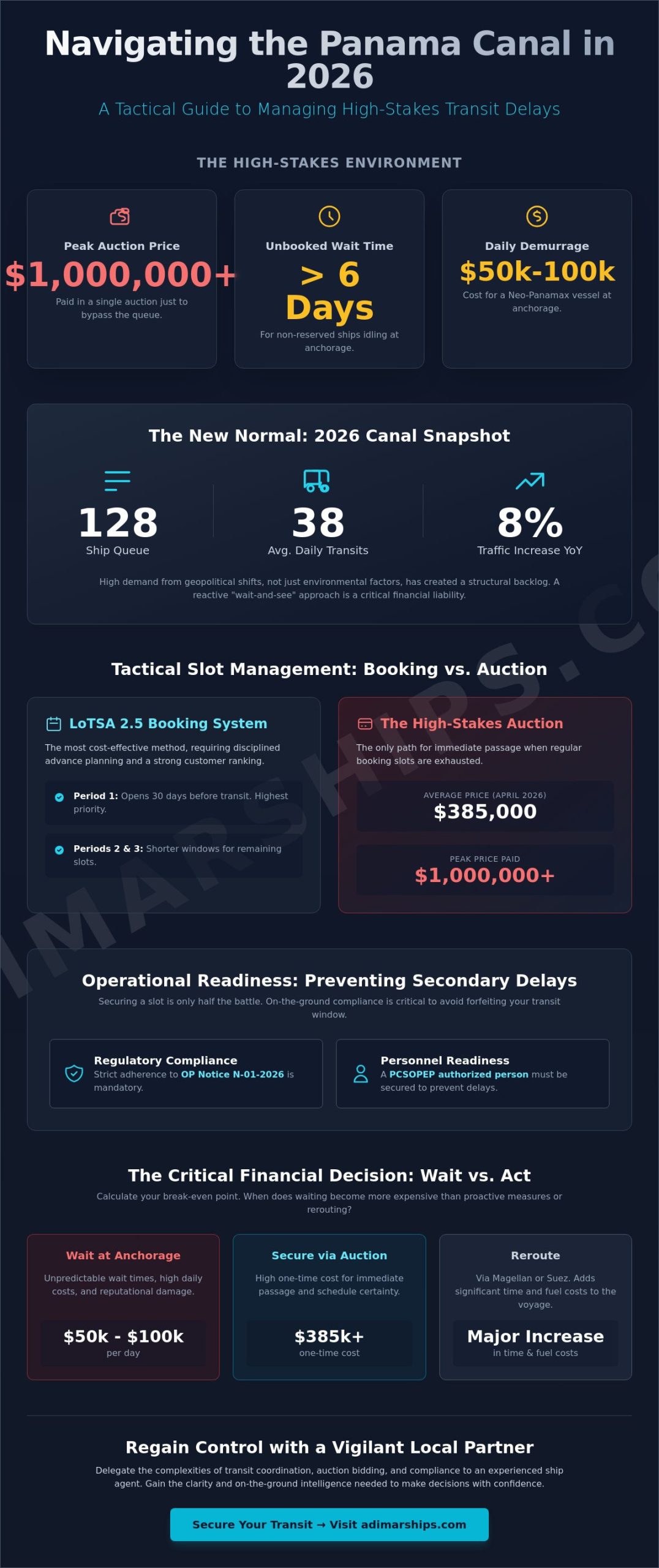
You can regain control over your schedule by adopting a proactive approach to transit logistics. This guide provides a clear framework for mastering the LoTSA 2.5 booking system and navigating a volatile auction market where average prices climbed to $385,000 in April 2026. We’ll show you how to leverage local expertise to ensure strict compliance with the OP Notice to Shipping No. N-01-2026 and reduce anchorage time. You’ll gain the insights needed for predictable financial modeling and secure slot acquisition, even as average daily transits rise to 38 vessels.
Key Takeaways
- Learn why 2026 requires a shift from a ‘wait-and-see’ approach to tactical intervention when managing panama canal transit delays.
- Navigate the LoTSA 2.5 booking periods and the auction system to secure slots even during peak congestion.
- Eliminate secondary delays by addressing technical deficiencies and securing a PCSOPEP authorized person for regulatory compliance.
- Use financial modeling to find your break-even point when comparing anchorage costs against rerouting via the Magellan or Suez.
- Benefit from a vigilant local partner who provides custom transit alerts and on-the-ground oversight at the locks.
The State of Panama Canal Transit Delays in 2026
In 2026, the Panama Canal operates at a complex intersection of high water levels and unprecedented global demand. While the severe drought of previous years has receded, the waterway faces a new challenge: a surge in traffic driven by geopolitical shifts. Active delay management now goes beyond monitoring weather. It’s a tactical discipline where ship operators must use real-time data to secure transit windows. The Panama Canal Authority (ACP) manages this delicate balance by adjusting daily transit quotas and booking rules. In this environment, a “wait-and-see” approach is a liability. Managing panama canal transit delays in 2026 requires immediate, interventionist strategies to protect your schedule and your bottom line.
Beyond Environmental Factors: The New Normal
Traffic density has reached new heights. As of May 2026, average daily transits have risen to 38 vessels, an 8% increase year-on-year. This volume means even minor maintenance at the locks can cause immediate ripples through the queue. Managing panama canal transit delays effectively means recognizing that unbooked vessels often find themselves caught in a structural backlog that isn’t just seasonal. It’s a permanent fixture of the modern maritime landscape. For fleet managers, the psychological impact of this uncertainty is significant. Crew morale suffers when anchorage stays stretch into a week, and the pressure from cargo owners becomes relentless. We see this as a call for higher vigilance and better local intelligence from your representative on the ground.
The Cost of Inaction: Demurrage and Reputational Risk
Idling at anchorage is expensive. Between fuel consumption for auxiliary engines and daily charter hire rates, the burn rate for a Neo-Panamax vessel can easily exceed $50,000 to $100,000 per day. These costs don’t include the indirect damage to your reputation. Missing a berthing window at your next port of call often leads to secondary congestion and additional fines. Transparency is your best defense. Providing cargo interests with expert local data helps manage expectations and preserves trust. By delegating the complexities of transit coordination to an experienced ship agent, you gain the operational freedom to focus on your broader fleet objectives. We act as your eyes and ears, ensuring you have the clarity needed to make difficult decisions with confidence.
Tactical Slot Management: Mastering the Booking and Auction System
Securing a transit slot in 2026 isn’t just about administrative filing; it’s a competitive exercise in timing and financial calculation. The Panama Canal Authority operates a tiered reservation system divided into three distinct booking periods. Period 1 opens 30 days before the transit date, while Periods 2 and 3 offer shorter windows for vessels that miss the initial opening. Customer ranking, based on your historical transit volume and payment reliability, dictates your priority in these competitive rounds. For operators without a high ranking, managing panama canal transit delays often requires a more aggressive tactical approach involving the auction system.
The Auction Framework: A Strategic Approach
When booking slots are exhausted, the daily auction becomes the only path for vessels needing immediate passage. In early 2026, average auction prices surged to approximately $385,000, with some operators paying over $1,000,000 to bypass the queue. Success in this high-stakes environment depends on real-time data and a clear “walk-away” price. A specialized Panama Canal ships agent monitors these price trends daily, executing bids on your behalf with precision. If an auction bid fails, we immediately pivot to contingency planning, such as adjusting husbandry schedules or re-evaluating the next port window. Delegating this complex task to a local expert ensures you don’t overpay in a moment of operational panic. Effective coordination is the key to managing panama canal transit delays without draining your budget.
Booking Windows and Advance Planning
The most cost-effective way to handle your Panama Canal transit is through a disciplined 30-day planning cycle. This structured approach provides the predictability needed for complex logistics.
- Analyze the Forecast: We review the projected traffic density and water levels 30 days out to determine the likelihood of “Condition” changes.
- Secure Period 1 Slots: Aiming for the earliest possible window avoids the volatility of later booking periods and the extreme premiums of the auction house.
- Monitor ACP Advisories: The Authority frequently issues dynamic updates regarding draft clearances and the Enhanced Long-Term Slot Allocation program (LoTSA 2.5).
Staying ahead of these shifts allows for more predictable financial modeling. If you’re looking for a partner to oversee these tactical maneuvers, our ship agency services provide the local vigilance required to protect your bottom line. Success requires constant observation of the locks and the digital booking board.
Operational Readiness: Preventing Secondary Delays
Securing a slot is only half the battle. Managing panama canal transit delays also involves rigorous operational readiness to prevent secondary setbacks that occur after you’ve already paid for your window. Technical deficiencies or administrative errors can lead to immediate transit cancellation, forcing a vessel back to the end of a very long queue. The ACP enforces strict vessel requirements, and any failure to comply results in lost time and significant fines. You must ensure all documentation is verified through the Electronic Data Collection System (EDCS) at least 96 hours before arrival. This window is critical for the Authority to review your ship’s specifications and equipment status.
Compliance as a Competitive Advantage
Viewing compliance as a strategic tool rather than a hurdle gives you a distinct edge. While external factors like drought and low water levels have historically slowed global trade, technical non-compliance is a variable you can control. For instance, ensuring your Panamax vessel adheres to the maximum beam of 32.31 meters is essential. Even minor administrative discrepancies regarding visibility or mooring equipment can trigger secondary inspections. We emphasize the importance of an accurate ETA; arriving late by even an hour can lead to slot forfeiture and the loss of your booking fee, which for Neopanamax vessels starts at $100,000.
The Logistics of the ‘Last Mile’
Coordination of the “last mile” requires a vigilant presence at the locks. Your ship agency Panama manages the complex timing of pilotage and tugboat orders. These services must align perfectly with your transit window to avoid idling. We also recommend integrating husbandry services, such as crew changes or Cash to Master (CTM), while your vessel is already in the transit flow. This prevents unnecessary time at anchorage. A critical part of this readiness is appointing a PCSOPEP authorized person. This specialist ensures your oil spill response plans are current and approved, meeting the specific regulatory demands of the waterway. By delegating these specialized tasks to a knowledgeable partner, you eliminate the bottlenecks that often derail unmanaged transits. Managing panama canal transit delays is ultimately about removing every possible friction point before your ship reaches the first lock.
Financial Modeling: Waiting at Anchorage vs. Alternative Routes
Deciding whether to wait at anchorage or reroute around the Cape of Good Hope or through the Suez Canal is a high-stakes calculation for fleet managers in 2026. Managing panama canal transit delays effectively requires a robust financial model that accounts for more than just the booking fee. You must evaluate the Total Voyage Cost (TVC) against the volatility of the slot auction market, where prices averaged $385,000 in early spring. When auction bids exceed the cost of extra fuel and time for a longer route, rerouting becomes a viable tactical move. We provide the local data needed to determine this break-even point with precision.
Calculating the True Cost of Delay
Idling at anchorage carries a heavy daily burn rate. Beyond the obvious daily vessel operating costs (OPEX), which include crew wages and auxiliary fuel consumption, you must factor in the potential for penalty clauses. Many charter parties in 2026 include strict delivery windows; missing these can trigger significant financial liabilities. There’s also the opportunity cost to consider. Every day your vessel spends waiting is a day it isn’t earning on its next scheduled voyage. To forecast these trends accurately, we analyze the ACP Panama annual report to understand long-term traffic patterns and anticipated canal capacity. This data helps you move from reactive waiting to proactive scheduling.
Strategic Decision Framework
Rerouting decisions are increasingly complex due to environmental regulations and global fuel price shifts. In 2026, the impact of carbon taxes, such as the EU ETS, must be weighed against the fees of a Panama transit. While rerouting via the Strait of Magellan avoids the canal’s auction premiums, it significantly increases fuel consumption and emissions. You must also conduct a risk assessment of alternative routes, comparing the security concerns of the Red Sea against the stability of the Panamanian passage. An experienced owner’s nominated agency acts as your strategic partner in this process, providing the real-time anchorage data and queue forecasts required for an informed choice. We ensure you aren’t making these million-dollar decisions in an information vacuum.
If you need a detailed cost-benefit analysis for your upcoming transit, our team is ready to assist. Contact us today to learn how our ship agency services can protect your bottom line from the rising costs of congestion.
Adimar Shipping: Your Vigilant Partner in Delay Mitigation
Success in the waterway depends on more than just digital paperwork. We act as your eyes and ears at the locks, providing a level of oversight that standard automated reports simply can’t match. Managing panama canal transit delays is a high-stakes commitment that requires constant observation of Gatun Lake levels and lock throughput. We transform complex ACP data into actionable intelligence, allowing you to breathe easier while your vessel approaches the Isthmus. Our team leverages decades of local expertise to find ‘unseen’ transit opportunities, such as identifying shifts in the queue that might allow for an earlier pilot boarding or a more favorable husbandry window.
Proactive communication is our hallmark. We move beyond generic industry advisories to provide custom transit alerts tailored to your specific hull and cargo type. This precision ensures you aren’t surprised by sudden changes in draft clearances or booking conditions that could impact your financial modeling. Our commitment to ethical standards and transparent financial reporting means every dollar spent in the auction or on husbandry services is fully documented. You’ll never have to wonder about the status of your funds or the legitimacy of a local fee. We build trust through absolute clarity and reliability.
Why Local Representation Matters in 2026
Navigating the nuances of local protocols in 2026 requires deep-rooted expertise. We understand the interpersonal relationships and administrative expectations of the ACP that can make or break a transit schedule. When technical issues arise or documentation needs immediate verification, we troubleshoot in real-time on the ground. This includes coordinating with tugboat operators or ensuring your PCSOPEP authorized person is ready to board without delay. By acting as your local office in Panama, we protect your interests as an owner or charterer. We ensure you aren’t just another number in a queue of over 120 vessels. Our presence provides the protection and observation that standard business language cannot achieve.
Secure Your Transit Today
Delegating your logistics to a specialist provides the operational freedom you need to manage your global fleet. You don’t have to navigate the volatility of the 2026 transit market or the stress of million-dollar auctions alone. We invite you to initiate a consultation for your upcoming voyage to see how our local vigilance can prevent costly setbacks. Our focus is on creating feelings of trust and security through reliable, expert execution. Contact Adimar Shipping, Inc. to manage your Panama Canal transit efficiently. Our team is ready to serve as your dependable partner in one of the world’s most demanding maritime zones.
Securing Your Fleet’s Schedule in 2026
Managing panama canal transit delays in 2026 requires more than patience; it demands tactical intervention and local foresight. We’ve explored how mastering the auction system and ensuring technical compliance can protect your bottom line from surging costs. By integrating precise financial modeling with real-time anchorage data, you can make informed decisions between waiting and rerouting with confidence. Delegating these specialized tasks to a knowledgeable partner ensures your vessel maintains its schedule without the stress of administrative friction.
As a specialized Panama Canal Ships Agent and Authorized PCSOPEP Provider, we offer the vigilant local oversight necessary for a zero-friction transit. We act as your eyes and ears at the locks, providing the security and reliability your operations deserve. You don’t have to navigate these logistical complexities alone. Partner with Adimar Shipping for Expert Delay Mitigation and gain the operational freedom to focus on your next port of call. We look forward to protecting your interests in the Isthmus.
Frequently Asked Questions
How long are current Panama Canal transit delays for unbooked vessels?
Vessels arriving without a reservation currently face delays of approximately 5.5 to 6.3 days depending on the direction of travel. These wait times have increased by roughly 50% year-on-year as of late April 2026. Managing panama canal transit delays effectively requires advance planning to avoid these lengthy anchorage stays, which can significantly inflate your daily voyage operating costs and disrupt downstream schedules.
Can a ship agent help my vessel get a priority slot during high congestion?
A ship agent provides a tactical advantage by navigating the LoTSA 2.5 program and identifying slot openings the moment they become available. While the Canal Authority awards slots based on established booking periods and customer rankings, we act as your vigilant representative to ensure all documentation is flawless. This prevents administrative rejections that would otherwise move your vessel further back in the queue.
What is the difference between a booked transit and an auction slot?
A booked transit is a reservation secured during standard windows at a fixed fee, while an auction slot is a last-minute opportunity awarded to the highest bidder. Booking windows open up to 30 days in advance, providing financial predictability for your voyage. Auctions are typically used by operators who need to bypass the queue immediately, often resulting in much higher costs.
How much should I expect to bid in a Panama Canal slot auction in 2026?
You should prepare for average auction bids of approximately $385,000 based on market trends observed in early 2026. However, extreme demand has seen some vessels pay over $1,000,000 to secure a slot during peak congestion. These prices fluctuate based on daily traffic levels and cargo type, making real-time data from your agent essential for setting a competitive yet sensible maximum bid.
What happens if my vessel is delayed and misses its booked transit window?
Missing a booked transit window typically results in the forfeiture of your booking fee and a return to the end of the unbooked queue. The Panama Canal Authority enforces strict arrival requirements, and late arrivals can incur penalties of up to 250% of the original fee. We work closely with your crew to ensure an accurate ETA and flawless coordination with pilotage services.
Does having a PCSOPEP authorized person on board reduce transit delays?
Yes, having a PCSOPEP authorized person on board is a mandatory requirement that prevents administrative delays during the inspection process. This specialist ensures your ship’s oil spill response plan meets the specific regulatory standards of the Panama Canal. Without this verified compliance, your vessel may be denied entry into the locks, leading to secondary delays and potential fines that disrupt your entire transit window.
Are there specific vessel types that experience longer delays at the Canal?
Neopanamax vessels often experience more complex scheduling challenges due to the limited number of slots available for the larger locks. Additionally, the recent surge in energy cargo has increased demand for tanker slots. Managing panama canal transit delays for these specific vessel types requires a deeper understanding of the daily transit quotas set by the Authority for different lock dimensions and vessel beams.
How can I monitor real-time traffic and delay updates for the Panama Canal?
You can monitor traffic through the official Panama Canal Authority website or by receiving custom alerts from your local ship agent. We provide our clients with real-time updates on Gatun Lake levels, current queue numbers, and anticipated “Condition” changes. This on-the-ground intelligence offers a clearer picture than public data, allowing for more precise tactical adjustments to your vessel’s approach and husbandry schedule.