
On September 14, 2024, a Tier 2 tanker captain realized that a single outdated contact in his filing could lead to a vessel rejection at the Cristobal anchorage. You likely already know that the Panama Canal Authority is uncompromising when it comes to environmental safety. It’s frustrating to see a global MARPOL plan, which works in every other port, get rejected here because it lacks specific local mandates. We understand the pressure of the 96-hour notification window and the fear that a minor error in Panama Canal SOPEP requirements will result in massive fines.
We are experts so you don’t have to be. This guide will help you master these regulations to secure your 2026 transit with total confidence. We are your eyes at the Panama Canal, and we’ll provide a clear submission checklist, explain how to identify your vessel’s specific Tier, and detail the legal requirements for your Authorized Person. You will finish this article with a technical roadmap that eliminates confusion and keeps your fleet moving safely through the waterway.
Key Takeaways
- Identify if your vessel meets the 400 MT oil capacity threshold and understand the mandatory ACP regulations governing every 2026 transit.
- Learn how to navigate the four-tier classification system to ensure your ship’s total oil carrying capacity is calculated accurately for full compliance.
- Avoid costly delays by distinguishing between standard MARPOL plans and the unique localized Panama Canal SOPEP requirements necessary for ACP approval.
- Master the critical 96-hour rule and the VUMPA electronic submission timeline to guarantee your documentation is vetted and approved well before arrival.
- Understand the legal mandate of appointing a Panama-based Authorized Person to serve as your 24/7 liaison and expert “eyes at the Canal” during any incident.
Understanding the Panama Canal Shipboard Oil Pollution Emergency Plan (PCSOPEP)
Navigating the Panama Canal involves much more than standard maritime transit procedures. It requires strict adherence to localized environmental safeguards. The Panama Canal Shipboard Oil Pollution Emergency Plan (PCSOPEP) is a mandatory requirement under the Panama Canal Authority (ACP) Maritime Regulations, specifically Chapter IX. While most crews are familiar with the global Shipboard Oil Pollution Emergency Plan (SOPEP) standards, the Panama Canal version is a distinct, localized mandate that addresses the unique risks of transiting a narrow, freshwater bridge between two oceans.
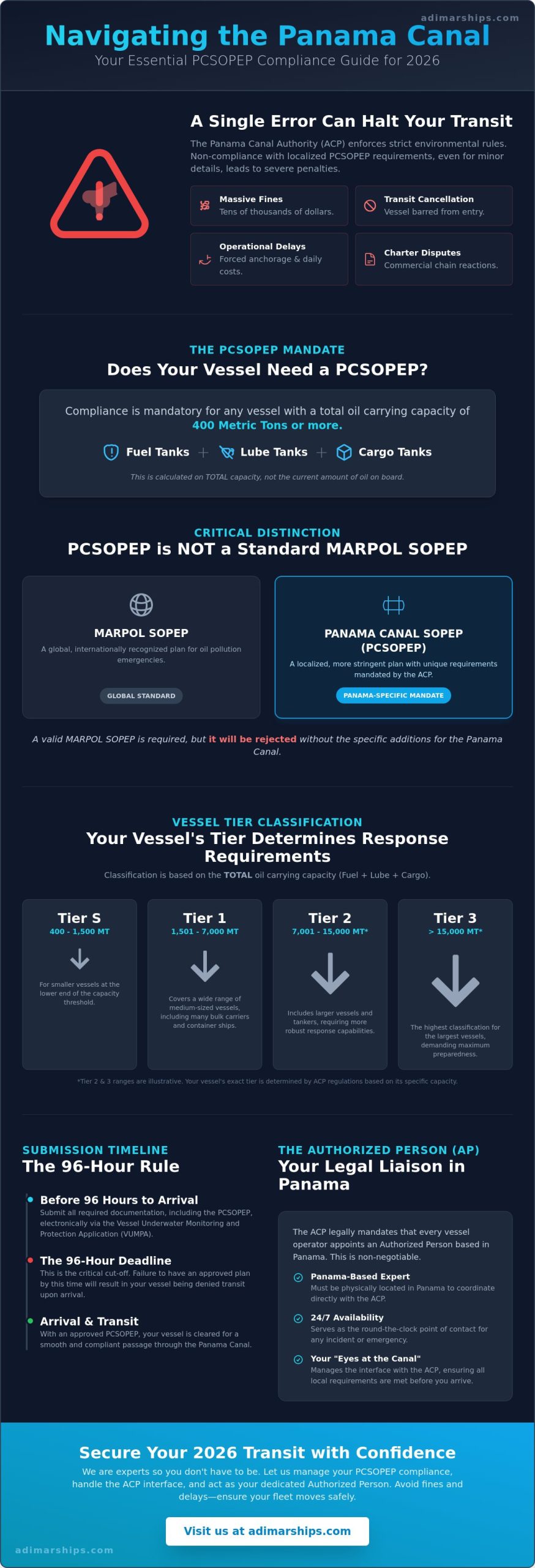
The Panama Canal SOPEP requirements apply to any vessel with an oil carrying capacity of 400 Metric Tons (MT) or more. This threshold is calculated based on the total capacity of all fuel, lube, and cargo tanks combined. The core objective is simple: protecting the Canal’s freshwater ecosystem. Gatun Lake isn’t just a transit lane; it’s the primary source of drinking water for over 50% of Panama’s population. Any spill would threaten both the national water supply and the operational continuity of a waterway that handles roughly 6% of global trade.
Failing to meet these standards carries a high price. The ACP doesn’t hesitate to impose fines that can reach tens of thousands of dollars. Beyond the immediate financial penalty, the greatest risk is transit cancellation. If your plan is expired, incorrect, or missing, your vessel will be barred from entering the locks. You’ll be forced to remain at anchorage, incurring daily fuel costs and potential charter party disputes, until the paperwork is corrected and approved.
The Legal Framework: ACP Chapter IX
The ACP maintains unique jurisdiction over its waters, which creates a regulatory environment different from standard international maritime law. While MARPOL Annex I provides a global baseline, ACP Chapter IX introduces specific local layers of accountability. These regulations ensure that every vessel has a pre-approved plan and a designated Authorized Person (AP) within Panama to coordinate emergency responses. Any vessel with a 400 Metric Ton (MT) or more oil carrying capacity must comply with the PCSOPEP mandate as defined in Chapter IX of the ACP regulations.
Who is Responsible for Compliance?
The responsibility for compliance sits with a hierarchy involving the Ship Owner, the Operator, and the Master. The ACP operates on a strict “no excuses” policy. They’ve made it clear that “ignorance of local rules” is never an acceptable defense for a vessel that arrives at the breakwater unprepared. The Master must ensure the physical plan is on board and that the crew is trained, while the Owner and Operator must ensure the plan is filed and the local fees are paid.
Because these rules are so specific, many owners rely on a trusted Ship Agency Panama to manage the interface with the ACP. We act as your eyes at the Panama Canal, ensuring your Panama Canal SOPEP requirements are fully met long before you reach the canal entrance. We’re experts so you don’t have to be, allowing you to focus on your business while we handle the technical compliance details that prevent costly delays.
PCSOPEP Vessel Tier Classifications: Where Does Your Ship Fit?
Understanding your vessel’s classification is the foundation of 2026 compliance. The Panama Canal Authority (ACP) uses a four-tier system to dictate the level of response readiness required for every transit. This classification isn’t a suggestion; it’s a rigid regulatory framework based on the total oil carrying capacity of your ship. We see many operators struggle because they focus on current cargo rather than total capacity.
The ACP calculates capacity by totaling the maximum volume of all oil carried, including fuel, lubricants, and cargo. If your vessel has a total capacity of 7,001 Metric Tons (MT), you’re a Tier 2 vessel, even if you’re transiting in ballast. Miscalculating this figure leads to immediate plan rejection. You can find the full technical breakdown in the official Panama Canal Authority vessel requirements. We are experts so you don’t have to be, ensuring your Panama Canal SOPEP requirements are met with precision before submission.
Tier S and Tier 1: Small to Medium Vessels
Vessels with a capacity between 400 MT and 1,000 MT fall under Tier S (Small). Tier 1 covers ships from 1,000 MT to 7,000 MT. While these are considered lower risk, they still require documented response capabilities and a verified PCSOPEP. You’ll need to provide specific tank plans and capacity plans to prove you belong in these categories. Documentation must be clear and match the ship’s actual configuration to avoid delays at the locks.
Tier 2 and Tier 3: Large Scale Compliance
Once you cross the 7,000 MT threshold, the compliance burden shifts significantly. Tier 2 (7,000 to 15,000 MT) and Tier 3 (over 15,000 MT) vessels must maintain active contracts with an authorized Oil Spill Response Organization (OSRO) in Panama. Tier 3 vessels require the highest level of pre-positioned response equipment. This ensures that resources are ready to deploy at a moment’s notice within the Canal’s jurisdiction.
The operational difference between Tier 2 and Tier 3 isn’t just paperwork; it involves higher fees and more rigorous verification of response readiness. If you’re unsure where your fleet stands, having a trusted partner at the Panama Canal can prevent the frustration of a rejected filing. We act as your local eyes on the ground, making sure your Panama Canal SOPEP requirements are handled with integrity and transparency. Avoiding a tier misclassification today saves you from costly transit delays tomorrow.
PCSOPEP vs. MARPOL SOPEP: Identifying the “Panama-Only” Elements
The #1 mistake ship owners make is assuming their global MARPOL SOPEP regulations compliance automatically satisfies the Panama Canal Authority (ACP). It doesn’t. While MARPOL provides the international framework for shipboard oil pollution emergency plans, the Panama Canal requires a localized, high-tier supplement known as the PCSOPEP. This is a standalone requirement for all vessels with a 400 gross tonnage (GT) or more.
The ACP enforces distinct Panama Canal SOPEP requirements that go beyond international standards. Unlike a standard SOPEP, which focuses on general shipboard spill prevention, the PCSOPEP is a tactical document. It demands specific reporting formats and full integration with the Canal’s Incident Management System (IMS). If your plan lacks Panama-specific contact lists or uses a generic reporting template, the ACP vetting team will reject it. We’ve seen clerical errors and outdated contact data lead to a 15% rejection rate during initial submissions.
Localized Response Strategies
The ACP requires a plan tailored to the unique geography of the waterway. Spills in the open ocean are managed differently than those in the restricted waters of Gatun Lake or the Culebra Cut. In these narrow channels, response times are measured in minutes. Your plan must account for the proximity of fresh water intakes and the physical constraints of the locks. For detailed guidance on who manages these local interactions, see our PCSOPEP Authorized Person Guide.
Mandatory Plan Components
A successful PCSOPEP approval hinges on 11 essential elements. These range from spill notification procedures to the identification of the Vessel Response Plan (VRP) for tankers. The most common omissions we see include:
- Local Spill Contractor Agreements: Proof of a contract with an ACP-approved Oil Spill Response Organization (OSRO).
- Authorized Person (AP) Details: The AP must be a Panama-resident individual or entity available 24/7 to act as a liaison with the ACP.
- Internal Reporting: Specific flowcharts showing how the crew communicates with the ACP’s Vessel Traffic Control.
Language and formatting are equally critical. All documentation must be in English. Even a minor deviation from the prescribed ACP reporting format can cause delays that result in missed transit slots. We are your eyes at the Panama Canal to ensure these technicalities don’t halt your operations. We are experts so you don’t have to be; we manage the paperwork with integrity to keep your schedule on track.
The 96-Hour Rule and the Submission Timeline
Timing is everything at the Panama Canal. The clock starts ticking long before your vessel reaches the breakwater; it begins with the precision of your documentation. Meeting the Panama Canal SOPEP requirements isn’t a suggestion. It’s a rigid operational mandate. The Autoridad del Canal de Panamá (ACP) operates on a schedule that leaves zero room for administrative errors. If your paperwork isn’t synchronized with your arrival, the financial fallout is immediate.
Success follows a strict four-step workflow:
- Step 1: Preparation. Your Authorized Person (AP) must vet your plan to ensure it aligns with the latest 2026 technical standards.
- Step 2: VUMPA Upload. The plan is submitted electronically through the Vessel Traffic Management and Maritime Services system.
- Step 3: The 96-Hour Window. You must confirm your notification at least 96 hours before arrival at Canal waters.
- Step 4: Real-Time Adjustments. Your team must be ready to handle ACP feedback or plan amendments within hours, not days.
We see ourselves as your local office at the Panama Canal. We are experts so you don’t have to be. By letting us manage this timeline, you eliminate the confusion that often leads to costly “vessel not ready” statuses.
Mastering the VUMPA Submission
The VUMPA portal is the digital gatekeeper of the waterway. For 2026, the ACP has updated technical requirements for all uploads. Documents must be in high-resolution, searchable PDF formats, typically under a 5MB limit per file to prevent system lag. A critical change for the 2026 roadmap is the mandatory use of encrypted digital signatures. Standard scanned signatures are no longer sufficient; they must be verified through recognized maritime certification authorities. If you time your submission poorly, you risk a “not ready” status, which places your vessel at the back of the transit queue regardless of your booking.
The Consequences of Late Notification
The ACP is unforgiving regarding the 96-hour rule. Data shows that even a minor 2-hour delay in submitting your notification can result in a 24-hour transit delay. This isn’t just lost time; it’s lost capital. When a vessel misses its slot, it may be subject to additional harbor fees and administrative fines that start in the thousands of USD $. Failing to meet the Panama Canal SOPEP requirements on time can also trigger mandatory inspections, further inflating your operational costs. For a deeper look at avoiding these bottlenecks, consult our Panama Canal Transit Guide.
Don’t let a clerical oversight derail your schedule. We are your eyes at the Panama Canal, ensuring every signature and timestamp is perfect. Nominate Adimar as your agent to secure your transit today.
The Authorized Person (AP): Your Legal Liaison in Panama
The Authorized Person (AP) isn’t just a point of contact. They’re a legal mandate under the Panama Canal SOPEP requirements. The ACP requires every vessel to designate a representative who resides within the Republic of Panama. This individual serves as the primary link between your ship and the Panama Canal Authority during any pollution incident. Because the Canal operates every hour of every day, your AP must be available 24/7. They act as your “Eyes at the Canal,” providing the immediate on-the-ground response that offshore offices simply can’t manage.
Beyond communication, the AP handles the critical “Letter of Guarantee.” This document ensures the ACP that funds are available to cover potential cleanup costs, preventing your vessel from being detained due to financial uncertainty. Without a valid AP and a secured guarantee, your transit could be canceled, leading to massive operational losses. We see ourselves as your local office at the Panama Canal, taking ownership of these legal burdens so you don’t have to.
AP Qualifications and Responsibilities
The AP plays a central role in the Incident Management System (IMS). If a spill occurs, they don’t wait for permission from a headquarters six time zones away. They have the legal authority to commit vessel funds immediately for cleanup and containment. This prevents minor leaks from becoming catastrophic legal and environmental liabilities. To meet ACP standards, an Authorized Person must be a legal resident of Panama with documented proficiency in the IMS and a deep understanding of local maritime response protocols.
Specific responsibilities include:
- Maintaining 24-hour communication with the Canal’s Marine Traffic Control Center.
- Coordinating with the Spill Response Organization (SRO) for immediate equipment deployment.
- Facilitating the immediate release of funds for emergency services without administrative delay.
- Serving as the legal representative in all proceedings following an incident.
Choosing Adimar as Your PCSOPEP Partner
With over 20 years of experience, Adimar Shipping understands that time is money at the Canal. We don’t just act as a middleman; we function as your local office in Panama. Our team eliminates the frustration of navigating Tier 1 and Tier 2 classifications, ensuring your PCSOPEP plan is technically sound and fully compliant with the 2026 Panama Canal SOPEP requirements. We prioritize integrity and transparency, so you’ll never face unexpected fines or delays.
Our expertise allows you to focus on your core business while we handle the complexities of maritime compliance. We’ve spent two decades building relationships with the ACP to ensure our clients receive the most efficient service possible. Don’t leave your transit to chance or generic agencies. Nominate Adimar as your PCSOPEP Authorized Person today to secure your vessel’s passage with a partner who sees what you see.
Secure Your 2026 Transit with Expert Compliance
Success at the Panama Canal depends on precise timing and adherence to ACP Chapter IX regulations. You need to identify your specific vessel tier and ensure all documentation hits the strict 96-hour submission window. Meeting the Panama Canal SOPEP requirements isn’t just about paperwork; it’s about having a legal liaison who understands the local landscape. We’ve spent 20 years acting as your eyes at the Panama Canal, providing the stability and integrity your fleet requires. Our team offers personalized, 24/7 coordination for all vessel tiers, ensuring you never face the frustration of a rejected plan or a delayed transit. We are experts in these specific maritime rules so you don’t have to be. Put your compliance in the hands of specialists who treat your business with the care it deserves. Every minute counts when your ship is approaching the locks. You can trust us to eliminate the confusion and keep your operations moving forward without interruption.
Get a Quote for PCSOPEP Authorized Person Services
Your next smooth transit starts with the right partner by your side.
Frequently Asked Questions
Is a MARPOL SOPEP sufficient for a Panama Canal transit?
No, a standard MARPOL SOPEP doesn’t meet the specific Panama Canal SOPEP requirements. The Panama Canal Authority (ACP) mandates a separate, locally approved PCSOPEP that includes specific notification procedures and a designated Oil Spill Response Organization (OSRO). You must have this canal-specific plan verified and on board before your vessel enters canal waters to avoid significant delays.
What is the minimum oil capacity that triggers PCSOPEP requirements?
Any vessel with an oil carrying capacity of 400 metric tons or more must comply with Panama Canal SOPEP requirements. This measurement includes all fuel oil used for propulsion and any oil carried as cargo. If your vessel meets this 400 metric ton threshold, you’re required to submit your plan for approval at least 96 hours before you arrive at the canal.
Does the Authorized Person (AP) need to be a resident of Panama?
Yes, your Authorized Person must be a resident of the Republic of Panama to comply with ACP regulations. The canal authorities require a local contact who is available 24/7 to act as a direct liaison during an emergency. We serve as your local office and eyes at the canal, ensuring your AP is always reachable to handle official communications and coordination.
How much are the fines for PCSOPEP non-compliance in 2026?
Fines for failing to meet Panama Canal SOPEP requirements can reach $25,000 per violation under the 2026 enforcement guidelines. Beyond the initial penalty, non-compliant vessels often face transit cancellations that lead to massive daily operational losses. It’s much more cost-effective to ensure your documentation is perfect before your ship reaches the breakwater.
Can I change my PCSOPEP Tier classification once the vessel is in transit?
You can’t change a vessel’s Tier classification once it has entered canal waters or began the arrival process. Tier levels are strictly based on the vessel’s total oil carrying capacity, such as Tier 1 for vessels carrying up to 7,000 barrels. You don’t want to risk a mismatch in data, so verify your capacity and Tier status during the initial filing.
What happens if I miss the 96-hour notification deadline?
Missing the 96-hour notification deadline usually triggers an administrative fine and can result in the loss of your scheduled transit slot. The ACP requires this lead time to verify your response contracts and safety documentation. If you realize a deadline has been missed, notify your ship agent immediately to attempt a late submission and minimize the impact on your schedule.
How long is a PCSOPEP approval valid for?
A PCSOPEP approval remains valid for four years from the date the ACP issues the compliance letter. You must re-submit the plan for approval if the vessel’s name, ownership, or technical oil capacity changes during that period. We track these expiration dates for our clients so they don’t face unexpected issues during a busy transit season.
What specific equipment must a Tier 1 vessel have on board?
Tier 1 vessels must maintain a minimum of 100 meters of containment boom and sufficient sorbent materials to manage small spills on deck. While the vessel relies on a shore-based OSRO for large-scale water recovery, these onboard tools are mandatory for immediate response. Our team helps you audit your spill kit to ensure every piece of equipment meets the 2026 technical standards.