
A single oversight in your documentation can trigger a $15,000 non-compliance fine before your vessel even reaches the Miraflores Locks. You likely already know that timing is everything in maritime logistics, and the pressure to meet the Panama Canal Authority’s strict 96-hour notification window is a constant source of stress. It’s frustrating when international MARPOL SOPEP plans fall short of the specific local requirements needed for a successful PCSOPEP authorization panama canal transit. We are experts so you don’t have to be, and we believe your focus should remain on your business, not on complex local paperwork.
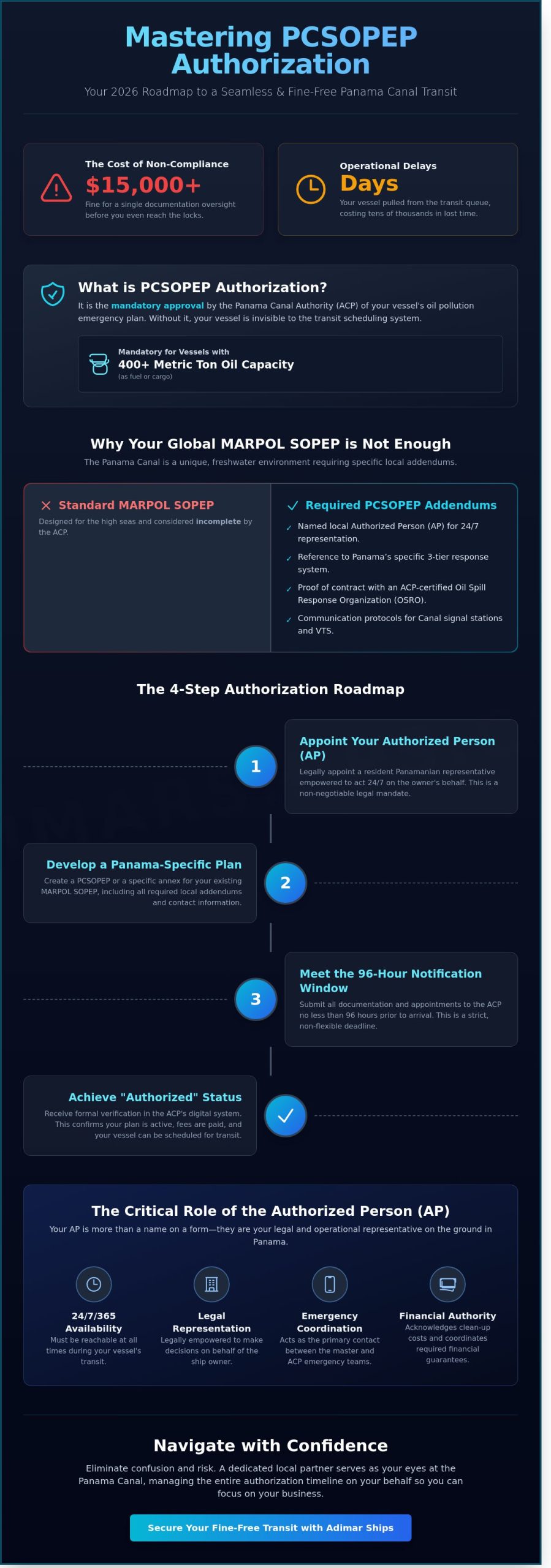
This guide provides the definitive 2026 roadmap to vessel approval, ensuring you master the mandatory oil pollution authorization process for a seamless, fine-free journey. You’ll learn exactly how to navigate the differences between international and ACP-specific plans while avoiding the common pitfalls that lead to costly delays at the locks. We will detail the essential steps for pre-arrival compliance and show you how a dedicated local partner can eliminate confusion by acting as your eyes at the Panama Canal.
Key Takeaways
- Understand why vessels exceeding the 400 MT oil capacity threshold must secure mandatory ACP approval to avoid transit delays and fines.
- Learn the legal necessity of appointing a resident Panamanian Authorized Person (AP) for 24/7 emergency representation during your transit.
- Navigate the step-by-step roadmap to secure your PCSOPEP authorization panama canal, including Tier classification and the critical 96-hour appointment rule.
- Identify the specific documentation and emergency plan requirements for Tier 1 and Tier S vessels to ensure full regulatory compliance.
- Discover how a transparent local partner serves as your eyes at the Panama Canal to manage the entire authorization timeline on your behalf.
What is PCSOPEP Authorization for the Panama Canal?
PCSOPEP authorization is the formal verification and approval by the Panama Canal Authority (ACP) of a vessel’s oil pollution emergency plan and its designated local representation. It’s not enough to simply have a plan on the bridge. Your vessel must achieve “Authorized” status within the ACP’s digital systems before you can even schedule a transit. This requirement is legally rooted in Chapter IX of the Maritime Regulations for the Operation of the Panama Canal, which dictates strict environmental safety protocols for all traffic through the waterway.
Almost every commercial vessel entering the canal falls under these rules due to the 400 Metric Ton threshold. If your vessel has a carrying capacity of 400 metric tons or more of oil as fuel or cargo, you must have a valid Panama Canal Ship Oil Pollution Emergency Plan (PCSOPEP) on file. Because most modern bulkers, tankers, and container ships far exceed this limit, authorization is a universal requirement for the global fleet. We are experts at this process so you don’t have to be, ensuring your documentation matches the ACP’s rigorous standards before you arrive at the locks.
The distinction between compliance and authorization is where many operators fail. You might be compliant with international law, but without the ACP’s official stamp of approval, your ship is effectively invisible to the scheduling system. Authorization confirms that your plan is active, your fees are paid, and your local responders are ready. We see ourselves as your local office at the Panama Canal, bridging the gap between your onboard manuals and the ACP’s administrative requirements.
Why Your Global MARPOL SOPEP is Not Enough
A standard MARPOL SOPEP is designed for the high seas, but the Panama Canal is a unique, freshwater environment with its own ecological risks. The ACP rejects generic international plans because they lack Panama-specific addendums. These missing pieces must include:
- Named local Authorized Persons (AP) who can act on behalf of the owner.
- Specific references to Panama’s three-tier response system.
- Proof of a contract with an ACP-certified Oil Spill Response Organization (OSRO).
- Communication protocols specific to the Canal’s signal stations and VTS.
Without these local details, your international plan is considered incomplete. The ACP requires a standalone document or a very specific Panama-specific annex that names your local representative who can be reached 24/7 during the transit.
The Consequences of Transit Without Authorization
Attempting to transit or even book a slot without active authorization leads to immediate and painful consequences. The ACP levies financial penalties for non-compliance that typically start at $15,000 for a standard violation. This fine doesn’t include the additional costs of emergency plan development or the administrative fees required to rectify the situation under pressure.
Beyond the money, the operational impact is often worse. If your authorization is flagged as expired or invalid, the ACP will pull your vessel from the transit queue. This can lead to delays of several days, costing your charterers tens of thousands in lost time. The Authorization Gateway stands as the primary hurdle for 2026 transits, dictating which vessels move smoothly and which remain anchored in costly uncertainty.
The Role of the Authorized Person (AP) in Your Authorization
Every vessel over 400 gross tons transiting the waterway must secure a valid PCSOPEP authorization panama canal. A critical component of this process is the appointment of an Authorized Person (AP). This isn’t a mere administrative formality; it’s a legal mandate established by the Panama Canal Authority (ACP) to ensure immediate response capabilities. The ACP requires a resident Panamanian representative who is legally empowered to act on behalf of the ship owner. If a spill occurs, the Canal won’t wait for a call to a headquarters in London or Singapore. They need someone on the ground who can make decisions instantly.
Your AP must be reachable 24/7/365. During an oil spill emergency, the AP serves as the primary contact point between the ship’s master and the ACP emergency teams. They coordinate the initial response and act as the vital bridge for communication. Beyond logistics, the AP holds significant financial weight. They’re responsible for acknowledging clean-up costs and coordinating the financial guarantees required by the ACP. Without an AP who understands the Official PCSOPEP Requirements, your vessel risks costly delays or denied entry into the canal waters.
Qualifications of a Valid Authorized Person
A valid AP must reside in the Republic of Panama. Your ship manager in London or Singapore cannot fulfill this role because they lack the local legal standing required by the ACP. Technical expertise is non-negotiable; the AP needs deep knowledge of the ACP Notice to Shipping N-12. Additionally, mandatory fluency in both English and Spanish is required for effective emergency coordination. Clear communication prevents $10,000 mistakes or even higher fines during high-pressure situations. The ACP maintains strict standards for these representatives to ensure the safety of the local environment.
Adimar Shipping, Inc.’s Role as Your ‘Eyes at the Canal’
We serve as your local office at the Panama Canal to manage the entire authorization lifecycle. With 20 years of experience navigating ACP regulatory shifts, we ensure your PCSOPEP authorization panama canal remains compliant and active. We act as your “eyes at the Canal,” providing the vigilance needed to protect your interests and your schedule. You can learn more about these requirements in our PCSOPEP Authorized Person: A Complete Guide. If you’re preparing for an upcoming transit, you can get a personalized quote to see how we can streamline your arrival.
Step-by-Step: How to Secure PCSOPEP Authorization
Securing PCSOPEP authorization panama canal is a rigid process where timing is everything. We handle the heavy lifting so you can focus on your voyage. The Panama Canal Authority (ACP) requires every vessel over 400 gross tons to follow a specific sequence of actions to ensure compliance. Following these five steps will keep your transit on schedule and avoid unnecessary costs.
- Step 1: Appointment of an Authorized Person (AP). You must designate a local AP at least 96 hours before your vessel arrives. This person acts as the liaison between the ship and the ACP for all oil spill response matters.
- Step 2: Tier Classification. Your vessel is categorized based on its oil carrying capacity. Tier 1 is for vessels under 7,000 barrels, Tier 2 covers 7,000 to 15,000 barrels, and Tier 3 is for any vessel exceeding 15,000 barrels.
- Step 3: Plan Submission. We upload your specific PCSOPEP document directly into the VUMPA system. This document must detail your ship’s specific spill prevention and response strategies.
- Step 4: Verification. The ACP conducts a thorough review of the submitted plan. They check the AP’s credentials and ensure the vessel’s response equipment meets local standards.
- Step 5: Confirmation. Once the ACP is satisfied, they issue the official authorization status. You’ll see this updated in the maritime portal, clearing you for the upcoming transit.
Mastering the 96-Hour Rule
The 96-hour pre-arrival notification (PAN) isn’t just a suggestion. It’s a hard deadline. Missing this window often leads to immediate transit delays or administrative fines. Clerical errors are the most common reason for rejection. A simple typo in the IMO number or an outdated contact for the AP can trigger an automatic system bounce. We act as your eyes at the Panama Canal, reviewing every data point before it hits the ACP’s desk. This proactive approach relies on industry guidance on PCSOPEP to ensure the AP is fully prepared to take financial responsibility if an incident occurs.
Navigating the VUMPA System
The Maritime Service Portal, known as VUMPA, is the digital nerve center for all Canal logistics. It handles every piece of PCSOPEP authorization panama canal data for your vessel. Technical hurdles often arise when uploading large plan files or when the system fails to sync with the vessel’s previous records. If the portal doesn’t show a “verified” status, your ship won’t move. Your local agent must provide real-time status monitoring to catch these glitches early. We don’t wait for the system to fail; we verify the upload immediately to keep your transit timeline intact. Time is money, and a single day of delay at the locks can cost thousands of dollars in fuel and port fees.
Tier Classifications and Their Authorization Requirements
The Panama Canal Authority (ACP) uses a tiered system to categorize vessels based on their oil carrying capacity. This classification isn’t just a label; it directly dictates the complexity of your PCSOPEP authorization panama canal and the specific response resources you’re legally required to have on standby. Understanding where your vessel fits is the first step in avoiding costly delays at the locks.
- Tier S (Small): This category is reserved for specialized vessels with minimal oil capacity, typically under 400 Metric Tons (MT). While the requirements are less stringent, these vessels still need a verified plan to transit.
- Tier 1: This is the standard commercial bracket for vessels with an oil capacity between 400 MT and 1,000 MT. Most mid-sized bulkers and container ships fall into this category.
- Tier 2 & 3: These tiers are for large-scale operators. Tier 2 covers vessels with 1,000 MT to 7,000 MT of oil, while Tier 3 applies to anything exceeding 7,000 MT. This includes massive tankers and Neo-Panamax container ships that require the highest level of response readiness.
Tier 1 vs. Tier 2: Key Differences for Operators
The jump from Tier 1 to Tier 2 is significant. For Tier 1, the ACP requires basic equipment and personnel coordination. However, Tier 2 authorization demands a much more robust local response setup. You’ll need to prove that your Oil Spill Response Organization (OSRO) has the specialized gear and manpower to handle a larger discharge. Operators often underestimate this shift and face last-minute rejections. You can find a detailed breakdown of these evolving standards in our PCSOPEP 2026 Compliance Guide.
Annual Authorization Renewals
A PCSOPEP authorization panama canal isn’t a “set it and forget it” document. It’s typically valid for only one year. You must track your expiration dates closely because the ACP won’t allow a vessel to schedule a transit with an expired plan. It’s also vital to remember that any change in vessel ownership or management immediately voids your current authorization. You’ll need to submit a completely new plan under the new entity’s name.
For fleet managers, the Annual Re-validation process is a non-negotiable task that involves updating contact lists, response contracts, and vessel specifics to ensure the ACP database remains accurate. We are experts so you don’t have to be. If your renewal date is approaching, contact Adimar Shipping for a personalized compliance review to keep your fleet moving without interruptions.
Why Adimar is Your Trusted Partner for PCSOPEP Authorization
Adimar Shipping has spent 20 years serving as your eyes at the Panama Canal. We understand that in the maritime world, time is money. Misjudge your timing and you lose. Our team eliminates that risk by providing a personalized service that manages the entire PCSOPEP authorization panama canal timeline for you. We are the experts so you don’t have to be. By putting your transit in our hands, you remove the confusion of dealing with complex regulatory filings and shifting deadlines.
Integrity is at the heart of every interaction we have. We offer clear, upfront communication regarding all ACP requirements and fees. You won’t encounter hidden costs or unexpected surcharges when working with us. Our deep-rooted relationships with ACP authorities allow us to resolve authorization snags quickly. If a document is flagged or a tier assessment is questioned, we step in immediately to provide solutions. This local expertise is vital for maintaining a smooth schedule.
Proactive management is the key to cost-efficiency. A single day of delay at the canal can result in thousands of dollars in operational losses. We prevent these “hidden” costs by identifying potential issues before they become fines. Our team ensures your PCSOPEP authorization panama canal is active and compliant well before your vessel reaches the locks. We see ourselves as your local office in Panama, working tirelessly to protect your bottom line.
Beyond Authorization: Full Ship Agency Services
We believe in a holistic approach to maritime logistics. Adimar integrates your authorization needs with comprehensive transit clearance and husbandry services. Having a single partner for all Panama Canal operations reduces the margin for error and streamlines communication. You can find detailed insights on these integrated solutions in our guide, Ship Agency Panama: Your Guide to a Smooth Canal Transit. This coordination ensures that from the moment your vessel arrives until it clears the canal, every detail is managed with precision.
Get Your 2026 Authorization Quote
Planning ahead is the best way to secure your transit windows for the coming years. We invite you to nominate Adimar Shipping as your Authorized Person for your upcoming voyages. By providing your vessel specifications, our team can deliver a rapid assessment of your required tier and a transparent quote for the authorization process. Don’t leave your compliance to chance. Contact Adimar Shipping for PCSOPEP Authorization today to secure a reliable partner for your next Panama Canal transit.
Secure Your 2026 Transit with Expert PCSOPEP Oversight
Navigating the 2026 roadmap for vessel approval requires a proactive approach to ACP compliance. You must understand your vessel’s Tier classification and ensure your spill response plans meet the latest Panama Canal Authority standards. This isn’t a process you should leave to chance. Miscalculating your requirements leads to costly delays and administrative frustration in a market where time is money.
Adimar serves as your local office and eyes at the Panama Canal. We bring 20 years of maritime expertise to every transit, providing Red Dot level precision to ensure your documentation is flawless. Our team maintains 24/7/365 local availability, so you’re never without support during a critical window. We handle the complexities of PCSOPEP authorization panama canal so you can focus on your core business operations. We are the experts so you don’t have to be.
Don’t let regulatory hurdles disrupt your schedule. Nominate Adimar as Your PCSOPEP Authorized Person today and experience the security of a partnership built on integrity and local knowledge. Your smooth transit is our priority.
Frequently Asked Questions
What is the difference between SOPEP and PCSOPEP?
SOPEP is a global MARPOL requirement for vessels over 400 gross tons, while PCSOPEP is a site-specific regulation mandatory for the Panama Canal. While your standard SOPEP covers international waters, the PCSOPEP requires a local Authorized Person and a verified agreement with a Panama-based Oil Spill Response Organization. It’s a specialized layer of protection designed specifically for the unique environment of the Canal.
Who can serve as an Authorized Person (AP) for the Panama Canal?
An Authorized Person must be an individual or entity residing in the Republic of Panama who is officially registered with the Panama Canal Authority. They act as the legal liaison between your vessel and the ACP, holding the power to commit funds for spill response efforts. We act as your eyes at the Panama Canal to ensure your AP is properly designated and ready to respond 24/7 if an incident occurs.
What is the fine for arriving at the Panama Canal without PCSOPEP authorization?
Vessels arriving without valid PCSOPEP authorization panama canal documentation often face administrative fines ranging from $2,500 to $10,000 USD. Beyond the initial fine, the ACP will likely delay your transit until the plan is approved and an Authorized Person is appointed. These delays can cost owners over $20,000 USD per day in lost charter time and additional operational overhead.
How long does it take to get a PCSOPEP plan authorized?
The Panama Canal Authority typically requires 96 hours to review and authorize a plan once it’s submitted through the official channels. We recommend starting the process at least 30 days before your arrival to account for any requested revisions or documentation updates. If your paperwork is incomplete, the review cycle can restart, which is why early coordination with your agent is vital for a smooth transit.
Does every vessel transiting the Panama Canal need PCSOPEP authorization?
PCSOPEP authorization panama canal is only mandatory for vessels with an oil carrying capacity of 400 metric tons or more. This calculation includes both your fuel oil and any oil carried as cargo. If your vessel falls below this 400 metric ton threshold, you’re exempt from the formal PCSOPEP filing, though you must still follow general ACP pollution prevention guidelines during your transit.
Can I use my ship agent as my PCSOPEP Authorized Person?
Yes, you can designate your ship agent as your Authorized Person provided they are registered and certified by the ACP for that role. This is a common choice for many owners because it simplifies communication and ensures the person handling your logistics also manages your compliance. It’s a practical way to eliminate confusion and ensure that one trusted partner handles every aspect of your arrival.
What happens if I miss the 96-hour notification deadline for authorization?
Missing the 96-hour pre-arrival notification window usually triggers a mandatory vessel inspection and a fine starting at approximately $1,000 USD. Your vessel might also lose its scheduled transit slot, leading to expensive wait times in the bay. We work to prevent these issues by verifying all documentation in the VUMPA system well before the ACP’s strict deadlines.
Is PCSOPEP authorization required for vessels in ballast?
Authorization is required for vessels in ballast if their total oil fuel capacity is 400 metric tons or higher. The ACP bases the requirement on the vessel’s potential to cause a spill, not the actual volume of oil on board at the time of transit. Even if your cargo tanks are empty, your bunker capacity determines your compliance status, so don’t overlook this during your voyage planning.