
Misjudging a crew change window by just two hours at the Panama Canal can trigger cascading delays that cost your operation thousands of dollars in avoidable fees. You already know that managing a vessel transit from a distance feels like flying blind, especially when you’re worried about hidden port costs or a sudden medical emergency on board. This uncertainty often leads ship owners and charterers to ask, what is a husbandry agent, and why is this role so critical for a successful transit? We’re experts in this field so you don’t have to be.
In this guide, you’ll discover how a husbandry agent serves as your essential local partner, managing crew welfare, supplies, and local compliance to ensure a seamless journey through Panamanian waters. We’ll clarify the differences between husbandry and general agency services while providing a 10 point checklist of what to expect from a top tier provider. You’ll gain the confidence needed to choose a partner who acts as your eyes at the Panama Canal, ensuring your vessel stays on schedule and your budget remains intact.
Key Takeaways
- Learn the critical distinction between cargo-focused agency and vessel-focused support by understanding what is a husbandry agent and how they represent your interests on the ground.
- Discover how expert local coordination manages the “vessel’s clock” to overcome the unique timing frustrations and logistical bottlenecks inherent to the Panama Canal.
- Identify the essential services that keep your vessel moving, including seamless crew changes, visa management, and the efficient “last mile” delivery of technical spares.
- Understand how an Owner’s Protective Agency (OPA) serves as your ultimate safeguard, providing a second layer of oversight and integrity during complex maritime operations.
- Gain insights into choosing a partner in Panama who offers the personalized service and rapid communication necessary to eliminate confusion and protect your bottom line.
Defining the Husbandry Agent: More Than Just a Port Representative
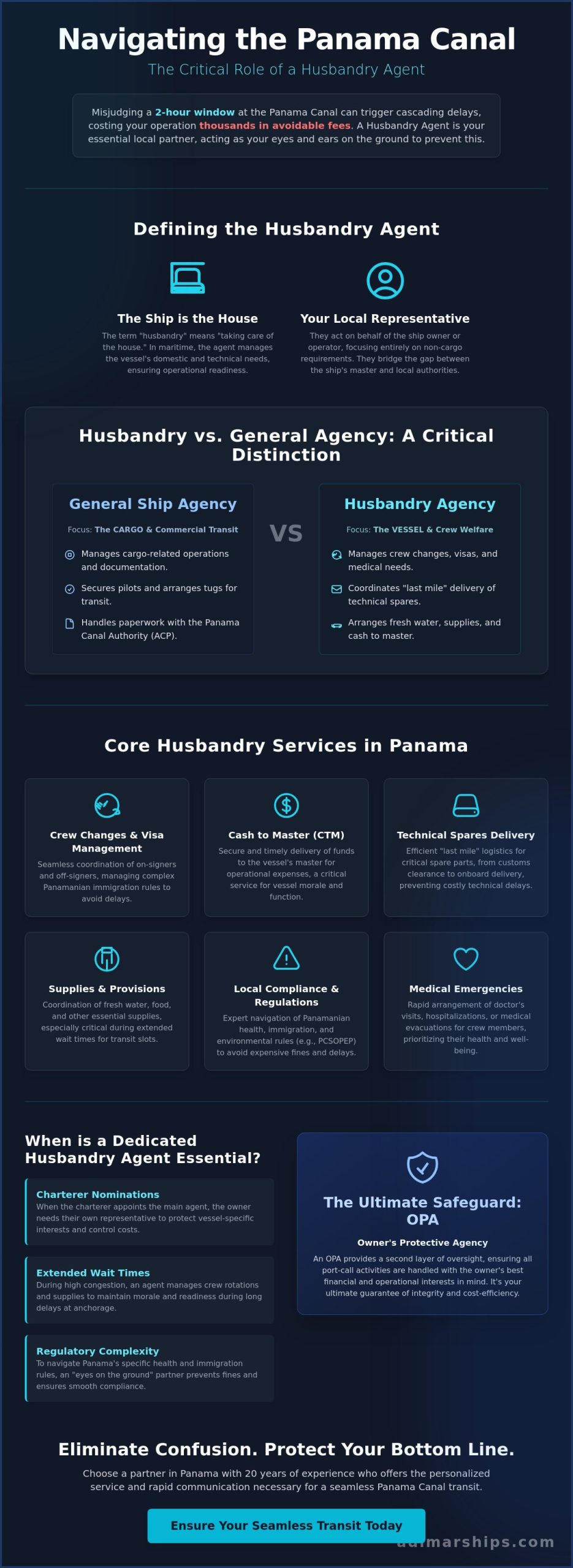
In the maritime industry, time is money. When a vessel enters a port or prepares for a complex crossing like the Panama Canal, two distinct sets of needs arise. One involves the cargo and the commercial contract. The other involves the ship itself and the people living on it. To understand what is a husbandry agent, you have to look at the vessel as a moving household. A husbandry agent acts as the local representative for a ship owner or operator, focusing entirely on non-cargo vessel requirements. They are your eyes at the port, ensuring that the operational side of the voyage never stalls.
The term husbandry stems from the historical practice of “taking care of the house.” In a maritime context, the ship is the house. The agent manages the domestic and technical needs that keep the vessel running. They serve as the critical bridge between the ship’s master, local authorities, and third-party suppliers. Whether it’s coordinating a technician for a sudden engine repair or arranging a doctor’s visit for a crew member, the agent handles the logistics so the captain can focus on safe navigation.
Husbandry vs. Ship Agency: Clearing the Confusion
The roles within a Shipping agency often overlap, but the distinction between general agency and husbandry is vital for cost control. General agency focuses on the commercial transit. This includes securing pilots, arranging tugs, and managing documentation with the Panama Canal Authority (ACP). Husbandry focuses on the human and mechanical needs of the vessel. This includes fresh water delivery, spare parts logistics, and crew changes. This partnership ensures that a Panama Canal transit remains on schedule through the seamless coordination of cargo clearance and crew welfare.
When Do You Need a Dedicated Husbandry Agent?
There are specific scenarios where hiring a specialized husbandry representative is a strategic necessity rather than an option. These situations often involve protecting the owner’s interests when the primary agent has different priorities.
- Charterer Nominations: Often, the charterer nominates the primary port agent to handle cargo. The ship owner should appoint their own husbandry agent to ensure vessel-specific tasks are handled with integrity and cost-efficiency.
- Extended Wait Times: During periods of high congestion at the Panama Canal, ships may wait days for a transit slot. A husbandry agent manages crew rotations and supplies during these delays to prevent morale or supply issues.
- Regulatory Complexity: Panama has specific health and immigration rules. Local agents provide the “eyes on the ground” to manage these requirements in USD ($), preventing expensive fines or delays.
We are experts so you don’t have to be. By separating husbandry from general transit duties, ship operators gain a dedicated partner who prioritizes the vessel’s operational readiness above all else.
Why Husbandry Services are Critical for Panama Canal Transits
The Panama Canal is a unique maritime bottleneck where timing and coordination are often difficult and frustrating. It’s a high-stakes environment where a single hour of delay can ripple through a global shipping schedule. While the Panama Canal Authority (ACP) manages the transit clock, your husbandry agent manages the vessel’s clock. This distinction is vital. The ACP focuses on moving hulls through the locks; the husbandry agent focuses on the specific needs of the ship, its cargo, and its crew.
Understanding what is a husbandry agent requires seeing them as your eyes at the Panama Canal. When you’re operating from an office in London or Singapore, you can’t see the local weather changes or the congestion at the anchorage. A local expert identifies quick solutions that save thousands of USD in port fees by anticipating these shifts. We act as a proactive partner to ensure your vessel stays on schedule, leveraging Adimar’s 20 years of experience to navigate local complexities.
Managing Local Regulations and Compliance
Navigating the specific requirements of the PCSOPEP authorized person is essential for oil pollution compliance in Panamanian waters. We ensure all documentation for inbound and outbound passage is handled with absolute integrity and transparency. Our team manages the liaison with Panama immigration and health authorities to ensure smooth port entry. One missing signature can delay a ship for 24 hours; we prevent these bureaucratic errors that often catch foreign owners off guard.
The ‘Time is Money’ Factor in Panama
In this region, time is money. A delay in husbandry, such as a late spare part delivery or a slow crew change, can cause a vessel to miss its assigned transit slot. Missing a slot can result in days of waiting and massive financial penalties. Excellent communication is our standard. We provide real-time updates so you can make informed decisions. We don’t just act as a third-party vendor; we view ourselves as your local office at the Panama Canal. If you need a partner who understands these commercial pressures, you can nominate Adimar as your agent to secure your next transit and protect your bottom line.
Core Services: What Does a Husbandry Agent Actually Do?
Understanding what is a husbandry agent starts with looking at the “non-cargo” side of shipping. While a port agent handles the vessel’s business with the terminal, the husbandry agent manages the ship’s needs as a living, breathing entity. In a high-traffic zone like the Panama Canal, where roughly 14,000 vessels transit annually, these services keep operations from grinding to a halt. We act as a local extension of your office, managing the logistics that ship owners don’t have the time to handle from thousands of miles away.
Financial management is a major part of this role. We handle “Cash to Master” (CTM) deliveries, ensuring the Captain receives physical USD for crew wages and incidentals safely. This process requires secure transport and strict documentation to comply with local maritime regulations. We also manage local disbursements, paying port authorities and suppliers on your behalf to keep your accounts transparent and efficient.
Crew Welfare and Medical Assistance
Managing crew changes in Panama involves much more than a simple taxi ride. We coordinate the entire chain: securing visas, arranging 24/7 transportation, and booking hotels for incoming and outgoing seafarers. If a crew member falls ill, we arrange emergency medical evacuations or specialized medical appointments in Panama City’s top hospitals. Provisioning is another vital task where we source high-quality fresh water, fresh food, and specific engine stores to restock the vessel. Taking care of a crew far from home is a core brand value that defines how we protect your most important assets.
Technical and Spares Coordination
Specialized engine parts often need to reach a ship during its narrow transit window. The complexity of getting these spares through Panama customs shouldn’t be underestimated. We manage the “last mile” logistics, ensuring a critical component reaches the vessel without delaying the schedule. This often involves coordinating with bunkering services in Panama to ensure fuel quality and timely delivery coincide with other technical stops.
When a vessel requires urgent maintenance, we act as the bridge to local experts. We coordinate with:
- Local workshops for emergency engine or deck repairs.
- Certified divers for hull inspections and underwater cleaning.
- Technical surveyors to document vessel condition.
Time is money in this industry. We provide quick solutions so you don’t have to worry about the details. By serving as your eyes at the Panama Canal, we ensure every local contractor performs their job correctly and every spare part is accounted for before the ship moves to open water.
Owner’s Protective Agency (OPA): The Ultimate Husbandry Safeguard
A Protective Agent is an expert appointed specifically to oversee the operations of another agent. When understanding what is a husbandry agent, it’s vital to recognize that roles often split based on who pays the freight. In many Panama Canal transits, the charterer holds the right to nominate the primary ship agency in Panama. While that agent handles the vessel’s basic needs, their primary loyalty lies with the charterer. This can leave the ship owner vulnerable to overlooked details or inflated costs.
We act as your vigilant protector. We serve as a check and balance system to ensure the charterer’s agent doesn’t cut corners at your expense. Our team monitors every step of the process. We verify that your ship’s interests aren’t sidelined. We are your eyes at the Panama Canal, providing the security you need to focus on your broader business goals. We don’t just watch; we intervene when necessary to protect your bottom line.
Protecting Your Interests in a Charterer-Led Transit
When a charterer manages the transit, the financial paperwork can become complex. We meticulously review Disbursement Accounts (DAs) for accuracy and fairness. We’ve seen cases where local port fees or pilotage charges were miscalculated, leading to unnecessary $500 or $1,200 overages that add up quickly. We also verify that your vessel receives the priority it deserves at the canal locks. For a deeper dive into these protections, read our Owner’s Nominated Agency guide. We ensure the primary agent follows all Panama Canal Authority (ACP) regulations without compromise.
The Value of an Independent Eye
Transparency is the most important trait in a protective agent. Our OPA services prevent the confusion and delays that often happen when communication breaks down between multiple parties. We eliminate the “middleman” fog by providing direct, honest reporting. In a recent 2023 operation, our team spotted a coordination window that the primary agent missed. By stepping in, we saved the owner 12 hours of idle time. This proactive approach prevents billing errors before they reach your desk. We are experts so you don’t have to be. We handle the technicalities so you can maintain a profitable voyage.
Don’t leave your vessel’s safety and finances to chance during a charterer-led transit. Nominate Adimar as your protective agent to secure your interests today.
Choosing the Right Husbandry Partner in Panama
Selecting a partner to manage your vessel’s needs requires more than just a search for the lowest price. In the maritime industry, time is money. Misjudge your timing at the Panama Canal and you lose thousands of dollars in operational costs. When you ask what is a husbandry agent, you’re looking for a partner who understands that every minute counts. You need a team with a proven local reputation and communication speed that matches the 24/7 nature of global shipping.
Many global agencies use a “one-size-fits-all” portal that can feel distant and rigid. This often leads to delays when unexpected issues arise. A personalized service model is superior because it provides direct access to decision-makers who know the local terrain. Shipping never sleeps, especially at the Panama Canal where transit windows are tight. You need a partner who is available at 03:00 to handle a crew medical emergency or a last-minute spare part delivery without hesitation.
- Local Experience: Deep knowledge of Panama Maritime Authority regulations and terminal requirements.
- Communication: Immediate, proactive responses that eliminate confusion for owners and charterers.
- Transparency: Clear reporting and honest fee structures that prevent hidden costs.
The Adimar Advantage: 20 Years of Integrity
Adimar Shipping has spent two decades refining our role as specialized Panama Canal ships agents. We don’t just process paperwork; we serve as your “local office” on the ground. Our commitment is to provide high quality, timely services with integrity every time. We are your eyes at the Panama Canal, ensuring that your interests are protected while you focus on your core business. We are experts so you don’t have to be.
Next Steps: Nominate Adimar for Your Next Transit
Getting started with a new agent shouldn’t be a hurdle. Our “Quick Solutions” approach makes onboarding new vessels efficient and stress-free. Whether you need a full husbandry package or a protective agent to oversee a specific transit, we’re ready to assist. To request a quote or nominate Adimar as your agent, reach out to our team with your vessel details. Contact Adimar Shipping today to secure a trusted local partner in Panama and put your transit in expert hands.
Maximize Your Efficiency at the Panama Canal
Understanding what is a husbandry agent reveals why these specialized services are the backbone of every successful maritime operation. You can’t afford to misjudge timing at the Panama Canal, where even minor coordination errors lead to significant operational delays and unnecessary costs. A dedicated agent manages essential non-cargo tasks like crew changes, medical assistance, and technical spares, ensuring your vessel stays compliant with all Panama Canal Authority (ACP) regulations. Since we’re celebrating our 20th year in business, Adimar understands the nuances of local requirements better than anyone else in the region. We act as your eyes at the canal, providing the integrity and transparency you need to focus on your core business goals. As an authorized PCSOPEP representative, we eliminate confusion and manage every detail with precision. We’re the experts so you don’t have to be. Let us protect your interests and keep your schedule on track with personalized, proactive local support.
Nominate Adimar as your trusted husbandry partner at the Panama Canal today.
We look forward to ensuring your next transit is your most efficient and stress-free journey yet.
Frequently Asked Questions
What is the difference between a ship agent and a husbandry agent?
A ship agent manages the commercial and regulatory aspects of a port call, while a husbandry agent focuses on the vessel’s internal needs like crew and supplies. General agents deal with the Panama Canal Authority (ACP) for transit scheduling and tolls. Husbandry agents coordinate local logistics such as fresh water delivery or medical visits. This distinction ensures the ship’s operation and its crew’s welfare remain separate priorities.
Is husbandry service mandatory for a Panama Canal transit?
Husbandry services aren’t legally mandatory for a Panama Canal transit, but they’re essential for operational efficiency. While the ACP requires a licensed port agent for transit clearance, you don’t have to book husbandry. However, 95 percent of vessels utilize these services to avoid delays when picking up spares or swapping crew. Without a dedicated agent, managing local vendors in Balboa or Cristobal becomes nearly impossible for a foreign owner.
What does ‘Cash to Master’ mean in husbandry services?
‘Cash to Master’ refers to the physical delivery of secure funds to the ship’s Captain for onboard operational expenses. This service allows the Master to pay crew wages or purchase local provisions without using electronic transfers. In Panama, husbandry agents coordinate with local banks and security teams to deliver these funds safely while the vessel is at anchor. It’s a critical service for maintaining morale and immediate purchasing power.
Can one agent handle both general agency and husbandry?
Yes, a single provider like Adimar Shipping can manage both general agency and husbandry duties simultaneously. This integrated approach reduces communication gaps and streamlines the 24 hour coordination required for a smooth transit. By using one firm, you ensure that understanding what is a husbandry agent becomes a seamless extension of your port agency. It often results in lower total agency fees because of consolidated logistics and reporting.
How do husbandry agents handle crew changes in Panama?
Husbandry agents handle crew changes by coordinating with Panama’s National Migration Service and the Ministry of Health. They manage every step from airport pickup at Tocumen International to launch boat transport at the Pacific or Atlantic terminals. Agents secure the necessary 72 hour transit visas and arrange hotel stays if flights don’t align with vessel arrival. This local expertise prevents costly delays that can reach $5,000 per day in extra vessel waiting time.
What are the typical costs associated with husbandry services?
Costs for husbandry services typically consist of a flat agency fee plus the actual cost of third party services. While we don’t quote specific internal rates, the ACP publishes a tariff for official transit fees. Husbandry agents charge for specific interventions like ‘Cash to Master’ delivery or spare parts clearance. These fees are transparent and listed in the Proforma Disbursement Account provided before the vessel arrives in Panamanian waters.
How does a husbandry agent assist with PCSOPEP compliance?
A husbandry agent ensures your vessel meets the Panama Canal Shipboard Oil Pollution Emergency Plan (PCSOPEP) requirements before arrival. They verify that the vessel has a valid contract with an authorized Oil Spill Response Organization (OSRO) as mandated by ACP regulations. Since January 2005, all vessels over 400 gross tons must comply. Your agent acts as the local point of contact for these environmental responders, ensuring all documentation is filed correctly to avoid transit rejection.
What happens if a vessel needs emergency repairs during transit?
If a vessel requires emergency repairs, the agent immediately notifies the Panama Canal Authority to coordinate a safe anchorage or layover berth. They then mobilize local technical workshops and class surveyors to board the vessel. Knowing what is a husbandry agent helps in these moments, as they manage the logistics of getting specialized technicians and heavy tools to the ship. This rapid response minimizes the impact on the vessel’s scheduled transit slot.