
A single oversight in a 2026 crew schedule can trigger a $5,000 spike in unexpected launch boat fees and logistics penalties before your vessel even reaches the locks. You already know that in the maritime industry, time isn’t just money; it’s your reputation for reliability. Coordinating a vessel crew change panama shouldn’t feel like a gamble against local bureaucracy or shifting arrival windows.
We’ve designed this guide to help you master the complexities of Panama’s maritime corridor with expert insights into the latest 2026 regulations and port-specific logistics. You’ll learn how to implement cost-saving coordination strategies that protect your bottom line while ensuring zero-delay rotations. We’ll preview the essential visa requirements for diverse nationalities and show you how a professional “meet and greet” service secures seafarer safety. By the end of this article, you’ll have a clear roadmap for transparent cost reporting and efficient husbandry services that keep your fleet moving without the usual headaches.
Key Takeaways
- Learn how to leverage Panama’s “Zero Deviation” advantage to conduct crew rotations at anchorage, saving significant time and operational costs during Canal transits.
- Navigate the 2026 documentation requirements for a vessel crew change panama, including Seafarer Visa timelines and the essential role of local agents in managing USD-denominated costs.
- Compare the logistical strengths of Balboa and Cristobal to select the optimal port for your specific launch-boat rotations and anchorage needs.
- Streamline the transition from Tocumen International Airport (PTY) to the vessel with professional coordination strategies that align flight schedules with your ship’s arrival.
- Understand why a specialized husbandry agent serves as your trusted “eyes on the ground,” managing complex local regulations so you can focus on your core business.
Why Panama is the World’s Most Strategic Crew Change Hub in 2026
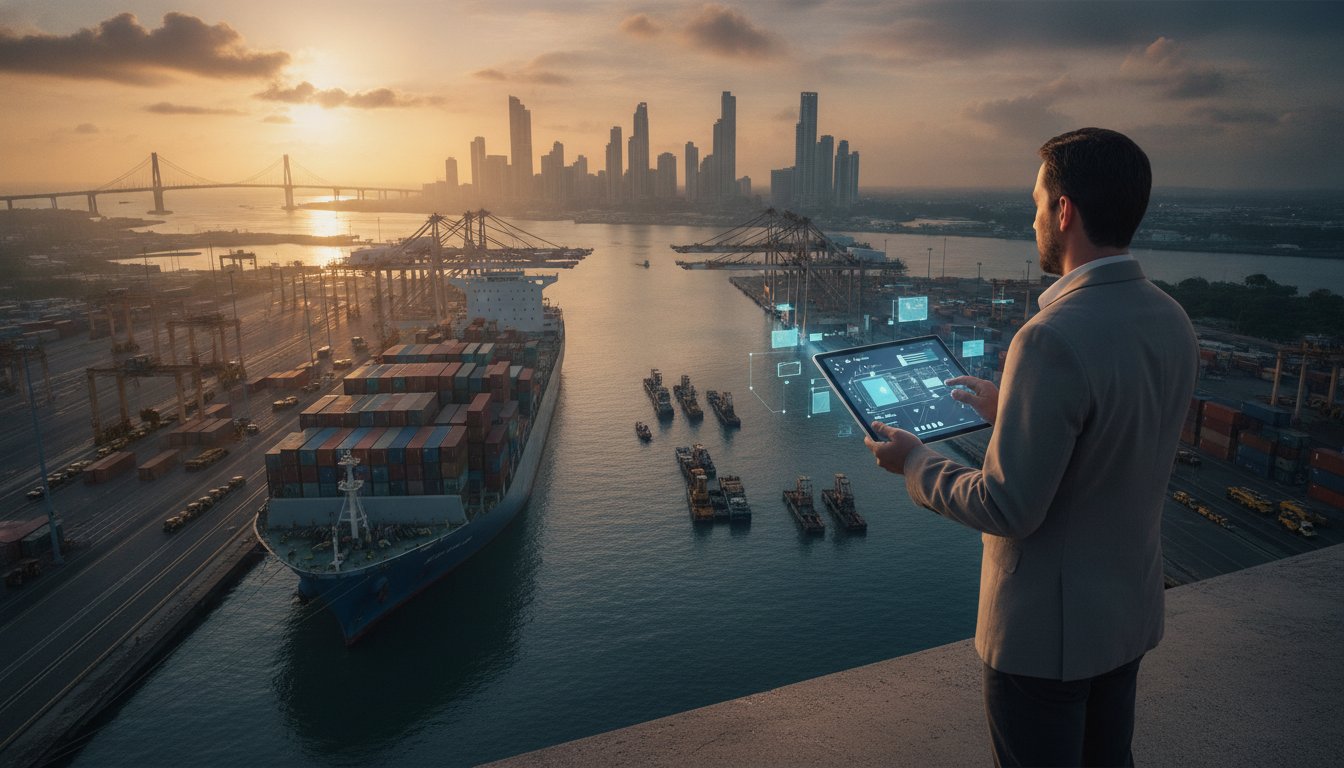
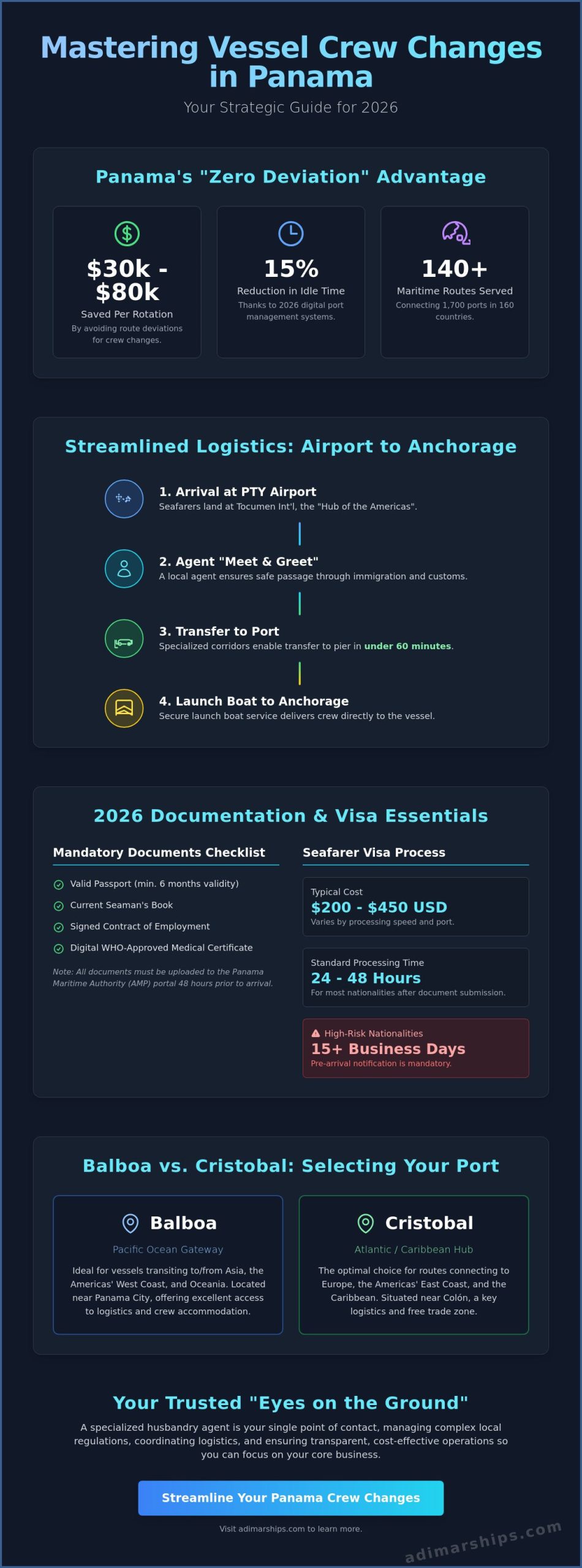
Panama’s geographical position makes it the inevitable crossroads of global maritime trade. For ship owners, performing a vessel crew change panama isn’t just a logistical necessity; it’s a calculated financial decision. The Panama Canal serves over 140 maritime routes, connecting 1,700 ports in 160 countries. This natural bottleneck creates a “Zero Deviation” opportunity. Vessels don’t have to steer off course or waste thousands of dollars in fuel to reach a port for rotations. They perform crew swaps at anchorage while waiting for their scheduled transit time. This efficiency saves operators an estimated $30,000 to $80,000 per rotation compared to deviating to other regional hubs in the Caribbean or Pacific.
The economic impact of Panama’s maritime infrastructure extends beyond fuel savings. By 2026, the integration of digital port management systems has reduced vessel idle time by 15%. This means your crew is moved quickly, safely, and without the hidden costs of extended port stays. We understand that time is money in this industry. Our role is to ensure your vessel stays on schedule while your crew transitions seamlessly.
The Hub of the Americas: Connectivity and Logistics
Tocumen International Airport (PTY) remains the primary engine behind Panama’s logistics dominance. By 2026, the completion of specialized seafarer transit corridors at PTY has reduced transit times from the terminal to the pier to under 60 minutes. The airport offers direct flights to major labor sources, including the Philippines, India, and Eastern Europe. This connectivity is vital for minimizing travel fatigue. Local infrastructure includes over 20,000 hotel rooms in Panama City and world-class medical centers. These facilities ensure off-signing crew members receive immediate care or rest before their long-haul flights home. For those planning a well-deserved vacation after their maritime contract, you might check out Indonesia en tus Manos for expert-led, personalized tours across the Indonesian archipelago.
A Supportive Regulatory Environment
The Panama Maritime Authority (AMP) continues to lead the industry by maintaining the “key worker” designation for all seafarers. This status simplifies the legal hurdles that often delay rotations in other jurisdictions. Immigration authorities have streamlined the “OK to Board” process, typically issuing clearances within 24 to 48 hours for most nationalities. Managing these government interactions requires local expertise and constant vigilance. A reliable ship agency panama acts as your local office on the ground. They handle the complex paperwork and logistics so you don’t have to. We’re your eyes at the Panama Canal, ensuring every vessel crew change panama happens with total transparency and zero delays.
Navigating Panama Seafarer Visas and Documentation in 2026
Panama maintains its status as the Hub of the Americas, which means the immigration landscape for maritime professionals is both highly efficient and strictly regulated. For a successful vessel crew change panama, every seafarer must arrive with a valid passport (minimum six months’ validity), a current Seaman’s Book, and a signed Contract of Employment. In 2026, the Panama Maritime Authority (AMP) requires these documents to be uploaded to their digital portal at least 48 hours before the crew member’s arrival.
The Seafarer Visa process is managed by your local agent and typically costs between $200 and $450, depending on the speed of processing and the specific port of entry. We act as your eyes at the Panama Canal to ensure these filings are error-free. Timelines are tight; while standard visas take 24 to 48 hours, “High Risk” nationalities require a pre-arrival notification period of at least 15 business days. Failure to meet these windows often results in immediate deportation at the shipowner’s expense.
Health protocols have evolved. By 2026, all seafarers must present a digital WHO-approved medical certificate. Vaccination standards now include the latest seasonal respiratory boosters, and these records must be synchronized with the Panama Ministry of Health (MINSA) digital platform before the “OK to Board” is issued.
The ‘OK to Board’ Process Explained
The ‘OK to Board’ (OTB) is the most critical electronic document for any joining crew member. It serves as a guarantee to airlines that the seafarer has the legal right to enter Panama for maritime transit. You should submit all documentation to your agent at least 72 hours before the flight to avoid last-minute boarding denials. Common mistakes, such as low-resolution passport scans or expired medical endorsements, cause 12% of all documented transit delays in the region. We focus on these details so you don’t have to worry about costly airport bottlenecks.
Immigration Formalities at Port and Anchorage
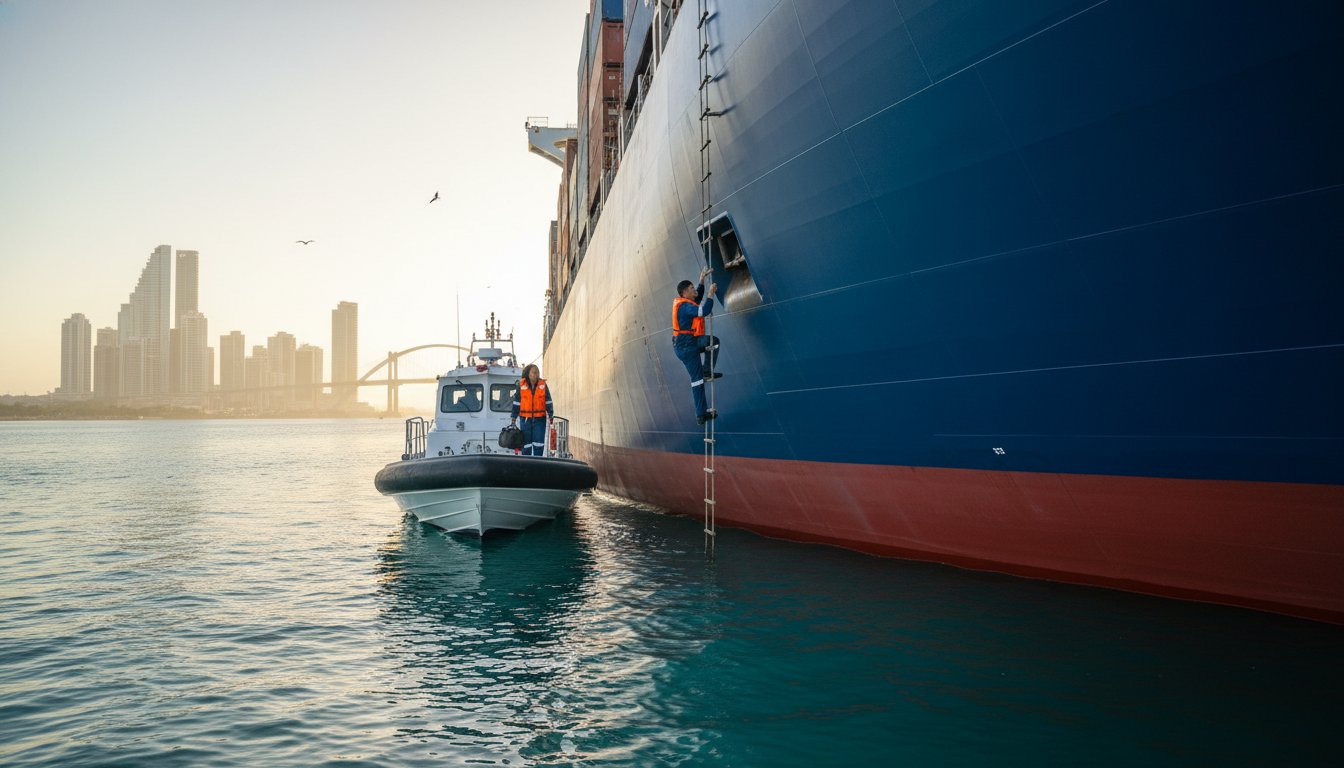
The Migration Officer plays a central role in the boarding and disembarking process. For shore-side changes at terminals like Balboa or Cristobal, the officer meets the crew at the pier. For anchorage-side changes, the officer must be transported to the vessel via a certified launch boat to perform a physical muster. This ensures the vessel’s crew list matches the physical personnel on board. To streamline these logistics, you should nominate a local partner who maintains strong relationships with port authorities.
Balboa vs. Cristobal: Choosing the Right Port for Your Crew Change
Selecting the optimal port for a vessel crew change panama depends on your ship’s direction and the specific urgency of the rotation. Panama offers two primary hubs: Balboa on the Pacific and Cristobal on the Atlantic. While both handle high volumes, the logistics of moving personnel vary significantly between the two coasts. We serve as your eyes at the Panama Canal to ensure you don’t lose time or money due to poor port selection.
Weather plays a decisive role in launch boat safety. During the dry season from January to April, strong trade winds create heavy swells at the Cristobal breakwater. This often makes boarding more difficult than at the calmer Pacific anchorages. Conversely, the wet season from May to December brings intense tropical downpours that can temporarily halt operations on both sides due to limited visibility. We monitor these patterns daily to keep your schedule on track.
Pacific Side: Balboa and Panama City
Balboa is often the preferred choice for logistical efficiency. It’s located just 30 to 45 minutes from Tocumen International Airport (PTY), which handles over 15 million passengers annually. This proximity minimizes transport costs and reduces the risk of missed flights. The Flamenco and Balboa anchorages provide robust launch boat availability, ensuring quick turnarounds for off-signing crew members who need to reach the airport quickly.
The Pacific side offers superior access to the capital’s top-tier medical facilities and international hotel chains. If a seafarer requires a specialized check-up or an overnight stay, Panama City provides the most reliable infrastructure. We manage the documentation with Panama’s National Migration Service to ensure every transit follows the latest 2026 regulations without delay. Our team coordinates the “waiting area” logistics so your crew spends less time in transit and more time resting.
Atlantic Side: Cristobal and Colon
Cristobal serves vessels arriving from or heading toward the US East Coast and Europe. While it’s strategically positioned, logistics require more planning. Personnel must travel approximately 1.5 hours from Panama City via the Panama-Colon expressway. Because security in certain areas of Colon remains a concern, we always utilize vetted, professional transport services to move crew safely between the port and the capital.
Performing a vessel crew change panama at Cristobal is highly efficient for ships that don’t intend to transit the full canal. It saves the time and fuel required to enter the Pacific side. However, you must account for the $100 to $150 average cost of private transport for small groups. We are experts so you don’t have to be; we balance these transit costs against your vessel’s schedule to find the most cost-effective solution for your fleet.
Step-by-Step Logistics: From Tocumen Airport to Vessel Anchorage
A successful vessel crew change panama depends on millisecond precision. It’s not just about booking a flight; it’s about aligning the 2026 aviation schedules at Tocumen International Airport (PTY) with the fluid ETA of a ship approaching the Canal. We act as your eyes at the Panama Canal, monitoring vessel positions in real-time to ensure shore-side transport is ready the moment wheels touch the tarmac.
The process starts with a professional ‘Meet and Greet’ service. Our agents handle immigration clearances immediately, moving crew members into secure, pre-vetted housing or directly to the port facility. Timing is everything. If a flight is delayed by even two hours, it can ripple through the entire rotation, potentially missing a scheduled launch window at the Pacific or Atlantic anchorages. We manage these variables so you don’t have to.
The Critical Role of Launch Services
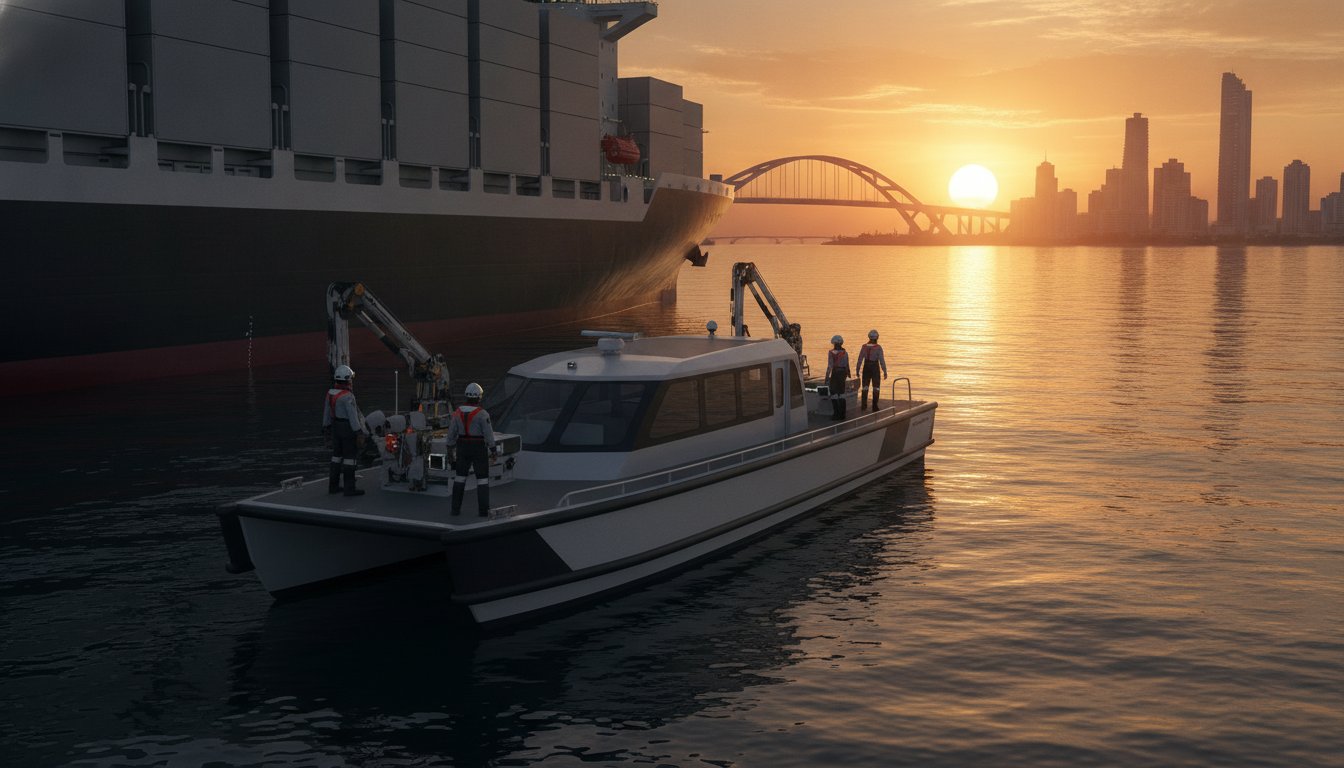
Launch boat coordination represents the most variable cost in the logistics chain. Data shows that timing failures here account for nearly 40% of hidden costs in crew rotations. Every launch must align perfectly with the Panama Canal Authority (ACP) transit schedule. If the vessel is moving, the launch must meet it at a specific pilot station. We ensure all launch providers meet strict international safety and insurance standards, protecting your most valuable asset: your people.
Managing ‘Cash to Master’ and Spare Parts
Efficiency means doing more with every boat run. We recommend combining personnel rotations with husbandry services to maximize your budget. Our one-stop approach allows us to deliver Cash to Master (CTM) and critical small spares during the same launch used for the vessel crew change panama. Security is paramount. We follow rigid protocols for high-value deliveries, ensuring CTM reaches the Master’s safe without incident. This integrated strategy reduces the number of trips and lowers your overall agency fees.
Once the new crew is safely onboard, the cycle continues. We ensure the departing crew reaches PTY with ample time for check-in, handling all exit formalities so they can focus on getting home. We don’t just move people; we manage the entire transition with integrity. Ready to streamline your next rotation? Nominate Adimar as your agent for your next Panama transit.
Why a Trusted Ship Agent is Your ‘Eyes on the Ground’ in Panama
Timing and coordination at the Panama Canal are difficult. Misjudge a single window and your costs skyrocket. There is a fundamental difference between a transit agent and a husbandry specialist. A transit agent manages the vessel’s movement through the locks and handles toll payments. A husbandry specialist manages the people, the parts, and the provisions. Adimar Shipping operates with a clear philosophy: we are experts so you don’t have to be. We serve as your local office, ensuring every vessel crew change panama happens without delay.
Transparency is our baseline. We understand that “time is money” in maritime logistics. Surprise fees in the final Disbursement Account (DA) create friction and distrust. We provide clear, upfront Proforma DAs and stick to them. By treating seafarers as the “key workers” they are, we ensure they receive respectful, efficient transfers from Tocumen International Airport to the deck. Our goal is to eliminate the stress and frustration often associated with complex logistics in Central America.
Owner’s Protective Agency (OPA) for Crew Changes
When a charterer appoints the primary agent, owners often feel left in the dark regarding actual costs. This is why savvy owners appoint Adimar as an owner’s nominated agency to supervise the process. We protect your interests by vetting local service charges and preventing the inflation of launch boat fees or land transportation costs. Our team provides audit-ready reporting and documentation that meets strict corporate compliance standards for 2026, ensuring every dollar spent is accounted for.
The Adimar Advantage: 20+ Years of Local Expertise
Our 20th year in business is a testament to our stability and deep roots in the region. We maintain daily contact with the Panama Maritime Authority and local port captains at both Balboa and Cristobal. This relationship allows us to bypass common bottlenecks and resolve issues before they reach your desk. We eliminate confusion through proactive communication. You’ll never have to guess the status of your personnel during a vessel crew change panama. Nominate Adimar Shipping for your next Panama crew change.
Secure Your 2026 Crew Rotation Strategy
Panama remains the world’s most critical maritime junction. Success in 2026 requires mastering the logistics between Tocumen Airport and anchorages at either Balboa or Cristobal. Navigating seafarer visas and the latest maritime regulations demands absolute precision; a single timing error can lead to unnecessary expenses. We handle these complexities so you don’t have to.
With 20+ years of experience as Panama Canal ship agents, Adimar Shipping acts as your eyes on the ground. As an authorized PCSOPEP representative with a specialized husbandry department for 24/7 support, we ensure your vessel crew change panama is seamless and cost-effective. We’ve built our reputation on integrity and transparent communication. Put your transit in our hands and eliminate the confusion of local coordination.
Request a Quote for Your Next Crew Change in Panama to partner with a team that treats your vessel like its own. We’re ready to help you navigate the Canal with confidence.
Frequently Asked Questions
Can crew changes be performed while the vessel is transiting the Panama Canal locks?
Crew changes cannot be performed while a vessel is transiting the Panama Canal locks due to strict Panama Canal Authority (ACP) safety regulations. All personnel transfers must take place at designated areas like the Pacific or Atlantic anchorages before or after the transit begins. This ensures the safety of the crew and the efficiency of the canal operations during the transit process. We coordinate these movements at the anchorages to ensure your schedule remains intact.
What is the typical cost range for a launch boat for crew changes in Panama?
Launch boat costs for a vessel crew change in Panama are influenced by the distance to the anchorage and the specific pier used, such as Balboa or Cristobal. While rates fluctuate based on fuel prices, typical industry ranges for standard transfers start at $450 per trip. We provide transparent, itemized quotes based on current 2026 market conditions to ensure you don’t face unexpected expenses. Our team ensures you get the most efficient service for your budget.
How much lead time does a ship agent need to arrange a crew change in Panama?
Ship agents require at least 48 to 72 hours of lead time to coordinate a successful crew change. This window allows for the processing of immigration permits, flight verification, and launch boat scheduling. Providing documentation 3 days in advance helps us eliminate the confusion and ensures all local authorities are notified before the vessel’s arrival. We are experts so you don’t have to be, managing every detail of the timeline to prevent costly delays.
Are there nationality restrictions for seafarers entering Panama for crew changes?
Panama allows most seafarers to enter for crew changes with a valid Seaman’s Book, but specific “Restricted Nationalities” require a pre-authorized visa from the National Immigration Service. As of 2026, nations on the restricted list must submit applications 15 business days before arrival. We act as your eyes at the Panama Canal to verify current visa requirements for every individual on your crew list, ensuring 100% compliance with local immigration laws and avoiding fines.
Can crew members receive medical or dental treatment while at the Panama Canal?
Crew members can receive comprehensive medical or dental treatment at private facilities in Panama City or Colon while the vessel is at anchor. We arrange specialized transportation and appointments with maritime-certified doctors to handle everything from routine checkups to emergency procedures. Our team manages the logistics so you can focus on your business while your crew receives quality care. We treat every medical case with the urgency and integrity it deserves at all times.
What happens if a crew member’s flight is delayed and the vessel must depart?
If a flight is delayed and the vessel must depart, the crew member is transferred to a secure, immigration-approved hotel until the next travel arrangement is finalized. Panama’s immigration laws require the ship agent to maintain custody and guarantee the departure of the seafarer within 72 hours. We handle these logistics with integrity, ensuring the seafarer is safe and the vessel avoids costly delays. Your crew’s welfare is our priority during these unexpected transitions and travel shifts.
Is it possible to perform crew changes at the outer anchorage (Limon Bay or Bay of Panama)?
Crew changes are frequently performed at the outer anchorages of Limon Bay on the Atlantic side and the Bay of Panama on the Pacific side. These locations are the primary hubs for husbandry services because they allow for transfers without interfering with the main canal channel. We use reliable launch providers to ensure safe boarding and disembarkation at these strategic points. Our local presence ensures we are your eyes at the Panama Canal during every single transfer.
How do current 2026 regulations handle crew members with expired Seaman’s Books?
Under 2026 regulations, Panama’s National Immigration Service does not permit entry or exit for seafarers with expired Seaman’s Books. All crew members must possess a document valid for at least 6 months beyond their arrival date. If a book expires while onboard, we assist in obtaining an emergency extension or temporary permit from the Panama Maritime Authority to facilitate a legal vessel crew change in Panama. We provide quick solutions to keep your operations moving smoothly.