
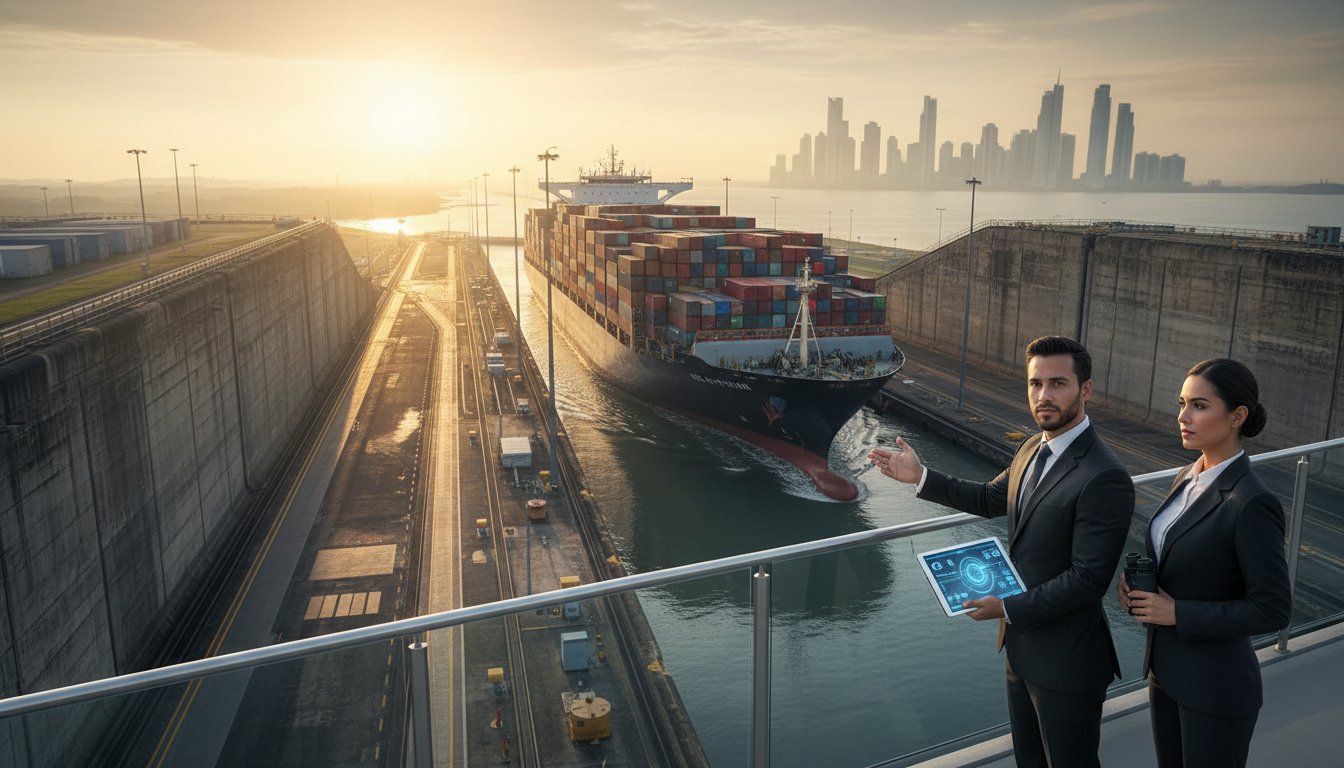
Would you risk a $4 million auction bid on a vessel that doesn’t meet the latest ACP technical standards? With slot auction prices surging to an average of $385,000 in March 2026, the financial stakes of a “vessel not ready” delay are higher than ever. We know that managing the panama canal transit requirements for ships is frustrating, especially when a single clerical error can lead to a $15,000 fine or a lost transit window.
You deserve a partner who acts as your eyes at the Canal. This guide provides the exact checklist you need to ensure your passage is seamless and compliant with the N-01-2026 standards. Adimar Shipping, Inc. helps you navigate the transition to LoTSA 2.0 and ensures your technical declarations are flawless so you can focus on your business while we handle the local coordination. We are experts so you don’t have to be.
We’ll examine the updated Neopanamax visibility rules, the mandatory ISO-standardized PDF/A formats for PCSOPEP filings, and the structural constraints required for a zero-delay passage through the locks. Whether you’re operating a Panamax bulk carrier or a Neopanamax container ship, this operational guide provides the clarity you need to arrive ready.
Key Takeaways
- Distinguish between Neopanamax and Panamax LOA and Beam limits to prevent rejected entries or unexpected draft restrictions.
- Master the specific panama canal transit requirements for ships regarding deck machinery, including the precise placement of chocks and bitts required for lock maneuvers.
- Ensure full administrative compliance by submitting ISO-standardized documentation and appointing a Panama-based Authorized Person for your mandatory PCSOPEP.
- Verify that all boarding facilities and pilot ladders meet ACP safety standards to facilitate a smooth transition of command and avoid “vessel not ready” delays.
- Discover how a local ship agent conducts pre-transit inspections to identify technical deficiencies before they result in expensive fines or lost transit slots.
Vessel Dimensions and Structural Constraints for 2026
Miscalculating your ship’s physical footprint is the fastest way to lose a transit slot. In 2026, the Panama Canal Authority (ACP) maintains a strict divide between the original locks and the expanded Neopanamax locks. Understanding this distinction is vital for accurate scheduling. For a foundational understanding, this Panama Canal overview highlights how the dual-lock system operates and why these constraints exist.
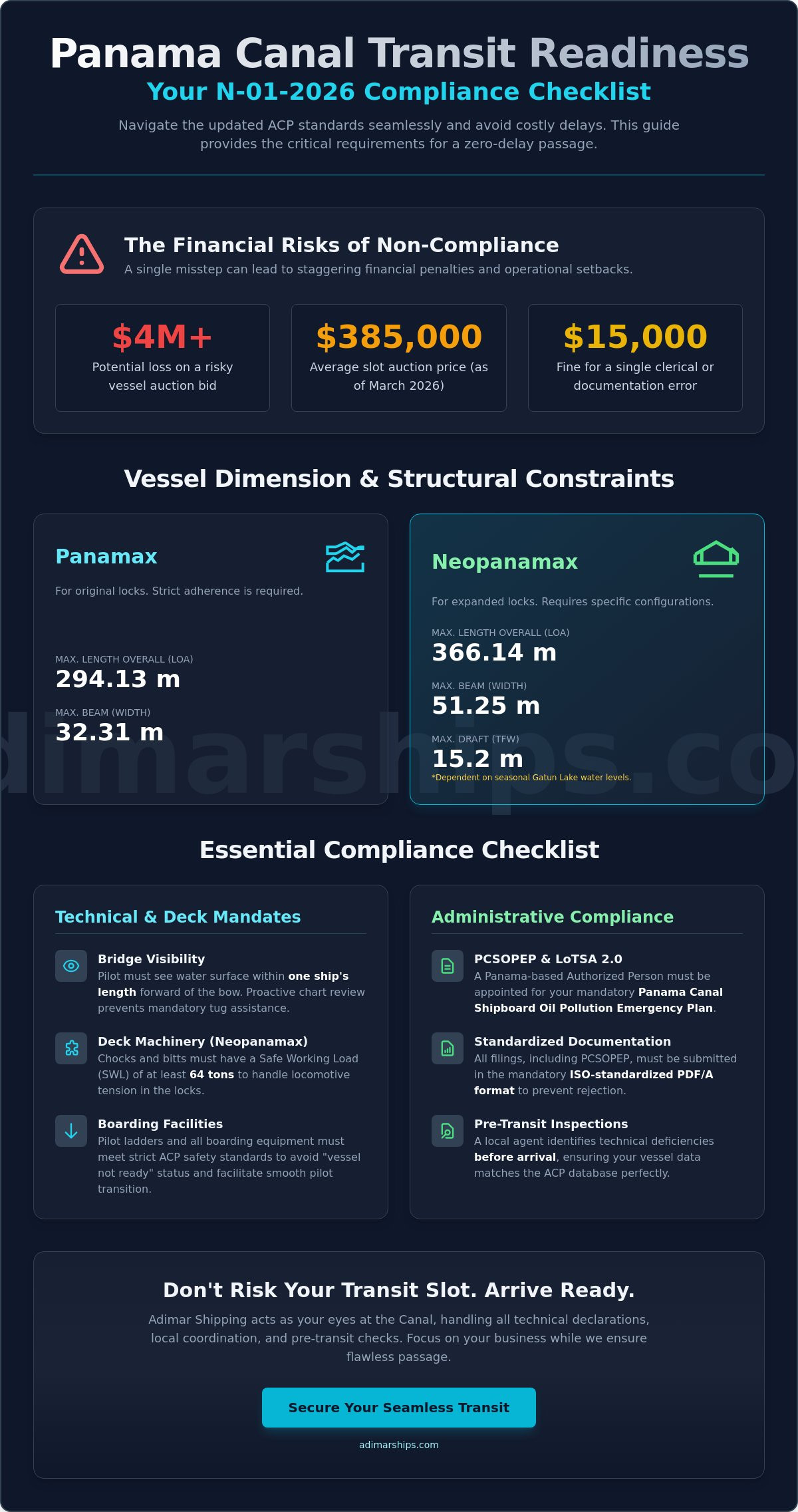
The panama canal transit requirements for ships regarding dimensions are non-negotiable. For Neopanamax vessels, the maximum Length Overall (LOA) is 366.14 meters, with a beam of 51.25 meters. Panamax vessels are restricted to an LOA of 294.13 meters and a beam of 32.31 meters. Even a few centimeters of protrusion from cargo or hull fittings can lead to a “vessel not ready” status. You must account for every structural detail, including the placement of bridge wings and hull appendages, before arrival.
Draft calculations are equally critical. The maximum draft for Neopanamax ships is 15.2 meters in Tropical Fresh Water (TFW), but this depends on Gatun Lake’s seasonal water levels. While water management efforts have stabilized levels in early 2026, restrictions can change with short notice. Misjudging your TFW draft leads to forced cargo discharge or transit denial. We monitor these levels daily so you don’t have to guess about your vessel’s immersion.
Panamax vs. Neopanamax Dimension Comparison
The 1000-foot threshold is the primary dividing line for Neopanamax status. Vessels exceeding a 32.31-meter beam must use the newer locks and will require specific tugboat assistance configurations. It’s also important to maintain your “Vessel of Record” status. If you’ve modified your ship since its last transit, you’ll need a new admeasurement for the Panama Canal Universal Measurement System (PC/UMS). Adimar Shipping, Inc. handles these technical declarations to ensure your data matches the ACP’s database perfectly.
Visibility and Navigation Bridge Standards
Safety at the Canal starts with what the pilot can see. The ACP requires that the pilot, from the conning position, can see the water surface within one ship’s length forward of the bow. If your cargo or bridge design blocks this view, you’ll face mandatory tug assistance or be forced to retrofit your bridge. Blind sectors must be calculated with extreme precision before you enter the channel.
Your bridge must also be equipped with:
- Updated Automatic Identification Systems (AIS)
- Specialized steering light placement
- Standardized pilot boarding facilities and ladders
Adimar Shipping, Inc. acts as your eyes at the Panama Canal by reviewing your bridge visibility charts before you reach the locks. This proactive check identifies deficiencies before the ACP inspectors do, eliminating the confusion that often leads to costly fines or forfeited slots. Put your transit in our hands and we’ll ensure your ship’s structure meets every 2026 mandate.
Technical Equipment and Deck Machinery Mandates
Technical failures during transit aren’t just inconvenient. They’re expensive. If your deck machinery doesn’t meet the ACP’s rigid standards, your vessel will be declared “not ready,” leading to steep fines and lost slots. Understanding the panama canal transit requirements for ships means looking beyond standard international maritime regulations. The Canal has its own set of rules for mooring and maneuverability that every ship master must verify before arrival.
The Official Vessel Requirements document specifies that all technical equipment must be in peak condition. This includes wheelhouse indicators, whistles, and the specialized steering light placement required for night transits. You must also ensure your vessel is ready for fuel switch-over procedures. The ACP requires ships to use maneuvering fuel, typically marine distillates, while in Canal waters to prevent engine failure and comply with local environmental standards. This switch must be completed before entering the channel to ensure propulsion stability during critical lock entries.
Mooring Lines and Deck Hardware
Standard mooring gear often falls short of Canal needs. For Neopanamax transits, chocks and bitts must have a Safe Working Load (SWL) of at least 64 tons to handle the tension from the powerful locomotives used in the locks. You’ll need a specific number of chocks located at the bow, stern, and midships, precisely positioned to allow for the steep angles of the towing wires. For 2026, the ACP has updated its stance on synthetic lines. While high-modulus synthetic fibers are common, they must meet specific diameter and breaking strength criteria to be approved. If you’re unsure if your current deck layout is compliant, you can nominate Adimar Shipping, Inc. as your agent to conduct a pre-arrival technical review.
Propulsion and Steering Gear Readiness
The Canal is a “Zero Failure” zone. Once you enter the channel, your main engine and steering gear must be 100% reliable. Pilots will often request an emergency steering drill immediately upon boarding to verify your crew’s readiness. If the response is sluggish or the equipment fails, the transit is aborted. Specific vessel classes, particularly larger Neopanamax ships, are required to have fully operational bow thrusters with a minimum power rating based on the vessel’s displacement. These thrusters are essential for maintaining position in the narrow reaches of the Culebra Cut. Adimar Shipping, Inc. is an expert so you don’t have to be. We’ll help you verify these technical specs so your ship moves through the locks without a single mechanical delay.
Manning, Pilotage, and Boarding Facilities
The moment an ACP pilot steps onto your deck, the operational dynamic changes. Unlike many other global ports, Panama Canal pilots take the con, meaning they have primary control over the vessel’s navigation and movement. This transition of command is a critical phase of the panama canal transit requirements for ships. If your boarding facilities are substandard, the pilot may refuse to board, leading to an immediate “vessel not ready” status and the possible forfeiture of your transit slot.
Safety during this 8 to 12 hour journey is the top priority for both the crew and the Canal personnel. Historical safety frameworks, such as those found in the U.S. Panama Canal Regulations, emphasize the need for rigorous access standards to protect personnel and property. Beyond the pilot, your crew must be prepared for a high intensity transit where fatigue can quickly become a factor if the manning levels aren’t optimized.
Safe Boarding and Pilot Access
Compliance with IMO/SOLAS standards for pilot ladders isn’t just a recommendation; it’s a prerequisite for entry. We often see delays caused by seemingly minor deficiencies. These include worn out manropes, incorrect step spacing, or inadequate lighting for night boardings. Pilots are particularly vigilant about the combination ladder setup required for vessels with a high freeboard. Neopanamax vessels must provide a permanent, sheltered platform on the navigation bridge wings to protect ACP pilots from tropical sun and heavy rain during the transit. Any defect in these structures can result in the pilot ordering additional tug assistance at your expense.
Crew Readiness and Communication
Your bridge team must be capable of seamless communication. All bridge to engine room commands must be understood instantly to prevent maneuvering errors in the narrow locks. While English is the standard, having a crew that understands basic Spanish maritime terms can be a significant advantage. During the transit, your line handling crew plays a vital role. They must be stationed at the bow and stern to receive and attach the locomotive towing wires with precision. Misjudging the timing of a line attachment can damage the ship’s hull or the lock structures.
We see ourselves as your local office at the Panama Canal. Our team coordinates directly with the ship’s Master to ensure every crew member knows their role before the pilot arrives. We provide quick solutions for husbandry needs, such as fresh provisions or crew changes, so your team can stay focused on the transit itself. Put your transit in our hands and we’ll eliminate the confusion surrounding manning and safety compliance.
Administrative Compliance: PCSOPEP and Documentation
Administrative precision is just as critical as your vessel’s technical readiness. In 2026, the Panama Canal Authority (ACP) has fully transitioned to digital validation, leaving no room for manual errors. Missing a single deadline or misfiling a document in the Vessel Monitoring System (VMS) portal can lead to immediate slot forfeiture. The panama canal transit requirements for ships include a robust digital paper trail that proves your vessel is environmentally and operationally safe before it ever reaches the breakwater.
A major focus for 2026 is the Greenhouse Gas (GHG) Emissions Rating. The ACP now requires detailed efficiency data as part of its “Green Vessel” initiative. Vessels with higher efficiency ratings may receive priority or reduced environmental fees, but this data must be submitted alongside your standard cargo declarations and sanitation records. We provide transparent, personalized service to ensure these technical declarations are accurate and timely. We are your eyes at the Panama Canal, catching clerical discrepancies before they become financial liabilities.
PCSOPEP and the Authorized Person
The Panama Canal Shipboard Oil Pollution Emergency Plan (PCSOPEP) is mandatory for any vessel with an oil carrying capacity of 400 metric tons or more. This is not the same as your standard MARPOL SOPEP. It’s a localized plan that requires a designated Authorized Person (AP) who resides in Panama to act as a legal liaison. For the 2026 cycle, all digital submissions must be in ISO-standardized PDF/A format. You can find a detailed breakdown of these requirements through our PCSOPEP authorized person services. We ensure your spill response tiers meet the latest 2026 criteria to avoid fines ranging from $15,000 to $50,000.
Pre-Arrival Notification Timelines
Timing is everything. The 96-hour rule is the absolute deadline for submitting your VUMPA (Ventanilla Única Marítima de Panamá) package. This includes your crew list, dangerous cargo declarations, and ‘Hot Work’ permits if repairs are needed during transit. Common errors in the Electronic Data Collection System (EDCS) often involve incorrect draft readings or mismatched vessel dimensions. These discrepancies trigger red flags that delay your boarding. Calculating your ‘Arrival Time’ accurately is essential for slot preservation, especially with auction prices reaching $385,000 in early 2026. We are experts so you don’t have to be. Let us manage your digital filings to ensure a zero-delay passage. If you need assistance with your pre-arrival package, contact us for a quote today.
How a Local Ship Agent Manages Transit Requirements
Misjudge your timing and you lose. While the technical and administrative panama canal transit requirements for ships are clearly documented, their real-world application requires on-the-ground vigilance. We act as your eyes at the Panama Canal, protecting your schedule from the moment your vessel enters the anchorage. We see ourselves as your local office, bridging the gap between the ship’s Master and the Panama Canal Authority (ACP) to ensure every requirement is met with precision.
Managing a transit in 2026 involves more than just filing paperwork. It requires coordinating husbandry services, technical support, and pilotage schedules simultaneously. We provide high quality, timely shipping services with integrity. By identifying potential issues before they reach the ACP inspectors, we eliminate the friction that often leads to “vessel not ready” delays and high cost fines.
Preventing Delays Through Local Expertise
We eliminate confusion by providing clear, direct communication. Our team conducts pre-transit inspections to identify potential deficiencies in bridge equipment or deck hardware before the pilot boards. For example, we recently resolved a mooring gear deficiency in just 4 hours by coordinating immediate technical support and replacement parts. This proactive approach prevented a total slot forfeiture and saved the operator significant auction costs. For a deeper look at our scheduling strategy, view our Panama Canal transit guide.
Integrity and Transparency in Agency Services
Adimar prides itself on a 20-year history of cost-conscious transit management. We understand that time is money in the maritime industry, especially with surging auction prices. Our agency services are delivered with total transparency, ensuring there are no hidden fees in your requirement compliance. We serve as your trusted partner, providing quick solutions for everything from crew changes to specialized technical inspections. Our goal is to let you focus on your business while we handle the local complexities.
Timing and coordination are the ultimate transit requirements. Put your vessel in our hands and we’ll ensure it’s fully compliant with the N-01-2026 standards. We are experts so you don’t have to be. Ready to secure a seamless passage? Request a Quote for your 2026 Transit and let our team manage the details with integrity and efficiency.
Secure Your 2026 Transit with Confidence
Mastering the panama canal transit requirements for ships is the difference between a profitable voyage and a costly delay. In 2026, success depends on your ability to align physical vessel readiness with the ACP’s digital validation standards. You’ve seen how critical it is to verify your TFW draft against Gatun Lake levels and ensure your PCSOPEP documentation is submitted through the VUMPA portal at least 96 hours before arrival. Precision in these technical and administrative details is no longer optional.
Don’t let the complexity of the N-01-2026 standards disrupt your operations. We are experts so you don’t have to be. With our 20 years of local experience, we serve as your eyes at the Panama Canal to identify technical deficiencies before they result in fines. As an authorized PCSOPEP representative, we provide the localized legal liaison required for full compliance. Our proven track record of zero-delay transits means you can put your vessel in our hands with absolute trust.
Nominate Adimar as your Panama Canal Ship Agent today to eliminate the confusion and focus on your business. We look forward to being your trusted partner at the Panama Canal and ensuring your next passage is your smoothest yet.
Frequently Asked Questions
What are the maximum dimensions for a Neopanamax ship in 2026?
The maximum length overall (LOA) for Neopanamax vessels is 366.14 meters, while the maximum beam is 51.25 meters. These limits are absolute. Even a protrusion of a few centimeters will result in transit denial. You must ensure all cargo and hull fittings stay within these boundaries to avoid the “vessel not ready” status that follows an incorrect admeasurement declaration.
Is a PCSOPEP plan mandatory for all vessels transiting the Panama Canal?
No, it’s mandatory only for vessels with an oil carrying capacity of 400 metric tons or more. This includes both fuel and cargo. If your vessel meets this threshold, you must designate a Panama-based Authorized Person and submit your plan through the VUMPA system at least 96 hours before arrival. Failing to meet these panama canal transit requirements for ships results in minimum fines of $15,000.
What happens if my ship fails a technical requirement inspection?
Your vessel will be declared “Not Ready,” which usually leads to the immediate forfeiture of your transit slot. In early 2026, where auction prices have reached $385,000, this is a massive financial blow. You’ll likely face a fine between $15,000 and $50,000 and be forced to wait at anchor until the deficiency is corrected and a new slot is secured.
How many pilots are required for a Neopanamax transit?
Neopanamax transits typically require two pilots to manage the increased complexity of the expanded locks. This ensures safe navigation through the Culebra Cut and the new lock chambers. The transition of command happens upon boarding. Your bridge team must be ready to support multiple ACP personnel throughout the 8 to 12 hour journey across the Isthmus.
Can I transit the Panama Canal without a local ship agent?
Commercial vessels cannot transit efficiently without a local ship agent because the ACP requires a Panama-based Authorized Person for legal and administrative liaison. We act as your eyes at the Panama Canal, managing the VUMPA portal and digital filings. Without local representation, you’ll struggle to meet the mandatory 96-hour notification rules and coordinate essential husbandry services during your wait.
What is the ‘Tropical Fresh Water’ draft limit for 2026?
The maximum Tropical Fresh Water (TFW) draft for Neopanamax vessels is 15.2 meters, which is 50.0 feet. For Panamax ships, the limit is 12.04 meters, or 39.5 feet. These figures are subject to change based on the seasonal water levels of Gatun Lake. We monitor these levels daily so you don’t have to worry about forced cargo discharge upon arrival.
Are there specific fuel requirements for ships in the Panama Canal?
Ships must use maneuvering fuel, such as marine distillates, while transiting Canal waters. This switch-over must be completed before you enter the channel to ensure propulsion reliability. The ACP enforces this to prevent engine failures in narrow reaches and to comply with local environmental standards. We help you verify your fuel specifications to ensure they meet the 2026 “Green Vessel” guidelines.
What are the boarding facility requirements for ACP pilots?
Boarding facilities must strictly adhere to IMO/SOLAS standards, including the use of certified pilot ladders. For Neopanamax vessels, the panama canal transit requirements for ships also mandate permanent shelters on bridge wings to protect pilots from the elements. If your ladder is worn or your platform is obstructed, the pilot will refuse to board, causing an expensive delay.