

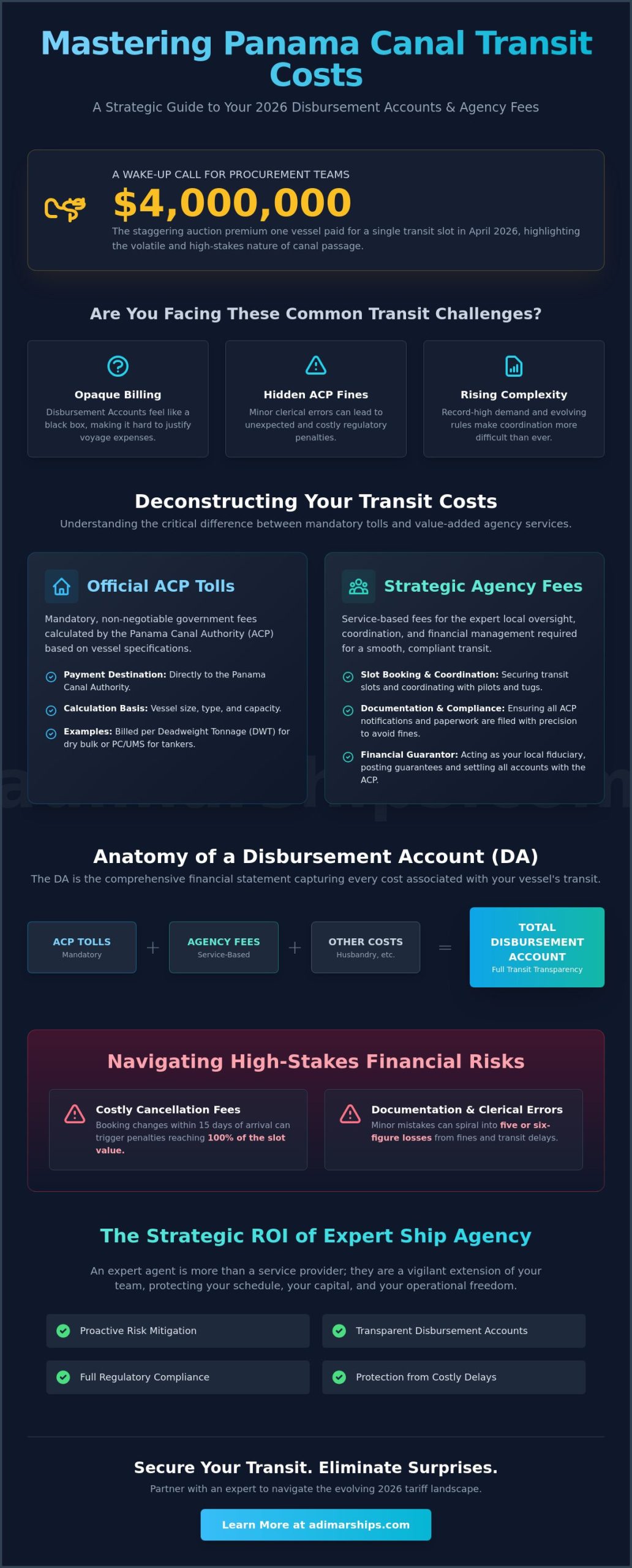
Could a single 4 million dollar auction fee be the wake-up call your procurement team needs? In April 2026, one vessel paid that staggering premium just to secure a transit slot, proving that the cost of entry is only half the battle. It’s frustrating to manage a voyage when disbursement accounts feel like a black box and hidden ACP fines lurk behind every minor clerical error. You likely feel the pressure of opaque billing and the rising complexity of coordinating with the Panama Canal Authority during this period of record-high demand. Understanding the structure of panama canal transit agent fees is no longer just about accounting; it’s a strategic necessity to protect your bottom line.
We agree that navigating these waters requires more than just a checklist. You need a partner who acts as a vigilant extension of your own team. This guide will help you master the complexities of your disbursement accounts by clarifying exactly what ship agents charge and how they provide essential local oversight. You’ll gain a clear breakdown of agency versus authority fees, a framework for budgeting your 2026 transits, and proven methods to reduce the risk of compliance-related fines. Whether you require ship agency services or a PCSOPEP authorized person, we’ll show you how to maintain operational freedom in an increasingly volatile maritime corridor.
Key Takeaways
- Identify the critical differences between mandatory ACP tolls and service-based agency fees to ensure your Disbursement Accounts remain transparent and predictable.
- Learn how to choose between an Owner’s Nominated Agency and a Charterer’s Nominated Agency based on your specific vessel interests and cargo requirements.
- Establish a reliable framework for budgeting 2026 transits by requesting detailed Pro-forma Disbursement Accounts that account for PCSOPEP compliance.
- Master the structure of panama canal transit agent fees to understand how professional coordination protects your vessel from expensive regulatory fines and transit delays.
- Recognize the strategic ROI of expert ship agency services in navigating the high-stakes logistics of the Panama Canal’s evolving 2026 tariff landscape.
Understanding the Components of Panama Canal Transit Fees in 2026
Managing a vessel’s passage through the Panama Canal requires precise financial coordination. At the center of this process is the Disbursement Account (DA). Think of the DA as a comprehensive financial statement that captures every cost associated with a single transit. It isn’t just a bill; it’s a living document that tracks mandatory government tolls, specialized service charges, and husbandry expenses. For operators, the DA provides the transparency needed to justify voyage expenses to stakeholders and ensure every dollar is accounted for during the journey.
A ship agent acts as your financial guarantor to the Panama Canal Authority. The ACP does not typically deal with individual ship owners for payment processing. Instead, they require a locally registered and authorized agency to post guarantees and settle accounts. This relationship ensures that the canal’s operations remain fluid. If an agent doesn’t manage these funds correctly, a vessel can face significant delays at the locks. We take this responsibility seriously, acting as a vigilant protector of your capital while your vessel is in our care.
The 2026 fee structures reflect a shift toward vessel efficiency and environmental compliance. With the implementation of stricter water management protocols and revised slot allocation rules, the “Notice to Shipping” updates now include specific penalties for last-minute cancellations or documentation errors. Your agent ensures these details are handled long before the vessel arrives, protecting your schedule from unforeseen penalties that can easily spiral into five or six-figure losses.
Official ACP Tolls vs. Private Agency Service Fees
Official tolls are mandatory government fees calculated based on vessel size, type, and capacity. For example, dry bulk carriers are billed per Deadweight Tonnage (DWT), while tankers use the Panama Canal Universal Measurement System (PC/UMS). These costs are non-negotiable and go directly to the Authority. In contrast, panama canal transit agent fees are service-based. These fees cover the labor-intensive work of slot booking, documentation, and the constant coordination required with canal pilots and tugboat operators. While tolls are fixed by the ACP, agency fees reflect the complexity of the specific transit and the level of local oversight required to prevent operational friction.
The Role of the Panama Canal Authority (ACP) in Fee Regulation
The ACP is the sole governing body that sets the maritime tariff list. Their recent updates introduced more nuanced pricing for Neopanamax vessels and revised booking cancellation fees, which can now reach 100% of the slot value if changed within 15 days of arrival. You can find more details in our guide on what is the Panama Canal Authority (ACP). The Authority also maintains strict oversight of authorized shipping agencies. They monitor billing practices to ensure that surcharges are applied accurately across all Disbursement Accounts. Our role is to navigate these regulations on your behalf, ensuring your vessel remains in full compliance with the latest ACP mandates.
The Anatomy of Panama Canal Ship Agent Fees: What Are You Paying For?
Understanding the value behind your panama canal transit agent fees requires looking past the administrative paperwork. While the official Panama Canal Authority tariffs dictate the cost of the water itself, the agency fee covers the human expertise that ensures you actually reach the other side. This includes the complex pre-transit coordination that begins long before the vessel enters the breakwater. We manage the delicate timing of slot bookings and ensure all ACP notifications are filed with absolute precision. Without this proactive oversight, even a minor scheduling conflict can lead to costly anchorage time.
Financial management is another critical component of the agency’s role. We act as your local fiduciary, handling the prompt payment of port dues, light dues, and various local taxes that are required for a smooth passage. Our team provides 24/7 monitoring of the vessel’s position and schedule. We don’t just track the ship; we anticipate potential bottlenecks in the canal’s daily flow and adjust our coordination with pilots accordingly. This constant vigilance transforms what could be a stressful logistical hurdle into a predictable and managed operation, protecting your voyage’s profitability at every stage.
Transit Clearance and Documentation Services
Navigating the “VUMPA” (Panama’s Maritime Single Window) system is a specialized skill. This digital interface is the primary gateway for all transit documentation, and any error in data entry can trigger expensive “deficiency” fines. We conduct a rigorous review of all vessel certificates to ensure they are valid and compliant with 2026 regulations. By coordinating directly with pilots and tugboat operators, we ensure the vessel meets its precision timing requirements. This level of detail is essential for maintaining your position in the transit queue and avoiding the steep penalties associated with missing a booked slot.
Husbandry and Protective Services
Beyond the transit itself, we provide comprehensive husbandry services to support your crew and vessel maintenance. This includes the secure delivery of Cash to Master (CTM), the logistics of spare parts delivery, and the coordination of fresh water or provisioning. In our role as a Protective Agent, we serve as your local advocate, overseeing third-party operations to ensure they align with your standards. This oversight prevents the hidden costs that often arise from unmonitored vendor activities. If you are looking for a partner to simplify these logistical layers, the team at Adimar Shipping, Inc. is ready to provide the local expertise your fleet requires.
Comparing Owner’s vs. Charterer’s Agency Fees: Who Pays What?
Financial responsibility for a transit often depends on the specific terms of the charter party agreement. While the mandatory tolls paid to the Authority remain a constant, the delegation of ship agency services is frequently divided between the ship owner and the charterer. This distinction is vital because each party has different operational priorities. Owners focus on the vessel’s long-term regulatory standing and technical integrity. Charterers, conversely, prioritize cargo readiness and the minimization of port-stay duration to optimize their voyage expenses. Understanding how these roles influence panama canal transit agent fees is essential for clear financial planning in 2026.
Split-fee arrangements are common in modern maritime contracts. These occur when both parties feel the need for dedicated representation. If a charterer nominates the primary agent for the transit, the owner may still appoint a Protective Agent to oversee their specific vessel interests. This ensures that while the charterer’s agent handles cargo-related logistics, the owner’s interests in husbandry and technical compliance aren’t sidelined. These arrangements help prevent the conflicts of interest that can arise when a single agent tries to serve two masters with competing schedules.
The legal and financial implications of these nominations have become more pronounced in 2026 contracts. With the Panama Canal’s updated scheduling and auction systems, the party that nominates the agent often carries the burden of liability for documentation errors. If an agent fails to correctly report a vessel’s technical specifications in the VUMPA system, the resulting fines and delays are usually attributed to the nominating party. This makes the choice of a dependable partner a form of financial insurance against the volatility of canal operations.
The Owner’s Nominated Agency (ONA) Fee Structure
Ship owners typically appoint an Owner’s Nominated Agency to manage long-term vessel compliance and maintenance coordination. These fees cover the oversight of technical inspections, crew welfare, and the validation of international certificates. Owners benefit from these specialized services because they ensure the vessel remains “fit for purpose” throughout its stay in Panamanian waters. When a charterer nominates the main agent, owners often pay a “Protective Agency” fee to have a vigilant representative verify that all third-party charges in the Disbursement Account are accurate and justified.
Charterer’s Nominated Agency (CNA) Responsibilities
Charterers view their agency nomination as a tool for voyage optimization. A Charterer’s Nominated Agency (CNA) focuses heavily on cargo-related efficiency and ensuring the vessel meets its laycan requirements. Their primary goal is to move the cargo through the canal with zero unnecessary delays. Disputes occasionally arise regarding panama canal transit agent fees when husbandry costs, such as crew medical visits or spare parts delivery, are bundled into the charterer’s DA. We resolve these issues through transparent, itemized accounting that clearly separates owner-related expenses from charterer-related voyage costs, fostering a sense of trust and partnership between all parties.
Budgeting for 2026: Estimating Total Transit Disbursements (DA)
Accurate financial forecasting for a canal passage begins with a Pro-forma Disbursement Account (PDA). This document serves as your financial blueprint, detailing every expected expense from official tolls to panama canal transit agent fees. We recommend requesting a PDA at least three weeks before your vessel’s required arrival time. This window allows for precise calculation based on the latest vessel dimensions and cargo weight. Because the maritime environment is dynamic, we advise our clients to budget a contingency of 5% to 10% above the PDA total. This buffer provides security against unforeseen ACP surcharges or minor technical delays that can occur during the transit window.
Your vessel’s physical dimensions play a decisive role in the total fee structure. In 2026, the gap between Panamax and Neopanamax costs remains significant. For instance, a standard transit reservation fee for a regular vessel is $12,000, while a Neopanamax vessel requires a $100,000 reservation fee. Beyond these fixed costs, you must factor in specialized compliance. Every vessel must appoint a PCSOPEP authorized person to manage oil pollution compliance. These fees are mandatory for all vessels over 400 gross tons and are a critical component of your total disbursement account.
Hidden Costs: Surcharges and Compliance Fines
Operational discipline is the best way to avoid hidden costs. As of January 2026, the ACP has enforced a strict booking cancellation policy. If you cancel a long-term slot with less than 15 days’ notice, the fee is 100% of the awarded slot value. Additionally, the “Fresh Water Surcharge” fluctuates based on Gatun Lake levels. When water levels are low, this surcharge increases to manage the canal’s resources. Our team monitors these environmental factors in real-time, providing you with the data needed to adjust your budget before the vessel arrives at the locks.
Slot Auctions and Reservation Fees
The auction system has become a high-stakes environment in 2026. Due to geopolitical shifts and increased demand, last-minute auction premiums have recently averaged between $385,000 and $425,000. These fees are paid in addition to standard transit tolls to avoid long queues. If your voyage requires an urgent, unscheduled transit, the auction fee can exponentially increase your total panama canal transit agent fees and overall DA. Our role is to act as your strategic partner, helping you decide when to participate in auctions and when to rely on standard reservations to protect your bottom line. To receive a tailored estimate for your next voyage, you can request a Pro-forma Disbursement Account from our experienced team.
Minimizing Operational Costs Through Expert Local Representation
High stakes define every maritime voyage. While some operators view panama canal transit agent fees as a simple line item, experienced managers recognize them as a strategic insurance policy. The return on investment for quality representation is clear. A professional agency fee of approximately $5,000 can easily prevent a $50,000 delay caused by scheduling friction or administrative holds. When your daily vessel operating expenses (OPEX) are climbing, the cost of an idle ship far outweighs the price of expert oversight. We act as your vigilant eyes on the ground, ensuring that every detail is managed before it becomes a financial liability.
The Cost of Delays vs. The Cost of Quality Agency
Daily vessel running costs continue to rise in 2026, making efficiency more valuable than ever. Choosing a “cheap” agent often leads to higher total Disbursements (DA) because they lack the local influence or technical depth to prevent errors. Consider a scenario where proactive document review saved a client from a 48-hour delay. Our team identified a minor certificate discrepancy 72 hours before arrival, allowing for a remote correction that kept the vessel in its assigned slot. Without that intervention, the ship would have lost its reservation, resulting in massive displacement fees and lost charter revenue. Quality agency service pays for itself by eliminating these avoidable risks.
Why Adimar Shipping, Inc. is the Preferred Partner for 2026
Our team provides a specialized focus on Panama Canal transit efficiency. We don’t just process paperwork; we manage the entire lifecycle of your passage, from the initial booking to the final settlement of the DA. Whether you require an Owner’s Nominated Agency to protect your technical interests or husbandry services for a rapid crew change, our personalized service ensures your vessel receives the attention it deserves. Adimar Shipping, Inc. streamlines the documentation process to remove confusion and keep your voyage on schedule. To secure your passage with a partner you can trust, request a customized Pro-forma DA for your next transit and experience the value of expert local representation.
Securing Your Operational Freedom in the 2026 Panama Canal Landscape
We stand ready to serve as your vigilant representative on the ground. As an authorized PCSOPEP representative with a 24/7 local presence in Panama City, we provide the specialized expertise needed for both Owner and Charterer nominations. Delegating these complex logistical tasks to a dedicated ship agency ensures your vessel remains a priority so you don’t have to worry about local regulatory friction. We invite you to Get a Transparent Quote for Your Panama Canal Transit Fees today. Trust our experience to protect your interests and keep your global supply chain moving with confidence.
Frequently Asked Questions
What is the average ship agent fee for a Panama Canal transit in 2026?
Fees vary depending on the vessel size, transit complexity, and the specific scope of services required for the voyage. While official tolls are fixed by the Authority, agency fees are professional service charges that cover essential coordination, documentation, and financial guarantees. We recommend requesting a Pro-forma Disbursement Account (PDA) to receive a precise estimate tailored to your vessel’s specific needs and 2026 voyage requirements.
Are Panama Canal agent fees negotiable?
Agency fees reflect the level of expertise and local oversight provided to protect your vessel interests. While some service components might be adjusted based on transit volume or long term partnerships, the primary focus should remain on the quality of representation. Reducing these fees often results in less vigilance, which can lead to much higher costs from transit delays or regulatory fines that far exceed any initial savings.
Do I need a separate agent for husbandry services and canal transit?
You don’t need separate agents because a full service ship agency can manage both requirements simultaneously. Combining these services under one representative often streamlines communication and reduces administrative overhead. This integrated approach ensures that crew changes, provisioning, and technical support are coordinated perfectly with your assigned transit slot, preventing any avoidable conflicts in the vessel’s schedule.
What is a Disbursement Account (DA) in the context of Panama Canal fees?
A Disbursement Account is a comprehensive financial statement that tracks every cost associated with a vessel’s passage. It includes mandatory tolls, port dues, and panama canal transit agent fees in one transparent document. The process begins with a Pro-forma DA (PDA) for budgeting and concludes with a Final DA (FDA) once all third party invoices are settled and verified by your local agent.
How does the Panama Canal Authority (ACP) bill for its services?
The ACP bills through a centralized system that requires financial guarantees from an authorized local agent. They utilize a multi-faceted tariff structure based on vessel type and capacity measurements like the PC/UMS system. Most payments must be settled well in advance of the transit date to ensure the vessel is cleared for passage through the locks without administrative holds.
What happens if I don’t use a local agent for my Panama Canal transit?
Transit without a local agent is practically impossible for commercial vessels due to the ACP’s requirement for local financial guarantees. Without an agent, you’ll lack the necessary representation in the VUMPA system and won’t have a local entity to manage the complex coordination with pilots and tugs. This lack of oversight almost always results in significant delays and heavy administrative penalties for the ship owner.
Are there extra fees for Neopanamax vessels compared to Panamax?
Yes, Neopanamax vessels incur higher costs due to their larger dimensions and the increased resources required for their passage through the expanded locks. These vessels pay higher reservation fees and are subject to different toll rates based on their specialized requirements. Understanding how these variables impact panama canal transit agent fees is essential for operators transitioning to larger vessel classes in the 2026 maritime environment.
How far in advance should I pay the estimated transit fees?
Most estimated fees must be paid at least 48 to 72 hours before the vessel’s arrival at canal waters. This lead time allows your agent to post the necessary guarantees with the ACP and ensure all port and light dues are settled. Timely payment is critical. If funds aren’t cleared by the Authority, your vessel will not be allowed to enter the transit queue, leading to expensive schedule disruptions.