
A single oversight in your PCSOPEP filing or a 48-hour delay in toll payment can turn a routine transit into a $400,000 logistical nightmare. In the high-stakes environment of the 2026 waterway, there is no margin for administrative error. You understand that managing a vessel’s arrival is about more than just hitting a window; it’s about protecting your bottom line from avoidable fines and costly idle time. Partnering with a specialized bulk carrier agent panama canal ensures that every technical detail is handled with local vigilance and precision.
We recognize the pressure you face regarding updated transit regulations and the variable freshwater surcharges that impact your voyage costs. This comprehensive checklist provides the clarity you need to master every logistical detail of your passage. You’ll learn how to secure a zero-delay transit by aligning with the latest Panama Canal Authority (ACP) requirements. We will preview the critical 96-hour documentation deadlines, the specific duties of your Authorized Person, and the 2026 toll structures that remain frozen through September. By the end of this guide, you will have a clear roadmap for seamless coordination and predictable operational costs.
Key Takeaways
- Learn why the 96-hour notification rule is your first line of defense against transit delays and how to ensure your EDCS data is flawless.
- Understand the precise technical standards and mooring requirements needed to pass the ACP boarding inspection when you partner with a specialized bulk carrier agent panama canal.
- Navigate the 2026 toll structure freeze and the 48-hour advance payment mandate to keep your transit costs predictable and secure.
- Coordinate complex crew changes and spare parts deliveries through professional husbandry services that minimize idle time at the Pacific or Atlantic anchorages.
- Evaluate potential partners using a vetting checklist that prioritizes local expertise, transparency, and established relationships with port authorities.
The Strategic Role of a Bulk Carrier Agent Checklist in 2026
A specialized bulk carrier agent checklist is more than a simple administrative tool. It’s a rigorous protocol designed to synchronize the complex mandates of the Panama Canal Authority with the high-pressure operational needs of a bulk vessel. In the maritime sector, success depends on the seamless alignment of documentation, technical readiness, and financial clearance. For technical managers and ship owners, this structured approach provides a sense of security, ensuring that no minor detail triggers a massive financial penalty.
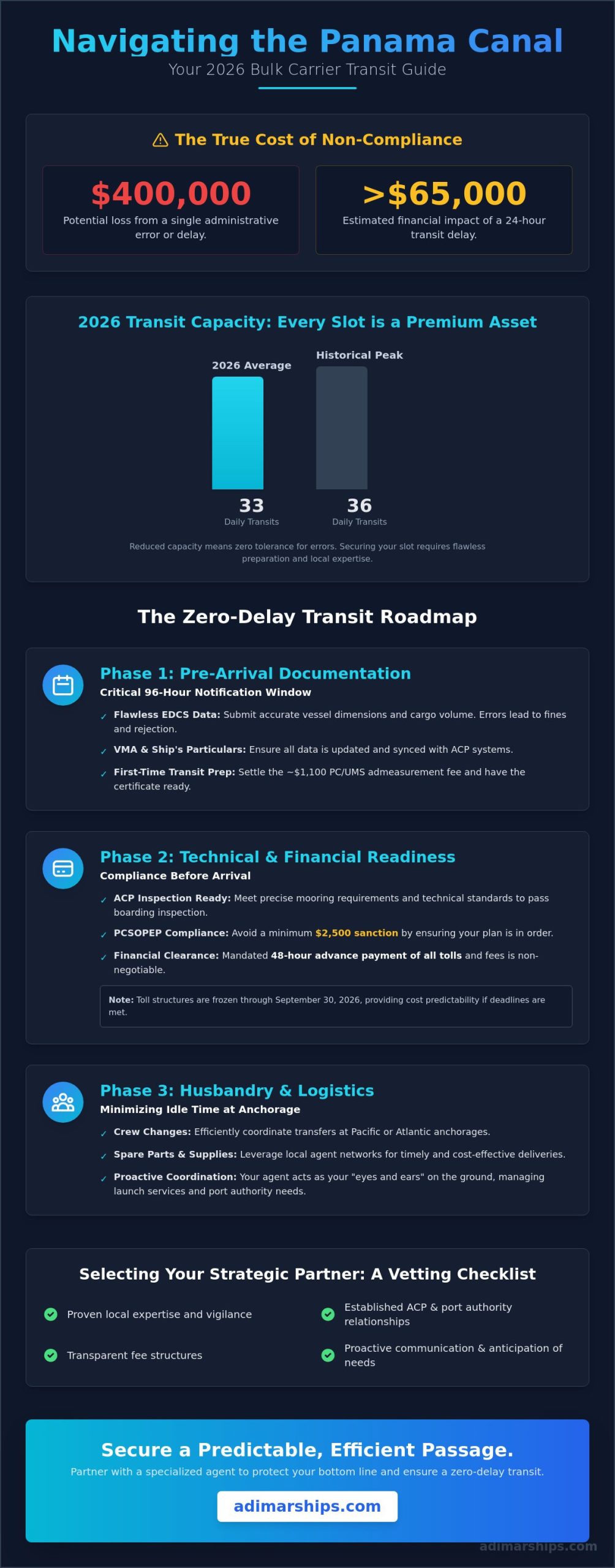
Precision has never been more critical than it is today. As of 2026, the Panama Canal Authority (ACP) expects to handle an average of 33 transits daily. While this shows a steady recovery from recent drought conditions, it remains below the historical peak of 36 transits. This reduced capacity means every transit slot is a premium asset that cannot be wasted. When you hire a bulk carrier agent panama canal, you’re securing a partner who understands that current draft restrictions and water conservation measures leave zero room for error. Their role as your vigilant “eyes and ears” on the ground is what prevents administrative delays from spiraling into operational shutdowns.
Understanding the Agent’s Local Oversight
Navigating the Panama Canal Authority (ACP) requires more than just an internet connection. It requires deep-rooted local relationships and an understanding of the nuances within their communication channels. There’s a fundamental difference between a “paperwork agent” who simply reacts to requests and a proactive strategic partner who anticipates them. A strategic partner understands the Panama Canal history and operations well enough to predict potential bottlenecks before they occur.
Local knowledge of logistics in areas like San Francisco (the Pacific anchorage) and Panama City is a critical asset. Whether it’s coordinating a last-minute launch service or managing complex husbandry requirements, your agent must have a physical presence. They act as an extension of your own team, providing the oversight necessary to ensure that local port authorities and ACP pilots have everything they need the moment your vessel arrives.
The True Cost of Non-Compliance in Panama
The financial stakes for bulk carriers in 2026 are exceptionally high. Errors in the Electronic Data Collection System (EDCS) regarding cargo volume or vessel dimensions can lead to immediate fines and transit rejections. A rejection doesn’t just result in a fine; it forces your vessel to the back of the queue, damaging your long-term schedule and reputation with charterers. While the ACP has frozen toll rates until September 30, 2026, the cost of inefficiency remains volatile.
Based on current market conditions and ACP reservation fees, a 24-hour delay for a Panamax bulk carrier can result in financial losses exceeding $65,000 when factoring in idle fuel, crew costs, and potential slot forfeiture. This figure doesn’t even account for the $2,500 minimum sanction for PCSOPEP non-compliance. By delegating these complex tasks to a specialized agent, you protect your vessel from these avoidable expenses and ensure a predictable, efficient passage.
Phase 1: Pre-Arrival Documentation and ACP Notification
The success of your transit begins exactly 96 hours before your vessel arrives in Canal waters. This 96-hour rule is the most critical window for a bulk carrier agent panama canal to secure your slot and prevent administrative friction. It’s not just a notification; it’s the first technical handshake between your vessel and the Panama Canal Authority (ACP). Any discrepancy in this initial filing can lead to a loss of priority or, in worse cases, a total transit rejection. Accuracy here is vital.
Your agent must meticulously coordinate the Ships Particulars and the Vessel Monitoring Application (VMA) updates. For bulkers, this includes precise cargo tonnage reporting and specific mooring configurations that meet Neopanamax standards. If your vessel is transiting for the first time, a PC/UMS admeasurement fee of approximately $1,100 applies. Your agent must ensure the measurement certificate is ready for the ACP inspectors. The ACP uses these dimensions to calculate your tolls and determine your draft restrictions, so there’s no room for guesswork.
Mastering the EDCS and VMA Systems
The Electronic Data Collection System (EDCS) is the backbone of your transit documentation. Common errors often stem from a lack of communication between the Master and the shore-side team regarding current draft and cargo tonnage. A proactive bulk carrier agent panama canal doesn’t just forward the Master’s data; they validate it against the vessel’s history and current ACP requirements. This validation process includes checking for dangerous goods declarations. These declarations can significantly impact your transit priority and safety requirements. If you’re looking for a partner to manage these complexities, our ship agency services provide the local oversight needed to catch errors before they reach the ACP.
Security and Health Compliance Protocols
Compliance with the ISPS Code is mandatory for all vessels entering Panama. Your agent must submit pre-arrival security documentation and sanitation declarations well in advance. This is especially important for vessels arriving from high-risk zones where quarantine protocols may apply. The goal is to obtain “Free Pratique” without physical boarding delays. Under the U.S. Shipping and Navigation Regulations that historically shaped the legal framework of the Canal, inspection and health standards remain rigorous. Your agent ensures that all health certificates and crew lists are processed digitally. This allows your bulk carrier to proceed to the anchorage without unnecessary stops, minimizing idle time and keeping your operational schedule on track.
Phase 2: Bulk Carrier Technical Readiness & PCSOPEP
Technical readiness is the number one cause of transit rejection during the Panama Canal Authority (ACP) boarding inspection. For a vessel with a $100,000 Neopanamax booking fee on the line, a failure here isn’t just an inconvenience; it’s a massive financial blow. A seasoned bulk carrier agent panama canal acts as your final line of defense, conducting a pre-inspection audit to catch mechanical or structural issues before the official ACP inspector climbs the pilot ladder. This proactive approach ensures that your bulk carrier meets every technical standard required for a safe and efficient passage.
Reliability in the steering gear and engine room is non-negotiable. ACP pilots require absolute confidence in the vessel’s maneuverability as it navigates the tight tolerances of the locks. Before arrival, the Master must conduct and log comprehensive tests of all critical systems. If any deficiency is found, your agent must be notified immediately to coordinate with local technicians. Addressing these issues at the anchorage is far more cost-effective than being ordered out of the queue after a failed inspection.
Mooring and Deck Equipment Standards
Bulk carriers, particularly Neopanamax vessels, face strict requirements regarding the number and condition of mooring lines, chocks, and bitts. The ACP has updated safety circulars for 2026 that specify the exact configuration needed for different lock types. Your agent verifies that your deck equipment is not only present but also fully compliant with these localized standards. This includes a thorough check of boarding facilities and pilot ladders. If equipment fails to meet specifications, your agent can arrange for the delivery of compliant gear or facilitate emergency repairs at the Pacific or Atlantic anchorages before the inspector arrives.
PCSOPEP and Environmental Readiness
Environmental compliance in Panama is distinct from international SOPEP requirements. Any vessel with an oil-carrying capacity of 400 metric tons or more (including fuel and cargo) must have an approved Panama Canal Shipboard Oil Pollution Emergency Plan (PCSOPEP). A critical part of this plan is the formal appointment of a PCSOPEP authorized person. This individual must reside in Panama and serve as the official liaison between the vessel and the ACP in the event of an incident.
Your ship agent ensures your PCSOPEP certificate is valid for the 2026 calendar year and that all contact information is current. Non-compliance with these environmental regulations carries a minimum sanction of $2,500. Beyond avoiding fines, having a designated authorized person provides the ACP with the security of knowing that a local, English and Spanish-speaking representative is ready to coordinate with spill response teams if necessary. This level of preparation reflects the high ethical and operational standards required for modern Canal transits.
Phase 3: Husbandry, Logistics, and Financial Clearance
Managing the human and mechanical needs of your vessel is the final hurdle before entering the locks. While technical readiness ensures the ship can transit, husbandry and financial clearance ensure the voyage remains profitable. A reliable bulk carrier agent panama canal coordinates these moving parts to prevent your vessel from becoming a logistical bottleneck. From securing medical assistance to managing the 48-hour advance payment mandate for ACP tolls, every detail requires precise timing and local vigilance.
Financial transparency is the foundation of a stress-free transit. The Panama Canal Authority requires all tolls and fees to be paid in full at least 48 hours before the scheduled transit. For a typical Panamax bulk carrier, these costs can range from $250,000 to $400,000. Your agent manages these significant fund transfers, ensuring your reservation isn’t jeopardized by a banking delay. This financial oversight extends to agency fees and ancillary costs, such as line handlers and freshwater surcharges, which are calculated based on real-time water levels in Gatun Lake.
Coordinating Crew Changes and Seafarer Welfare
Crew changes in Panama require a deep understanding of 2026 immigration protocols and visa requirements. Your agent manages the entire process, from processing shore passes to arranging secure transportation from Tocumen International Airport. Seafarer welfare is a priority, especially during unexpected health issues. By utilizing professional husbandry services, you ensure that medical or dental emergencies are handled by local specialists without delaying the vessel’s departure. This level of care protects your crew and maintains operational continuity during the transit window.
Spare Parts and Provisioning Logistics
The delivery of “ship spares in transit” is a complex exercise in customs clearance and timing. Your agent acts as a vigilant guardian, ensuring that critical components are cleared through customs and delivered via launch boat to meet the vessel at the Pacific or Atlantic anchorage. This coordination includes provisioning and bunkering services, where timing is everything. Fuel samples and supplies must be delivered without interfering with the vessel’s assigned transit slot. If you need a partner who treats your logistics as their own, consider our Owner’s Nominated Agency services to guarantee seamless coordination and peace of mind.
Selecting Your Partner: The Bulk Carrier Agent Vetting Checklist
Choosing the right partner is the final safeguard for your vessel’s transit. You need more than a service provider; you need a vigilant representative who understands the high stakes of the 2026 regulatory environment. While many firms offer basic logistics, a specialized bulk carrier agent panama canal provides the strategic oversight necessary to distinguish between charterer requirements and owner interests. This distinction is vital for maintaining operational freedom and protecting your vessel’s long-term reputation in the maritime industry.
Ethical standards and transparency aren’t just buzzwords; they’re core requirements for a successful passage. Not all agents are equal. A generalist might handle the basic paperwork, but they often lack the deep-rooted local relationships with ACP pilots and port authorities that a specialist possesses. These relationships allow for smoother communication and faster resolution of the minor technical queries that often arise during the boarding inspection. Your agent should act as a proactive problem-solver, not just a relay for information.
Critical Vetting Criteria for 2026
When evaluating potential partners, prioritize their communication response time and technical track record. A delay in communication can lead to a missed transit slot or a failure to address an ACP inquiry within the required window. You should ask if the agency offers owner’s nominated agency services. This ensures that your interests as a ship owner are protected, even when a charterer has appointed the primary agent.
Additionally, verify their experience as a PCSOPEP authorized person for bulk carriers. Their ability to leverage technology for real-time updates, rather than relying on manual daily reports, is a hallmark of a modern, efficient partner. In a year defined by draft restrictions and traffic density, you can’t afford to work with an agency that doesn’t provide constant, data-driven oversight of your vessel’s position and status.
Why Adimar Shipping, Inc. is the Strategic Choice
Adimar Shipping, Inc. is built on the principle of “Eliminating Confusion.” We don’t just act as a third-party vendor; we function as an extension of your own team. Our Adimar “Vigilance” Guarantee means we provide constant oversight from the moment your pre-arrival documentation is filed until your vessel clears the outbound passage. We understand that trust is earned through consistent, ethical conduct and deep local knowledge of the Panama Canal’s specific technical nuances.
By delegating the complex coordination of your transit to us, you gain the peace of mind that comes from working with a seasoned expert. We treat your vessel’s schedule and budget with the same care you do. Contact Adimar Shipping, Inc. today to secure your personalized bulk carrier transit strategy and ensure a seamless, zero-delay passage through the heart of global trade.
Master Your 2026 Transit Strategy
Achieving a zero-delay transit requires a perfect alignment of technical readiness and administrative precision. You’ve seen how critical the 96-hour notification window is and why mooring equipment must meet specific Neopanamax standards. Managing these details alongside strict financial deadlines and complex crew logistics is a heavy burden for any technical manager. By delegating these tasks to a specialized bulk carrier agent panama canal, you protect your vessel from avoidable administrative sanctions and the much larger costs of slot forfeiture.
Adimar Shipping, Inc. stands ready as your specialized Panama Canal Ships Agent. We provide personalized, vigilant local representation that acts as an extension of your own team. As your Authorized PCSOPEP Person, we ensure environmental compliance is never in doubt. Our team handles the husbandry and logistics that keep your voyage profitable and on schedule. Secure Your Seamless Panama Canal Transit with Adimar Shipping, Inc. and move through the waterway with absolute confidence. Your successful passage is our priority.
Frequently Asked Questions
How many hours before arrival must the bulk carrier agent notify the Panama Canal Authority?
The bulk carrier agent panama canal must submit the initial notification to the ACP at least 96 hours before the vessel arrives in Canal waters. This window is essential for slot allocation and technical data verification through the Electronic Data Collection System (EDCS). Missing this deadline can lead to significant delays or the loss of a reserved transit slot, which is particularly costly in the current high-demand environment.
What are the most common reasons for a bulk carrier to be rejected for transit?
Technical deficiencies in the steering gear and engine room are the primary reasons for transit rejection during the ACP boarding inspection. Non-compliant mooring equipment, such as chocks and bitts that don’t meet Neopanamax standards, also causes frequent failures. Additionally, documentation errors in the vessel’s dimensions or cargo tonnage can trigger a rejection. A proactive agent conducts a pre-inspection audit to catch these issues before the official inspector arrives.
Can my ship agent handle crew changes and bunkering during the same transit window?
Yes, your agent can coordinate husbandry services and bunkering simultaneously, provided these activities don’t interfere with your assigned transit slot. These services usually take place at the Pacific or Atlantic anchorages while the vessel waits for its scheduled entry. Efficient timing is critical. Your agent manages the launch boat logistics and customs clearance to ensure that crew, provisions, and fuel samples are handled without disrupting the voyage timeline.
Is a PCSOPEP authorized person required for all bulk carriers transiting the Panama Canal?
A PCSOPEP authorized person is mandatory for any vessel with an oil-carrying capacity of 400 metric tons or more, which includes most bulk carriers. This individual must be a local resident in Panama and act as the official liaison with the ACP for environmental emergencies. Failing to designate an authorized person or having an expired plan leads to a minimum sanction of $2,500 and potential transit delays until compliance is met.
How do 2026 Panama Canal fees differ from previous years for dry bulk vessels?
The Panama Canal Authority has frozen the toll structure for dry bulk vessels until September 30, 2026, providing much-needed price stability for the industry. Panamax bulkers are currently charged $1.65 per DWT, while Neopanamax vessels pay $0.80 per DWT. While tolls are stable, you must still account for the variable freshwater surcharge. This fee fluctuates based on the water level of Gatun Lake at the time of your transit.
What is the role of a protective agent versus a nominated ship agent for bulkers?
The nominated bulk carrier agent panama canal manages the official ACP transit and documentation, often acting on behalf of the charterer. In contrast, a protective agent (OPA) is appointed by the ship owner to safeguard their specific interests. The OPA monitors the nominated agent’s disbursements, verifies port costs, and ensures that the owner’s technical and husbandry needs are prioritized. This dual-layered representation provides an extra level of financial and operational security.
How does the agent coordinate the Cash to Master (CTM) process safely in Panama?
The agent manages Cash to Master (CTM) through secure, audited logistics channels to ensure the safe delivery of funds to the vessel. Once the funds are received in the agency’s local bank account, the agent coordinates with specialized security transport to move the cash to the port. The final delivery to the Master occurs via a secure launch boat at the anchorage, with all transactions documented and signed to maintain total financial transparency.
What documentation is needed for spare parts to be delivered as “ship spares in transit”?
You must provide a commercial invoice, a detailed packing list, and an airway bill or bill of lading clearly marked “Ship Spares in Transit.” This specific notation is vital for customs clearance in Panama, as it allows parts to enter the country without standard import duties. Your agent uses these documents to pre-clear the items through customs, ensuring the parts are ready for immediate delivery to the vessel upon its arrival.