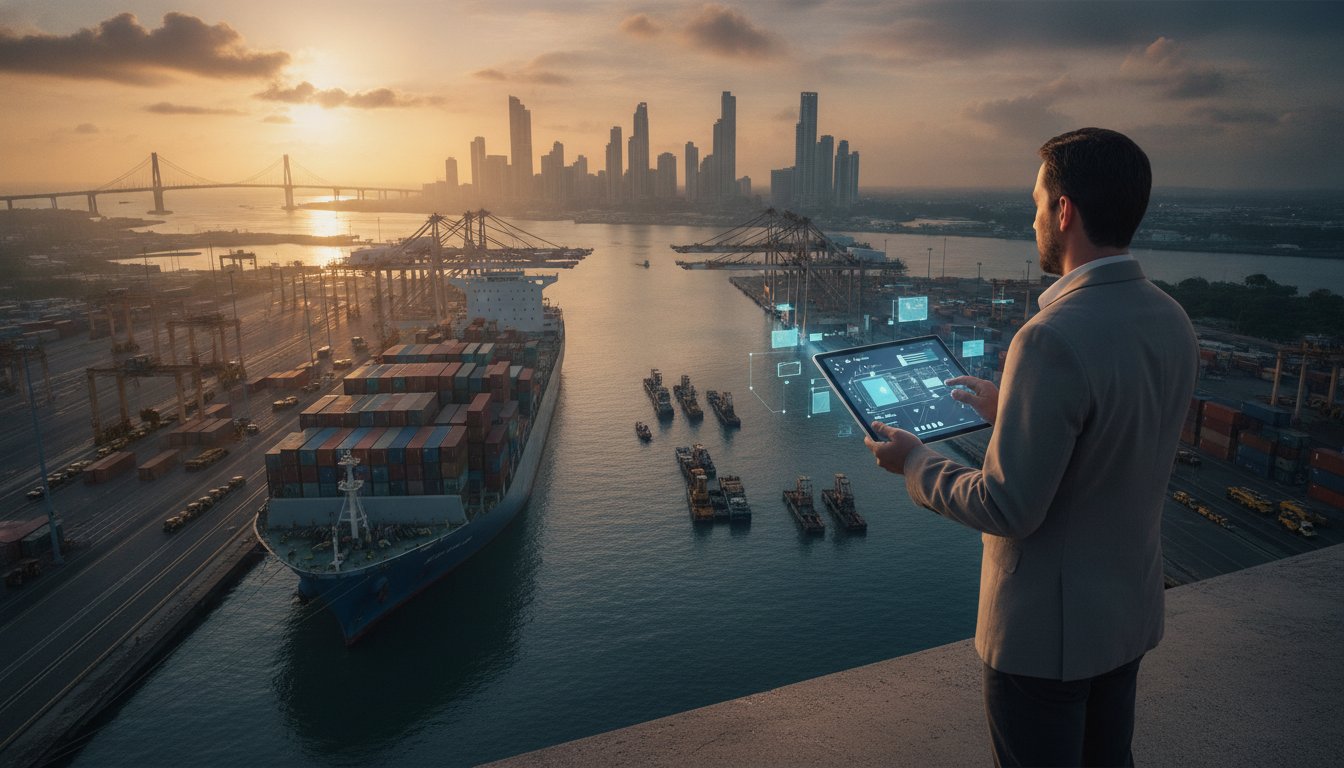


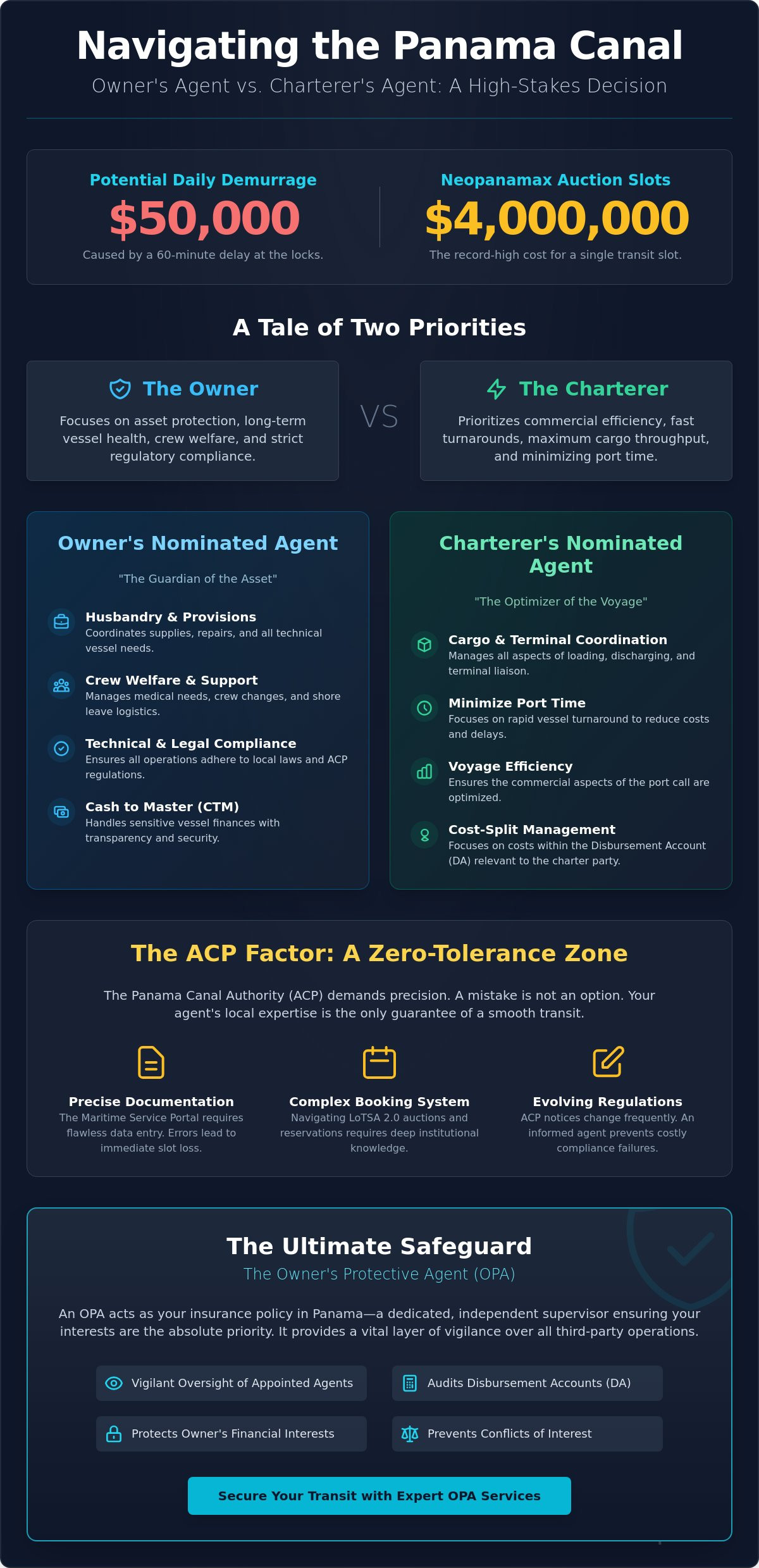
Mismanaging a transit window by just sixty minutes at the Gatun Locks can lead to a $50,000 daily demurrage bill. In an environment where Neopanamax auction slots have reached $4 million, the agent you choose isn’t just a coordinator; they’re a financial and legal firewall for your vessel. Understanding the distinction between a charterer’s agent vs owner’s agent panama is the first step in safeguarding your maritime interests against hidden costs and operational delays.
You likely feel the pressure of overlapping responsibilities and the fear of unexpected fees buried in your Disbursement Accounts. It’s a complex landscape where miscommunication with the Panama Canal Authority (ACP) carries heavy penalties. We’re here to provide the clarity you need to ensure your interests remain the priority. This comparison explains the specific duties and legal protections offered by each agency type to help you avoid fines and optimize your port call. You’ll learn exactly who represents your interests during a transit and how to manage your financial risk with confidence.
Key Takeaways
- Identify the distinct priorities between charterers and owners to prevent conflicts of interest during high-stakes transits.
- Learn how the Owner’s Nominated Agent protects your vessel through husbandry services, crew welfare, and technical compliance.
- Understand the role of the Charterer’s Nominated Agent in optimizing commercial turnaround times and cargo coordination at terminals.
- Analyze the financial breakdown of a Disbursement Account (DA) to clarify the cost split in the charterer’s agent vs owner’s agent panama debate.
- Discover why an Owner’s Protective Agent (OPA) acts as a vital insurance policy, providing vigilant oversight of third-party operations.
Understanding the Dual Agency System in the Panama Canal
The Panama Canal is more than a geographic shortcut. It’s a high-stakes operational zone where mistakes cost thousands of dollars per minute. Because of this complexity, a dual agency system has become the industry standard. This system allows both the ship owner and the charterer to have dedicated representation on the ground. While a single agent might technically suffice, the inherent conflict between operational speed and asset protection often necessitates specialized roles. You shouldn’t have to choose between a fast transit and a safe one.
The primary conflict usually centers on priorities. The charterer prioritizes commercial efficiency. They want the vessel through the locks and back at sea to minimize port time and maximize cargo throughput. The owner, however, focuses on the long-term health of the vessel, crew welfare, and strict regulatory compliance. This tension is why the choice between a charterer’s agent vs owner’s agent panama isn’t just about logistics. It’s about whose interests are being protected when your vessel reaches the Gatun or Cocoli locks.
Having a local representative provides a level of vigilance that remote management cannot match. They act as your eyes and ears, offering a physical presence to oversee operations and verify costs. This “vigilance” concept is central to modern maritime strategy. It transforms the agent from a simple document processor into a proactive partner who anticipates bottlenecks before they result in a $50,000 demurrage bill.
The Role of the Nominated Agent
Under Panamanian maritime law, the nominated agent serves as the legal bridge between the vessel and the state. Nominated Agency is the formal appointment of a local representative to act on behalf of a principal. In the past, general port agents handled every aspect of a call. Today, the intensity of canal transits requires a specialized approach. Owners often appoint a supervisory agent in shipping to monitor the primary agent’s performance. This ensures every decision made on the ground aligns with the owner’s specific safety and financial standards. It’s a necessary layer of protection in a region where local knowledge is the only currency that truly matters.
Why Panama is Unique: The ACP Factor
The Panama Canal Authority (ACP) operates with zero tolerance for documentation errors. Every inbound and outbound passage requires precise data entry into the Maritime Service Portal. If your paperwork is late or inaccurate, you lose your slot. Local expertise is vital here because the ACP’s regulations, such as the updated OP Notice to Shipping No. N-01-2026, change frequently. Your agent’s relationship with the ACP can be the difference between a smooth passage and a week-long delay.
Your choice of agent directly impacts your standing in the transit booking queue. With the implementation of LoTSA 2.0 (Long-Term Slot Allocation), navigating the auction and reservation system requires a partner who understands the nuances of the ACP bureaucracy. A seasoned agent provides the reassurance you need to manage your reputation with the Canal Authority. They don’t just process forms; they safeguard your position in one of the world’s most competitive waterways.
The Owner’s Nominated Agent: Safeguarding the Asset
The owner’s representative acts as a dedicated guardian for the vessel’s long-term health. While the charterer’s agent focuses on the clock, the owner’s nominee ensures that the ship’s integrity and the crew’s well-being are never compromised. In the specific context of a charterer’s agent vs owner’s agent panama, the owner’s agent is responsible for everything from technical compliance to the delivery of essential provisions. They are the primary point of contact for the Master, providing a secure bridge between the ship and the local infrastructure.
Protecting the vessel’s Master is a core priority. This includes managing Cash to Master (CTM) requirements with total transparency and ensuring the Captain has the local support needed to navigate complex port calls. By handling these sensitive financial and administrative tasks, the owner’s agent allows the Master to focus entirely on safe navigation. They act as a vigilant partner, ensuring that all local interactions remain ethical and efficient.
Husbandry and Crew Support
A vessel’s needs don’t stop once it enters the canal zone. Managing the “husbandry” side of a call involves a high degree of coordination. This includes arranging seafarer medical needs and emergency transfers in Panama City, which can be logistically challenging without deep local roots. Our team facilitates these movements with speed and empathy, ensuring crew members receive the care they need without delaying the voyage.
Technical support is equally vital. We coordinate spare parts logistics and technical repairs while your vessel is at anchor, preventing minor issues from becoming major transit delays. For a deeper look at these critical tasks, you can explore our husbandry services. This level of oversight provides the peace of mind that your asset is being maintained to the highest standards while in transit.
PCSOPEP and Regulatory Compliance
The Panama Canal has some of the strictest environmental standards in the world. Compliance with Panama Canal Authority regulations is not optional. Every vessel transiting the waterway must have a designated PCSOPEP (Panama Canal Shipboard Oil Pollution Emergency Plan) Authorized Person. This individual must be based in Panama and capable of coordinating with the ACP at a moment’s notice.
This role is mandatory for all canal transits. The owner’s agent ensures that your vessel meets all environmental and safety benchmarks to avoid heavy ACP fines. You can find detailed information on these requirements in our PCSOPEP authorized person guide. Delegating these regulatory hurdles to an experienced Ship Agency Services provider ensures your asset remains protected throughout its stay in Panamanian waters.
The Charterer’s Nominated Agent: Optimizing the Voyage
While the owner’s agent safeguards the physical asset, the charterer’s agent focuses on the commercial success of the voyage. This is a critical distinction in the charterer’s agent vs owner’s agent panama dynamic. The charterer’s agent ensures that every minute spent in port or at anchor translates into commercial throughput. They manage the logistics of the cargo, from terminal coordination to the precise issuance of the Bill of Lading (B/L). Their primary mission is to protect the charterer’s interest by meeting the ‘Laycan’ and avoiding costly delays that disrupt the broader supply chain.
Understanding the roles of key industry players is essential for smooth operations in a transit zone as busy as Panama. The charterer’s agent acts as the commercial liaison between the vessel and the cargo interests. They don’t just process paperwork; they manage the operational cadence of the entire port call. If a vessel misses its window because of poor coordination with stevedores or terminals, the financial fallout falls squarely on the charterer. This necessitates a proactive approach to local logistics that prioritizes turnaround time above all else.
Port Operations and Cargo Management
Liaising with port authorities for berth arrangements and pilotage is a core task that requires constant communication. The agent handles cargo sampling and the Statement of Facts (SOF) documentation, which is the definitive record used for calculating laytime and demurrage. The Charterer’s Agent’s priority is the swift execution of the commercial contract. They ensure that shore-side operations, including stevedoring and terminal labor, align perfectly with the vessel’s arrival. This level of coordination prevents the ship from sitting idle, which is vital when daily charter rates are high. Mastering these Panamanian terminal protocols ensures that the commercial voyage stays profitable and on track.
Bunkering and Logistics Coordination
Efficiency extends to the vessel’s fueling and technical needs. Arranging fuel delivery and coordinating with bunker barges in Balboa or Cristobal requires precise timing to avoid interfering with cargo operations or canal transit slots. For operators looking to streamline this process, our guide on bunkering in Panama provides essential insights into local requirements and barge availability. The charterer’s agent also manages the logistics of cargo-specific equipment, such as shore crane setups and specialized gear. By delegating these complex tasks to a knowledgeable local partner, charterers gain the operational freedom to focus on their core business while we handle the ground-level complexities of the Panamanian maritime sector.
Charterer’s Agent vs Owner’s Agent: Side-by-Side Comparison
Managing a canal transit requires a precise division of labor. When two different principals are involved, the line between responsibilities can blur, leading to communication gaps or, worse, duplicate billing. A successful port call depends on a clear understanding of the charterer’s agent vs owner’s agent panama dynamic. While they often work in the same physical space, their loyalties and legal obligations point in opposite directions. One focuses on the cargo’s journey; the other focuses on the ship’s safety.
Conflicts of interest are common in this high-pressure environment. For example, if a vessel develops a minor technical fault, the charterer’s agent might push to maintain the transit slot to avoid a $100,000 reservation loss. However, the owner’s agent must prioritize the vessel’s long-term integrity and ACP compliance, potentially advising a delay for repairs. Having your own representative ensures that these critical decisions aren’t made solely based on commercial deadlines. Accountability for ACP fines or port delays rests with the agent responsible for the specific failure, making real-time reporting essential for your legal protection.
The Responsibility Matrix
Cooperation is necessary, but the split in duties is usually distinct. You can visualize the separation of tasks through this common operational breakdown:
- Transit Booking and Tolls: Usually handled by the Charterer’s Agent as part of the commercial voyage costs.
- Crew Changes and Medical: Exclusively the domain of the Owner’s Agent.
- Cargo Documentation: Managed by the Charterer’s Agent to ensure terminal and customs compliance.
- Technical Repairs and Spares: Coordinated by the Owner’s Agent to safeguard the asset.
- ACP Communication: The primary agent handles official clearance, but the Owner’s Agent monitors for regulatory accuracy.
Owners should insist on their own nominated agent whenever the primary agent is appointed by the charterer. This provides a necessary “second set of eyes” on the ground in Balboa or Cristobal. It’s the only way to ensure that your vessel isn’t being sacrificed for the sake of a quicker turnaround.
Financial Transparency and Disbursement Accounts
The Disbursement Account (DA) is where most disputes arise. Adimar Shipping, Inc. ensures total transparency by providing clearly itemized reporting that separates owner-related expenses from charterer-related costs. You should be wary of “bundled” fees in a DA. These often hide markups or administrative charges that aren’t justified by the actual services rendered. Spotting these irregularities requires deep local knowledge and a commitment to ethical standards.
Protecting your financial interests starts with choosing a partner who understands the nuances of Panamanian maritime billing. For a deeper look at how to secure your vessel’s interests, consult our Owner’s Nominated Agency guide. By delegating oversight to a specialist, you gain the reassurance that every dollar spent is accounted for. If you need expert representation for your next transit, consider the professional Ship Agency Services provided by Adimar Shipping, Inc. to maintain full control over your operational costs.
The Protective Agency (OPA) Solution: Adimar Shipping, Inc.’s Expert Approach
The decision between a charterer’s agent vs owner’s agent panama often leads to a middle ground known as Protective Agency. In the high-stakes environment of the Panama Canal, an Owner’s Protective Agent (OPA) acts as the ultimate insurance policy. Even when the charter party allows the charterer to nominate the primary agent, the owner retains the right to appoint their own representative. Adimar Shipping, Inc. steps in as the “Vigilant Watcher,” providing an essential layer of security for your maritime assets.
Our OPA services are designed to prevent demurrage and eliminate unnecessary operational expenses. We monitor the primary agent’s performance, verify the accuracy of the Disbursement Account, and ensure that all local operations align with your specific standing orders. By delegating this oversight to Adimar Shipping, Inc., a partner with deep local history, you mitigate the risk of miscommunication with the Panama Canal Authority. We provide the ground-level protection needed to navigate the complexities of the waterway without the stress of remote management.
Vigilance and Ethical Standards
Ethical conduct is the foundation of our service. In an industry where “bundled” fees can erode your margins, the commitment to transparency at Adimar Shipping, Inc. protects your brand reputation. We operate under a “local office” concept, acting as a seamless extension of your own team. OPA is a secondary layer of oversight that ensures the primary agent is acting in the vessel’s best interest. This vigilance ensures that every decision made at the Gatun or Cocoli locks prioritizes the safety of your crew and the integrity of your ship.
Our role as a supervisory partner allows us to identify potential bottlenecks before they result in ACP fines. We verify that the charterer’s agent is meeting all documentation deadlines and that port services are rendered efficiently. This proactive stance provides the peace of mind that your vessel is being handled with the same care you’d provide yourself. You don’t have to worry about the details when you have a seasoned expert on the ground.
Next Steps: Securing Your Panama Transit
Appointing a trusted partner is the most effective way to optimize your next canal passage. Whether you require a Charterer’s Nominated Agent to handle cargo logistics or an Owner’s Nominated Agent to manage husbandry and technical compliance, Adimar Shipping, Inc. offers the specialized expertise your voyage demands. In an increasingly corporate maritime world, our personalized service stands out. We provide direct communication and tailored solutions that generic agencies can’t match.
The complexity of the Panama Canal requires more than just a document processor. It requires a proactive partner who understands the nuances of local regulations and terminal protocols. We invite you to experience the security and operational freedom that comes with professional representation. Contact Adimar Shipping, Inc. for a tailored agency quote and ensure your maritime interests are protected by the region’s leading experts.
Secure Your Interests in the Panama Canal
Choosing between a charterer’s agent vs owner’s agent panama is a strategic decision that directly impacts your bottom line. We’ve detailed how these roles differ in priority, from the charterer’s focus on commercial speed to the owner’s emphasis on vessel safety and husbandry. Understanding these distinctions allows you to navigate the complexities of the Panama Canal Authority with greater financial and operational control.
You can eliminate the stress of coordination by delegating these tasks to a partner who understands the local landscape. Adimar Shipping, Inc. provides the vigilant oversight necessary to safeguard your interests, offering specialized PCSOPEP Authorized Person services and 24/7 on-the-ground support. By ensuring total transparency in every Disbursement Account, we help you avoid hidden costs and maintain the highest ethical standards throughout your transit.
Secure your Panama Canal transit with the expert agency services of Adimar Shipping, Inc.
We look forward to ensuring your next passage is efficient, secure, and fully optimized for success.
Frequently Asked Questions
Can one agent represent both the owner and the charterer in Panama?
Yes, a single agent can technically represent both parties during a transit. However, this often creates an inherent conflict of interest. The charterer typically prioritizes commercial speed and cargo deadlines, while the owner focuses on vessel safety and crew welfare. Appointing a separate owner’s protective agent ensures that your specific interests remain the primary focus throughout the entire port call.
What happens if a conflict of interest arises between the charterer and owner?
When a conflict occurs, the nominated agent is legally bound to the principal who made the appointment. If only a charterer’s agent is present, the owner’s concerns regarding technical maintenance or husbandry might be secondary to operational efficiency. This risk highlights why the charterer’s agent vs owner’s agent panama distinction is vital for ship owners seeking to protect their high-value assets from compromise.
How much does it cost to appoint an Owner’s Protective Agent (OPA)?
The cost of OPA services varies depending on the vessel category and the specific scope of coordination required. While we don’t quote fixed rates in public guides, the investment is a small fraction of the potential ACP fines or demurrage costs it helps prevent. Most operators view this service as a necessary insurance policy that provides vigilant oversight and long-term financial security.
Is it mandatory to have a local agent for a Panama Canal transit?
Yes, every vessel transiting the Panama Canal must be represented by a licensed local agent by law. This agent serves as the official legal link between the ship and the Panama Canal Authority (ACP). They handle all mandatory documentation, manage the pre-payment of tolls, and coordinate the transit schedule to ensure the vessel meets its assigned window at the locks.
Who is responsible for paying the Panama Canal transit fees?
Responsibility for canal tolls is determined by the specific terms of the charter party agreement. In most standard time charters, the charterer is responsible for all transit fees and reservation costs. The nominated agent facilitates the actual transfer of these funds to the ACP, ensuring the vessel’s account is fully funded before it arrives at the Atlantic or Pacific breakwaters.
What is the difference between a port agent and a canal transit agent?
A port agent manages terminal-specific tasks like stevedoring, cargo handling, and berth arrangements. A canal transit agent specializes in the unique regulatory environment of the ACP, including slot auctions and admeasurement. While some agencies offer both, a specialized transit partner provides the deep local knowledge necessary to navigate the complexities of the canal’s updated booking systems and safety protocols.
How does the choice of agent affect my PCSOPEP compliance?
Your choice of agent is critical because the ACP requires a designated PCSOPEP Authorized Person who is physically based in Panama. An owner’s agent typically manages this role to ensure the vessel meets all environmental and emergency response standards. Selecting an experienced partner prevents regulatory delays and protects your reputation by ensuring total compliance with the canal’s strict anti-pollution requirements.
Can the Master of the vessel act as the agent for the ACP?
No, the Master cannot serve as the official agent for communications with the Canal Authority. Panamanian regulations require a licensed, shore-based agency to handle all administrative and financial interactions with the ACP. This allows the Master to focus entirely on the technical and navigational challenges of the transit while the agent manages the bureaucratic requirements on the ground.