

With auction premiums for unreserved slots surging to $425,000 as of May 2026, a single scheduling error now carries a price tag that can destabilize an entire voyage budget. You’re likely familiar with the frustration of shifting ACP tariff structures and the constant risk of forfeiting a high panama canal transit slot booking fee because of an unpredictable delay. It’s a high-stakes environment where timing isn’t just about logistics; it’s about protecting your bottom line.
This guide helps you master the complexities of the current reservation system to guarantee your transit dates and optimize your 2026 budget. We’ll provide a clear breakdown of the LoTSA 2.5 program, explain the latest non-refundable cost structures, and show you how to coordinate effectively with the Panama Canal Authority. You’ll gain the technical insight needed to turn these logistical hurdles into a streamlined, predictable part of your operations.
Key Takeaways
- Understand how the ACP’s tiered reservation system operates to help you accurately forecast your panama canal transit slot booking fee across different vessel classes.
- Identify the critical arrival deadlines and “1400/0200” protocols that determine whether you retain your slot or face significant financial penalties.
- Explore strategic “Slot Swap” options and timing windows that allow your fleet to remain agile while securing a firm position in the transit queue.
- Learn why a registered ship agency is vital for managing the complex electronic information exchanges and financial guarantees required by the Panama Canal Authority.
Understanding the 2026 Panama Canal Transit Reservation System
The Panama Canal operates as a highly regulated waterway where efficiency is the primary currency. The Transit Reservation System (TRS) is the backbone of this operation. It’s a tiered booking mechanism designed to provide certainty in an environment where demand often exceeds capacity. By paying a panama canal transit slot booking fee, you aren’t just buying a place in line; you’re securing a specific date and time for your vessel to begin its passage. This system allows the Panama Canal Authority (ACP) to balance daily traffic loads between the historic Panamax locks and the newer Neopanamax locks.
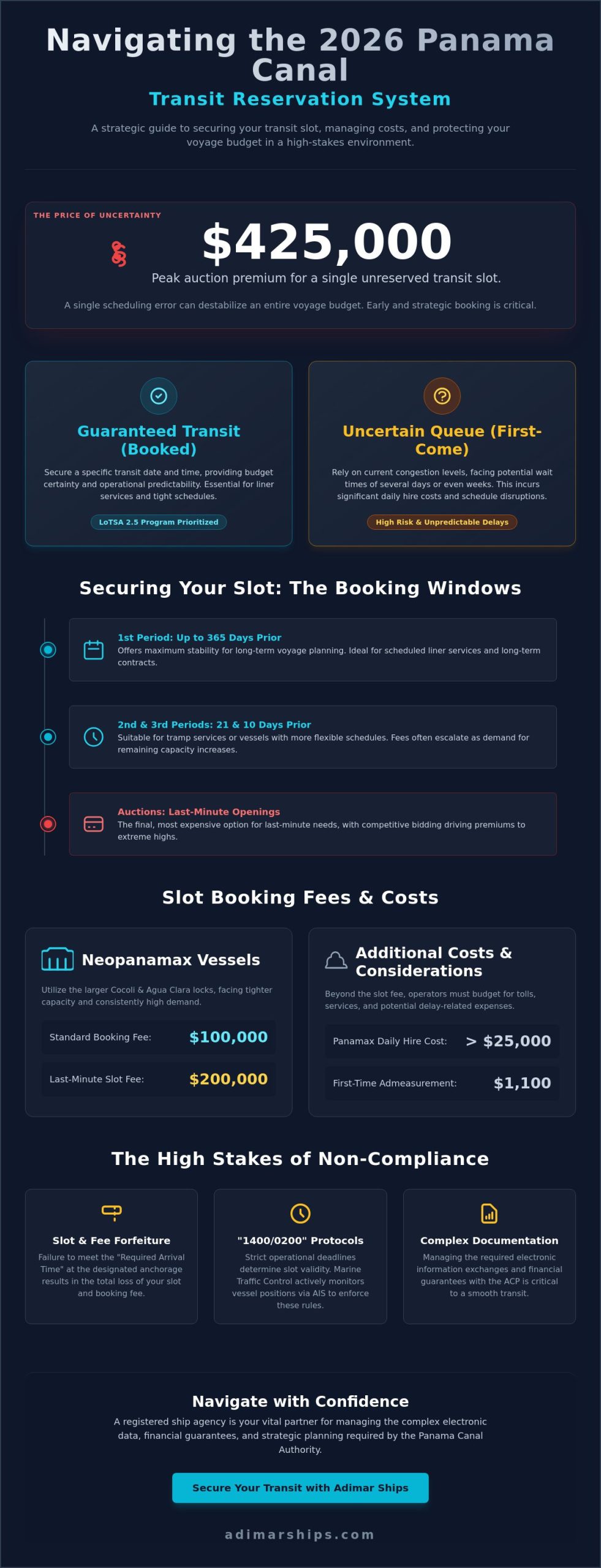
For 2026, the ACP has refined these regulations to prioritize specific vessel classes, particularly through the Enhanced Long-Term Slot Allocation Program (LoTSA 2.5). This shift means that unreserved vessels often face wait times of several days or even weeks, whereas booked vessels move with predictable precision. The distinction between a booked transit and the “first-come, first-served” queue is stark. While the queue relies on luck and current congestion levels, a reservation provides a guaranteed window, provided you meet all operational requirements.
The Role of Marine Traffic Control
Marine Traffic Control serves as the operational overseer that validates every reservation by tracking vessel positions in real-time. This system ensures that only vessels capable of meeting their “Required Arrival Time” retain their slots. If your vessel fails to reach the designated anchorage by the cut-off time, you risk forfeiting your slot and the associated fees. Marine Traffic Control effectively acts as the arbiter of slot validity by correlating AIS data with scheduled transit windows.
Booking Periods: 1st, 2nd, and 3rd Periods Explained
Securing a slot requires understanding three distinct booking windows that open at specific intervals. The 1st Period opens 365 days before the transit date, offering the most stability for long-term voyage planning. As the transit date approaches, the 2nd and 3rd Periods open, typically at 21 and 10 days respectively. The panama canal transit slot booking fee often escalates as the window narrows, reflecting the increased demand for remaining capacity.
- 1st Period: Best for scheduled liner services and long-term contracts.
- 2nd & 3rd Periods: Suitable for tramp services or vessels with flexible schedules.
- Auctions: The final, most expensive option for last-minute openings.
The competitive nature of the auction period cannot be overstated. During peak demand periods in May 2026, auction premiums reached as high as $425,000. For operators, this highlights the financial importance of early coordination and the risks associated with missing a primary booking window.
Breakdown of Panama Canal Slot Booking Fees by Vessel Size
The ACP applies a sophisticated tiered fee structure that moves beyond simple cargo volume. Instead, the panama canal transit slot booking fee is dictated primarily by vessel dimensions, specifically length and beam. Recent modifications to its Transit Reservation System emphasize this dimension-based pricing to ensure lock capacity is used with maximum efficiency. Neopanamax vessels require significantly more tugboat assistance and lockage time than the older Panamax classes, which is reflected in the base reservation cost.
It’s important to distinguish the booking fee from the statutory tolls or the mandatory $1,100 first-time admeasurement fee. While tolls cover the right of passage, the booking fee buys you a guaranteed window. Operators often utilize Just-in-Time (JIT) services to manage their total expenditure. By coordinating an arrival that aligns closely with the booked transit time, you can minimize anchorage duration and reduce the daily hire costs that often exceed $25,000 for Panamax vessels.
Neopanamax Slot Fees: The High-Stakes Tier
For Neopanamax vessels, the standard booking fee is currently $100,000. If you’re forced to secure a last-minute slot, that fee can jump to $200,000. These vessels are restricted to the Cocoli and Agua Clara locks, where capacity is tighter and demand is consistently high. Vessel draft also impacts your strategy; as water levels in Gatun Lake fluctuate, the ACP may adjust draft limits, making available slots for deep-draft gas carriers and large container ships (≥10k TEU) even more competitive. In 2026, meeting the technical requirements for these larger tiers is essential to avoid being bumped to a lower priority queue.
Panamax and Small Vessel Reservation Costs
Vessels with a beam under 100 feet operate under a different tariff structure. While the base panama canal transit slot booking fee for this class is lower than the Neopanamax tier, many operators opt for “Daylight Transit” requests. This specific request ensures the vessel transits during daylight hours for safety or operational reasons, but it adds a significant premium to the base reservation cost. For smaller bulkers and tankers, you must weigh the booking fee against the risk of waiting in the “first-come, first-served” queue, where delays can quickly outpace the cost of a reservation.
Securing the right slot at the right price requires local oversight and technical expertise. Engaging a reliable ship agency in Panama allows you to receive an accurate Proforma Disbursement Account (PDA) that accounts for these tiered fees and prevents unexpected surcharges during your 2026 transit.
The True Cost of Missing Your Slot: Forfeiture and Penalties
Missing a transit window isn’t just a scheduling headache. It’s a financial catastrophe. The ACP enforces the “1400/0200 Rule” with zero flexibility. Northbound vessels must arrive at the designated anchorage by 1400 the day before transit; southbound vessels must be in position by 0200 on the scheduled day. If your vessel misses these marks, you immediately forfeit your panama canal transit slot booking fee and lose your priority status. The vessel is then relegated to the “first-come, first-served” queue, where wait times are unpredictable and costly.
A local agent acts as your vigilant representative on the ground to prevent these scenarios. When weather or mechanical issues threaten an arrival time, we intervene to explore “Slot Swaps” or “Substitutions” before the deadline passes. By coordinating with the ACP, an experienced agent can sometimes reassign a slot to another vessel under the same ownership or agency, preserving the initial investment. Without this proactive oversight, the cascading costs of demurrage, wasted fuel, and crew wages can quickly exceed the cost of the reservation itself.
Cancellation Fees and Deadlines
The ACP utilizes a sliding scale for penalties that rewards early notification. If you cancel at least 15 days before the scheduled transit, you still incur a charge of 80% of the awarded bid price. As the date approaches, the penalties become more severe. A cancellation made within 48 hours of the scheduled transit results in a 100% loss of the panama canal transit slot booking fee, and in specific auction scenarios, penalties can escalate to 250% of the original bid price.
The Forfeiture Trap: Why “Waiting in Line” is Rarely Cheaper
Some owners avoid booking fees to save on upfront costs. This gamble rarely pays off in the current market. With daily hire rates for Panamax vessels exceeding $25,000 as of May 2026, a five-day wait in the queue costs $125,000 in hire fees alone. When you compare this to the certainty of a secured slot, the psychological objection to paying a reservation fee vanishes. A secured slot protects you from the volatility of the queue, ensuring your 2026 voyage remains on schedule and within budget.
Strategic Booking: When to Reserve and How to Minimize Costs
Operational efficiency in 2026 relies on more than just securing a date; it requires a calculated approach to the booking timeline. While early reservations offer peace of mind, they also lock you into a rigid schedule that may not account for unforeseen port congestion elsewhere. The “Optimum Window” strategy involves waiting until your vessel’s position is more certain, typically within the 2nd Period lead time, to commit to your panama canal transit slot booking fee. This reduces the risk of incurring the high cancellation penalties discussed earlier while still ensuring you aren’t forced into the volatile auction market.
One of the most effective ways to protect your capital is through the strategic use of “Slot Swaps” and “Substitutions.” If a vessel is delayed, you can often reassign its reserved window to another ship within your fleet that meets the same dimension criteria. This administrative maneuver requires precise coordination with the ACP but effectively saves the initial booking fee from total forfeiture. It turns a potential financial loss into a manageable fleet adjustment, provided your agent manages the electronic request within the Authority’s strict timeframes.
Navigating the Slot Auction System
When standard booking periods close, the auction system becomes the final tool for securing a transit. These slots often appear with very little notice, requiring an agent who maintains constant observation of the ACP’s digital alerts. We help our clients set maximum bid thresholds based on current market premiums, ensuring you don’t overextend your budget during periods of peak demand. This real-time vigilance allows you to seize openings that others might miss, providing a safety net for urgent cargo commitments.
Coordinating with Husbandry and Bunkering
A successful transit strategy integrates all local requirements into a single, cohesive timeline. By aligning your reserved slot with necessary husbandry services, you can complete crew changes and technical inspections during the mandatory waiting period at anchorage. It’s also vital to ensure that bunkering in Panama is completed well before your Required Arrival Time. Any delay at the bunker barge could cause you to miss the arrival deadline, leading to the immediate loss of your priority status and reservation investment.
Securing a smooth passage requires a partner who understands the high stakes of these logistical intersections. Contact Adimar Shipping, Inc. to develop a tailored 2026 booking strategy that minimizes your risks and maximizes your operational freedom.
Navigating the Booking Application with Adimar Shipping, Inc.
The Panama Canal Authority’s digital reservation interface is a restricted environment that is not accessible to foreign operators or ship owners directly. To process a panama canal transit slot booking fee and secure a firm window, you must work through a registered ship agency in Panama. Adimar Shipping, Inc. serves as your authorized local gateway, managing the complex electronic information exchange required to validate your arrival and cargo data. This local presence is a mandatory requirement to provide the “Guarantee of Payment,” which acts as the financial anchor for every reservation.
Operational compliance also involves meeting environmental and safety standards that extend beyond the booking itself. Every vessel over 400 gross tons must have a PCSOPEP authorized person available to coordinate with the Authority in case of emergencies. Adimar Shipping, Inc. provides this specialized representative, ensuring that your vessel remains in full standing with the ACP throughout its passage. By delegating these technical tasks to a local expert, you eliminate the risk of administrative rejections that could jeopardize your transit date.
Your Local Office at the Canal
When you appoint Adimar Shipping, Inc. as your owner’s nominated agency, we function as a dedicated extension of your own operations team. We maintain 24/7 monitoring of the booking application to identify sudden slot releases or auction opportunities that match your fleet’s schedule. Our team handles all financial bridge transactions with the ACP, ensuring that your booking fees are processed accurately and that your vessel’s priority status is never compromised by clerical errors or payment delays.
Eliminating Confusion and Delays
Our “Vigilance” philosophy means we are constantly observing local conditions—from lockage trends to changing water levels—to predict delays before they impact your schedule. Unlike larger, impersonal agencies, Adimar Shipping, Inc. offers a personalized service model where your vessel’s specific constraints are our primary focus. We simplify the 2026 regulatory landscape into clear, actionable advice, providing the peace of mind that comes from having a seasoned expert on the ground. To begin your next transit with a partner committed to your operational freedom, nominate Adimar Shipping, Inc. for your upcoming 2026 voyage.
Securing Predictable Transits for Your 2026 Fleet
The complexities of the 2026 transit landscape require more than just a logistical plan; they demand a proactive strategy for capital protection. Throughout this guide, we’ve explored how the panama canal transit slot booking fee serves as the foundation for voyage certainty, allowing you to bypass the volatility of the unreserved queue. By aligning your fleet’s arrival with the ACP’s strict protocols and utilizing local expertise to manage slot swaps, you ensure that your operations remain resilient against unpredictable delays.
Adimar Shipping, Inc. stands ready to act as your vigilant representative in Panama, providing the specialized local knowledge necessary to navigate the latest tariff modifications. As your authorized PCSOPEP representative and technical partner, we simplify the coordination between lock schedules, husbandry requirements, and financial obligations. Nominate Adimar Shipping, Inc. as your Panama Canal Ship Agent today to secure your 2026 transit windows and optimize your operational budget. We’re committed to ensuring your passage is as efficient and secure as possible.
Frequently Asked Questions
How much is the Panama Canal transit slot booking fee for a Panamax vessel in 2026?
The reservation fee for Panamax vessels is tiered based on specific vessel dimensions, including length and beam. While the standard fee for the larger Neopanamax class is $100,000, Panamax fees are generally lower but still reflect the high demand for lock capacity. You should request a detailed Proforma Disbursement Account from your agent to identify the exact tier applicable to your vessel’s specific measurements and your chosen booking period.
Can I change my booked transit date without losing the booking fee?
You can’t simply move a date without incurring a penalty, but you can utilize “Slot Swaps” or “Substitutions” to maintain your investment. Swapping allows two vessels under the same agency or ownership to trade their reserved dates if they meet similar dimension requirements. This maneuver is a vital tool for fleet managers who need to adjust to port delays or mechanical issues without forfeiting their initial reservation costs.
What is the difference between a transit toll and a booking fee?
A transit toll is a mandatory statutory charge paid to the ACP for the right to use the waterway, whereas a panama canal transit slot booking fee is a separate cost for a guaranteed transit window. Tolls are calculated based on vessel volume or capacity, such as the PC/UMS system. In contrast, the booking fee is a strategic reservation payment that ensures your vessel bypasses the unpredictable first-come, first-served queue.
What happens to the booking fee if my vessel arrives after the 1400/0200 deadline?
Your vessel will immediately forfeit its reservation and the total booking fee if it misses the strict arrival cut-off times. Northbound ships must reach the anchorage by 1400 the day before transit, while southbound ships must arrive by 0200 on the scheduled day. Once the slot is forfeited, the vessel is relegated to the unreserved queue, which can lead to significant daily hire costs while waiting for a new opening.
Is the booking fee refundable if the Panama Canal Authority cancels the transit?
The fee is typically refundable if the ACP cancels the transit for operational reasons, such as unexpected lock maintenance or waterway closures. However, the fee is non-refundable if the cancellation results from vessel non-compliance, such as failing a safety inspection or arriving late. It’s critical to have an agent monitor the specific reason for any cancellation to ensure your funds are protected or correctly applied to a future window.
How far in advance should I book a Neopanamax transit slot?
You should aim to book during the 1st Period, which opens 365 days before your transit date, to secure the most predictable rates. For Neopanamax vessels, the standard panama canal transit slot booking fee is $100,000. Waiting until the last minute can double this cost to $200,000 or force you into the auction market, where premiums for unreserved slots surged as high as $425,000 in May 2026.
Do I need a registered agent to book a slot, or can I do it through the ACP website?
You must use a registered ship agency in Panama to access the ACP’s electronic booking application and finalize any reservation. The Authority doesn’t allow foreign operators to manage bookings or financial guarantees directly. Your agent acts as your local representative, managing the complex information exchange, ensuring document compliance, and processing the mandatory payments required to secure your vessel’s position in the transit schedule.
What are “slot swaps” and how can they help me avoid cancellation penalties?
Slot swaps are administrative trades between two vessels of similar dimensions that are represented by the same agency or owner. If one ship in your fleet is delayed, you can swap its reserved slot with another vessel that is ready to transit. This allows you to avoid the heavy cancellation penalties, which can be as high as 100% of the booking fee if a reservation is canceled within 48 hours of transit.