

A single administrative oversight at the Panama Canal can now cost your operation $5,000 per hour in idling fees, which is why mastering how to avoid Panama Canal transit delays is critical for your 2026 strategy. You’re likely already feeling the pressure of tightening Neo-Panamax draft limits and the ACP’s shift toward aggressive digital validation. It’s frustrating to see a voyage’s profitability eroded by avoidable non-compliance fines that start at $15,000 and auction premiums that reached $425,000 earlier this year.
Achieving a seamless transit requires a shift from reactive management to proactive local coordination and digital precision. This guide provides the technical and administrative roadmap you need to ensure a reliable, zero-fine transit through the waterway. We’ll break down the 96-hour VUMPA requirements, the 14.78-meter draft restrictions effective this August, and the essential PCSOPEP safeguards that protect your vessel from costly terminal hold-ups.
Key Takeaways
- Navigate the strict 2026 draft limits and physical dimensions for Neo-Panamax vessels to prevent unexpected lockage denials.
- Verify that your mooring equipment and navigational aids meet the latest ACP specifications, including specific SWL requirements for chocks.
- Learn how to avoid Panama Canal transit delays by perfecting the VUMPA digital submission process at least 96 hours before arrival.
- Ensure environmental compliance by appointing an authorized PCSOPEP person to manage mandatory oil pollution emergency plans.
- Understand the strategic value of local ship agency representation to act as your on-the-ground buffer during critical ACP inspections.
Physical Dimensions and Tonnage Requirements for 2026
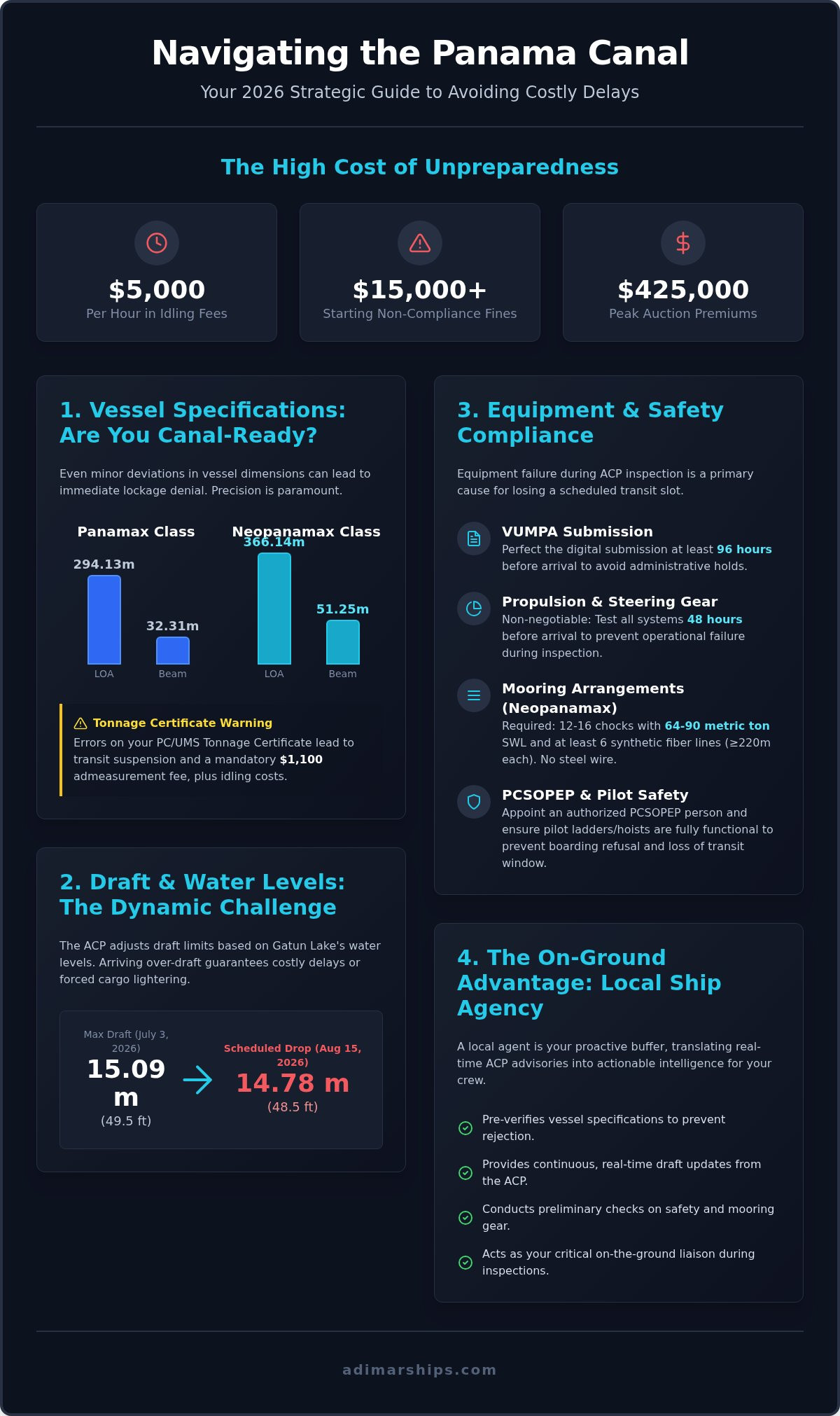
Compliance begins with precision. For any operator, the physical specifications of a vessel aren’t just technical details; they’re the gatekeepers of your schedule. The ACP enforces strict adherence to these limits because even a few centimeters of deviation can compromise lock safety. Understanding these constraints is the first step in learning how to avoid Panama Canal transit delays in 2026. If your PC/UMS Tonnage Certificate contains errors, the Canal will suspend your transit immediately. This oversight often leads to a mandatory admeasurement service fee of $1,100 and significant idling costs.
Panamax vs. Neopanamax: Size Limitations
The Panama Canal operates two distinct lock systems with vastly different capacity ceilings. Ensuring your vessel is “Canal-ready” means verifying its class against these 2026 maximums:
- Neopanamax Class: Maximum Length Overall (LOA) of 366.14 meters and a beam of 51.25 meters.
- Panamax Class: Maximum LOA of 294.13 meters and a beam of 32.31 meters.
- Visibility: Ships must meet specific bridge visibility requirements. For example, the view of the water surface from the bridge must not be obscured by more than two ship lengths forward of the bow.
Confirming these dimensions well in advance is the first hurdle for any successful panama canal transit. Our team pre-verifies these specs to ensure your vessel fits the intended lockage without last-minute rejection.
Draft Restrictions and Gatun Lake Water Levels
Water management is the most dynamic challenge for transit reliability. The Panama Canal Authority adjusts draft limits based on the real-time water levels of Gatun Lake. These restrictions are particularly volatile during the dry season. For instance, as of July 3, 2026, the maximum authorized draft for Neopanamax vessels was 15.09 meters (49.5 feet). However, this limit is scheduled to drop to 14.78 meters (48.5 feet) starting August 15, 2026.
Arriving with a draft that exceeds the current advisory is a guaranteed way to incur delays. You’ll be forced to lighter cargo or wait for water levels to rise, costing you thousands in operational downtime. Your ship agent plays a vigilant role here, providing real-time draft updates and coordinating with the ACP to ensure your vessel is loaded according to the most recent maritime advisories. By delegating this monitoring to a local expert, you gain the operational freedom to adjust your cargo plan before it’s too late. It’s about proactive readiness, not just reactive compliance.
Mandatory Navigational and Mooring Equipment
Equipment failure during inspection is the primary reason vessels lose their scheduled slots. If your gear doesn’t meet the standards in the Panama Canal Authority Notices to Shipping, your transit will be suspended until repairs are made. This is why testing all propulsion and steering gear 48 hours before arrival is non-negotiable. It’s the most effective way to protect your voyage from the $5,000 per hour costs associated with operational delays.
Mooring Arrangements for Tugs and Locomotives
Neopanamax vessels require specific configurations for tugboat operations, which carry a mandatory fee of $30,000. Usually, this means 12 to 16 chocks with a Safe Working Load (SWL) of at least 64 metric tons. Larger vessels might need a 90-ton SWL to handle the immense pressure of canal maneuvers. Don’t use steel wire mooring lines; the ACP mandates at least 6 synthetic fiber lines, each at least 220 meters long. Understanding these gear requirements is essential when planning how to avoid Panama Canal transit delays.
Pilot and Crew Safety Standards
A neglected factor in transit success is the safety and comfort of the ACP pilot. If boarding facilities like pilot ladders or mechanical hoists are faulty, the pilot may refuse to board, causing an immediate loss of your transit window. You must also maintain high sanitary and living condition standards for pilots during the transit. Clear communication between the bridge and Canal Port Control on VHF Channel 12 is essential to avoid confusion. A specialized panama canal ships agent can perform a preliminary check of these systems to catch issues before the ACP arrives.
Navigational aids must be in perfect working order. A Class A Automatic Identification System (AIS) is mandatory, and signal dropouts are a frequent cause of technical delays. Your bridge must also be equipped with at least two operational VHF radios to monitor Channels 12 and 13. For vessels over 274 meters, fully operational bow and stern thrusters are required for the precise maneuvers needed within the locks. By delegating the technical oversight of these requirements to a local partner, you ensure your vessel remains a priority for the Canal inspectors.
Administrative Procedures and Digital Documentation
Digital precision is now as vital as physical specifications. The Panama Canal Authority (ACP) has fully transitioned to digital validation, meaning a single typo in your electronic filing can result in vessel blacklisting or immediate transit suspension. Mastering the administrative side of the voyage is a core component of how to avoid Panama Canal transit delays in 2026. The margin for error has disappeared, replaced by machine-validated systems that demand total accuracy across all Ship Information Index (SIN) and Arrival Declarations.
Adhering to the Official Panama Canal Vessel Requirements ensures your paperwork aligns with the latest ACP standards. The most critical deadline is the 96-hour pre-arrival window. Failing to submit the complete VUMPA package within this timeframe often leads to the loss of your reserved slot, forcing your vessel into the expensive and unpredictable auction queue.
The VUMPA System Workflow
The Panama Maritime Single Window (VUMPA) is the centralized portal that integrates ACP, Health, and Immigration requirements. It streamlines the clearance process, but its complexity requires expert oversight. Coordinating this data with a reliable ship agency in Panama is the best way to ensure your cargo declarations and crew lists are cross-referenced before submission. We act as a vigilant filter, verifying every digital data point to prevent customs discrepancies that could sideline your ship at the anchorage. This proactive verification is what separates a seamless transit from a logistical nightmare.
Transit Booking and Scheduling Strategies
The 2026 reservation system is highly competitive and demands strategic timing. For Neopanamax vessels, the standard reservation fee is $100,000, but last-minute bookings can double that cost. If you miss your window, the auction system is your only recourse, where premiums for unreserved slots reached as high as $425,000 in May 2026. You must provide constant ETA updates to the ACP. Late arrival penalties are steep, and even a small deviation from your declared arrival time can result in slot forfeiture.
Delegating these complex scheduling tasks to an experienced partner provides you with the operational freedom to focus on the voyage itself. We monitor the LoTSA 2.0 slot allocation system in real-time, allowing us to advise you on the most cost-effective booking windows. By maintaining a clear digital trail and meeting every administrative threshold, you protect your bottom line from the financial risks of non-compliance and administrative friction.
Environmental Compliance and PCSOPEP Standards
Environmental scrutiny in the Panama Canal watershed is at an all-time high for 2026. The ACP enforces zero-tolerance policies for pollution because the canal’s fresh water is the primary source for the local population. Understanding these ecological mandates is a critical part of how to avoid Panama Canal transit delays. Fines for PCSOPEP-related violations range from $15,000 to $50,000, and an environmental hold can sideline a vessel for days during a formal investigation. These costs don’t include the reputational damage and potential loss of future transit priority that follows a pollution incident.
PCSOPEP Requirements and the Authorized Person
Any vessel with an oil carrying capacity of 400 metric tons or more must have an approved Panama Canal Shipboard Oil Pollution Emergency Plan (PCSOPEP). This requirement applies whether the oil is carried as cargo or strictly as fuel for propulsion. A key administrative hurdle for 2026 is the mandatory appointment of a PCSOPEP authorized person. This individual must be based in Panama and acts as the official liaison between your ship and the ACP if a spill occurs.
You must maintain Tier 1 and Tier 2 oil spill response readiness throughout the transit. This includes having specialized equipment on deck and a crew trained for immediate deployment. ACP inspectors frequently review logbooks to verify that drills are conducted and equipment is serviced. Proactive logbook maintenance is the best way to ensure a zero-deficiency inspection. By delegating this compliance oversight to a local expert, you ensure that your documentation is always ready for a surprise audit without diverting your crew’s attention from safe navigation.
Waste and Ballast Water Management
Discharging sewage, gray water, or solid waste within Canal waters is strictly prohibited. For 2026, all vessels must demonstrate Ballast Water Treatment System (BWTS) compliance according to MARPOL standards. If your system is non-functional, you must coordinate with your agent for alternative management plans before entering the watershed. Arriving with a faulty system and no pre-approved plan is a guaranteed way to trigger a transit hold at the anchorage.
Many operators use the transit window to coordinate essential husbandry services, such as waste removal or crew changes. However, these activities must be performed by ACP-authorized providers to ensure environmental standards are met. Failing to use an approved vendor can lead to administrative fines and immediate delays. The ACP’s “Green Route” initiative also offers incentives for vessels that exceed environmental standards, such as using low-sulfur fuel. Participating in these programs can improve your vessel’s environmental ranking and potentially streamline your future slot allocations.
Secure your transit with an authorized partner who understands every environmental nuance. Contact Adimar Shipping, Inc. today to appoint your mandatory PCSOPEP authorized person and ensure full compliance.
Operational Success: Why Local Agency Representation is Required
A local panama canal ships agent is a legal necessity. The ACP mandates that every vessel must have a local representative to serve as a financial guarantor for all tolls and maritime fees. Without this representation, your vessel cannot enter the scheduling queue. Beyond legal compliance, your agent is the primary strategy for how to avoid Panama Canal transit delays through expert financial management. Ensuring that toll payments are cleared through the local banking system prevents administrative holds that could otherwise sideline your vessel for days.
Your agent acts as a vital buffer between your ship and the ACP inspectors. When a vessel arrives, it faces a gauntlet of inspections covering everything from sanitary conditions to mooring gear. If an inspector identifies a deficiency, a seasoned agent doesn’t just relay the bad news. They immediately coordinate local technicians and spare parts to resolve the issue before your slot is forfeited. This rapid problem solving prevents minor technical hitches from ballooning into major operational setbacks.
The Agent as Your Local Advocate
Your agent provides the on the ground advocacy needed to navigate the Canal’s shifting priorities. They coordinate directly with pilots, tugboat captains, and line handlers to ensure your vessel is ready the moment the ACP gives the order. This coordination is especially critical when protecting the interests of the owner or charterer. By maintaining a constant presence at the port office, your agent ensures that your vessel isn’t pushed back in the queue due to administrative friction or simple miscommunication.
Adimar Shipping, Inc.: Your Expert Partner at the Canal
We provide personalized service that eliminates the “black box” of Canal logistics. Instead of wondering where your vessel stands in the scheduling queue or if your digital filings were accepted, you receive real-time, transparent updates. Adimar Shipping, Inc. acts as your vigilant local office on the ground, providing the oversight and protection your vessel needs to navigate the Canal’s complex regulatory environment. Our support extends through every phase of the transit:
- Pre-arrival: Meticulous VUMPA filing and document verification.
- Compliance: Mandatory PCSOPEP authorized person representation.
- Operations: Real-time coordination with ACP traffic control and pilotage.
- Husbandry: Seamless management of crew changes and waste removal.
By delegating these specialized tasks to a knowledgeable partner, you gain the operational freedom to focus on your global fleet. We handle the local complexities, ensuring your transit is defined by speed, reliability, and success. Trust the decades of experience at Adimar Shipping, Inc. to keep your 2026 voyages on schedule and within budget.
Secure Your 2026 Transit Schedule Today
The operational landscape of 2026 demands more than just a seaworthy vessel; it requires a sophisticated approach to regulatory and digital integration. As we’ve explored, mastering how to avoid Panama Canal transit delays involves a synchronized effort across physical readiness, administrative precision, and environmental stewardship. The financial stakes of a single oversight are too high to leave to chance, especially with the dynamic slot pricing and draft restrictions currently in play.
Adimar Shipping, Inc. provides the localized vigilance needed to navigate these complexities with confidence. By delegating your transit requirements to an authorized PCSOPEP person and an expert local ship agency in Panama, you ensure that every detail of your husbandry and protective services is handled with expert care. We act as your on-the-ground extension, protecting your schedule and your bottom line.
Partner with Adimar Shipping, Inc. for a smooth Panama Canal transit and secure the operational freedom your fleet deserves. Let our experience turn the complexities of the waterway into a reliable pathway for your global trade.
Frequently Asked Questions
What are the maximum vessel dimensions for the Neopanamax locks in 2026?
The maximum authorized dimensions for Neopanamax locks in 2026 are 366.14 meters in length overall (LOA) and 51.25 meters in beam. While the design draft is 15.2 meters, the actual authorized draft fluctuates based on Gatun Lake water levels. As of August 2026, the limit is set at 14.78 meters. Exceeding these limits during arrival will result in an immediate transit suspension and potential cargo lightering requirements.
How far in advance must I submit my Panama Canal transit documentation?
You must submit the complete pre-arrival documentation package via the VUMPA portal at least 96 hours before your vessel reaches the Canal anchorage. This deadline is strictly enforced by the ACP. Late submissions are a leading cause of slot forfeiture and expensive auction premiums. Providing accurate data within this window is a primary method for how to avoid Panama Canal transit delays and associated idling costs.
Is a PCSOPEP Authorized Person mandatory for all vessels?
A PCSOPEP Authorized Person is mandatory for any vessel with an oil carrying capacity of 400 metric tons or more. This regulation applies regardless of whether the oil is carried as cargo or fuel. The Authorized Person must be a Panama-resident liaison who can coordinate with the ACP during an emergency. Failing to appoint this representative at least 30 days before transit can lead to administrative holds and fines starting at $15,000.
What happens if my vessel fails the ACP inspection upon arrival?
If a vessel fails its arrival inspection, the ACP will suspend the transit until the deficiency is corrected. Depending on the severity, you may lose your reserved slot and be forced to re-book, often incurring significant fees. A local ship agent can help mitigate this by coordinating rapid repairs or spare part deliveries. Pre-arrival checks of mooring gear and pilot ladders are essential to prevent these costly technical holds.
Can I transit the Panama Canal without a local ship agent?
No, you cannot transit the Panama Canal without a licensed local ship agent. The ACP requires a local representative to act as the official financial guarantor for all tolls and maritime services. Beyond legal compliance, an agent manages the complex VUMPA filings and coordinates with canal pilots. Delegating these tasks to a specialist provides you with operational security and ensures your vessel meets all administrative thresholds for a successful transit.
How do Gatun Lake water levels affect my vessel’s maximum draft?
Gatun Lake water levels directly dictate the maximum authorized draft for all transiting vessels. During the dry season or periods of low rainfall, the ACP implements progressive draft restrictions to conserve water. These limits are expressed in Tropical Fresh Water (TFW) and can change with short notice. Arriving with a draft exceeding the current advisory is a major risk, making real-time updates from your local agent indispensable for voyage planning.
What are the main communication requirements for the bridge during transit?
Vessels must maintain at least two operational VHF radios on the bridge throughout the transit. One radio must monitor Channel 12 for Canal Port Control, while the other monitors Channel 13 for ship-to-ship navigational communication. Additionally, a fully functional Class A Automatic Identification System (AIS) is mandatory. Any failure in these communication systems during the transit can lead to immediate pilot intervention or transit delays for safety reasons.
Are there specific fuel requirements for transiting the Panama Canal?
Vessels must comply with MARPOL Annex VI regulations regarding sulfur content while in Panama Canal waters. The ACP requires vessels to use fuel with a sulfur content not exceeding 0.50% m/m, or 0.10% m/m if within an Emission Control Area (ECA). You must also have the ability to switch to light fuel if requested by the pilot for maneuvers. Proper fuel logging and sampling readiness are essential to pass environmental inspections without administrative delays.