

Would your 2026 voyage budget survive a six-figure “surprise” fee appearing days after your vessel clears the locks? Selecting a panama canal ship agent shouldn’t feel like a gamble against a volatile market. With auction premiums hitting record highs and Neopanamax draft restrictions tightening to 47.5 feet this September, the margin for error in your Pro-forma Disbursement Account (PDA) has vanished. You need a partner who acts as a vigilant extension of your team, identifying risks before they impact your bottom line.
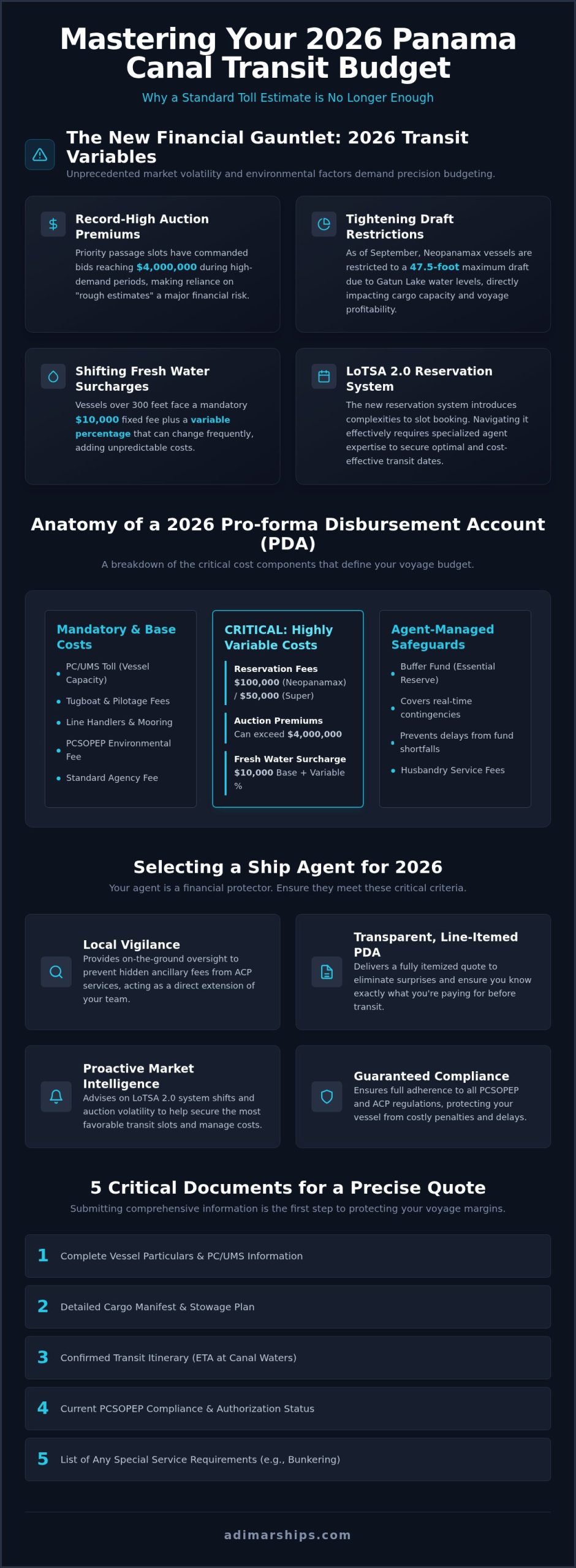
We understand the anxiety that comes with the new LoTSA 2.0 reservation system and the shifting fresh water surcharges. It’s frustrating when hidden costs surface after a transit is complete. This guide will help you master the complexities of 2026 Panama Canal budgeting by showing you how to select an agent for accurate, transparent transit quotes. You’ll learn how to secure a line-itemed PDA that ensures predictability in your voyage costs and guarantees full compliance with PCSOPEP and ACP regulations.
Key Takeaways
- Learn why a standard toll estimate is insufficient in 2026 and how to account for shifting environmental surcharges and draft restrictions.
- Understand the line-item structure of a 2026 Pro-forma Disbursement Account to eliminate hidden fees and unexpected buffer fund charges.
- Master the criteria for selecting a panama canal ship agent who provides local vigilance against auction volatility and reservation system shifts.
- Navigate the complexities of the LoTSA 2.0 reservation system and its direct impact on slot booking costs for Panamax and Neopanamax vessels.
- Identify the five critical documents required to receive a precise, binding transit quote that protects your voyage margins.
Why a Panama Canal Transit Quote is More Than a Toll Calculation
A generic online calculator gives you a number. It doesn’t give you a budget. In 2026, that distinction is the difference between a profitable voyage and a financial disaster. A professional transit quote serves as the definitive baseline for your Pro-forma Disbursement Account (PDA). It’s more than a simple toll tally; it’s a strategic financial roadmap that accounts for the volatile reality of the current maritime market.
The Volatility of 2026: Why Precision Matters Now
The maritime industry faces unprecedented environmental variables this year. El Niño patterns continue to strain Gatun Lake water levels, which directly impacts your bottom line. This forces the Panama Canal Authority (ACP) to adjust the Fresh Water Surcharge frequently. For vessels over 300 feet, this includes a $10,000 fixed fee plus a variable percentage that can shift your costs by thousands overnight. Without a precise quote, these fluctuations stay hidden until it’s too late.
Draft restrictions add another layer of complexity. As of September 2026, Neopanamax vessels must adhere to a 47.5-foot maximum draft. If your quote doesn’t account for how these limits impact your specific cargo volume, your voyage planning is incomplete. We understand the stress voyage managers feel when facing record-high auction premiums for priority passage. In an environment where a single slot can command millions in bids, relying on a “rough estimate” is a risk you can’t afford.
The Role of the Local Agent in Quote Accuracy
When you’re selecting a panama canal ship agent, you’re hiring a financial protector. Local vigilance is the only way to prevent hidden fees from ACP ancillary services. These include tugboat usage, which can cost approximately $30,000 for Neopanamax transits, as well as pilotage and mooring fees. A specialized agent acts as a direct extension of your office on the ground in Panama.
They provide the oversight that global aggregators simply cannot match. For a broader perspective on the waterway’s operational significance, reading a Panama Canal overview helps clarify why these local variables are so critical. By leveraging local expertise, you ensure your PDA reflects reality rather than a best-case scenario. This level of detail is exactly what makes our approach to Panama Canal transit coordination a vital asset for global operators. It’s about providing the security and transparency needed to navigate 2026 with total confidence.
Anatomy of a 2026 Pro-forma Disbursement Account (PDA)
The PDA is your vessel’s binding financial roadmap. It transforms complex tariff structures into a clear budget estimate. In 2026, this document is critical for maintaining voyage margins amidst shifting regulations and environmental surcharges. A precise PDA ensures you don’t face unexpected debit notes after your vessel has already cleared the locks. It provides the predictability your operations team needs to authorize funds with total confidence.
Mandatory ACP Fees and Ancillary Services
The foundation of any PDA is the PC/UMS toll. This system, mandated by the Panama Canal Authority (ACP), calculates capacity based on specific vessel dimensions. Beyond the base toll, mandatory costs include tugboat usage and line handlers. For Neopanamax vessels, tugboat fees typically hover around $30,000, but these costs vary based on the number of units required for a safe transit. You must also account for the PCSOPEP authorized person requirement. This environmental compliance fee is a non-negotiable part of your security and safety profile.
Variable costs in 2026 are where budgets often break. Standard reservation fees for Neopanamax ships are $100,000, while Super vessels pay $50,000. However, auction premiums for priority passage have reached $4 million in high-demand periods. Your agent must also factor in the Fresh Water Surcharge, which includes a $10,000 base fee for vessels over 300 feet plus a variable percentage. To manage these uncertainties, we utilize a Buffer Fund. It’s an essential reserve that covers real-time contingencies like draft changes or last-minute slot adjustments, ensuring the vessel isn’t delayed due to insufficient funds.
Agency and Husbandry Service Cost Structures
When selecting a panama canal ship agent, transparency in service fees is paramount. A standard agency fee covers the heavy lifting of coordination, documentation, and ACP communication. We act as your local office, ensuring all regulatory filings are submitted without error. Many operators find value in bundling these with husbandry services. This includes managing crew changes, medical assistance, and provisioning while the vessel is in Panama waters.
Combining these tasks under one protective agency reduces administrative overhead. It ensures your local representative has a holistic view of the vessel’s needs, from technical compliance to crew welfare. If you need a clear breakdown of these costs for an upcoming voyage, requesting a detailed PDA estimate is the best first step to secure your budget.
Selecting a Ship Agent Based on 2026 Transit Variables
Selecting a panama canal ship agent in 2026 requires a partner who understands how your vessel’s specific dimensions and cargo type interact with the latest ACP regulations. A Neopanamax container ship and a Panamax bulk carrier face entirely different financial hurdles. While the history of the Panama Canal shows a legacy of constant engineering adaptation, the modern operator must adapt to shifting slot allocation frameworks and draft limits that change with the season. We serve as your local eyes, ensuring these variables are managed before they inflate your voyage costs.
Neopanamax vs. Panamax: Different Locks, Different Costs
Neopanamax transits are exceptionally sensitive to draft restrictions in 2026. With the maximum authorized draft set at 47.5 feet effective September 3, Neopanamax operators must calculate cargo loads with extreme precision. These larger vessels also require a different tugboat configuration compared to Panamax ships. Because the newer locks rely on tugboats for positioning rather than the locomotives used in the older locks, mandatory tugboat fees are significantly higher for Neopanamax transits. Your agent must account for these operational differences to provide an accurate Pro-forma quote that reflects the true cost of using the expanded canal.
Navigating the 2026 Slot Auction Market
The LoTSA 2.0 system is the primary slot allocation framework for 2026. This system has fundamentally changed how we approach slot booking costs by prioritizing long-term allocations while leaving a highly competitive market for daily slots. We help you navigate the strategy of Booking versus Waiting by analyzing current Transit-Time Performance data. If wait times for non-booked vessels increase, the cost of idling can quickly exceed the price of an auction slot. Auction premiums are now a standard consideration in many quotes, reflecting a market where priority passage is a high-stakes commodity. We monitor bid patterns daily to ensure you don’t overpay while still securing your necessary transit window.
Cargo type further influences your environmental compliance surcharges. Vessels carrying specific fuel types or hazardous materials face stricter PCSOPEP requirements and potential additional security fees. We ensure your documentation is flawless to prevent delays that could trigger expensive wait-time costs. By delegating these complex variables to a specialized local partner, you gain the operational freedom to focus on your global logistics chain.
Step-by-Step: How to Request and Evaluate an Accurate Transit Quote
Precision in your voyage budget begins long before your vessel reaches the breakwater. When you’re selecting a panama canal ship agent, the quality of the initial quote request determines the accuracy of the final disbursement. Early engagement is vital in 2026. We recommend initiating the quote process at least 30 days before the expected arrival to account for LoTSA 2.0 slot availability and shifting draft restrictions. This lead time allows us to act as your local office, verifying every detail against current ACP advisories.
The Essential Document Checklist
To provide a binding financial roadmap, we require the “Critical Five” documents. These certificates allow us to calculate tolls and surcharges without the guesswork that leads to “surprise” fees. The foundation of any quote is the PC/UMS Certificate, which is the Panama Canal’s specific measurement system. Without it, tolls are calculated using high-end estimates that can inflate your budget by thousands of dollars.
- PC/UMS Certificate: The primary document for ACP toll calculation.
- ITC-69 (International Tonnage Certificate): Used to verify the vessel’s volume and weight against canal requirements.
- Updated Vessel Particulars: Includes engine specifications and bow thruster status, which impact tugboat requirements.
- Current Draft Specifications: Essential for calculating 2026 freshwater surcharges and ensuring compliance with the 47.5-foot limit.
- Cargo Declaration: Necessary for determining specific environmental and security surcharges.
Don’t forget to communicate your husbandry needs during this initial phase. If you require crew changes, spare part delivery, or medical assistance, these must be integrated into the PDA from the start. Clear communication ensures these services are coordinated alongside the transit, preventing logistical bottlenecks and ensuring all costs are accounted for in the initial fund request.
Evaluating Your Quote: Red Flags to Watch For
Transparency is the hallmark of a dependable partner. A major red flag is the “lump-sum” or “all-in” quote. These often lack the line-item detail necessary to see if mandatory fees, such as PCSOPEP compliance or the Buffer Fund, are included. If a quote seems suspiciously low, it’s often because the agent has omitted the necessary reserves for 2026 auction premiums or draft-related contingencies. The cheapest agency fee often leads to the most expensive transit when hidden costs surface after the vessel has cleared the locks.
Verify that your agent provides a line-itemed PDA that clearly distinguishes between ACP tolls, mandatory ancillary services, and agency fees. This level of detail protects your voyage margins and ensures ethical accounting standards. To secure your 2026 voyage budget with a partner who prioritizes accuracy, request a precise 2026 transit quote from our local team today.
Adimar Shipping: Your Local Partner for Transparent Transit Budgeting
Success at the Panama Canal depends on having a partner who treats your vessel’s interests as their own. Adimar Shipping, Inc. acts as your specialized eyes on the ground, serving as a vigilant representative for global operators. When you’re selecting a panama canal ship agent, you aren’t just looking for a service provider; you’re looking for an extension of your own team. We prioritize ethical conduct and transparent accounting, ensuring that every line item in your budget is verified and justified. This commitment to clarity eliminates the stress of post-transit financial surprises.
Our role as an Owner’s Nominated Agency is designed specifically to protect your vessel’s interests. We provide the local oversight that larger global aggregators often lack, focusing on precise PDAs and proactive coordination. By delegating the complexities of 2026 transit variables to us, you gain the operational freedom to manage your fleet while we handle the intricate local requirements. From the moment you receive your initial quote to the final disbursement, our process is built on trust and reliability.
Eliminating Confusion and Delays Through Local Vigilance
We’ve built deep, long-standing relationships with the Panama Canal Authority (ACP) that directly benefit our clients’ schedules. Our team operates as proactive problem-solvers, identifying potential logistical bottlenecks before they cause delays. We understand that in the maritime industry, time is literally money. Our communication style is direct and reassuring, providing you with real-time updates so you’re never left wondering about your vessel’s status. This local vigilance ensures that your transit remains on track despite the environmental and regulatory challenges of 2026.
Securing Your 2026 Transit Strategy Today
The slot scarcity of 2026 means that early engagement is no longer optional; it’s a strategic necessity. Voyage managers who wait until the last minute risk facing exorbitant auction premiums or lengthy wait times. We encourage you to start your transit planning now to navigate these market pressures effectively. Appointing Adimar as your nominated agent is a straightforward process that immediately places our local expertise at your disposal. We’ll guide you through every step, from document verification to final clearance, with the dependability you expect from a seasoned regional specialist.
Don’t leave your voyage margins to chance in a volatile market. Our team is ready to provide the security and predictability your operations demand. Request your custom Panama Canal transit quote from Adimar Shipping, Inc. today and experience the peace of mind that comes with specialized local representation.
Navigate a Secure and Profitable 2026 Transit
Mastering your voyage budget in 2026 requires more than a simple toll estimate. It demands a detailed financial roadmap that accounts for the volatile realities of LoTSA 2.0 and shifting draft restrictions. By identifying the critical documents needed for a precise quote and understanding the anatomy of a modern PDA, you protect your margins from unexpected surcharges. Every line-item matters when auction premiums and freshwater fees are in play.
Selecting a panama canal ship agent with deep local expertise is the most effective way to ensure your vessel’s interests are protected. We act as your vigilant representative on the ground, leveraging decades of experience and our status as an authorized PCSOPEP representative to simplify complex coordination. Whether you’re managing Neopanamax or Panamax vessels, our team provides the transparency and reliability needed to eliminate logistical bottlenecks.
Don’t let the complexities of the current market disrupt your operational flow. You deserve a partner who functions as an extension of your own team. Contact Adimar Shipping for a Transparent 2026 Transit Quote and secure your passage with total confidence. We’re ready to help you navigate every mile of the Canal with precision and peace of mind.
Frequently Asked Questions
What is a Pro-forma Disbursement Account (PDA) and why is it mandatory?
A PDA is the estimated financial statement detailing all costs associated with a vessel’s transit. It serves as a binding roadmap for fund authorization. The Panama Canal Authority requires full payment of estimated tolls and fees before a vessel is scheduled for transit. Without a funded PDA, your vessel won’t receive a transit slot. It ensures all parties have a clear baseline for the voyage budget, covering tolls, tugs, and agency fees.
How long does it take to receive a Panama Canal transit quote?
You can typically expect a preliminary transit quote within 24 to 48 hours of submitting your request. The complexity of 2026 market variables means that more detailed PDAs involving husbandry services or specific auction strategies may take slightly longer. Early engagement is critical. Providing the “Critical Five” documents immediately allows our team to verify current ACP tariffs and draft restrictions for the most accurate possible estimate.
What information do I need to provide for an accurate 2026 quote?
To receive a precise quote, you must provide five essential documents: the PC/UMS Certificate, the International Tonnage Certificate (ITC-69), updated vessel particulars, current draft specifications, and a detailed cargo declaration. These certificates allow us to calculate exact tolls and freshwater surcharges. When selecting a panama canal ship agent, ensure they request this specific data, as generic estimates often lead to expensive surprises once the vessel arrives at the locks.
How does the 2026 LoTSA 2.0 system affect my transit costs?
The LoTSA 2.0 system prioritizes long-term slot allocations, which directly impacts the availability and price of daily transit slots. This framework creates a more competitive environment for vessels without long-term commitments, often driving up auction premiums during peak demand. Your transit costs will fluctuate based on whether you secure a slot through the standard reservation system or the daily auction market. We help you navigate these variables to optimize your voyage budget.
Are Panama Canal auction premiums included in the initial quote?
Auction premiums are typically treated as variable contingencies and aren’t included in a standard base quote unless specifically requested. Because auction prices have reached record highs of $4 million in 2026, we include a Buffer Fund in our PDAs to manage these potential costs. We monitor daily bid patterns to provide you with the most realistic estimate of what a priority slot might cost for your specific transit window and vessel type.
What happens if the actual transit costs differ from the Pro-forma quote?
Any difference between the PDA and the final costs is settled during the Final Disbursement Account (FDA) process. If the actual costs are lower, the surplus funds are returned to the owner or charterer. If costs exceed the estimate, a supplemental payment is required. We use a “no surprises” policy, utilizing a Buffer Fund to cover minor fluctuations in freshwater surcharges or tugboat requirements, ensuring your transit isn’t delayed by funding gaps.
Why is a local ship agent better than a global service aggregator?
A local agent provides the vigilant, on-the-ground representation that global aggregators cannot match. We maintain direct relationships with the ACP and have immediate knowledge of real-time draft changes and lock operations. Selecting a panama canal ship agent with local roots ensures you receive accurate, line-itemed PDAs based on current conditions rather than outdated global databases. We act as an extension of your team, providing the local oversight necessary for complex 2026 transits.
How do 2026 draft restrictions impact my vessel’s transit quote?
Draft restrictions directly influence the freshwater surcharge and the total cargo volume your vessel can safely carry. With Neopanamax limits set at 47.5 feet as of September 2026, even a minor miscalculation can lead to significant fees or the need for cargo offloading. Our quotes factor in these limits alongside the Gatun Lake water levels to provide a realistic financial outlook. This precision prevents unexpected costs and ensures your vessel remains in full regulatory compliance.